history

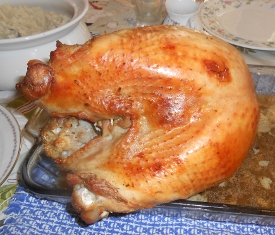
Brined Turkey Breast.

American Entree

BRINED TURKEY BREAST

INGREDIENTS – BRINE
1 gallon ice-cold water
2 bay leaves
2 garlic cloves
1 teaspoon peppercorns
1 teaspoon allspice
½ teaspoon mustard
1 teaspoon rosemary
1½ cups coarse salt
½ cup light brown sugar
½ cup white sugar
½ teaspoon thyme
8 pounds thawed turkey breast (for love of God, Montressor, the turkey must be thawed)

INGREDIENTS – COOKING TURKEY

¼ cup butter
¼ teaspoon pepper
½ teaspoon salt
2-to-3 cups chicken broth

SPECIAL UTENSILS

really big pot, 8+ gallons, or turkey bag
spice grinder
large oven-safe pan or casserole dish
wire rack
meat thermometer

Serves 12. Takes 15-to-24 hours

PREPARATION – THAWING TURKEY

A large frozen item like a turkey requires at least a day (24 hours) to defrost in the refrigerator for every 5 pounds of weight.

If you are pressed for time, use this quicker defrosting method. Keep turkey in packaging and add it to a large pot. Cover turkey with ice-cold water. Let turkey sit in cold water for 30 minutes per pound. In this recipe, that would be 4 hours. Pour out water.

But the turkey must be thawed before cooking. Or there will be much wailing and gnashing of teeth.

PREPARATION – BRINE

Crumble bay leaves. Mince garlic cloves. Grind peppercorns. Remove packaging from turkey and rinse in cold water. Add brine ingredients except turkey to pot. Stir until salt and sugar dissolve. Add turkey. Add ice-cold water as needed to cover turkey. Cover pot or close turkey bag and refrigerate for at least 12 hours but not more than 24.

PREPARATION – COOKING TURKEY

Remove turkey from brine and pat dry. Preheat oven to 400 degrees. Put turkey in large pan. Melt butter. Brush melted butter onto turkey. Sprinkle pepper and salt onto turkey. Place wire rack in pan. Put turkey on rack. Put meat thermometer in thickest part of turkey. Bake at 400 degrees for 20 minutes. Reduce heat to 325 degrees. Bake for 2-to-3 hours or until meat thermometer reads 165 degrees. Baste with ½ cup of chicken broth after every 30 minutes of baking at 325 degrees.

TIDBITS

1) Wild turkeys hide in trees at night. Just like human ninjas.

2) Wild turkeys can fly. That’s better than human ninjas.

3) All turkeys have periscopic vision. This means they can twist their heads around to see everything. Can human ninjas do that? I think not.

4) Female turkeys do not gobble. This stealthiness makes them the perfect silent warriors.

5) Our founding father, Benjamin Franklin, wanted to make the turkey our national bird. Why? Culinary historians suspect that turkey ninjas fought on the colonists’ side during the American Revolution.

6) How do they know this? The British soldier was far better trained than the American militiaman. The British king had many more soldiers under his autocratic command than did our fractious Continental Congress. King George’s army possessed thousands of cannon and could boast of the biggest and best navy in the world.

7) America could only have won if it had ninja turkeys swooping down, dealing quick, silent death out of the pitch-black night. Historians think American units coordinated ambushes by using bird calls. Culinary historians know better. These were turkey calls, made by fierce turkey warriors.

8) Britain finally countered with the King’s Bear Battalion in 1782. These bears could climb up any tree and were paid in honey. America’s ninja turkeys wouldn’t have stood a chance against the bears’ great strength and massive, sharp claws. Fortunately for America, Britain’s will to continue the war had already been shattered by the decisive battle of Yorktown during the previous year.

9) America disbanded its turkey ninjas in 1806. This is why it didn’t win the War of 1812.

10) America might be using turkey ninjas in covert operations. Who can say? Washington remains mute on the subject.


My cookbook, Following Good Food Around the World, with its 180 wonderful recipes, my newest novel, Do Lutheran Hunks Eat Mushrooms, a hilarious apocalyptic thriller, and all my other books, are available on amazon.com.

Categories: cuisine, history, international | Tags: , , , , , , , , , , , , , , , , , , , , , , , , , , , | Leave a comment

Japanese Rice Omelette

Japanese Entree

RICE OMELETTE
(Omurice)

INGREDIENTS – FRIED RICE

3 ounces boneless chicken
1 small onion
1½ tablespoons butter (1½ tablespoons more later)
1½ cups cooked rice (warm)
¼ cup ketchup
¼ teaspoon pepper
½ teaspoon salt

INGREDIENTS – OMELETTE

4 eggs
2 tablespoons milk
1½ tablespoons butter
1 ketchup bottle for squirting

SPECIAL UTENSILS

no-stick pan
paper towels

Serves 2. Takes 30 minutes.

PREPARATION – FRIED RICE

Slice chicken into ½” cubes. Mince onion. Add 1½ tablespoons butter and onion to regular pan. Sauté onion at medium heat for 3 minutes. Stir frequently. Add chicken. Sauté for 2 minutes or until chicken is no longer pink. Add rice, ketchup, pepper, and salt. Reduce heat to medium and sauté for 2 minutes or until rice is hot and coated with ketchup. Remove and cover to keep warm.

PREPARATION – OMELETTE

Add eggs and milk to mixing bowl. Blend with whisk. Add 1½ tablespoons butter to no-stick pan. Melt butter using medium heat. Add ½ of the blended eggs. Tilt pan so that egg mixture covers the surface. Cook egg mixture using medium heat for 1 minute or until egg starts to set on the bottom, but is still runny on top. Sprinkle ½ of the fried rice onto the setting egg mixture, leaving 2″ of egg uncovered on the left and right sides. Use spatula to fold uncovered sides over the rice as far as they can go.

Tilt pan to the right so that the right side of the omelette gets curved slightly by the pan. Then tilt the pan to the left for the same result. Put serving plate on top of pan. While holding plate, turn pan upside down so that the egg side of the omelette is on the top. Cover with paper towel to remove oil and to gently shape omelette into the shape of an American football. Remove towel and artistically drizzle omelette with ketchup. Repeat for the second omelette.

TIDBITS

1) The above picture of Omurice looks a lot like a triangular sail. This is no accident. Look at the Viking ship shown in the picture below.


2) Now, add a happy face to the triangular sail.


3) Let’s put those two pictures together.


4) Whoa! The pictures are nearly identical.. The Vikings did get the idea for their sail from the Japanese rice omelette. These pictures prove the Erik the Happy saga is true beyond all questioning.

5) In the Happy saga, Erik and his crew of oarsmen set off from Sweden to raid Northumbria. But, he refused to ask for directions and ended up in Japan. While there, Erik dined on a rice omelette. His synapses fired and he made the sail you see above. Voyaging back to Sweden with a sail was a snap.

6) Erik the Happy told Ragnar Lothbrok how easy sailing can now be, Just two months later, in the summer of 792. Ragnar built a long boat and added a triangular sail. He sailed to Northumbria and sacked the monastery of Lindisfarne. Much bloodshed and looting ensued. The age of the Vikings had begun. Now you know.


– Paul De Lancey, The Comic Chef, Ph.D.

My cookbook, Following Good Food Around the World, with its 180 wonderful recipes, my newest novel, Do Lutheran Hunks Eat Mushrooms, a hilarious apocalyptic thriller, and all my other books, are available on amazon.com.

Categories: cuisine, history, international | Tags: , , , , , , , , , , , , , , , , , , , , , , , , , , , , , | 2 Comments

Char Kway Teow (Rice Noodle Stir Fry)

Malaysian Entree

CHAR KWAY TEOW
(Rice Noodle Stir Fry)

INGREDIENTS

¾ pound flat rice noodles
2 Chinese sausages
3 ounces fish cake (optional)
3 garlic cloves
1 cup garlic chives*
2 tablespoons dark soy sauce or soy sauce
2 tablespoons light soy sauce or soy sauce
½ tablespoon fish sauce
1 teaspoon oyster sauce or fish sauce
1 teaspoon sugar
¼ teaspoon white pepper
2 eggs
¼ cup vegetable oil
¾ pound shrimp, peeled and deveined
2 cups bean sprouts

* = Can be found in Asian supermarkets. Or substitute with garlic, chives, shallots, or combination.

SPECIAL UTENSIL

wok or Dutch oven.

Serves 6. 50 minutes.

PREPARATION

Soak dried noodles in warm water for 45 minutes. Drain. Cut Chinese sausage into ½” diagonal slices along their length. Cut fish cakes into ½” wide strips. Mince garlic cloves. Cut garlic chives in 2″ long pieces. Add dark soy sauce, light soy sauce, fish sauce, oyster sauce, sugar, and white pepper to medium mixing bowl. Mix with fork until well blended. Add eggs to small mixing bowl. Beat with whisk until well blended.

Add oil, Chinese sausage, fish-cake strips, garlic, garlic chives, shrimp. Sauté at medium-high heat for 5 minutes or until garlic softens. Stir frequently. Add noodles. Stir until well mixed. Add liquid from medium mixing bowl. Mix with wooden spoon until well blended.

Push sausage/fish strips/noodles to one side. Ladle egg from small mixing bowl to newly made space on wok. Scramble eggs. Let everything fry until egg nearly sets. Cook for 1 minute, stirring frequently. Add bean sprouts. Cook for 2 minutes. Stir frequently.

TIDBITS

1) String theory replaces the point-like particles of particle physics with one-dimensional objects called strings. Scientists could have thrown over the point-life particles for Hula Hoops(tm). But they didn’t. Culinary physicists have discovered why the mainstream physicists chose strings.

2) Look below for a rendering of string theory. The alluring spiffiness of this image hides its inspiration.


3) Let’s put a red and white bowl around the center of this picture.


4) Doesn’t that look a lot like Char Kway Teow? Let’s put it next to this recipe’s photo.


5) Wow! Char Kway Teow clearly provided the inspiration for String Theory. Proof you cannot deny.

6) But unlike String Theory you can eat Char Kway Teow. Whenever travel takes you to Kuala Lumpur, Malaysia, be sure to dine at Carl La Fong’s House of String Theory. His Char Kway Teow tastes divine. Perhaps it will inspire you as well.


– Paul De Lancey, The Comic Chef, Ph.D.

My cookbook, Following Good Food Around the World, with its 180 wonderful recipes, my newest novel, Do Lutheran Hunks Eat Mushrooms, a hilarious apocalyptic thriller, and all my other books, are available on amazon.com.

Categories: Carl La Fong, cuisine, history, international, science | Tags: , , , , , , , , , , , , , , , , , , , , , , , , , , , , , | Leave a comment

Simple Fig Bars

American Dessert

SIMPLE FIG BARS

INGREDIENTS

6½ tablespoons butter, softened
½ cup brown sugar
1 egg
1 teaspoon vanilla extract
1 cup flour (2 tablespoons more later)
½ cup wheat flour
½ teaspoon baking powder
¼ teaspoon salt
2 tablespoons flour
½ pound fig jam

SPECIAL UTENSILS

electric beater
14″ x 10″ cookie sheet
parchment paper

Makes 32 bars. Takes 2 hours 15 minutes.

PREPARATION

Preheat oven to 350 degrees. Add butter and brown sugar to large mixing bowl. Mix with electric beater set on high until light and fluffy. Add egg and vanilla extract. Mix with electric beater set on high until light and fluffy.

Add 1 cup flour, wheat flour, baking powder, and salt to small mixing bowl. Mix with fork or whisk until well blended. Gradually add in flour mix from small mixing bowl to egg/sugar mix in large mixing bowl. Mix with electric beater set on high until light and fluffy. Use hands to form a round dough ball. Cover and place in refrigerator for 1 hour or until firm.

Dust 14″ x 10″ flat surface with 2 tablespoons flour. Add dough ball. Roll out dough ball until it’s ¼” thick. Cut dough along its length into 10″ x 3½” strips. Spread ¼ of the fig jam down the middle of a strip until it’s 1″ wide. Carefully fold both edges of the dough over the fig jam. Pinch seam together to complete fig/dough log. Repeat for each dough strip. Cut each log into 2 shorter mini-logs to make transferring them to the parchment paper easier.

Place parchment paper on cookie sheet. Use spatula to carefully place mini logs seam side down on parchment paper. Use fingers to smooth together any tears in the mini logs. Bake at 350 degrees for 20 minutes or until mini logs turn golden brown and feel slightly firm. Cut each mini log into 4 fig bars. Let cool on cookie sheet for 15 minutes or until slightly warm. Store in airtight container.

TIDBITS

1) Be sure to mark your calendar for January 16. That’s International Hot and Spicy Food Day.

2) It’s also National Fig Newton Day.

3) So eat hot-and-spicy food and fig bars on that day (IHSFNFND).

4) You might not want to do anything else.

5) Indeed. The Super Bowl used to held in January, but the prospect of having their biggest game of the year fall on International Hot and Spicy Day AND National Fig Newton Day terrified National Football League Executives. They knew the NFL would lose the match up.

6) This is why recent Super Bowls have been held in February.

7) Baseball, for decades, held its World Series in October for the very same reason.

8) Now, World Series Games spillover into November.

9) November is still two months away from IHSFNFND.

10) But the end of the World Series is getting ever closer to that eventful culinary day, because of ever increasing rounds of post-season play.

11) The World Series might eventually coincide with IHSFNFND. If that happens, television executives will simply throw up their hands and stop broadcasting the Fall Classic. This is something even World War II could not do.

12) This must not happen. Contact your senator. Now.

13) It’s worth noting that fig bars’ existential challenge to professional sports in America derives from their many great attributes.

14) Fig bars are high in fiber. Football and baseball are not.

15) Fig bars have many vitamins. Football and baseball do not.

16) Fig bars have many minerals. Football and baseball do not.

17) Fig bars are a tasty snack. Football and baseball do not.

18) Fig bars help digestion. Football and baseball do not.

19) Indeed, footballs and baseballs are even difficult to eat.

20) Oh crudness, National Fig Week runs from November 1 to November 7. The same time as the World Series. Stock up on fig bars; we live in dark, troubling times.


– Paul De Lancey, The Comic Chef, Ph.D.

My cookbook, Following Good Food Around the World, with its 180 wonderful recipes, my newest novel, Do Lutheran Hunks Eat Mushrooms, a hilarious apocalyptic thriller, and all my other books, are available on amazon.com.

Categories: cuisine, history, international | Tags: , , , , , , , , , , , , , , , , , , , , , , , , , , , , , , , , | Leave a comment

Chicken Basquaise

French Entree

CHICKEN BASQUAISE

INGREDIENTS

1 green bell pepper
1 red bell pepper
1 large onion
2 garlic cloves
2 tablespoons fresh thyme
3 tomatoes
2 pounds chicken pieces, bone in or boneless
1 teaspoon salt or fleur de sel*
¼ cup olive oil
3 ounces thinly sliced prosciutto or Bayonne ham*
¾ cup white wine
1 bay leaf
1 cup chicken stock
2 teaspoon Spanish paprika, paprika, or espelette*
1 tablespoon fresh parsley

* = You can find fleur de sel, Bayonne ham, and espelette online, but they can be expensive.

SPECIAL UTENSILS

mandoline
8″ * 12″ casserole dish

Serves 6. Takes 1 hour 15 minutes.

PREPARATION

Preheat oven to 425 degrees. Seed bell peppers. Cut bell peppers and onion into ¼” slices with mandoline or knife. Cut slices in half. Dice garlic and thyme. Cut tomatoes into ½” wedges. If you are using chicken breasts, cut them in two. Rub chicken pieces with salt.

Add olive oil and prosciutto to large pan. Sauté for 2 minutes at high heat or until prosciutto becomes crispy. Stir frequently. Remove and drain on paper towels. Add chicken pieces to large pan. Sauté for 10 minutes at medium heat or until chicken turns golden brown. Flip chicken pieces every 2 minutes. Remove chicken and drain on paper towels. Add bell pepper, garlic, and onion. Sauté for 2 minutes at medium-high heat. Stir frequently. Add white wine and bay leaf. Simmer at low heat for 2 minutes. Stir frequently.

Add contents of pan, thyme, chicken stock, and chicken pieces to casserole dish. Sprinkle chicken pieces with Spanish paprika. Place tomato wedges between chicken pieces. Bake for 20 minutes at 425 degrees or until sauces thickens. While chicken bakes, dice parsley. Remove casserole dish from oven. Remove bay leaf. Place crispy prosciutto slice over chicken. Garnish with parsley.

TIDBITS

1) It is well known fact that the Basque word for basket is saskia

2) The Franks who overran Gaul, modern day France, after the fall of the Western Roman Empire loved peaches.

3) Indeed, they invaded purposefully to pick prized perfect peaches produced by the innumerable peaches orchards to be found there.

4) At first, frenetic fresh Franks gathered peaches with their hands.

5) But one can only carry off two peaches that way.

6) The ravenous ravagers ranged right to the Rhone valley. The Rhone Valley had for reasons unclear to current culinary historians had a surplus of over a million peach baskets.

7) An advance party of Franks plundered the valley and carried off all the peach baskets. Indeed, everyone of the frightening Franks walked away with maybe twelve baskets; we don’t know the exact number.

8) The First Franks never went anywhere without their baskets. The enraged basketless Second Franks chased them to southwest France.

9) The locals called them Saskia after the First Franks word for basket.

10) In time the Saskia lost their original language. A new language required a new name. The medieval French dubbed these people, Basques.

11) The Basques loved sports. In particular, they loved to play Basquaise Boule. The object of this game was to pass a ball around and try to toss it into a peach basket. Sometimes the players fashioned the ball out of chicken breasts, hence the name Chicken Basquaise. Chef Jean Paul La Grange created this dish to honor the new sport.

12) But wait! There’s more! In 1890, YMCA director James Naismith toured the land of the Basques. His synapses fired and he determined bring this sport back home. It’d be just the thing to tire out restless school kids. The game proved popular, at first, in his town of Springfield. But the kids eventually grew bored of having to climb up a ladder to retrieve the ball from the peach basket. Late one night, a gang of hoodlums calling themselves The Epic of Gilgamesh Haters cut the bottom off all the baskets.

13) But far from ruining the game, this vandalism, made the game much faster. Indeed the tempo of pass, shoot, score, pass, shoot, score now prevailed. The kids loved the game now. So did their parents. A year later, a senior taking Basque studies opined that as we’re living in America, why not call the name something American like basketball.

14) America embraced basketball and soon became a superpower. Now you know how.


– Paul De Lancey, The Comic Chef, Ph.D.

My cookbook, Following Good Food Around the World, with its 180 wonderful recipes, my newest novel, Do Lutheran Hunks Eat Mushrooms, a hilarious apocalyptic thriller, and all my other books, are available on amazon.com.

Categories: cuisine, history, international | Tags: , , , , , , , , , , , , , , , , , , , , , , , , , , , , , , , , , , , , , , , , | 2 Comments

French Omelette

French Breakfast

OMELETTE

INGREDIENTS – OMELETTE

2 eggs
⅛ teaspoon pepper
⅛ teaspoon salt
1 tablespoon butter (1 more teaspoon later)
1 teaspoon butter

INGREDIENTS – FILLING (OPTIONAL)*

One or more of the following:

2 teaspoons diced herbs – fresh chervil, chives, parsley, or tarragon (½ teaspoon more for garnish)
1½ tablespoons grated cheese – Gruyère, Gouda, or Parmesan
1½ tablespoons diced meat – cooked bacon, ham, or prosciutto
1½ tablespoons combination of the above

* = These ingredients really must be prepared before you start to cook the omelette.

INGREDIENTS – GARNISH

½ teaspoon diced herbs – fresh chervil, chives, parsley, or tarragon

SPECIAL UTENSIL

no-stick pan. If you can dedicate this pan to omelettes only, so much the better.

PREPARATION

Add eggs, pepper, and salt to mixing bowl. Beat eggs vigorously with fork until for 20 seconds or until whites and yolks are well mixed. Heat pan at high heat. The pan is warm enough when a tiny bit of butter sizzles in it. Add 1 tablespoon butter. Tilt the pan into different directions so as to completely coat the pan, including the sides, with melted butter. When butter just starts turning slightly brown, add eggs.

Let eggs settle for 3 seconds. (You have to careful with this recipe.) Sprinkle in any filling ingredients now. Start yanking the pan vigorously back to you, tilting more steeply each time. (This forces the egg to roll over itself more after each jerk.) Omelette should be creamy, but not viscous. This process takes about 20 seconds.

Cover pan, serving side down, with plate. Hold plate in place with one hand. Turn omelette onto plate. (The bottom side of the omelette should now be facing up.) Use fork to gently finish shaping omelette. Brush omelette with 1 teaspoon butter. Sprinkle omelette with herb garnish.

TIDBITS

1) The French Omelette is quite tasty.

2) It also looks like a very thin brick.

3) This is no accident.

4) Culinary archeologists tell us that the pharaohs built the very first pyramids in Ancient Egypt with French-Omelette bricks.

5) Look at that! I spelled the word “archeologists” correctly on the first try. Go me.

6) But these omelette pyramids took forever to build. The worker ate the French omelette as fast as they were made.

7) The completed pyramids proved irresistible to neighboring villagers as well. These pyramids rarely lasted more than a day before they gobbled up all the tasty bricks.

8) Doesn’t that mean the villagers ate quite a bit of food at once?

9) Yes, yes it does.

10) Then didn’t the gluttonous eaters get fat?

11) Yes. Hence the saying “French Omelette pyramids, fat people.”

12) So, succeeding pharaohs tried building pyramids with bread slices. Remember the slogan “Pharaoh Twelve Grain Bread(tm) builds strong pyramids twelve ways.”

13) Of the pharaohs instructed their workers to dry out the bread before using it to construct the pyramids. That worked well until . . .

14) It rained.

15) Pyramid construction kept failing until Sadiski of Saqaara, near Memphis, stumbled over a block of limestone. Yowzer! That hurt. “Limestone ain’t no good for nobody but for pharaohs building pyramids.” Clearly English grammar was not rigorously taught in Ancient Egypt.

16) After the swelling in his ankle went down a light bulb–not yet invented at that time–went on in Sadiki’s brain. Why not quarry the limestone in his backyard?

17) In 2630 B.C,, he pitched the idea of cutting limestone into bricks and then using them to make pyramids to Pharaoh Djosi. Djosi, known as DJ to his subjects, loved the idea. And so, Egypt built the first lasting pyramid.

18) Overtime, Memphis would become famous for barbecue, blues, and rock and roll. The musically talented Djosi would provide the inspiration for millennia of future Djs. Now you know.


– Paul De Lancey, The Comic Chef, Ph.D.

My cookbook, Following Good Food Around the World, with its 180 wonderful recipes, my newest novel, Do Lutheran Hunks Eat Mushrooms, a hilarious apocalyptic thriller, and all my other books, are available on amazon.com.

Categories: cuisine, history, international | Tags: , , , , , , , , , , , , , , , , , , , , , , , , , , , , , , , , , | Leave a comment

British Digestive Biscuits

British Dessert

DIGESTIVE BISCUITS

INGREDIENTS

⅔ cup flour
3 cups wheat flour
2 teaspoons baking powder
1½ cups confectioners’ sugar
1 cup butter, softened
½ cup milk

SPECIAL UTENSILS

parchment paper
2 baking sheets

Makes 60 cookies. Takes 2 hours.

PREPARATION

Preheat oven to 350 degrees. Add flour, wheat flour, baking powder, and sugar to large mixing bowl. Mix with fork or whisk. Cut butter into ½” cubes. Knead with hands until mixture resembles bread crumbs. Add milk. Knead with hands until dough forms.

Roll out dough until it’s ⅛” thick. Cut dough into 2½” circles. Place parchment paper on baking sheet. Place biscuits on parchment. Prick biscuits all over with fork. (Make a design if you wish.) Bake at 350 degrees for 15 minutes or until biscuits turn golden brown. (You will most likely need to cook in batches.) Cool on wire rack. Goodness, these simple biscuits are tasty.

TIDBITS

1) From Professor Nicholas Baigent, London School of Economics, “ Did you know that they are seldom consumed in public places in the South of England, though lots are enjoyed privately with family and friends? In the Deep South here, dunking is thoroughly frowned upon. If you don’t want the job you are being offered, just dunk your biscuit in the cup of weak tea they will force upon you at the interview.”

2) Mitch Jagger attended the London School of Economics (LSE). However, he dropped out after only one year.

3) “He announced his attention of going into business but was worried about mathematics,”
– Walter Stern, Jagger’s tutor at the LSE

4) Mr. Jagger’s career path gained more traction when he became lead singer for The Rolling Stones. He did rather well while there, by all accounts.


– Paul De Lancey, The Comic Chef, Ph.D.

My cookbook, Following Good Food Around the World, with its 180 wonderful recipes, my newest novel, Do Lutheran Hunks Eat Mushrooms, a hilarious apocalyptic thriller, and all my other books, are available on amazon.com.

Categories: cuisine, history, international | Tags: , , , , , , , , , , , , , , , , , , , , , | Leave a comment

Sri Lankan Fried Rice

Sri Lankan Entree

FRIED RICE

INGREDIENTS

1 cup rice
1 medium carrot
3 garlic cloves
2 green chiles
1 leek
1 medium onion
1½ tablespoons olive oil
7 curry leaves or kaffir leaves or bay leaves
½ teaspoon cumin
1 teaspoon minced ginger
¼ cup vegetable broth or water
2 eggs

Serves 4. Takes 50 minutes.

PREPARATION

Cook rice according to instructions on package. Grate carrot. Dice garlic cloves. Seed and dice green chiles. Cut leek into 1″ squares. Mince onion.

While rice cooks, add olive oil, cumin, curry leaves, garlic, ginger, green chiles, and onion. to large pan. Sauté for 5 minutes at medium-high heat or until onion softens. Add vegetable broth, carrot, and leek. Reduce heat to low and simmer for 10 minutes. Stir enough to prevent burning.

While vegetables simmer, scramble eggs. Add eggs and rice to pan. Simmer on low for 2 minutes. Stir frequently. Mix with fork or whisk until well blended.

TIDBITS

1) Fred Rice is an uncommon name in China, perhaps even extraordinarily so back in 1046 BC. Up to 1047 BC, the Chinese boiled their rice. But on April 2, 1046 BC, Chef Rice and his sous chef, Carl La Fong, dazzled the culinary world by serving fried rice to the patrons of Chăfàn. The diners loved the culinary creation. They came back night after night for their fried rice fix.

2) Disaster struck only two weeks later when the Shang Dynasty’s dreaded culinary police shut down Chăfàn. They said, “You may only serve food the way our ancestors made. Who made this?.” The head chef said, “I, Fred Rice.” A dyslexic court recorder combined this response to “Fried Rice.” The name stuck.

3) Anyway, irate Chefs Fred and Carl decided to feed the Zhou clan that would overthrow the Shangs. So, don’t tick off chefs. No, not ever.


Paul De Lancey, The Comic Chef, Ph.D.

My cookbook, Following Good Food Around the World, with its 180 wonderful recipes, my newest novel, Do Lutheran Hunks Eat Mushrooms, a hilarious apocalyptic thriller, and all my other books, are available on amazon.com.

Categories: cuisine, history, international | Tags: , , , , , , , , , , , , , , | Leave a comment

Loaded Nachos

Tex-Mex Appetizer

LOADED NACHOS

INGREDIENTS

1¼ pounds ground beef
½ teaspoon chili powder
½ teaspoon cumin
¼ teaspoon pepper
1 16-ounce* can refried beans
½ cup warm water
½ pound yellow tortilla chips
3 cups shredded cheese (Cheddar, Monterey Jack, four-Mexican cheeses, or combination)
3 green onions
1 avocado
1 jalapeno pepper
½ cup black olives, drained and chopped** (optional)
½ cup sour cream
1 cup salsa or pico de gallo

* = It might be hard to get exactly one pound. Manufacturers of canned are notorious for gradually shrinking the sizes of their products. It’s much easier for them to make money by shrinking sizes than by raising prizes. Boo.

** = Some people love black olives. Others hate it. Are our special forces forcing olives on prisoners to make them spill important information? It’s hard to say; no one’s talking.

SPECIAL UTENSILS

baking sheet
aluminum foil

Serves 12, 6 if served as an entree. Takes 40 minutes.

PREPARATION

Preheat over to 350 degrees. Add ground beef, chili powder, cumin, and pepper to mixing bowl. Mix with hands until well blended. Add ground beef to skillet. Cook for 5 minutes at medium heat or until meat is no longer pink. Stir occasionally. Drain grease. Add beans and water. Stir until well blended.

Line baking sheet with aluminum foil. Spread tortilla chips evenly over foil. Sprinkle tortilla chips with grated cheese. Top tortilla chips evenly with ground beef/bean mixture. Bake for 5 minutes at 350 degrees or until cheese melts and starts to brown. While nachos bake, dice green onions. Seed and dice avocado and jalapeno pepper. Remove sheet from oven. Top nachos evenly with sour cream, avocado, green onion, salsa, and jalapeno.

TIDBITS

1) Sometimes great inventions take place slowly. Here, progress occurs only after much brainstorming and experimentation. Such is the case of heavier-than-air flight. Your flight to see your Aunt Minnie most likely took place in a heavier-than-air jet. BoeingTM and AirbusTM have manufactured thousands of heavier-than air passenger planes.

2) Some inventions, like nachos, happen in a day.

3) Señor Ignacio Anaya opened up his restaurant, “Victory Club”, one fine morning in 1940, little dreaming that was destined for greatness and that he would change the trajectory of humanity forever.

4) A regular customer–We know her name! Her name was Mamie Finan, oh dear lady, blessed by fate!–came into his Anaya’s establishment. She had three female friends with her. This quartet had crossed the border from Eagle Pass, Texas to do some shopping in Piedras Negras, Coahuilla and had gotten quick peckish.

5) “Senor,” said Ms. Finan, “we’d like to try something different today. Would you be a dear and make us a totally new snack?”

6) The worthy restauranteur went to the kitchen. What to make? What to make? He saw freshly made tortillas. Then the culinary gods struck Anaya’s brow with cosmic inspiration. He fried those tortillas and cut them into triangles. He topped the triangles with shredded Colby cheese. He quickly heated the cheese-topped tortilla triangles. Anaya was on a roll. Adding sliced jalapeño pepper provided the crowning touch to his ground-breaking pièce de résistance.

7) Mamie Finan dubbed this culinary wonder, “Nacho’s Special.”

8) Why? Because Señor Anaya’s first name was Ignacio. The nickname for Ignacio in Mexico is Nacho. But the dish didn’t have be called ‘nachos.” It could have just as easily been named one of the following:

anayas – from the restaurateur’s last name
mamies – from Ms. Finan’s first name
finans – from her last name
victory clubs – from the name of the restaurant
piedro negrans – from the name of the town
coahuillans – from the name of the province
or evan
piedro negrans coahuillans

But I think we all agree that Nachos was the best choice.

10) Other dishes are named after people as well. Some of these culinary delights are:
Napoleons – named after the French emperor Napoleon.
beef Wellingon – named the English general who defeated Napoleon
franks – named after Frank. We don’t know he last name because he never routed any enemy army.


Paul De Lancey, The Comic Chef, Ph.D.

My cookbook, Following Good Food Around the World, with its 180 wonderful recipes, my newest novel, Do Lutheran Hunks Eat Mushrooms, a hilarious apocalyptic thriller, and all my other books, are available on amazon.com.

Categories: cuisine, history, international | Tags: , , , , , , , , , , , , , , , , , , , , , , , , , , , , , , | Leave a comment

SPAM

Part of my kitchen

1) The derivation of the term “spam” for torrents of unsolicited e-mail and posts comes from a Monty Python skit where a diner serves SPAM, SPAM, SPAM, and more SPAM.

2) While tidbit 1) advanced the cause of literature and the arts, the following tidbits will extol SPAM’s contribution to culinary history.

3) SPAM was first canned in 1937. It’s jingle was: “SPAM, SPAM, SPAM, SPAM, Hormel’s new miracle meat in a can. Saves time, tastes fine, to eat something grand as for SPAM.”

4) SPAM featured in soldiers’ meal during World War II as it is a good source of protein and is easy to eat. Famous people have spoken out about Spam.

“Without SPAM we wouldn’t have been able to feed our army.”
– Russian President Nikita Kruschev

“SPAM was a war-time delicacy.”
– Prime Minister Margaret Thatcher

“I ate my share of SPAM along with millions of other soldiers, I’ll even confess to a few unkind words about it – uttered during the strain of battle you understand. But as the former commander-in-chief of the allied forces, I believe I can still officially forgive you for your only sin: sending us so much of it.”
– President Dwight D. Eisenhower.

5) The SPAM Museum is Austin, Minnesota, “SPAM Town, USA.” Admission is free. Number One Son and I have been there. The poster picture on this blog is from the gift shop.

6) Restaurants in Austin, Minnesota serve SPAM. Sometimes it’s on the menu. Sometimes you just have to ask.

7) In 1989,Americans purchased 1,750 tons of SPAM. Purchases for other years is apparently a secret.

8) Hawaii has the largest per capita consumption of SPAM in the world. These islanders acquired their love for SPAM during World War II when millions of soldiers, marines, and seamen stationed there were fed vast amounts of SPAM.

9) There is an annual SPAM Jam block party in Waikiki. McDonald’s restaurants in Hawaii include SPAM, eggs, and rice on its breakfast menu.

10) Koreans love SPAM. Who knew? Okay, smarty pants, besides Koreans.

11) Many Koreans went hungry during and just after the Korean War. Thousands and thousands averted starvation only by getting food from nearby American army bases. The most prevalent gift from the GIs were cans of SPAM. People there are still grateful for this food and SPAM has been adopted into Korean cuisine.

12) I’ve heard that SPAM is popular in the Philippines as well because of the SPAM American soldiers brought with them in 1944 to 1946. My father was stationed in the Philippines after the War as part of America’s SPAM diplomacy.

13) South Korea is a firm ally of America and a strong trading partner. North Korea, however, threatens us with nuclear attack. Why? Because America never got a chance to get its SPAM bearing armies into that land. SPAM brings peace and amity everywhere. Wonderful SPAM, glorious SPAM.

14) Some years ago, I was asked to participate in the International Bento Contest. SPAM was part of my recipe.


Paul De Lancey, The Comic Chef, Ph.D.

My cookbook, Following Good Food Around the World, with its 180 wonderful recipes, my newest novel, Do Lutheran Hunks Eat Mushrooms, a hilarious apocalyptic thriller, and all my other books, are available on amazon.com.

Categories: food, history | Tags: , , , , , , , , , , , , , , , , , , , , , , , , , , , , , , | 2 Comments

Blog at WordPress.com.