Posts Tagged With: culinary
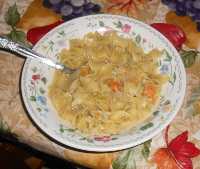
Chicken Noodle Soup
Creamy Lemon Chicken
American Entree
CREAMY LEMON CHICKEN
My cookbook, Following Good Food Around the World, with its 180 wonderful recipes, my newest novel, Do Lutheran Hunks Eat Mushrooms, a hilarious apocalyptic thriller, and all my other books, are available on amazon.com.
Origin of Our Obesity Epidemic
Many people worry about America’s obesity epidemic (AEO) Blame for this health crisis generally falls on processed food and sedentary lifestyles. Culinary historians, however, point to the signing of the Declaration of Independence as the trigger event of the march to obesity. The previously thin founding fathers put on such a lavish, after-signing pot luck that all put on a layer of founding fat. Some of the signers did go on diets to lose their signing blubber. Many of the other great kept piling on the gravy, the turkey dinners and got fatter. Ben Franklin exclaimed later, “I can’t for the life of me lose this founding fat. It’s turned to hard fat.”
During the early 1810s the British made such, unrelenting fun of our tubby politicians that we felt a moral imperative to chastise them in the War of 1812. And so concludes today’s history lesson.
– Paul De Lancey, The Comic Chef, Ph.D.
My cookbook, Following Good Food Around the World, with its 180 wonderful recipes, my newest novel, Do Lutheran Hunks Eat Mushrooms, a hilarious apocalyptic thriller, and all my other books, are available on amazon.com.
Cinnamon Shea Butter Soap
CINNAMON SHEA BUTTER SOAP
– Paul De Lancey, The Comic Chef, Ph.D.
My cookbook, Following Good Food Around the World, with its 180 wonderful recipes, my newest novel, Do Lutheran Hunks Eat Mushrooms, a hilarious apocalyptic thriller, and all my other books, are available on amazon.com.
Strawberry Glycerin Soap
STRAWBERRY GLYCERIN SOAP
– Paul De Lancey, The Comic Chef, Ph.D.
My cookbook, Following Good Food Around the World, with its 180 wonderful recipes, my newest novel, Do Lutheran Hunks Eat Mushrooms, a hilarious apocalyptic thriller, and all my other books, are available on amazon.com.
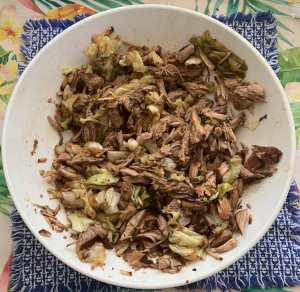
Slow Cooker Kalua Pork With Cabbage
Hawaiian Appetizer
SLOW COOKER KALUA PORK WITH CABBAGE
– Paul De Lancey, The Comic Chef, Ph.D.
.
My cookbook, Following Good Food Around the World, with its 180 wonderful recipes, my newest novel, Do Lutheran Hunks Eat Mushrooms, a hilarious apocalyptic thriller, and all my other books, are available on amazon.com.
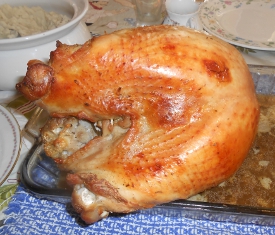
Brined Turkey Breast.
American Entree
BRINED TURKEY BREAST
1 gallon ice-cold water
2 bay leaves
2 garlic cloves
1 teaspoon peppercorns
1 teaspoon allspice
½ teaspoon mustard
1 teaspoon rosemary
1½ cups coarse salt
½ cup light brown sugar
½ cup white sugar
½ teaspoon thyme
8 pounds thawed turkey breast (for love of God, Montressor, the turkey must be thawed)
INGREDIENTS – COOKING TURKEY
¼ cup butter
¼ teaspoon pepper
½ teaspoon salt
2-to-3 cups chicken broth
SPECIAL UTENSILS
really big pot, 8+ gallons, or turkey bag
spice grinder
large oven-safe pan or casserole dish
wire rack
meat thermometer
Serves 12. Takes 15-to-24 hours
PREPARATION – THAWING TURKEY
A large frozen item like a turkey requires at least a day (24 hours) to defrost in the refrigerator for every 5 pounds of weight.
If you are pressed for time, use this quicker defrosting method. Keep turkey in packaging and add it to a large pot. Cover turkey with ice-cold water. Let turkey sit in cold water for 30 minutes per pound. In this recipe, that would be 4 hours. Pour out water.
But the turkey must be thawed before cooking. Or there will be much wailing and gnashing of teeth.
PREPARATION – BRINE
Crumble bay leaves. Mince garlic cloves. Grind peppercorns. Remove packaging from turkey and rinse in cold water. Add brine ingredients except turkey to pot. Stir until salt and sugar dissolve. Add turkey. Add ice-cold water as needed to cover turkey. Cover pot or close turkey bag and refrigerate for at least 12 hours but not more than 24.
PREPARATION – COOKING TURKEY
Remove turkey from brine and pat dry. Preheat oven to 400 degrees. Put turkey in large pan. Melt butter. Brush melted butter onto turkey. Sprinkle pepper and salt onto turkey. Place wire rack in pan. Put turkey on rack. Put meat thermometer in thickest part of turkey. Bake at 400 degrees for 20 minutes. Reduce heat to 325 degrees. Bake for 2-to-3 hours or until meat thermometer reads 165 degrees. Baste with ½ cup of chicken broth after every 30 minutes of baking at 325 degrees.
TIDBITS
1) Wild turkeys hide in trees at night. Just like human ninjas.
2) Wild turkeys can fly. That’s better than human ninjas.
3) All turkeys have periscopic vision. This means they can twist their heads around to see everything. Can human ninjas do that? I think not.
4) Female turkeys do not gobble. This stealthiness makes them the perfect silent warriors.
5) Our founding father, Benjamin Franklin, wanted to make the turkey our national bird. Why? Culinary historians suspect that turkey ninjas fought on the colonists’ side during the American Revolution.
6) How do they know this? The British soldier was far better trained than the American militiaman. The British king had many more soldiers under his autocratic command than did our fractious Continental Congress. King George’s army possessed thousands of cannon and could boast of the biggest and best navy in the world.
7) America could only have won if it had ninja turkeys swooping down, dealing quick, silent death out of the pitch-black night. Historians think American units coordinated ambushes by using bird calls. Culinary historians know better. These were turkey calls, made by fierce turkey warriors.
8) Britain finally countered with the King’s Bear Battalion in 1782. These bears could climb up any tree and were paid in honey. America’s ninja turkeys wouldn’t have stood a chance against the bears’ great strength and massive, sharp claws. Fortunately for America, Britain’s will to continue the war had already been shattered by the decisive battle of Yorktown during the previous year.
9) America disbanded its turkey ninjas in 1806. This is why it didn’t win the War of 1812.
10) America might be using turkey ninjas in covert operations. Who can say? Washington remains mute on the subject.
My cookbook, Following Good Food Around the World, with its 180 wonderful recipes, my newest novel, Do Lutheran Hunks Eat Mushrooms, a hilarious apocalyptic thriller, and all my other books, are available on amazon.com.
Are There Culinary Force Fields?
I don’t recall why I tried to find out about http://www.CulinaryForceFields.com or even why I thought the company Culinary Force Fields existed. At any rate, Google seems think Culinary Forces Fields is a thing. See below.
This is exciting! As far as study of physics holds, the known forces in the universe are: frictional, tension, normal, air resistance, applied, spring, gravitational, electric, and magnetic. Culinary force is not listed. I have discovered a new force. Wow. I look forward to receiving the Nobel Prize for Physics. You are welcome to attend the award ceremony. There will be drinks, snacks, and cookies afterward. I look forward to seeing you.

Paul De Lancey, The Comic Chef, Ph.D.
My cookbook, Following Good Food Around the World, with its 180 wonderful recipes, my newest novel, Do Lutheran Hunks Eat Mushrooms, a hilarious apocalyptic thriller, and all my other books, are available on amazon.com.
Tukasu (Stewed Beef With Dates) From Niger
Nigerien Entree
TUKASU
(Stewed Beef with Dates)
½ tablespoon yeast
½ cup warm water
1¾ cups flour
¼ teaspoon salt (1 teaspoon more later)
1 pound beef chuck, round roast, or rump roast
2 garlic cloves
2 medium onions
9 dates. (If fresh, remove pits)
4 tomatoes
2 tablespoons vegetable oil (2 tablespoons more later)
2 tablespoons vegetable oil
2 tablespoons tomato paste
1 cup tomato sauce
¼ teaspoon aniseed
1 bay leaf
¼ teaspoon cinnamon
¼ teaspoon cumin
¼ teaspoon pepper
1 teaspoon salt
1⅔ cups water
Serves 5. Takes 2 hours 20 minutes.
PREPARATION
Add yeast and ½ cup water to small mixing bowl. Mix with fork until yeast dissolves. Let sit for 15 minutes. Add flour and ¼ teaspoon salt to medium mixing bowl. Mix with fork. Make a small depression in the middle of the flour. Pour yeasty water into depression. Knead flour/yeasty water until you get a big, non-sticky dough ball. Cover medium mixing bowl and let dough sit for 1 hour.
While dough sits, cut beef into 1″ cubes. Mince garlic cloves and onions. Dice dates and tomatoes. Add beef and 2 tablespoons oil to pan. Sauté at medium-high heat for 5 minutes or until beef is completely browned. Stir enough to ensure even browning. Remove beef from heat.
Add 2 tablespoons oil, garlic, and onion to pot. Sauté at medium-high heat for 5 minutes or until onion softens. Stir frequently. Add tomato paste and return beef. Reduce heat to medium and cook for 2 minutes. Stir frequently. Add tomato sauce, aniseed, bay leaf, cinnamon, cumin, pepper, 1 teaspoon salt, and 1⅔ cups water to pot. Stir. Add diced dates and tomatoes. Cover stew and simmer on low heat for 25 minutes.
While stew simmers, divide the dough into 8 small dough balls. Cover with damp cloth and let sit for 30 minutes. Gently add small dough balls to pot. Simmer at low heat for another 40 minutes. Stir occasionally and gently. Remove bay leaf and serve.
TIDBITS
1) Tukasu is a stew.
2) “Stew” is an anagram for “wets.”
3) It is also as anagram for “west.”
4) Culinary anagramists will note that stew can be rearranged to form the word “stwe.”
5) Stwe is rarely used in normal conversation.
6) Oh my gosh, there’s a bunny outside my office window.
7) Bunny wants me to tell you there’s no such word in the English. Not even in medical terminology. Which is why none of the medical TV shows even say, “stwe.”
8) Bunny also says it not a French word, a Dutch word, nor even one in Latin.
9) Why did Bunny help me with this information? Because I feed him carrots and raisins.
10) My fair city, Poway, is justly proud of its multilingual rabbits.
11) Another arrangement of stwe is “twes.”
12) Twes is the plural form of twe.
13) As in, “Shall I take two twes or just one twe to the party?
14) My word! I forget the anagram “stew.”
15) Every word is its own anagram.
16) Like “onion” is an anagram for “onion.”
17) Oh sure it’s blindingly obvious now, but did you know that before you got to tidbit 16?
18) If you know of any real anagrams for “stwe” existing in other languages, please inform me.
21) And I’ll pass on your discovery to Bunny. Bunnies devote nearly all of theirs life searching for rabbit and watching out for hawks. The only real pleasure rabbits indulge in their rare leisure moments is creating new anagrams or finding out about new ones. Bunny and I thank you in advance for your help and consideration.
Paul De Lancey, The Comic Chef, Ph.D.
My cookbook, Following Good Food Around the World, with its 180 wonderful recipes, my newest novel, Do Lutheran Hunks Eat Mushrooms, a hilarious apocalyptic thriller, and all my other books, are available on amazon.com.
Ecuadorian Fritata
Ecuadorian Entree
FRITATA
1½ pounds pork loins
1 pound pork ribs
1 white onion
1 shallot or ½ red onion
2 teaspoons cumin
4 teaspoons minced garlic
½ teaspoon pepper
¾ teaspoon salt
4 cups water
1 cup orange juice
2 avocados
Serves 3. Takes 2 hours 30 minutes.
PREPARATION
Cut pork loin into 1″ cubes. Separate pork ribs. Dice white onion and shallot. Rub cumin garlic, pepper, and salt onto pork loin cubes and pork ribs. Cover and marinate in refrigerator for 1 hour 30 minutes.
While pork marinates, dice white onion and shallot. Add marinated pork, white onion, shallot, and water to large pan. Cook for 30 minutes at medium-high heat or until liquid disappears. Stir enough to prevent burning. Add orange juice. Reduce heat to medium and simmer for 10 minutes or until liquid disappears. Stir frequently to prevent burning and to ensure even browning of pork cubes and pork ribs.
Cut each avocado into 6 slices. Add pork to plates. Place 4 avocado slices to the side. Fritata is also often served with sides of: fried plantains, boil yucca, corn, potatoes, and banana.
TIDBITS
1) Pork cubes and avocado slices are natural enemies. The reason for this antagonism has long been lost in the mists of prehistory.
2) Culinary anthropologists, however, speculate that the demise of the dinosaurs 64 million years ago left a power vacuum on Earth. That led to an intense power struggle between pigs and avocados.
3) The Great Porcine-Avocado War ended when the pigs’ ribs decided they had no stomach for conflict and refused to fight anymore. This internal division curtailed the pigs’ desire for aggression. The war ended. And to this day, peace-keeping pork ribs have been placed between pork cubes and avocado slices on plates everywhere. Now you know.
Paul De Lancey, The Comic Chef, Ph.D., and culinary historian
My cookbook, Following Good Food Around the World, with its 180 wonderful recipes, my newest novel, Do Lutheran Hunks Eat Mushrooms, a hilarious apocalyptic thriller, and all my other books, are available on amazon.com.