history

Spaghetti And Meatballs

Italian Entree

SPAGHETTI AND MEATBALLS

INGREDIENTS

1 1/2 pounds of ground turkey meat
2 big garlic cloves
1 cup of sourdough bread crumbs
2 jars of spaghetti sauce
12 ounces of spaghetti

COOKING THE SPAGHETTI

Follow the instructions on your bag of spaghetti. Different sizes and types of spaghetti have different cooking instructions.

PREPARING THE MEATBALLS

This dish is relatively forgiving. If it’s too spicy, add some water or tomato sauce. If it isn’t spicy enough add some more. If it’s too “liquidy”–-“liquidy” is a legitimate cooking term–-cook the sauce a little longer. If there isn’t enough sauce add more.

Begin defrosting the turkey meat overnight. This way saves electricity and is better for the environment than defrosting by microwave. Sometimes, however, you just don’t have the time. It’s a good idea to take the meat out of the microwave and remove the defrosted outer meat. If you don’t, you will end up cooking the outer part of your block of turkey meat, making it extremely difficult to make meatballs.

Mince the garlic cloves. Take a slice of sourdough bread and make crumbs out of it. I suggest a food processor as it can make smaller crumbs than you can and it won’t get bored doing it either. Sourdough is the chosen bread in this recipe as it goes well with the garlic and spaghetti sauces.

Mix the meat, cloves, and crumbs together. Make meatballs that are at least 1 inch in diameter and less than two. Meatballs that are more than 2 inches across stand a good chance of resembling a model of the Earth–-a hard crust on the outside, gray in the middle with a reddish core.

Put the meatballs in the pan. Actually, this recipe will make two pans worth, giving a huge, delicious meal or wonderful leftovers that your kids will eat the next day before you get up.

Cook on medium heat. Gradually add spaghetti sauce until the medium balls are covered. Reduce heat to low and cover. You won’t have to turn over the meatballs more than a few times as the sauce atop will keep the moisture in.

You’re ready with your sauce at this point. However, if your noodles are not, if you can’t get your kids to log off Wizard 101 or if your sweetheart is in the middle of a Wii Fit session, it is an extremely good idea to set the heat to warm at most or even shut it off. Stir occasionally and gnash your teeth. Your anger will evaporate with the compliments your hungry brood or guests will give you for this meal.

TIDBITS

1) Pasta was eaten by the Chinese seven-thousand years ago.

2) Cortez brought tomatoes back to Spain from Mexico in 1519. So his conquest of Mexico, while bad for the Aztecs, was a positive boon for the culinary world. No tomato sauces for spaghetti noodles for 5,500 years! Ugh.

3)Pasta was not brought back from China by Marco Polo. Ancient Romans ate this food as well. Dang, yet another example of how boring history can be.

4) Pasta was considered to be peasant food by Italian nobility until around the 19th century.

5) Pasta is an anagram for “pa sat.”

– Paul De Lancey, The Comic Chef

My cookbook, Following Good Food Around the World, with its 180 wonderful recipes, my newest novel, Do Lutheran Hunks Eat Mushrooms, a hilarious apocalyptic thriller, and all my other books, are available on amazon.com.

Categories: cuisine, food, history, humor, international, recipes | Tags: , , , , , , , , , , , , , , , | Leave a comment

Juice And Sugar-Glazed Ham

American Entree

JUICE AND SUGAR-GLAZED HAM

INGREDIENTS

8.84 pounds spiral-cut ham
1/2 cup pear juice
1/2 cup orange juice
1/2 cup brown sugar
1/2 cup honey
1 tablespoons grated orange peel or orange zest
2 tablespoons butter
2 tablespoons honey
1 15-ounce can peach halves

SPECIAL UTENSILS

baster
oven thermometer

Serves 8. Takes 2 hours 30 minutes.

PREPARATION

(If you can’t find a spiral-cut ham that weighs exactly 8.84 pounds, then anything from 6 to 10 pounds will do. Remember improvise, improvise, improvise. For example, if your recipe calls for Moroccan camel cheese to be sprinkled atop your Saharan crepe and your guests are arriving in five minutes and all you have is Four-Mexican cheese blend, use the Mexican cheese. At that point you can hope no one notices the substitution, lie about the substitution, or brag about your ability to cook Moroccan-Mexican fusion.)

Meanwhile back at the recipe, grate an orange peel. Place ham, cut end down, in large baking pan. Cook ham according to directions on its package.

Combine pear juice and orange juice in mixing bowl. After one hour of cooking, take the ham out of the oven and baste the ham with the orange-and-pear-juices mixture. This step really is easiest with a baster. Put ham back in oven.

Take ham out of oven. Combine brown sugar, grated orange peels or orange zest, 1/2 cup honey, and 1/4 cup of drippings from ham in second mixing bowl. Picking up the drippings is easiest and safest with a baster. (If you have already cleaned your mixing bowl, you are an outstanding chef and worthy of the admiration of everyone.) Brush this mixture all over the exposed portion of the ham about an hour before the ham is supposed to be done. (You did save the cooking instructions that came with the ham, didn’t you?) Put ham back in oven.

TIDBITS

1) Eating pig is forbidden to Muslims. Eating beef is forbidden to Hindus. Even biting something cooked in the fat of those animals is impermissible.

2) Cartridges used by the world’s armies in 1856 were often coated in animal grease.

3) In 1856, many of the British Army’s soldiers in India were native Muslims or Hindus. The Moslem soldiers thought their cartridges were coated with pig fat. Religious outrage. The Hindus soldiers felt their bullets were dipped in cow fat. Religious outrage.

4) So the native Indian soldiers rebelled against British rule. Thousands and thousands of people died and many atrocities were committed before the British gained the upper hand.

5) See, proper spicing matters, whether in cooking or maintaining a world-wide empire.

6) If only the British had used duck grease to coat their cartridges. Hardly anyone has religious reservations about duck grease.

7) And everyone likes doughnuts.

8) However, may I recommend frying doughnuts made with vegetable oil, acceptable on every continent? We have a lot of nuclear weapons littering the Earth and the next World War is bound to be a downer.

– Paul De Lancey, The Comic Chef

My cookbook, Following Good Food Around the World, with its 180 wonderful recipes, my newest novel, Do Lutheran Hunks Eat Mushrooms, a hilarious apocalyptic thriller, and all my other books, are available on amazon.com.

Categories: cuisine, food, history, humor, international | Tags: , , , , , , , , , , , , , , , | Leave a comment

Hawaiian Eggs

Hawaiian Entree

HAWAIIAN EGGS

INGREDIENTS

2 medium onions
1 8 ounce can pineapple pieces
1 tablespoon rice wine vinegar
1/4 teaspoon ground ginger
2 tomatoes or 1 pound can diced tomatoes
2 tablespoons butter
1 tablespoon corn flour
1/4 teaspoon cinnamon
1/4 teaspoon salt
1/4 teaspoon pepper
6 hard-boiled eggs
1 cup rice
2 cups water

PREPARATION

Mince onions. (You have purchased a small processor, haven’t you?) Drain water from diced tomatoes. Saute the onion in butter. Remove the pineapple pieces. Keep the juice.

Blend the corn flour, 2 tablespoons reserved pineapple juice, vinegar, ginger, diced tomatoes, pineapple pieces, cinnamon, salt, and pepper. Add this mix to pan and half of the remaining pineapple juice.

Heat on medium heat for 2 minutes. Simmer for 8 minutes more. Peel eggs. Cut eggs in half lengthwise. Cook rice according to instructions on package.

Cook rice and water according to instructions on bag. Spread this exciting rice on plate. Add eggs. Spoon sauce over rice and eggs.

TIDBITS

1) “Pineapple” is slang for “hand grenade.” This term derives from the appearance of American hand grenades during World War II.

2) Hawaii is one of the only two states not to allow gambling. The other is Utah.

3) Pineapples were unknown to the ancient Romans.

4) Pineapples were originally native to Brazil and Paraguay. Brazil has won the most World Cups in soccer. Coincidence? Perhaps …

– Paul De Lancey, The Comic Chef

My cookbook, Following Good Food Around the World, with its 180 wonderful recipes, my newest novel, Do Lutheran Hunks Eat Mushrooms, a hilarious apocalyptic thriller, and all my other books, are available on amazon.com.


Categories: cuisine, food, history, humor, recipes | Tags: , , , , , , , , , , , , , , | 1 Comment

Niter Kibeh (seasoned, clarified butter) From Forthcoming Cookbook

Ethiopian Appetizer

NITER KIBEH

INGREDIENTS

1 pound unsalted butter
2 garlic cloves
1 cinnamon stick
3 cloves
1/2 teaspoon cardamom
1 teaspoon ginger
1/2 teaspoon turmeric
1/2 teaspoon fenugreek seeds

PREPARATION

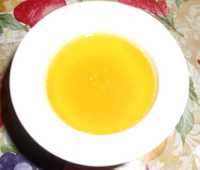
Mince garlic cloves. Melt butter on low heat in saucepan. Add garlic cloves, cinnamon stick, cloves, cardamom, ginger, turmeric, and fenugreek seeds. Simmer on lowest heat, between off and warm, for 1 hour. Stir occasionally.

Put bowl beneath colander. Pour buttery liquid into colander. Discard solids in colander. Keep buttery liquid. This Ethiopian butter may be stored in the refrigerator.

Makes two cups. Be the first on your block to do so.

TIDBITS

1) In 1870, the French Emperor Napoleon III asked his nation to come up with a substitute for butter.

2) In 1870, the German Kaiser’s armies at Sedan captured Napoleon and over 100,000 thousand soldiers under his command.

3) This was one of the decisive defeats in the Franco-Prussian War.

4) This war gave birth to the German nation, the French Republic, and sowed the seeds for World War I, the rise of Nazi Germany, and World War II.

5) We are less sure if Napoleon III enjoyed margarine on his toast during the battle of Sedan.

6) Maybe if Napoleon had spent more time instead getting the world’s first machine guns from his nation’s arsenals to his troops in the field the war would have turned out differently.

7) But then we wouldn’t be able to have cinnamon toast with fewer calories.

8) There are pluses and minuses to every culinary advance.

– Paul De Lancey, The Comic Chef

My cookbook, Following Good Food Around the World, with its 180 wonderful recipes, my newest novel, Do Lutheran Hunks Eat Mushrooms, a hilarious apocalyptic thriller, and all my other books, are available on amazon.com.

Categories: cuisine, food, history, humor, international, recipes | Tags: , , , , , , , , , , , | 2 Comments

Stir Fry Chicken

Chinese Entree

CHICKEN STIR FRY

INGREDIENTS

2 chicken breasts
2 cloves garlic
1 yellow bell pepper
2 teaspoons peanut oil
2 teaspoons sesame oil

3 tablespoons honey
2 1/2 tablespoons soy sauce
1/8 teaspoon white pepper
1/2 teaspoon ginger
6 ounces bean sprouts
2 large carrots
2 teaspoons cornstarch

1 cup rice
2 cup water

PREPARATION

Cut chicken into 1/2-inch cubes or dice with food processor. (Chicken cubes make poor ear plugs.) Scrape off skin from carrots with knife and remove tops and bottoms. Dice garlic, bell pepper, and carrots.

Put chicken, garlic, bell pepper, sesame oil, and peanut oil in large no-stick frying pan or wok. Cook on medium heat until chicken is lightly browned. Stir occasionally.

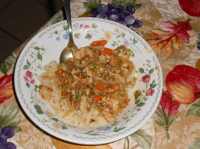
Add honey, soy sauce, white pepper, ginger, sprouts, and carrots. Cook on medium heat until all is hot. Stir occasionally. Add cornstarch. Stir in cooked rice (cooked according to instructions on bag) and serve.

Simple and tasty.

TIDBITS

1) Rice is much more popular in Asia than in the United States.

2) However, Sam Rice, of the 1924 Washington Senators, was very popular in Washington, D.C. It is doubtful many in Asia had ever heard of him.

3) 1924 was the only year the Senators won the World Series.

4) In the 1960s, some losers of the World Series later toured and played in Japan.

5) Japanese samurais of the 10th to 16th centuries were famous for their swordsmanship.

6) So naturally, samurai trading cards were all the rage in Australia in 1965. There was even a well-watched t.v. show called Shintaro.

7) I had an outfit just like Shintaro and a genuine toy sword, too.

8) Where did they go?

– Paul De Lancey, The Comic Chef

My cookbook, Following Good Food Around the World, with its 180 wonderful recipes, my newest novel, Do Lutheran Hunks Eat Mushrooms, a hilarious apocalyptic thriller, and all my other books, are available on amazon.com.

Categories: cuisine, food, history, humor, international, recipes, Uncategorized | Tags: , , , , , , , , , , , , , , , , , , , , , | Leave a comment

Potato-Leek Soup

American Soup

POTATO-LEEK SOUP

INGREDIENTS

1 pound leeks
3 tablespoons butter
1/2 cups celery stalks
4 medium potatoes
3 cups water
3 cups milk
3/4 teaspoon Vegetable MagicTM spice
1/4 teaspoon celery salt
1/4 teaspoon parsley
1/4 teaspoon salt
1/2 cup chopped cilantro
up to 1 cup grated cheese, optional

PREPARATION OF THE LEEKS

Cut off and remove the tough dark, green parts. Remove the bottom part with the little roots. Cut the leeks into pieces and swirl them in water to remove bits of dirt. Pat down the pieces with a towel to dry them. Put leeks into a food-processor and mince them.

PREPARATION OF THE SOUP.

Melt butter in pan. (Note it is much easier to measure 3 tablespoons from a stick of butter than from a tub.) Mince the celery. Add leeks and celery to melted butter.

Saute on low heat and stir frequently for about 6 minutes or until onions are soft. (Reading War and Peace is not advised at this point.)

Chop up potatoes until they are small enough to put into a blender. Blend the heck out of them. Put 3 cups water into pot. Heat water to boiling. Cook for about 15 minutes this way or until potato bits are tender. (Note you should gradually turn down the heat. The soup will still boil and you will avoid painful geysers of hot potato water. (A great reason not to cook in the nude.)

Dice cilantro until you have 1/2 cup. Add sauteed leeks, celery, milk, cilantro, vegetable spice, celery salt, parsley, and salt. Cover and cook at low heat for 20 minutes. Taste soup. Sprinkle in other spices if you wish. Some people love onion salt, garlic salt, or Tabasco sauce in everything. If you are that kind of cook, go for it!

Add grated cheese to taste.

EATING OF THE SOUP

Nom, nom, nom.

TIDBITS

1) The potato was cultivated by the Incas. The Spanish took it back to Europe and gave little in return.

2) The potato revolutionized warfare. Previous to widespread cultivation of this amazing tuber, armies on the move stripped the conquered territories of any food growing above ground. Farmers could now wait until the invading hordes left and dig up enough potatoes to survive. Armies could also feed themselves on the potatoes they brought along. There is a sketch of the great French general Napoleon asking a foot soldier for a potato.

3) The Irish depended quite heavily on the potato for their nutritional needs. When the potato crop failed in 1848, many Irish starved and large numbers of them migrated to America.

4) Indeed, loud guffaws never swirled around the humble potato.

5) Until HasbroTM created Mr. Potato HeadTM in 1962. Now we can all eat the potato or play with it.

6) Mr. Potato HeadTM seems so obvious now. That’s why genius is genius.

– Paul De Lancey, The Comic Chef

My cookbook, Following Good Food Around the World, with its 180 wonderful recipes, my newest novel, Do Lutheran Hunks Eat Mushrooms, a hilarious apocalyptic thriller, and all my other books, are available on amazon.com.

Categories: cuisine, food, history, humor, recipes | Tags: , , , , , , , , , , , , , , , , , , | Leave a comment

Turkey Burgers

American Entrée-Basic

TURKEY BURGERS

INGREDIENTS

1 1/2 pounds of ground turkey meat
1 onion
1/4 green bell peppers
2 green onion stalks
2 tablespoons garlic salt
1/2 tablespoons cumin
8 potato hamburger buns – top and bottom
1/4 head of lettuce, washed
1 cup of grated four-cheese blend
1 ketchup bottle
water
extra virgin olive oil

SPECIALTY UTENSILS

Sonic obliterator
Four-slice toaster

TOASTING THE BUNS

You really need a four-slice toaster. You simply cannot feed turkey burgers to a hungry horde with a two-hole toaster. Don=t do four bun halves, two whole buns, and rest on your laurels.

(You say you need more immediate motivation? Pretend the members of your brood have become ravenous cannibals ready to sink their razor sharp canines into your haunches unless they get their turkey burgers.) Keep on toasting.

(And DON’T, DON’T, microwave anything while toasting. You’ll trip your circuit breaker and you’ll have to dash outside and flip the circuits. This is one reason against cooking in the nude. The other being that grease splatters.)

PREPARING THE ONION

Remove the skin. It adds nothing to the taste, is papery, and gets stuck between your teeth. (How can you concentrate on your boss’s story about mango harvesting in Tahiti when you have onion skin between your first and second molars annoying the heck out of you? Remove the skin, now.)

Also cut off the root part at the bottom. It’s edible ,I suppose, but hardly tasty. If the onion has a big, green sprout in the middle, it’s because you bought it when Nixon was in office and is no longer edible.

PREPARING THE GREEN BELL PEPPERS

It really helps if you have a prepared green bell pepper left over from last night’s culinary extravaganza, made from the chapter on stuffed green peppers, for example.

If not, cut the top off the green bell pepper and discard, or at least discard the stem. Scoop out the innards of the pepper seeds and those four vertical, soft whitish columns and throw them away.

Chop up the pepper and put it in a pan. Coat the pieces with olive oil. Use extra-virgin olive oil. (That’s the most virgin you can get, unless you went through school studying economics.)

Cook the green bell pepper. This process is called sauteeing.

(See, you’re picking up the vocabulary. Mais oui. C’est magnifique, n’est ce pas? Ho, ho, ho.)

CHOPPING UP THE VEGGIES

You really must get yourself a food processor, big or small, one with two little whirling blades. This little gizmo will make chopping up or mincing the veggies so much faster than cutting them up with a knife. If your knife is blunt, this task takes forever. And a sharp knife is just too tempting for a spouse sulking over your latest big purchase.

Get a food processor. Mince the green onions. Mince the onions. Onions are big. (Don’t let that intimidate you. You’re bigger than they and have opposable thumbs.) Be sure to cut it up into at least four sections before putting it into the processor. Chop up the bell peppers.

SPICING

The above list of spices assumes you like the same amount of spices as I do. So experiment. Once you become adept at cooking, you=ll be able to smell the correct amount of spice to add as you mix.

 PREPARING THE BURGER

Get a big bowl. Put the ingredients you’ve prepared so far. Mix. Mix with your hands until everything is thoroughly mixed. Your hands will get extremely messy.

(Midway through the mixing is, of course, the time someone will knock on your front door to ask you if you want your trees trimmed, even if you don’t have any. In the meantime you have dropped turkey meat all over that hard-to-justify-buying Persian carpet and of course, on the front doorknob. 

This is the time to say, “Excuse me, I’ll just be a moment.” Go back to the kitchen table, pick up the sonic obliterator, and annihilate the would-be tree trimmer. Wipe up and pick up all bits of turkey meat on the way back to the kitchen. Cleanliness is a virtue.)

THE TURKEY-BURGER PATTIES

Make four patties and put them in your pan. The patties should not be much bigger than your spatula or they might fall apart when turned over.

Turn the heat to high to get things going and gradually turn it down to medium or medium high. The higher you set the temperature, the more closely you’ll need to watch the patties and turn them over.

Turkey meat turns white when cooked. The outside turns white  before the inside does. So how do you know when it’s done? It’s perfectly acceptable for a chef, particularly one that’s starting out, to cut a small piece near the edge and look at it and taste it. If the inside of the piece is white, then it is done. Remember, if no one saw you taste the burger, then it didn’t happen.

(By the way, it is a matter between you and your God about what to do if you should drop an entire patty on the floor. Consider the cleanliness of your floor and the likability of your guests in making your decision.)

You must flip the burgers repeatedly with your spatula. If you do not do so, the water will rise to the top of the burger and evaporate, making the burger too dry to eat. Flipping puts the water that has almost escaped on the bottom of the burger again.

 Consider occasionally sprinkling water on top of the patty and pouring a thin layer of water into the pan. This adds moisture to the burger and a moist burger is a yummy burger.

ASSEMBLING THE TURKEY BURGER

Put the bottom bun–it’s flat–on the plate. Put the cooked patty on the bun and the lettuce atop the patty. (There are some heretics who put the lettuce on first, but they are being hunted down without mercy.) Sprinkle the cheese on next. If you are adventurous, pour on some ketchup. Place the top bun–it’s dome shaped–on next.

You are now a culinary hero to your guests.

TIDBITS

1) A Hamburger is someone from Hamburg, Germany. The term a hamburger derives from this city. A Berliner is someone from Berlin. Berliner is also the name of a jelly doughnut. Some people think when President Kennedy said in that famous Cold War speech, Ich bin ein Berliner, he was actually saying, “I am a jelly doughnut.”

2) The first official listing of a hamburger on a menu occurred at Delmonico’s in New York in 1826.

3) Cheeseburger In Paradise is a great song.

4) A turkey is not someone from Turkey. It is a bowling term.

5) The turkey was one of the first animals in North America to be domesticated.

6) Turkeys were called turkeys in the 1500s by English merchants because they thought turkeys came from India and that Turkey owned India. Bozos.

– Paul De Lancey, The Comic Chef

My cookbook, Following Good Food Around the World, with its 180 wonderful recipes, my newest novel, Do Lutheran Hunks Eat Mushrooms, a hilarious apocalyptic thriller, and all my other books, are available on amazon.com.

Categories: cuisine, food, history, humor, recipes | Tags: , , , , , , , , , , , , , , , , , , , , , | Leave a comment

Santo Domingo: Land Of Many Flags And One Really Great Spice Blend

The pre-Facebook history of Santo Domingo

Period                   Owner of Santo Domingo
—————-     ——————————-
1500 – 1808        Spain
1808  – 1814       Santo Domingo
1814 –  1821        Spain
1821 –  1822        Santo Domingo
1822 – 1844         Haiti
1844 – 1861         Santo Domingo (voluntary return to Spanish authority)
1861 – 1865         Spain
1865 – 1870        Santo Domingo
1870 – 1872       Seeks unsuccessfully to be annexed by United States
1872 – 1916        Santo Domingo
1916 – 1924        Occupied by United States (which missed the 1870 invitation by 46 years)
1925 – 2000       Santo Domingo
2000 – 2010      Cruise ships
2010 – 2012       Cruise ships with WiFi, so passengers can access Facebook.

The most popular spice mix in Santo Domingo is sofrito and is rubbed on meats and sauteed.

I imagine that explains much of this country’s history.

Bacon!

– Paul De Lancey, The Comic Chef

My cookbook, Following Good Food Around the World, with its 180 wonderful recipes, my newest novel, Do Lutheran Hunks Eat Mushrooms, a hilarious apocalyptic thriller, and all my other books, are available on amazon.com.

Categories: history, humor, international | Tags: , , , , , , , , , | Leave a comment

Southwest Stuffed Bell Peppers – From Cookbook

American Entree

SOUTHWEST STUFFED BELL PEPPERS

INGREDIENTS

Ole.

1 green chile
5 green bell peppers
1/2 red onion
2 garlic cloves
1 cup pepper jack cheese
2 ounces Cotija cheese
1 1/2 pounds ground turkey
1/2 14.5 can diced tomatoes
4 teaspoons chili powder
1 teaspoon cornstarch
1 teaspoon cumin
1/2 teaspoon oregano
1/4 teaspoon cayenne pepper
3/4 cup water
4 tablespoons sour cream
2 green onions
1/2 14.5 can diced tomatoes
3/4 cup water

PREPARATION

Remove seeds from green chile. Cut bell peppers in half lengthwise. Remove stem, white innards, and seed from green bell peppers. Dice green chile, red onion, garlic cloves, and green onion. Grate or shred pepper jack cheese and Cotija cheese.

In a large frying pan or skillet, cook the turkey, green chile, red onion, and garlic over medium-high heat until meat is no longer pink. Stir occasionally.

Add 1/2 of the diced tomatoes, chili powder, corn starch, cumin, oregano, cayenne, green onion, and 3/4 cup water. Bring to boil then reduce. Simmer uncovered for about 15 minutes. (No, this does not mean to get angry and cook in the nude. Sauces can splatter.)

Place as many bell-pepper halves in microwavable dish. (You’ll need a 3-to-4 quart dish if you want to use just one.) Add 3/4 cup water to dish. Cover and microwave on high for 7 to 8 minutes. (Microwaves vary in strength, so in general it’s best to heat for a short time, check the food and, if necessary, microwave some more.)

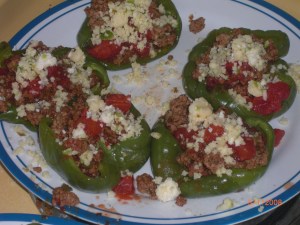
Pour any water out of the bell peppers. Fill each bell-pepper half to the top with ground-beef mixture. Put an equal amount of sour cream, remaining half of tomatoes, and cheese on bell peppers.

Serve to adoring guests.

TIDBITS

1) Bell peppers have recessive genes that prevent them from having capsaicin, the stuff that makes other peppers hot.

2) Red bell peppers are important in Portuguese cuisine.

3) In 1801 my great-great-great-grandfather Napoleon I directed an invasion of Portugal by French and Spanish troops.

4) In 1808, Napoleon I invaded Portugal again. Say what you will about his megalomania and the countless deaths he caused, he did possess an admirable work ethic.

5) Oh, and he invaded Spain as well in 1808, unleashing more bloody, unrestrained guerrilla warfare.

6) Strange to say, most Napoleonic historians fail utterly to mention how six years of conflict in that region affected red-bell-pepper production in Portugal.

7) It seems likely, though, that red-pepper planting and harvesting fell precipitously in previously culinarily happy Portugal.

8) One’s mind recoils at the thought of wary-weary Portuguese reduced to eating beef-and-red pepper sandwiches without red peppers.

9) Bad French emperor, no éclaire.

– Paul De Lancey, The Comic Chef

My cookbook, Following Good Food Around the World, with its 180 wonderful recipes, my newest novel, Do Lutheran Hunks Eat Mushrooms, a hilarious apocalyptic thriller, and all my other books, are available on amazon.com.

Categories: cuisine, food, history, humor, recipes | Tags: , , , , , , , , , , , , , , | Leave a comment

Berbere Burgers From Cookbook, “Eat Me”

Moroccan Entree

BERBERE BURGERS

INGREDIENTSBerbeHB-

1/2 head lettuce
1 medium yellow onion
1 tablespoon Berbere spices (See recipe for BERBERE SPICE MIX INGREDIENTS, if you can’t find the mix)
1/2 teaspoon cayenne pepper
1/4 teaspoon ground cinnamon
1/2 tablespoon ground coriander
1/4 teaspoon ground ginger
1 tablespoon parsley flakes
1/2 teaspoon black pepper
1/2 teaspoon sea salt
1 1/2 pounds ground beef
8 buns or 16 multi-grain bread slices
1 cup grated Mozzarella cheese
no-stick spray

UTENSILS

electric skillet

spice grinder (To make your own Berbere spice mix.)

PREPARATION

Tear lettuce into bun-size pieces by hand. Peel and dice onion. Put Berbere spices, cayenne pepper, cinnamon, coriander, ginger, parsley, pepper, salt, and ground beef in mixing bowl. Pretend you’re making the mortar for the mighty Egyptian pyramids as you mix everything together with your hands. (Edible pyramids. What a concept.) Make 8 hamburger patties.

Use non-stick spray on frying pan. Put 4 patties in pan. Cook on medium-high heat for 2 to 3 minutes. Flip patties over and cook for another 2 to 3 minutes. Don’t squash the patties with your spatula. This forces the juices out of the patties. (I also don’t recommend flattening oranges with your spatula for a similar if not more spectacular reason.) Patties should have no pink remaining. Repeat to make 8 patties. Toast buns.

Put a patty on each bun bottom. Top with lettuce and cheese. Put bun top and, violà, you have a burger so tasty you’ll want to conquer all of North Africa just to bring this dish’s culinary greatness to all its peoples.

TIDBITS

1) Most world conquerors, such as Napoleon, Cortes, Alexander the Great, Genghis Khan, and Julius Caesar didn’t bring much culinary enlightenment to their defeated nations.

2) Pretty much just death by the thousands and enslavement.

3) What would it have hurt them to give their newly enslaved peoples a wondrous culinary novelty in compensation?

4) Oh sure, there are such things as Napoleons and Caesar salad.

5) But those military geniuses didn’t come up with them.

6) The Caesar salad was invented last century at Caesar’s hotel in Tijuana Mexico.

7) Indeed, it is also verifiable that Julius Caesar and all of the Julian-Claudian Emperors had nothing to do with the comedic brilliance of Sid Caesar.

8) Frederick the Great did encourage potato production in his Kingdom of Prussia, the precursor to modern Germany. The mighty tuber enabled Prussia to feed all its people even though its lands were repeatedly invaded by its enemies.

9) To this day, one may still buy French Fries in Germany.

10) Well done, Frederick.

– Paul De Lancey, The Comic Chef

My cookbook, Following Good Food Around the World, with its 180 wonderful recipes, my newest novel, Do Lutheran Hunks Eat Mushrooms, a hilarious apocalyptic thriller, and all my other books, are available on amazon.com.

Categories: cuisine, food, history, humor, international, recipes | Tags: , , , , , , , , , , , , , , , , , , , , , , , , , , , , , | Leave a comment

Blog at WordPress.com.