Posts Tagged With: wheat

Cheese Lasagna

Italian Entree

­

CHEESE LASAGNA

­
INGREDIENTS – PASTA
­
3 cups flour*
2 eggs
1 egg yolk
½ cup water or more
­
* = More might be needed for dusting, texture.
­
INGREDIENTS – CHEESE
­
3 garlic cloves
1 white onion
2½ cups shredded mozzarella cheese
1¼ cups shredded Parmesan cheese (2 tablespoons more later)
2¼ cups ricotta cheese
⅓ cup red wine
2 tablespoons olive oil
1 26-ounce jar spaghetti sauce
1 15-ounce can diced tomatoes
1 teaspoon basil
1 bay leaf
1 teaspoon Italian seasoning
1 teaspoon oregano
¼ teaspoon pepper
½ teaspoon salt
½ teaspoon thyme
­
INGREDIENTS – ASSEMBLY
­
2 tablespoons Parmesan cheese
­
SPECIAL UTENSILS
­
9-inch x 13-inch baking dish
no-stick pastry mat
rolling pin
hand crank pasta machine
cooking scissors (If your baking dish is 8-inches x 8-inches, for example)
no-stick spray
­
Serves 12. Takes 3 hours 10 minutes.
­
PREPARATION – DOUGH
­
Combine 3 cups flour, eggs, egg yolk, and water into large mixing bowl. Knead with hands for 15 minutes. Make a ball of the mixture. It should be only slightly sticky and should just be able to come off your hand. If some of the ball sticks to your hand, then add a bit more flour, mix again, and try the new flour. If the flour ball is powdery, it is too dry. Add a bit more water, mix again, and try the consistency of the next ball. There may be a number of these iterations but it must be done. Divide dough ball into 3 equal mini-dough balls. Wrap mini-dough balls with plastic wrap and let sit in refrigerator for 1 hour.
­
PREPARATION – CHEESE
­
Preheat oven to 375 degrees. Mince garlic cloves and onion. Add mozzarella, Parmesan, and ricotta cheeses to medium mixing bowl. Mix with fork until well blended
­
Add onion, garlic, and olive oil. to frying pan. Sauté at medium heat for 5 minutes or until onion softens. Add red wine, spaghetti sauce, diced tomatoes, basil, bay leaf, Italian seasoning, oregano, pepper, salt, and thyme. Cook on medium heat for 3 minutes, stirring occasionally.
­
PREPARATION – PASTA
­
This preparation needs to be done 3 times. Dust no-stick pastry mat with flour. Remove 1 dough ball from refrigerator. Keep remaining dough balls in fridge until needed. Put this dough ball on pastry mat. Dust rolling pin. Roll out dough into oval shape 5½” wide and ¼” thick. (Anything thicker inhibits dough from going through hand-crank pasta machine.)
­
Use pasta machine’s thickest setting. (#1 on mine.) Hold dough vertically and straight as possible over pasta machine’s roller. Turn crank slowly to feed dough oval through roller. Fold resulting dough sheet in half. Cut about ¼” off each side to make it rectangular and thus easier to feed into roller. (This also makes for uniform dough sheets.) Run this folded sheet through roller.
­
Dust dough sheet. Set pasta’s setting the next narrower setting. (#2 on mine.) Again, hold dough sheet vertically and straight as possible over pasta machine’s roller. Repeat process, selecting a narrower setting each time, until final pasta sheet is about 1/16″ thick. Repeat entire pasta-sheet preparation until all dough is used. Trim pasta sheets to be 13″ * 4½”. The cutoff pieces of dough can be used to make another sheet.
­
PREPARATION – ASSEMBLY
­
Grate 2 teaspoons Parmesan. Use no-stick spray on baking dish. Put a layer of lasagna, 2 side-by-side noodles on the dish. If the noodles happen to be longer than your baking dish, snip off the excess length with your scissors. In this recipe, 6 noodles will make one lasagna dish with 2 layers of meat sauce. Reserve about ½ cup meat sauce. Divide remaining meat sauce and cheese equally between layers.
­
Cover this 1st layer of noodles with a layer of meat sauce and a layer of cheese. Add a 2nd
layer of noodles, meat sauce, and cheese. Add a 3rd layer of noodles. Spoon just a little meat sauce atop the top layer along with 2 tablespoons Parmesan cheese. Put glass lid or aluminum foil on top of baking dish. Cook lasagna in covered baking dish in oven at 375 degrees for 45 minutes. Cook uncovered for an additional 15 minutes or until bubbly. Remove and let sit for 5 minutes more.
­
TIDBITS
­
1) Lucy Olduvai of Olduvai Gorge was the world’s first human. Her parents were almost human. And oh my gosh, her brother Ogg, older than her by two years, was oh so close to be human. But with Lucy, they had finally got birthing a human right.
­
2) But, sad to say, Little Lucy was a brat. She taunted her sibling mercilessly. “You’re subhuman,”  The sensitive Ogg ran crying to Mama Olduvai. Mama Olduvai got cross with Little Lucy. “Go play with that herd of mammoth cattle until you’re ready to apologize to your brother.”
­
3) Oh, tidbit 3) proves that the nearly humans and first humans had the power of speech and in fact, could speak English. Well done, you.
­
4) Anyway, proud Little Lucy wasn’t ready to apologize. So, she spent a lot of time poking the cattle. Then she started pulling. Fortunately for the ascent of humanity, she didn’t start with a bull. She began with a cow and got milk. “Wow, this tastes great! I call it milk.”
­
5) Then she spotted a field of wheat. The equivalent of a light bulb turned on her first-human brain. “I’ll bet if I can get the cattle to stampede over the wheat field, they’ll trample and crush the wheat into flour.*”
­
6) * = First Human speech was much complex than was first suspected, constructing complicated sentences with commas and everything.
­
7) So, Little Lucy, ran back to her family as fast as her first-human legs would carry her. “Mama, Mama, I’ve discovered milk and wheat. We can evolve.”
­
8) Mama Ogg scowled. “Evolution can wait. Are you ready to apologize to Ogg?”
“I am. Sorry Ogg.”
“It’s okay,” said Ogg, “Do you think we could make lasagna? I’ve had visions of it in my sleep?”
“Well,” said Little Lucy, “we need culture to make cheese.”
­
9) So, the Olduvai Gorgers invented cave painting and five-act plays. But this was the wrong culture for making cheese out of milk. The next day, however, they discovered the right culture.
­
10) The Gorgers, being hunter-gathers, par excellence, gathered eggs, garlic, cloves, onions, grapes, olives, tomatoes, basil, bay leaves, peppercorns, thyme, and salt. With their almost-human synapses firing something fierce, they eventually uncovered the secret of making tasty cheese lasagna. Life was truly good for the Gorgers.
­
11) Until the mammoth-cattle herd migrated out of Africa. Oh no! No herd, no milk. No milk, no lasagna. “What’s the point of evolving?” said Papa Ogg, “if we can’t dine on lasagna?”
­
12) “Let’s follow the mammoth cattle,” said Little Lucy. “Let’s follow the most important ingredient in lasagna.” so they did. And this is how humanity spread over the entire planet. Yay.
­

– Paul De Lancey, The Comic Chef, Ph.D.

My cookbook, Following Good Food Around the World, with its 180 wonderful recipes, my newest novel, Do Lutheran Hunks Eat Mushrooms, a hilarious apocalyptic thriller, and all my other books, are available on amazon.com.

Categories: cuisine, history, international | Tags: , , , , , , , , , , , , , , | Leave a comment

Vietnamese Sugar Cane Shrimp (Chao Tom)

Vietnamese Appetizer

SUGAR CANE SHRIMP
(Chao Tom)

INGREDIENTS

1 pound medium shrimp, frozen, peeled and deveined (41-to-50 count)
1 teaspoon fish sauce
1 garlic clove
¼ teaspoon salt
2 teaspoons sugar
½ teaspoon white pepper or pepper
1 egg white
2 teaspoons corn starch
½ teaspoon vegetable oil
8 4″-sugar cane sticks (fresh or canned) *

* = I suggest using canned sugar as fresh sugar cane needs to be peeled and cut into 4″ sticks. Canned sugar cane can be found in Asian supermarkets. Fresh sugar cane can be found there as well or online.

SPECIAL UTENSILS

food processor
electric grill pan
no-stick spray

Serves 4. Takes 40 minutes. Allow for up to an extra hour if using fresh sugar cane. In this case, cut the sugar cane apart around the joints. Then use knives and cleavers to remove the hard outer shell of the can.

PREPARATION

Add shrimp, fish sauce, garlic, salt, sugar, and white pepper to food processor. Blend until ingredients form a shrimp paste. Add egg white to mixing bowl. Whip egg white with whisk until frothy. Add shrimp paste and corn starch to egg white. Mix with whisk until shrimp is again well blended.

Preheat grill to medium high. Dip hands in vegetable oil. Take 1½ tablespoons shrimp paste and press it evenly around the middle of a sugar-cane stick. Leave ¾” sugar-cane stick exposed at both ends. Brush shrimp paste on sticks lightly with oil to prevent sticking. Add shrimp-covered sticks to grill. Grill for 8 minutes or until shrimp paste is golden brown on all sides. Turn gently, at least every 2 minutes, Bite into the sugar cane a bit as you eat the shrimp. This will add sugar juice to your bite.

TIDBITS

1) Wherever the well loved Chef Tomasso went, everyone said, “Ciao, Tomasso.” Then one day he left his hometown of Padua in search of some squid ink for his next meal. He should have gone to Venice. Instead ended up in Hanoi as he was way too proud to ask for directions. Fortunately, the locals took him in. In gratitude, Tom, as he is now called, created this dish. Now, the Vietnamese greet him with “Chao, Tom” in honor of his cooking style .

2) Then, alas, tragedy struck.

3) Chef Tomasso fell off the edge of the edge of the Earth on July 1, 2018.

4) Apparently, he walked farther than normal and got lost.

5) He again refused to asked for directions and so, fell off the edge of the Earth.

6) Let this be a cautionary tale for all men.

7) This demise demised dumbfound all the physicists, who thought the Earth’s gravitational field would surely keep the good chef securely on terra firma.

8) Okay, the previous tidbit contained some ambiguity. It would be perfectly logical to wonder if, at some point, the physicists lost their dumfoundedness after Tomasso’s plunge into the interstellar abyss.

9) Let me clear up this confusion. These learned scientists remain perplexed by Tomasso’s misfortune.

10) It is amusing thought to think that Chef Tomasso truly lived life on the edge.

11) And if the word “dumfoundedness” from tidbit 8) is not a word, it ought to be.

12) Write your Miriam Webster and Oxford English Dictionary editors and ask them to include “dumbfoundedness” in their next editions. Thank you.

13) Tomasso’s great fall, shown on the 10 o’clock news, also flummoxed cartographers who, pretty much unanimously, agreed that our Earth is round like the globe in your fifth-grade classroom.

14) Meanwhile, maritime insurance rates have soared. If Tomasso, through no fault of his own, happened upon a spot that was the edge of the Earth, who’s to say that a freighter carrying wheat or a tanker bringing oil couldn’t fall off the edge of the Earth as well?

15) Can you imagine the following conversation?
Shipping CEO: Sorry, but your wheat will be a little late. Our freighter went over the Earth’s edge.
Food Importer CEO: Yeah sure, like I haven’t heard that one before.

16) As of yet, Chef Tomasso has not returned. His fate is still unlearned. I hope he will and that he’ll have a rattling good yarn to spin. In the meantime, watch your step.


– Paul De Lancey, The Comic Chef, Ph.D.

My cookbook, Following Good Food Around the World, with its 180 wonderful recipes, my newest novel, Do Lutheran Hunks Eat Mushrooms, a hilarious apocalyptic thriller, and all my other books, are available on amazon.com.

Categories: cuisine, history, international | Tags: , , , , , , , , , , , , , , , , , , , , , , , , , , , , , , , , , , | Leave a comment

Roast Beef with Yorkshire Pudding

British Entree

ROAST BEEF WITH YORKSHIRE PUDDING

INGREDIENTS – ROAST BEEF

3½ pounds top sirloin or rib roast
1 teaspoon pepper
1 teaspoon salt (¼ teaspoon more later)
2 garlic cloves
3 tablespoons olive oil
½ tablespoon rosemary

INGREDIENTS – YORKSHIRE PUDDING

4 eggs
1 cup flour
¼ teaspoon salt
1 cup milk

SPECIAL UTENSILS

wire rack
roasting pan
cooking thermometer
aluminum foil
8″ * 8″ casserole dish

MEAT DONENESS

This recipe assumes that the center cut will be medium-rare and the end cuts more well done. But you can roast to your desired level of doneness. A rule of thumb has the following meat temperatures for the following cuts: Rare = 125, medium rare =135, medium = 145, medium well =155, and well done = 160.

Serves 8. Takes 2 hours 15 minutes.

PREPARATION – ROAST BEEF

Preheat oven to 475 degrees. Rub sirloin with pepper and 1 teaspoon salt. Mince garlic cloves. Add garlic, olive oil, and rosemary to small mixing bowl. Mix with fork. Rub sirloin with olive oil/garlic mixture.

Put wire rack in roasting pan. Put sirloin on wire rack. Roast at 475 degrees for 20 minutes. (Roasting is similar to baking but at a higher temperature.) Reduce heat to 375 degrees and roast
until meat thermometer in middle of sirloin registers your desired level, about 1 hour. (Please note that different ovens and different thicknesses of meat will make roasting time vary. Pay attention to the meat thermometer.) Place roasted sirloin on plate and cover with aluminum foil. Save drippings.

PREPARATION – YORKSHIRE PUDDING

After you put sirloin to oven, add eggs to cup. Beat eggs with whisk. Add flour and ¼ teaspoon salt to large mixing bowl. Mix with whisk. Add eggs. Mix with whisk until well blended. Gradually pour in milk, whisking while doing so until you get a smooth batter with the thickness of heavy cream. Let sit until roast beef needs to be removed from oven.

After removing roast beef from oven, raise oven temperature to 425 degrees. Add ¼ cup reserved drippings to casserole dish. Put casserole dish in oven. Heat drippings for 15 minutes or until drippings start to smoke. (Save drippings remaining after this step. Put casserole dish on stove top. (Carefully! The casserole dish contains hot oil.) Ladle batter to casserole dish. (Again, do this carefully.) Bake at 425 degrees for 15 minutes or until batter puffs up and becomes golden brown.

PREPARATION – FINAL

Ladle any remaining drippings over roast beef. Carve the roast beef. (End cuts should be more well done than the center cuts.) Serve roast beef and Yorkshire pudding right away.

TIDBITS

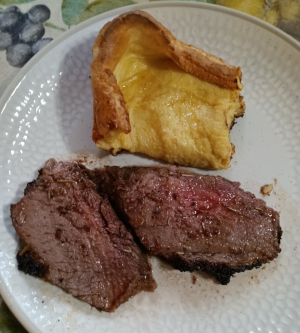
1) The above picture shows a corner piece of the Yorkshire pudding. Notice how two edges of this piece puff up way higher than the rest of the pudding. In fact, doesn’t the entire corner piece look like a meadow full of golden wheat ripe for harvesting all set against two majestic mountains?

2) This is no accident. People have want to know what different places of the world looked like. Before the age of cameras, the only real way to depict landscapes and mountains was to paint them. But painting was slow and laborious. Making pigments for the paint colors cost lots of money. Finding the proper clays and pigment bases proved daunting as well.

3) By the time the client who’d commissioned a field of grain swishing in the wind before the Alps, he could already traveled to the Alps. Alps painting languished. Travel to Switzerland fell to zero.

4) Then in 1777, Chef Hans Gasthaus made Yorkshire Pudding for some British nobility. Hans noticed his pudding looked exactly like the wheat field and Alps outside the kitchen window. Hans journeyed from Alpine town to Alpine town skillfully making Yorkshire pudding that looked exactly like the local fields and mountain. He ‘dlet these creation dry out and send them to British tour guides.

5) Penurious British lords took to displaying their pudding art in their manors. After all, pudding art cost much less than a painting. Other chef painters turned out great pudding sceneries. It was the golden age of Yorkshire Pudding landscapes.

6) Alas, the French Revolution and the Napoleonic wars soon broke out. These bloody wars ruined everything. Flour, milk, and eggs which had powered the Yorkshire Pudding Landscape Revolution (YPLR) got diverted to feed the rampaging armies on the continent.

14) Yorkshire Pudding Art died forever. Our world became forever grayer. Hardly any (YPLR) examples remain. But if you can find an antique Yorkshire pudding, keep it. They’re worth millions.


Paul De Lancey, The Comic Chef, Ph.D.

My cookbook, Following Good Food Around the World, with its 180 wonderful recipes, my newest novel, Do Lutheran Hunks Eat Mushrooms, a hilarious apocalyptic thriller, and all my other books, are available on amazon.com.

Categories: cuisine, history, international | Tags: , , , , , , , , , , , , , , , , , , , , , , , , , , , | Leave a comment

Tarragon Chicken – Poulet à Estragon

French Entree

TARRAGON CHICKEN
(Poulet à Estragon)

INGREDIENTS

3 chicken breasts
⅛ teaspoon pepper
¼ teaspoon salt
1 shallot
3 green onions
1 tablespoon butter
2 tablespoons olive oil
1 cup dry white wine
⅔ cup crème fraîche or heavy cream
1 tablespoon lemon juice
3 tablespoons fresh tarragon leaves (1 tablespoon if dried)

Serves 3. Takes 40 minutes.

PREPARATION

Rub chicken breasts with pepper and salt. Dice shallots. Thinly slice green onions. Add butter, olive oil, and shallot to pan. Sauté at medium-high heat for 3 minutes or until shallot softens. Stir frequently. Add chicken breasts and green onion. Sauté at medium-high heat for 5 minutes for each side or until chicken starts to brown. Stir occasionally. Add white wine and crème fraîche. Stir until sauce is well blended. Bring sauce to boil. Stir frequently. Reduce heat to medium. Cook for 5 minutes or until sauce has been reduced by half. Stir occasionally. Spoon lemon juice over chicken breasts. Sprinkle with tarragon.

TIDBITS

1) In 1922, the Agricultural Department, finding itself with an extra twenty-billion dollars decided to help the American farmer. Specifically, the American tarragon farmer. Why the tarragon growers? It had a really, really, really good lobby back then.

2) That amount of money bought quite a lot of tarragon seeds back then, enough to plant the entire Great Plains. Farmers gave up costly corn and wheat seeds in favor of free tarragon. USA became a global tarragon powerhouse. Tarragon farmers in other lands, however, faced bankruptcy. Foreign nations protected their farmers with prohibitively high tariffs on American tarragon. The United States retaliated with fees on European cheeses, even the non-stinky ones. European countered with tariffs on American wheat. Things got out of hand, with agricultural departments saying, “Na, nana, poo, poo” to each other and finding new ways to destroy each others commerce. Soon the global economy collapsed and we had the Great Depression of 1929-1939. Tens of millions of people were thrown out of work, including America’s tarragon farmers. This was bad; no tarragon on chicken for ten long years. But America survived. Its people are resilient.

Leave a message. I’d like to hear from you.

Chef Paul

My cookbook, Following Good Food Around the World, with its 180 wonderful recipes, my newest novel, Do Lutheran Hunks Eat Mushrooms, a hilarious apocalyptic thriller, and all my other books, are available on amazon.com.
Categories: cuisine, history, international | Tags: , , , , , , , , , , , , , , , , , , , , , , , | 2 Comments

Ma’mounia, Iraqi Wheat Pudding

Iraqi Dessert

MA’MOUNIA
(wheat pudding)

INGREDIENTSMa'mounia-

3 cups water
1¼ cups sugar
½ teaspoon lemon juice
⅓ cup unsalted butter or regular butter
¾ cups semolina or whole wheat flour
½ tablespoon orange blossom water
1 teaspoon rose water
½ teaspoon cinnamon (addition 1 teaspoon later)
1 teaspoon cinnamon
1 tablespoon slivered almonds
whipped cream (optional or is it?)

PREPARATION

Add water and sugar to pot. Cook on low heat, stirring constantly, until sugar dissolves. Bring mixture to boil on medium-high heat. Add lemon juice. Stir constantly. Reduce heat to low and simmer for 10 minutes, stirring occasionally. Remove from heat.

Melt butter. Add butter and semolina to second pot. Cook on medium heat for 5 minutes or until mixture turns golden brown. Stir constantly. Gradually add sugary mixture from first pot and to semolina mixture in second pot. Bring to boil on medium-high heat, stirring constantly. Reduce heat to low. Add orange blossom water, rose water, and ½ teaspoon cinnamon. Simmer for 10 minutes or until mixture thickens. Stir constantly.

Sprinkle 1 teaspoon cinnamon and slivered almonds evenly over bowls. Add whipped cream if desired.

TIDBITS

1) Writing first happened in Iraq over 5,000 years ago. It was used on the world’s first written story, The Epic of Gilgamesh. You can still buy it. And use it in literature classes. The Epic of Gilgamesh, tormenting millions of downtrodden students for millennia. Always spell millennia correctly. Doing so makes everything better.

2) Iraq is also responsible for the first accurate calendar. America provided the next advancement time keeping when in 1930 or so it produced the world’s first pin-up calendars. American men wished for more such calendars. Then they found they had no excuse for not filing their income taxes on time. Be careful what you wish for.

3) The Philippines, however, is responsible for the first attempted ban of fruit-flavored condoms believing flavor should only be added to things that get eaten. Ahem.

– Paul De Lancey, The Comic Chef

My cookbook, Following Good Food Around the World, with its 180 wonderful recipes, my newest novel, Do Lutheran Hunks Eat Mushrooms, a hilarious apocalyptic thriller, and all my other books, are available on amazon.com.
Categories: cuisine, food, history, humor, international, recipes | Tags: , , , , , , , , , , , , , , , , , , | Leave a comment

Cheese Fondue and World Peace

Swiss Entree

CHEESE FONDUE

INGREDIENTS??????????

6 ounces gruyère cheese
6 ounces emmenthaler cheese
1/2 baguette or French bread
3/4 cup dry white wine
½ teaspoon lemon juice
½ tablespoon corn starch
1 ½ tablespoons kirsch or dry sherry
1/8 teaspoon pepper
1/8 teaspoon nutmeg

SPECIAL UTENSILS

fondue pot
fondue forks

PREPARATION

Preheat oven to 350 degrees. Grate gruyère cheese and emmenthaler cheese. Cut baguette into 1″ cubes. Place baguette cubes on cookie sheet. Bake at 350 degrees for about 3 minutes or until cubes become toasted to your liking.

Add white wine and lemon juice to large pan. Warmt wine using medium heat for 5 minutes or until wine starts to bubble. Immediately reduce heat to low. Gradually stir in the grated gruyère and emmenthaler cheeses. Cook on low-medium heat for 5 minutes or until melted cheese begins to bubble. Stir frequently.

Blend cornstarch with kirsch in mixing bowl. Add cornstarch/kirsch mix, pepper, and nutmeg to pan. Cook on low-medium heat for about 3 minutes or until cheese fondue sauce becomes thick and creamy. Stir frequently

Transfer fondue in pan to fondue pot. Adjust flame under fondue pot so that the cheese fondue barely bubbles. Use fondue forks to dip toasted baguettes cubes in fondue sauce. Marry anyone who consistently buys you the ingredients.

TIDBITS

1) Dry sherry sounds wrong, kinda like dehydrated water.

2) To get water from dehydrated water, just add water.

3) A lot of shower water get wasted just waiting for it heat up.

4) Agriculture always needs more water.

5) But people like their hot showers.; won’t give them up.

6) The solution is to have the water that would normally go down the drain before the person gets in the shower be sent to the corn, wheat, rice, and lettuce fields of the world.

7) Of course, it would be impractical to build pipes from people’s showers to all the farms.

8) Instead, we must move everyone’s showers to the farms.

9) Commuting hours to our showers will be a hardship at first.

10) But things will get better when we move our homes, equipped with showers, to the farms.

11) But not entirely.

12) We will now face horrendous commutes to our jobs.

13) But that will get better when our factories move out to the farms as well.

14) Everything will be right next to us, our homes, our food, our employment, and our showers.

15) We won’t have to spend any more money on automobiles for commuting nor will we need trucks for shipping foods and merchandise.

16) We will have the money we spent or cars and trucks to buy things we really want.

17) The economy will boom.

18) With no gas being used on combustion engines, pollution and global warming will decline dramatically. The Earth will become a new Eden.

19) With little oil needed to make gasoline, there will be no need for nations to fight each other for that energy product. Putting all of humanity in these small farm/city/shower islands will free up previously used lands for all future and larger populations. An enduring peace will break out over the world.

20) No commuting and more income will mean that the two biggest stresses on the modern family disappear. Families will become bundles of happiness.

21) Teenagers will even clean their rooms.

– Paul De Lancey, The Comic Chef

My cookbook, Following Good Food Around the World, with its 180 wonderful recipes, my newest novel, Do Lutheran Hunks Eat Mushrooms, a hilarious apocalyptic thriller, and all my other books, are available on amazon.com.
Categories: Uncategorized | Tags: , , , , , , , , , , , , , , , , , , , , , , , , , , | Leave a comment

Simple Corned Beef Recipe

Irish Entree

SIMPLE CORNED BEEF

INGREDIENTSCornBee-

1 4-to-5 pound ready-to-cook corned beef brisket
6 russet potatoes
3 large carrots
1 large white onion
1/2 head cabbage
water

SPECIALTY UTENSIL

crock pot

PREPARATION

At the crock pot’s low setting, the brisket can take 10-to-14 hours to become tender. The high setting will cut this time by about half.

Put ready-to-cook corned beef brisket in crock pot. Add water to crock pot until it covers the brisket. You may need to cut the brisket into smaller pieces depending on the size of your crock pot. Cook for 10-to-14, possibly overnight, or until brisket is tender.

Clean potatoes and carrots. Cut potatoes carrots, onions, and cabbages in slices no thicker than 1/2″ inch and add them to the crock pot. and vegetables. Add water until it covers the brisket and vegetables. Cook on low setting for about 2 hours or until vegetables are tender. Serve to adoring guests.

This is an astoundingly versatile dish. See the following two recipes for delightful meals made out of this recipe’s leftovers.

Tell your spellbound guests corned-beef takes 10 days to prepare. This, of course, is the do-it-yourself corned-beef version. You used ready-to-eat corned beef brisket. But you needn’t tell them that.

TIDBITS

1) Potatoes make great French fries.

2) They’re nutritious and a great source of calories too.

3) They grow in the ground where they can’t be seen by hungry, foraging armies marching back and forth across peasants’ fields.

4) On July 14, 1689 Madame Farine du Blé of Poulet sur Marne noticed invading Bavarians ransacking the granary of her neighbors, the Herbes, while leaving her own field of potatoes completely untouched.

5) This fact kinda excited the peasantry of France who relied almost exclusively on food for eating.

6) Frederick the Great of Prussia noticed this fact as well. He insisted that all the Prussian peasants plant potatoes.

7) And boy, those peasants were glad they did. Massive French, Austrian, and Russian armies crisscrossed the Prussian kingdom from 1756 to 1763 carting off all the wheat they could find. But the Prussian peasants didn’t starve.

8) Why? These farmers simply waited for the invading soldiers to leave, dug up their potatoes, and cooked them. And if the peasants also had the proper spices and deep fryers, they dined on papas rellena, Peruvian stuffed potatoes.

9) When individual peasants don’t starve, the country as a whole doesn’t starve. A well-fed nation can afford to feed it armies in the field. And those Prussian armies did really well earning both victory and survival at the end of the Seven Years War.

10) Prussia united Germany in 1871. A united Germany caused World War I. A united Germany caused World War II. Both wars were unarguably unpleasant.

11) So think about that when you are asked, “Do you want fries with that?”

– Paul De Lancey, The Comic Chef

My cookbook, Following Good Food Around the World, with its 180 wonderful recipes, my newest novel, Do Lutheran Hunks Eat Mushrooms, a hilarious apocalyptic thriller, and all my other books, are available on amazon.com.

Categories: cuisine, food, history, humor, international, recipes | Tags: , , , , , , , , , , , , , , , , , , , , , , , , , , , , , , , , , , | Leave a comment

Blog at WordPress.com.