history

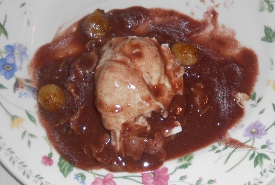
Oeufs en Meurette

French Entree

OEUFS EN MEURETTE

INGREDIENTSOeufsEnMeurette-
3 ounces thick, really fatty bacon*
12 pearl onions
1 small onion
½ celery stalk
2 shallots
1 garlic clove
5 cups water
¼ teaspoon pepper
12 ounces red Burgundy wine
1 cup beef stock
1 bay leaf**
5 springs parsley**
2 sprigs thyme**
2 tablespoons butter (2 additional tablespoons later)
3 tablespoons flour
4 eggs
4 slices white bread (¼” thick)
2 tablespoons butter

Makes 4 servings. Takes 1 hour 15 minutes.

* = How do you look for fatty bacon? It’s easy! Simply go to your supermarket and pick the package of bacon that has been tossed to the side, the one where the little flaps have been torn open. That’s the bacon for you. Or . . . buy any package of bacon and cut off all the fatty sections. Save the lean bits for future breakfasts. Your kids, family, and friends will love you for it.

** = This ingredients comprise bouquet garni or bouquet garnish. Now impress your friends with your culinary knowledge. Walk with pride.

PREPARATION

Cut bacon crosswise into ¼” wide strips. Cut off tops and bottoms of pearl onions. (Do not remove skins.) Dice onion. Thinly slice celery and shallots. Crush garlic. Add water to pot. Bring water to boil using high heat. Add pearl onions to pot. Boil for 1 minute. Remove pearl onions and set aside. Save oniony water to poach eggs.

While water comes to boil, add fatty bacon strips to pan. Fry using medium heat for 3 minutes or until bacon starts to brown. Stir frequently. Remove bacon strips and place them on a plate covered by paper towels. Keep bacon grease in pan. Remove skins from pearl onions. Place pearl onions in pan. Sauté on medium-high heat for 4 minutes or until they soften and turn golden brown. Stir frequently. Remove pearl onions and set aside. Keep bacon grease in pan.

Add diced onion, sliced shallot, and pepper to pan. Sauté for 5 minutes at medium-high heat or until onion and shallot soften. Stir frequently. Reduce heat to medium. Add garlic. Sauté for for 1 minute or until you can smell the garlic. Add wine, beef stock, celery, bay leaf, parsley, and thyme. Reduce heat to low and simmer for 30 minutes or until sauce is reduced by half.

While sauce reduces, add 2 tablespoons butter and flour to bowl. Smash together with fork. This is called beurre manié. (Don’t confuse beurre manié with beurre manic. You don’t want to know what manic butter is. Even I don’t want to know.) Add this to pan. Mix with whisk. Simmer on low-medium heat for 3 minutes or until sauce thickens. Stir occasionally. Add beurre manié to pan. Simmer for 3-to-5 minutes or until sauce thickens. Stir occasionally. Strain sauce through colander into bowl.

While sauce still reduces, bring oniony water in pot to boil using high heat. (You did save the oniony water, didn’t you?) Crack eggs into a large ladle. Gently place eggs in water one at a time. Poach the eggs for 3-or-5 minutes, depending on your preference for soft or hard eggs. Remove pot from burner. Add fatty-bacon strips.

Now make the croûtes, a fancy French work for bread crusts. Use a round cookie cutter, about the size of a poached egg, cut the 4 bread slices into 4 circles. Add 2 tablespoons butter to pan. Melt using medium heat. Add bread circles to pan. Sauté bread for 1-to-2 minutes on each side or until browned Add a croûte to each plate. Use slotted spoon to remove poached egg from pot. Place egg on top of croûte. Ladle ¼ of the sauce onto the egg. Garnish with ¼ of the pearl onions. Repeat for each croûte.

TIDBITS

1) A small kitchen is a kitchenette. A small pipe is a pipette. So, a small mural should be a muralette. But it isn’t. It’s a meurette. We can all blame the French impressionist Paul Gauguin for this.

2) Monsieur Paul was a painting maniac. He literally painted every moment he was awake. When he was full of vim and vigor and ate this recipe, then called oeufs en vin, he painted outside with his friend Vincent van Gogh. Paul and Vincent would talk about brush versus finger painting, the local babes, and fantasy baseball leagues. Yes, they were visionaries in matters outside of the arts as well.

3) However, on days when Paul had been consuming vat after vat of wine, it was hard for him to get out of bed, pick up his easel and paints downstairs, and head to the fields. Indeed, he even found it difficult to head down to the breakfast table. On these occasions, the owner of La Meur would bring a plate on runny, fried eggs to Paul’s bed. But even with a throbbing wine induced migraine, Paul had to paint. He’d just prop himself up on one elbow, dip his hand into the runny yolks, and fingerpaint on a mural on the wall. He did a great job! Wealthy art lovers came from all over France to admire his little murals.

4) Since Paul had no money to pay for his room and board, he sold the rights to his little murals to La Meur’s owner. This and the fact that Paul drank wine heavily and painted with runny eggs, made the renaming of oeufs en in to oeufs en meurette inevitable. And if you wish, you can go to the Gauguin room at the Louvre in Paris and see Monsieur Paul Gauguin’s walls covered with one finger-painted egg mural after another. Be sure to spend some looking at his most famous one, Le Chaton d’Or.

– Paul De Lancey, The Comic Chef

My cookbook, Following Good Food Around the World, with its 180 wonderful recipes, my newest novel, Do Lutheran Hunks Eat Mushrooms, a hilarious apocalyptic thriller, and all my other books, are available on amazon.com.

Categories: cuisine, history, humor, international | Tags: , , , , , , , , , , , , , , , , , , , | Leave a comment

Khachapuri (Georgian cheese roll)

Georgian Entree

KHACHAPURI

INGREDIENTSKhacapuri-

¾ cup milk
1 teaspoon sugar
2½ teaspoons yeast
1 tablespoon olive oil
2⅔ cups flour (4 additional tablespoon later)
¾ teaspoon salt
1 tablespoon flour (3 additional tablespoons later)
1 tablespoon butter (2 additional tablespoons later)
1 pound Muenster or mozzarella cheese
½ pound feta cheese
¼ pound ricotta cheese
2 eggs (2 additional eggs later)
2 tablespoons flour (1 additional tablespoon later)
1 tablespoon flour
2 eggs
2 tablespoons butter

SPECIAL UTENSILS

parchment paper or at least, no-stick spray
food processor
2 x 9″ pie tins
clothes dryer

Makes 2 loaves. Takes 2¾ hours.

PREPARATION

Add milk and sugar to small pot. Cook on low-medium heat until mixture is lukewarm. Stir constantly. Remove from heat and add yeast. Stir until well blended. Let cool for 10 minutes. Add olive oil, 2⅔ cups flour, and salt. Stir until mixture becomes a lumpy dough ball. Let sit for 30 minutes.

While dough ball sits, dust a flat surface with 1 tablespoon flour. Add dough ball to flat surface. Knead dough by hand until you are at peace with the world or 8 minutes. Grease large mixing bowl with 1 tablespoon butter. Add knead dough ball to greased, first mixing bowl. Turn dough ball around until it’s coated with butter. Cover bowl and let sit for 1 hour.

While dough rises, cut Muenster and feta cheeses into ½” cubes. Add grated Muenster, feta, and ricotta cheeses to food processor. Blend until only a few cubes remain. Add 2 eggs and 2 tablespoons flour. Blend until mixture is smooth. Preheat oven to 375 degrees.

After dough has risen, dust flat surface with 1 tablespoon flour. Add dough ball to flat surface. Flatten dough ball with hands. Divide dough ball in half. Flatten dough halves until they are 11″ wide and about ⅛” thick. Add parchment paper or no-stick spray to pie tins. Add flattened dough halves to pie tins. Add half of cheese/egg/flour mixture to center of each dough half. Pull edges of dough to the center until there is only a round 1″ hole in the middle. Pinch edges together.

Bake for 15 minutes at 375 degrees or until bread loaves are starting to brown. Use spoon or shot glass to press a 3″ hole in the center of the loaves. Add an egg to each 3″ hole. Bake at 375 for 15 minutes or until loaves turn golden brown and eggs are slightly set. (The eggs will continue to cook after being removed from the oven.) Remove from oven and brush each loaf with 1 tablespoon butter.

Serve hot to adoring guests. Put pairs of unappreciative guests in pairs of matched socks. Put sock-clad guests in clothes drier. When one of the matching socks disappears, as often happens, it’ll take one of the complainers with it. Repeat until your home has only happy people in it.

TIDBITS

1) This entree is from the country called Georgia. This Georgia is near Russia and Iran. There is also a state in America called Georgia. It is near Florida, Alabama, Tennessee, and South Carolina.

2) Both Georgias are named after Madamoiselle Georgia Chat. We know little about Mlle. Mousse save that she was born in Tours, France about 708. She was also extraordinarily beautiful. Okay, we know that. Oh, she was also fabulously rich. All right, we know that as well. So, you’d think she’d be a hot marriage prospect for all the local barons. Why did she never marry?

3) Mademoiselle Georgia never considered giving up her independence and she had a giant, pet rabbit Snuggles to protect her. How gigantic? Sources yield varying heights from twelve feet tall to the preposterous sixty-seven feet. Given the fact that Snuggles was also a ninja, you can see why the local nobility thought twice before courting her. On it went. Georgia performed scientific experiments. She even invented the briquette for barbecuing while Snuggles swung his one-ton hammer. at local lords and door-to-door salesmen.

4) Then in 732, Abd Al-Raman with his Berber tribesmen invaded the Frankish kingdom. The Franks assembled their forces at Tours under Charles the Pippinid. The Muslim Berbers were famed for their cavalry. The Franks had the fiercest infantry in all of Europe. Unfortunately, the Franks at the time were notorious for their allergy to horses.

5) The Muslims should have won. Europe should now be eating koushry instead of croissants. What happened? Snuggles happened. He shoved his way past the sneezing Frankish infantry and swung his mighty hammer over and over again at the massed Berber cavalry. Soon, the overmatched Berbers fled, but not before one of them shot an arrow through Snuggles’ heart.

6) Two bards saw the battle and would travel the world singing Snuggles’ praises. One settled in America, the other near Russia. Locals impressed by Snuggle’s deeds wanted to renamed their lands after him, but balked at his cutesy name. They settled on Georgia instead and there you have it.

– Paul De Lancey, The Comic Chef

My cookbook, Following Good Food Around the World, with its 180 wonderful recipes, my newest novel, Do Lutheran Hunks Eat Mushrooms, a hilarious apocalyptic thriller, and all my other books, are available on amazon.com.

Categories: cuisine, history, humor, international | Tags: , , , , , , , , , , , , , , , , , , , , , , , , , , , , , | Leave a comment

Baked Vidalia Onion

American Entree

BAKED VIDALIA ONION

INGREDIENTSBakedVidaliaOnion-

1 Vidalia onion
1 tablespoon butter
1 beef bouillon cube
½ teaspoon sherry

Makes 1 onion. Takes 1 hour 10 minutes. If you wish to serve everyone in the world, multiply ingredients by 7,000,000,000. You will need a big oven and most likely will want some help.

PREPARATION

Preheat oven to 350 degrees. Slice off a thin disk from the top of the onion. Peel the onion. Do not remove the root. Use potato peeler to make a cone-shaped hole in the middle of the onion. The hole should be about 1″ wide at the top and taper to a point at the bottom. The hole should stop 1″ from the bottom of the onion. Cut onion into thirds down the sides, stopping ½” from the bottom. Goodness.

Place a pat or slivers of butter equal to 1 teaspoon into each of the three cuts on the sides of the onion. Add bouillon cube and sherry in the onion’s cone-shaped hole. Wrap tightly in foil. Bake at 350 degrees for 1 hour or until onion is tender. Place tray underneath to catch drippings. Open foil slowly to let hot steam escape. Serve in a bowl as there will be broth.

TIDBITS

1) N.B. Ull was just one of thousands of wildcat oil men looking for oil in Hawaii in the 1880s. Why were oil men looking for oil in Hawaii? The weather, of course, it’s great there. And the sunsets and those drinks with the pink umbrellas and the hula dancers swaying back and forth and . . . Anyway, the oil men drilled and drilled and eventually gave up to go back to the beaches to watch the sunsets and swaying native dancers and . . . Anyway, Mr. Ull persevered month after month and Pow! A black, plume spurted into the sky. Only it wasn’t oil. It was something culinary..

2) Anagrammists rushed to the spot and rearranged N.B. Ull and Oil to form the anagram Bouillon. Unfortunately, whenever anagrammists gather in great numbers they get agitated, especially when there are no drinks with pink umbrellas in them because failed oil men have drunk them all. In this case, the excited wordsters fomented revolution against the Hawaiian Monarchy. Businessmen, fearing anarchy, successfully petitioned the U.S. to annex these idyllic islands. Something to think about whenever you enjoy bouillon or rearrange a word’s letters.

– Paul De Lancey, The Comic Chef

My cookbook, Following Good Food Around the World, with its 180 wonderful recipes, my newest novel, Do Lutheran Hunks Eat Mushrooms, a hilarious apocalyptic thriller, and all my other books, are available on amazon.com.

Categories: cuisine, history, humor | Tags: , , , , , , , , , , , , , , , , | Leave a comment

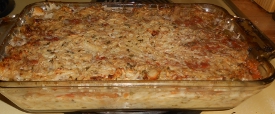
Pom Casserole

Suriname Entree

POM CASSEROLE

INGREDIENTSPom-

2 pounds chicken breasts
2 pounds taro or pomtayer*
2 celery stalks
1 large onion
4 tomatoes
1 tablespoon brown sugar
½ cup orange juice
1¾ tablespoons parsley
2 tablespoons olive oil (2 more tablespoons later)
1 teaspoon allspice
2 tablespoons olive oil
¼ teaspoon pepper
½ teaspoon salt
2 cups chicken broth
no-stick spray

* = Pomtayer is so, so hard to find in many parts of American. Give yourself the Culinary Explorer’s Badge if you find pomtayer. So far, the awarding of this badge is on the honor system.

SPECIAL UTENSIL

9″ x 13″ casserole dish

Makes 12 bowls. Takes 1.5-to-2 hours to prepare.

PREPARATION

Preheat oven to 375 degrees. Cut chicken into ½” cubes. Peel taro. Grate or shred taro. Dice celery, onion, and tomatoes.

Add taro, brown sugar, orange juice, and parsley to large mixing bowl. Mix by hand until taro is well coated. Add 2 tablespoons olive oil, allspice, celery, onion, and tomatoes cubes to first pan. Sauté on medium high-heat for 5 minutes or until onion softens. Stir frequently. Reserve 3 tablespoons juice from first pan.

Add 2 tablespoons olive oil, chicken cubes, pepper, and salt to second pan. Sauté on medium-high heat for 5 minutes or until chicken cubes turn golden brown. Stir occasionally. Add chicken broth and reduce heat to low. Simmer for 15 minutes. Stir occasionally.

Remove chicken from second pan and pour remaining broth into mixing bowl with taro mix. Blend with fork. Spray casserole dish with no-stick spray. Put half of taro/chicken broth from mixing bowl to casserole dish and spread evenly. Spread celery/onion/tomato mix from first pan on top. Spread chicken cubes evenly on top. Cover with remaining half of taro/chicken broth. Spread evenly. Drizzle top layer with reserved 3 tablespoons of juice from first pan. Bake at 375 degrees for 45 minutes to 1 hour-15 minutes or until top is golden brown and set.

TIDBITS

1) Because of the font I’m using, Pom, the name of this entree, looks a lot like Porn. Probably more people have indulged in Porn than Pom.

2) Britain found that 50% of women love chocolate more than sex. Clearly, my there is a need for my advice on culinary romance. In the interest of full disclosure, I have a Ph.D. in economics and you know how many of us there are in the world. Here they are, my greatest culinary sex tips. Some of them might even be true.

3) Chocolates make women feel slightly more romantic. So you see, chocolate is a really good gift.

4) Pecans help a man’s sex life. Pecans have a lot of zinc. Zinc helps men produce more testosterone.

5) Just clink glasses together when toasting in France. Clink one glass at a time. Don’t cross any person’s arm while clinking. Follow all these rules or be cursed with seven years of bad sex.

6) The Romans used anchovy entrails to make an aphrodisiac. The process itself of gutting the anchovy, however, is far from being a turn-on.

7) Ancient Romans, and there were a lot of them, held celery to be a powerful aphrodisiac. Modern scientists say celery contains androsterone. This pheromone, released by men’s sweat glands, attracts females.

8) The Karma Sutra says ginger is a potent aphrodisiac The FDA says ginger is generally recognized as safe. There you go.

9) Cabbage is hot, hot, hot. Recent English research has cabbage being the best natural aphrodisiac. Many other dishes are also aphrodisiacs. These include: grilled oyster, grilled asparagus, grilled bananas, honey-grilled shrimp, grilled Parmesan potatoes, and grilled carrots One can only imagine if you serve your sweetheart all of the above at once.

10) Chicago’s Smell and Taste Research Foundation holds that lavender and pumpkin pie produce the most sexually exciting smells for men. Having a man over for lavender chicken and a pumpkin pie for dessert really loads the odds in your favor. Unless, of course, your man has a migraine. But it’s okay even then, for the German nun Hildegard of Bingen (1098-1179) believed drinks mixed with lavender cured migraines. You’re still in action.

11) Korean red ginseng is supposed to increase arousal in menopausal women. A daily dosage of three grams a day is the correct amount. It’s not clear if red ginseng from another country is okay. Or what about Korean orange ginseng? Is it the real sexual McCoy? Does it only give those women a slightly amorous feeling, like one chocolate doughnut? Do you need to get a kitchen scale in order the get exactly the prescribed three ounce of Korean red ginseng? Clearly, future research is needed.

– Paul De Lancey, The Comic Chef

My cookbook, Following Good Food Around the World, with its 180 wonderful recipes, my newest novel, Do Lutheran Hunks Eat Mushrooms, a hilarious apocalyptic thriller, and all my other books, are available on amazon.com.

Categories: cuisine, history, humor, international | Tags: , , , , , , , , , , , , , , , , , , | Leave a comment

Hasselback Potatoes

Swedish Entree

HASSELBACK POTATOES

INGREDIENTSHasselbackPotatoes-

10 tablespoons butter (5 tablespoons for casserole dish. 5 tablespoons to spoon over potatoes.)
10 small potatoes
1 teaspoon dill
1 teaspoon salt
6 tablespoons grated Våsterbotten or Parmesan cheese
6 tablespoons breadcrumbs

SPECIAL EQUIPMENT

9″ by 13″ casserole dish
baster

Makes, well, 10 potatoes. Takes about 1½ hours to make.

PREPARATION

Preheat oven to 425 degrees. Melt all butter using medium heat. Peel potatoes Cut off a thin slice off the bottom of the potatoes so that they will lie flat in the casserole dish. Slice potatoes every 1/6″ along its width. Make the cut go ⅔ of the way through the potato. (One way to do this is to put the potato on a large spoon. The sides of the spoon will prevent cutting the potato apart.)

Pour 5 tablespoons butter into casserole dish. Add potatoes to casserole dish. Add 5 tablespoons butter, dill, and salt to mixing bowl. Mix with whisk until well blended. Drizzle potatoes with butter/dill mix. Bake potatoes at 425 degrees for about 30 minutes Baste two times with butter from casserole dish. Remove casserole dish from oven and sprinkle potatoes with grated cheese and bread crumbs. Bake for another 20-to-30 minutes or until golden brown. (The potatoes, not you, for goodness sake.)

TIDBITS

1) The Hasselback potato can be served with almost anything. Oh, don’t tempt me with what.

2) This entree was first made for the “Hasselbacken” restaurant in Sweden in 1940 after the start of World War II. This dish was responsible for keeping Sweden at peace when nearly every other nation got sucked into the conflict. The Germans were told that if they invaded Sweden, the Swedish chefs would stop making Hasselback potatoes. The German commanders knew their soldiers, weary from invading one country after another would stop fighting unless they were fed delicious Hasselback taters. So, Germany never invaded Sweden. To this day, Sweden has a small army. It doesn’t need a lot soldiers. It has a legion of Hasselback-potato chefs.

– Paul De Lancey, The Comic Chef

My cookbook, Following Good Food Around the World, with its 180 wonderful recipes, my newest novel, Do Lutheran Hunks Eat Mushrooms, a hilarious apocalyptic thriller, and all my other books, are available on amazon.com.
Categories: cuisine, history, humor, international | Tags: , , , , , , , , , , , , , , , | Leave a comment

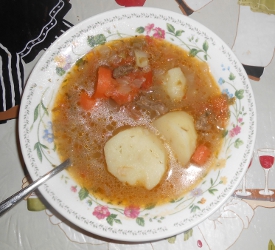
Kourma Shurpa (beef vegetable soup)

Uzbek Soup

KOURMA SHURPA
(beef vegetable soup)

INGREDIENTSKourmaShurpa-

1¼ pounds tri-tip or chuck
3 russet potatoes
2 medium carrots
1 green bell pepper
2 garlic cloves
2 medium onions
2 tomatoes
¼ cup vegetable oil
½ tablespoon cilantro
½ teaspoon coriander
¾ teaspoon cumin
2 teaspoons dill
½ teaspoon pepper
1 teaspoon pink Himalayan salt or salt
1½ quarts water
2 teaspoons parsley

Makes 10 bowls. Takes about 1½ hours.

SPECIAL UTENSIL

Dutch oven

PREPARATION

Cut tri-tip into ½” cubes. Peel potatoes. Cut potatoes into fourths. Cut carrots into round ½” slices. Remove seeds from bell pepper. Dice bell pepper, garlic, onions, and tomatoes.

Add tri-tip cubes and oil to Dutch oven. Stir occasionally. Sauté for 4 minutes on medium-high heat or until cubes brown. Add garlic and onion. Sauté for 5 minutes or until onion softens. Stir frequently. Add bell pepper, carrot, tomato, cilantro, coriander, cumin, dill, parsley, pepper, and salt.

Add water. Bring to boil using high heat. Reduce heat to warm and simmer for 30 minutes or until carrot becomes tender. Stir occasionally. Add potatoes. Simmer for 30 minutes or until potato fourths are tender. Stir occasionally. Garnish with parsley and serve to guests who will be agog with your knowledge of Uzbekistan.

TIDBITS

1) Uzbek is an anagram for bezku.

2) Kudzu is an extremely fast growing vine that’s spreading all over parts of the southern United States.

3) Bezku is a fast growing beet that’s growing all over Uzbekistan.

4) For the longest time, the Turkmen government was aghast about the proliferating bezku.

5) Then came last month’s announcement that Beetball would be added as a sport for the Summer Olympics. Now athletes all over the world are clamoring for beets.

6) Beetball is played very much like volleyball but with a beet instead of a volleyball. So, tough agile hands are a must for the successful participant.

7) Oh, also good eyesight, excellent eyesight, superb eyesight. You really don’t want to get hit in the nose by a beet hurtling toward you at 80 miles per hour, because you didn’t spot it in time.

8) The best beetball players hail from Mongolia. Genghis Khan trained his warriors to dodge arrows by hurling beets at them. Sure, he could have trained his fighters by loosing arrows at them, but men with arrows in their heads or heads invariably prove to be slow learners.

9) That reminds me, the phrase, “That beats all,” really came from “That beets all,” and is a deadly serious statement. Nothing beats beets for tough army training.

10) Genghis Khan and the succeeding khans of Mongolia nearly conquered Europe in 1241. No European army could withstand the Mongols. The Mongol horsemen, toughened by months of beet throwing, easily dodged the arrows of Russian, Hungarian, and Polish archers.

11) It looked really grim for the nascent French pastry industry.

12) Then suddenly in 1242, the fiercesome, all conquering Mongol armies withdrew to Mongolia. Their khan, Ogadai, had tied and the Mongols true to their tradition, had returned to their homeland to elect a new leader. How did Ogadai die?

14) Well, Sven Svenson of Sweden poisoned the Mongol leader with lutefisk. Sven knew that just as no Western army could stand up to the Terror of the East, no man could survive eating lutefisk, or even smelling and looking at it. Apparently though, Sven was okay with run-on sentences.

15) Indeed, lutefisk warfare is the primary reason the tiny Viking armies consistently overwhelmed the much larger armies of Ireland, England, France, and Germany. We hear the expression, “God save us from the fury of the Norsemen,” but it used to be, “God saves us from the horror of lutefisk.”

16) Anyway, Svenson was decapitated by the Mongols, which certainly was a bummer for Sven.

17) The United States and the European Union still permit the making and even the selling of lutefisk to adults and innocent children. Why? Why? Because we all know how lutefisk saved Western civilization in 1241. There is even the suspicion that Western armies maintain vast stockpiles of lutefisk, but no one will talk.

– Paul De Lancey, The Comic Chef

My cookbook, Following Good Food Around the World, with its 180 wonderful recipes, my newest novel, Do Lutheran Hunks Eat Mushrooms, a hilarious apocalyptic thriller, and all my other books, are available on amazon.com.

Categories: cuisine, history, humor, international | Tags: , , , , , , , , , , , , , , , , , , , , , , , , , , | Leave a comment

Honduran Nacatamales

Honduran Entree

NACATAMALES

INGREDIENTS – DOUGHNacatamales-

6 cups masa harina or corn flour
1 cup lard, shortening, or butter
1 teaspoon salt (1 more teaspoon later)
3 tablespoons orange juice
5 tablespoons lime juice
4 cups chicken stock

INGREDIENTS – FILLING

⅔ cup rice
2½ pounds pork
3 large potatoes
3 garlic cloves
1 green bell pepper
1 large onion
1 sweet green chile pepper
1 medium tomato
3 tablespoons cilantro
1½ tablespoons cumin
½ teaspoon pepper
1 teaspoon salt
1 teaspoon achiote paste (or ½ teaspoon paprika plus ½ teaspoon vinegar)
2 tablespoons vegetable oil

Makes 18 nacatamales. Takes at least 3 hours.

INGREDIENTS – ASSEMBLY

12 10″-x-10″ banana-leaf squares*
A roll of aluminum foil
Multiple big pots (4½ or larger. Extra pots enables you to cook more nacatamales at once.)
Good restorative drink to keep you going.

* = Banana leaves can be found in Mexican or Asian grocery stores. If they can’t be found, just use the tin foil without them. Oh, banana leaves are curved, not square at all. Bastards.

SPECIAL UTENSILS

electric beater
cooking twine or butcher’s twine

PREPARATION – INITIAL

Soak banana leaves in large pot. You really need to make the banana leaves flexible.

PREPARATION – DOUGH

Add masa harina, lard, and 1 teaspoon salt to first, large mixing bowl. Mix with electric beater set on low. With electric still set on low, slowly add orange juice, lime juice, and chicken stock. Mix until it has the consistency of mashed potatoes. Rev up electric beater to high setting or until it starts to become fluffy. Cover dough and let sit for 30 minutes.

PREPARATION – FILLING

While dough is sitting, cook rice according to instructions on package. Cut pork into ½” cubes. Peel potatoes. Slice potatoes into ½” cubes. Dice garlic cloves, green bell pepper, onion, sweet green chile pepper, and tomato. Add pork cubes, cilantro, cumin, pepper, salt, and achiote paste to second, large mixing bowl. Mix with hands until pork cubes are well coated with spices.

Add vegetable oil, coated pork cubes, and potato cubes to pan. Sauté on medium heat for 20 minutes or until potatoes soften. Stir frequently. Add garlic cloves, green bell pepper, onion, sweet green chile pepper, and tomato. Sauté for 5 minutes or until onion softens. Stir frequently.

PREPARATION – ASSEMBLY

Remove banana leaves soaking in pot. Heat water on high heat until it is scalding hot. Add banana-leaf square to pot. Keep leaf in pot until it becomes flexible. Remove banana leaf. Place ⅓ cup of dough in the middle of the banana leaf. Smooth dough with wet hands until it is about 2″ from the edges of the banana leaf.

Add equal amounts of pork cubes (about ⅓ cup), over the middle of the dough, followed by cooked rice (about 2 tablespoons) and potato cubes (about 1½ tablespoons). Add another ⅓ cup of dough over potato cubes. Smooth top layer of dough gently with wet hands. Fold bottom edge of banana leaf over filling until it reaches the top half of the leaf Gently fold in edges to make a square. Gently–Don’t break the banana leaf–tie kitchen twine around filled banana-leaf square.

Place the filled banana-leaf square over the center of an aluminum-foil square. (The aluminum-foil square large enough to wrap the banana square. Tightly fold bottom edge of foil over filled banana-leaf square. Tightly fold sides of aluminum foil over banana square, then the top side. Tie the aluminum-foil covered square like a parcel with kitchen twine. Repeat process for each banana leaf. There should be a banana leaf softening in the pot while constructing each nacatamale.

Put metal rack in bottom of each pot. Add water to each pot until level is ½” above the racks. (Aluminum cookie cutters work quite well as a substitute for wire racks.) Bring to boil using high heat. Cover and reduce heat to low. Add a single layer of nacatamales to rack. Simmer for 45 minutes. Add water as necessary to keep level ½” above the rack. Remove nacatamales from pots. Repeat for each batch of nacatamales. Remove all twine and tin foil and serve to adoring guests.

If your sweetheart makes this for you, propose marriage immediately.
TIDBITS

1) Nacatamales were invented by Señor Naca Tamale, chef to the royal governor in 1689. They were delicious, so much so that Governor Alfonso Bondigas knew he would win a million pieces of gold if he could send just one nacatamale to the Spanish king, Charles II.

2) So, in 1690, Governor Bondigas sent 100 nacatamales with the annual fleet carrying gold to Spain. They got eaten by the crews.

3) In 1691, Governor Bondigas sent 200 nacatamales with the fleet. 100 got eaten by the crews. The rest got eaten by gourmet rats.

4) In 1692, Governor Bondigas sent 400 nacatamales. The sailors devoured 100, the gourmet rats another 100, and the rest spontaneously combusted. No one saw that one coming.

5) Pirates captured the annual Nacatamale fleet in 1693, tamales having by that time become more valuable than gold.

6) In 1694, the Honduran governor sent 1,600 nacatamales with the nacatamale fleet. Unfortunately, First Mate Pedro Migas placed the nacatamales in the same room where he dried the crew’s socks. When half of the socks fled to a parallel dimension–a journey they continue to this day–they took all the nacatamales with them. By the way, culinary quantum physicists say trans-dimensional aliens took a great liking to nacatamales and can often be found at nacatamale stand through out Central America. You have to look closely for them; their disguises are excellent.

7) In 1695, Governor Bondigas tried catapulting the nacatamales to Spain. They only made it two miles out to sea where they utterly destroyed a pirate fleet. Karma, you bet.

8) In 1696, Señor Bondigas noticed a little boy skipping rocks all the way across a small stream. Could this work with nacatamales? No.

9) Spurred by the efforts of 1697, nacatamale skipping became the premier event of the Spanish-American games. All Honduras went sports mad. Every young man in that land spent every spare moment practicing to win the gold medal in nacatamale skipping. This naturally left no nacatamales left to be shipped to Spain.

10) The banana bug wiped out the banana crop in 1698. No banana leaves, no nacatamales.

11) In 1699, banana growers all used their leaves to make beer. Banana-leaf beer was enormously popular that year. You can only find this beer in a few Honduran villages. The brand is El Banano.

12) In 1700, the Nacatamale Fleet finally made it to Spain with fifty million nacatamales. But Charles II had died two weeks before. His successor, Philip of Anjou, grandsom of Louis XIV exported them all to Britain as a good-will gesture. The British loved the nacatamale. Lasting global peace seemed likely. But the British gobbled the nacatamales up in just one week, got sick of them, and in revenge declared war on France. Wars would rage across Europe for another 245 years. The new Spanish King blamed Governor Bondigas who died broken hearted. However, the legacy of the good man lives on in the millions upon millions of postal packages wrapped in the manner of the nacatamale.

– Chef Paul

4novels

My cookbook, Eat Me: 169 Fun Recipes From All Over the World,  and novels are available in paperpack or Kindle on amazon.com

As an e-book on Nook

or on my website-where you can get a signed copy at: www.lordsoffun.com

Categories: cuisine, history, humor, international | Tags: , , , , , , , , , , , , , , , , , , , , , , , | 3 Comments

Fish and Chips

British Entree

FISH AND CHIPS

INGREDIENTSFishAndChips-

2½ pounds potatoes (King Edward or Maris if you can get them.)
1⅓ cups flour (3 additional tablespoons later)
1 teaspoon pepper
1 teaspoon sea salt or salt
1¼ cups (10 ounces) beer
2 cups peanut oil
5 cups (or enough to cover fish) vegetable oil
4 7-ounce cod, pollock, or haddock fillets
3 tablespoons flour
malt vinegar (to be added by guest)

SPECIAL UTENSIL

deep fryer

Makes 4 servings. Takes 1 hour 30 minutes
Note:: Cooking times vary a lot between fryers or with the amount of food you put in them, so you’ll need to check the fryer periodically.

PREPARATION

Peel potatoes. Slice potatoes along their lengths into ½” by ½” strips. Add potato strips to first bowl filled with cold water. Let soak for 1 hour to remove starch. Pat the potato strips with paper towels until the strips are completely dry.

This is important. If you leave moisture on your potato strips, then your chips, if you are British, or your French fries, if you’re American, will not turn out well and the Earth will leave its orbit and spiral into the Sun. Enough said.

While potato strips are soaking, add 1⅓ cups flour, pepper, and salt to large, second mixing bowl. Mix thoroughly with whisk. Add beer. Stir with whisk until there are no lumps and mixture has the consistency of whipping cream.

When the potato strips have only 15 minutes left to soak, pre-heat oven to 200 degrees. (You will be making this entree in batches. Put fried fish and completely done fries warm in oven until everything is ready.) Add peanut oil and vegetable oil to deep fryer. Heat oil to 275 degrees. Carefully add ¼ of potato strips to deep fryer. Fry potato strips for 5 minutes or until any of them start to brown. There are now officially French fries or chips. (Pauses for ceremony.) Remove chips from fryer, drain, and set aside. Repeat for each batch of potato strips.

Add 3 tablespoons flour to third bowl. Add fish fillets, one at a time to bowl. Turn fish fillets around until they are coated with flour. This flour keeps the batter from slipping off later. Add flour-covered fish fillets to mixing bowl with batter. Slowly turn fish fillets until they are thoroughly covered with batter.

Increase heat on deep fryer to 375 degrees. Carefully add fish fillets to deep fryer. Fry for 6-to-10 minutes or until batter is crisp and golden brown. Turn fillets two or three times with wooden spoon to ensure even frying. Remove fish fillets with slotted spoon and place on wire rack above plate and let drain.

Add partially cooked French fries to deep fryer for second time. Keep heat at 375 degrees. Fry French fries for 10-to-20 minutes or until they are golden brown and crispy. Remove French fries with slotted spoon and dry with paper towels.

Serve fish and chips and malt vinegar to adoring, appreciative guests. Dredge unappreciative guests through any remaining batter. You were cooking with hot oil, for goodness sake.

TIDBITS

1) Gratuitous Capitalizing of Words has not been allowed in English speaking countries since 1945. Indeed, World War II was fought to preserve our minimalist capitalization approach.

2) You see, Germany capitalizes all nouns. Germany wants the whole world to capitalize nouns. Why does Germany want all this capitalization? Who would benefit from this?

3) The German ink makers. Capitalized letters take more ink than small letters. More capitalized letters means more ink. More ink means more income for the ink makers. No German government from 1814 to 1945 was strong enough to resist the dictates of the German Ink Makers’ League, GIML. So, when GIML told their leaders to invade one country after another to open up new market for ink, their governments obliged.

4) Things looked bad for the minimal-capitalizing countries in mid1940. The British Expeditionary Force was trapped against the beaches of Dunkirk. If this force had surrendered, Britain, the last hold out against German Capitalizing aggression, would have had to give up all resistance.

5) Fortunately in 1940, a young physicist named Peter Sakes, was in a London pub waiting for his fish and chips. Boom! A gigantic explosion blew apart the kitchen walls. Hot cod and hot potato strips flew into the eating and drinking areas. Patrons ran screaming from the establishment. A light clicked in Sakes’ head. Perhaps the same process used to explode fish and chips could be employed to make nuclear fission. A nuclear bomb would surely stop the invincible German armies.

7) Prime Minister Churchill agreed and gathered all British scientists to develop the atomic bomb. Well, the whole thing took longer than expected; the heat from cooking oil proved insufficient to trigger a nuclear chain reaction. So the Americans came on board with their Manhattan Project and by August, 1945, had an atomic bomb to use on Japan.

8) The atomic bomb came too late to use on Germany which had already surrendered. However, the mere hope the bomb had brought to Churchill had given him to will to resist. We owe our freedom and our small-lettered nouns to Mr. Sakes and his idea. Here’s to him and fish and chips!

– Paul De Lancey, The Comic Chef

My cookbook, Following Good Food Around the World, with its 180 wonderful recipes, my newest novel, Do Lutheran Hunks Eat Mushrooms, a hilarious apocalyptic thriller, and all my other books, are available on amazon.com.
Categories: cuisine, history, humor, international | Tags: , , , , , , , , , , , , , , , , , , , , , , | Leave a comment

Vidalia Onion Pie

American Entree

VIDALIA ONION PIE

INGREDIENTSVidaliaOnionPie-

3 Vidalia onions
4 tablespoons butter
2 large eggs
2 tablespoons flour
¼ cup milk
1 cup sour cream
¼ teaspoon pepper
¼ teaspoon salt
2 9-inch pie shells
⅓ cup grated Parmesan cheese

Makes 2 pies. Takes 50 minutes.

PREPARATION

Preheat oven to 425 degrees. Thinly slice Vidalia onions. Add butter and onion slices to pan. Sauté on medium-heat for 5 minutes or until onion softens. Add onion and its drippings, eggs, flour, milk, sour cream, pepper, and salt to large mixing bowl. Blend well with whisk. Pour into pie shell. Sprinkle with Parmesan cheese.

Bake in oven at 425 degrees for 15 minutes. Lower temperature to 325 degrees and bake for an additional 20-to-40 minutes or until center of pie is firm.

TIDBITS

1) Vidalia onions are too flat to be used in onion bowling. You need a completely round onion for onion bowling. The onion’s root must not stick out.

2) Don’t show up at the Onion Bowling Championship in Scalene, Iowa with ovoid and misshapen onions. Your onion will go into the gutter time after time. People will laugh at you. And have you tried to pick up a 7-10 split with a lumpy onion? Well, it’s difficult!

3). The roundest onions come found Roundia, Tennessee.

4) Onion bowling was particularly popular during the Civil War. Union and Confederate armies fighting in Tennessee would periodically declare three-day truces to hold onion-bowling tournaments. A good time was had by all. The Southerners usually won, having been raised since infancy to bowl onions.

5) Many culinary historians believe onion bowling would have won out over baseball in the South had the Rebels won the war. But the Yankees prevailed, Reconstruction followed, and the Southern states had to adopt baseball as their primary sport in order to be readmitted to the Union.

– Paul De Lancey, The Comic Chef

My cookbook, Following Good Food Around the World, with its 180 wonderful recipes, my newest novel, Do Lutheran Hunks Eat Mushrooms, a hilarious apocalyptic thriller, and all my other books, are available on amazon.com.

Categories: cuisine, history, humor | Tags: , , , , , , , , , , , , , , , , , , , | Leave a comment

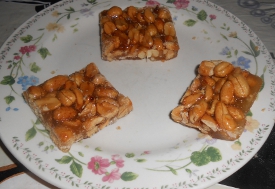
Peanut Brittle (Pé de Moleque)


Brazilian Dessert

PE DE MOLEQUE
(peanut brittle)

INGREDIENTSPeDeMoleque-

2 tablespoons butter
½ cup light corn syrup
2⅓ cups raw, unsalted peanuts
1¾ cup sugar

SPECIAL INGREDIENT

baking pan
big, badass knife

Makes 25 squares. Takes 20 minutes.

PREPARATION

Grease baking sheet with butter. Add corn syrup, peanuts, and sugar to pot. Cook using medium-high heat for 5-to-15 minutes or until the mixture has turned dark brown and carmelized. Stir frequently. Remove from heat. Pour caramelized sugar/peanuts into baking pan.

Let peanut brittle in pan cool. When peanut brittle has almost set, mark squares with thin cuts from a knife. This will make breaking the brittle apart easier. At least, that’s the theory. After the brittle has set, you might have to push down on those thin cuts with a big, badass kinfe.

If the brittle shatters into irregular shapes, shrug and say to your guests, “Look at the nice peanut brittle I made for you.” If people fuss, shake your big, badass knife at them. You don’t need that negativity in your life. And after they’ve fled, there’s even more yummy peanut brittle for you.

TIDBITS

1) Road construction was much simpler in early 19th-century Brazil. Workers poured sand where they wanted the road. The specialists took over from there and strew stones over the sand. Adults did not press the stones in the ground. Stones on the ground were beneath them. Literally, hee hee.

Ahem! So, kids, called were hired to walk up and down the road stomping stones into the sand. Kids everywhere, to this day, are excellent stompers. However, the stomping skills of Brazil’s kids during the early 1800s have never been rivaled. Brazil’s smooth roads were the envy of the entire world. Indeed, while people in America have the phrase, “As smooth as a baby’s bottom,” South Americans still say, “As smooth as a Brazilian road.”

2) These roads came to be called pé de moleque or kid’s feet. Similarly, hot dogs are named after the chihuahuas of 18th-century Mexico who tracked down banditos, while the word succotash derives from the not-so-good vacuum cleaners sold by Tash Appliances from 1923 to 1924.

– Paul De Lancey, The Comic Chef

My cookbook, Following Good Food Around the World, with its 180 wonderful recipes, my newest novel, Do Lutheran Hunks Eat Mushrooms, a hilarious apocalyptic thriller, and all my other books, are available on amazon.com.

Categories: cuisine, history, humor, international | Tags: , , , , , , , , , , , , , | Leave a comment

Blog at WordPress.com.