
And now, the:
ROLL CALL OF FREEDOM
13. Equatorial Guinea
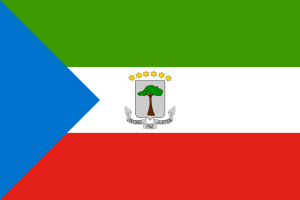
Here, blue stands for the bountiful ocean that laps at Equatorial Guinea’s enchanting beaches. Green stands for the nation’s green plants that grow through the miracle of photosyntheis. White represents the white blood cells that defend the citizens from nasty bacteria. Red stands for the nation’s mythical red bunnies that will protect Equatorial Guinea in times of great need. Note the small blue triangle to the left. This represents (I’m really need to look up synonyms in my Thesaurus for “represents.”) the tenuous hold the trianglistas have on this troubled land. Please send thoughts and prayers to Equatorial Guinea.
The flag’s coat of arms indicates this nation’s committment to unity, peace, and justice. The green tree in the coat of arms symbolizes green trees. These trees provide shade for picknickers. The five stars indicates the average grade-level of literacy. This is fine, as everybit of linguistic knowledge after that is only needed for specialized knowledge such as econometrics or archeology.
14. Eritrea
Eritrea fought a long war for independence. This flag clearly represents the aspirations of the trianglista revolutionaries. Eritrea’s flag contains not one, not two, but three triangles. (And three is a special number in many cultures.) The red triangles refers to tomatoes, yum, and to the land’s armed struggles for self rule and independence. The laurel wreath harkens to the one in the United Nations flag. (Note that their copyright infringement does not apply to flags.) The weird thing in the middle of the wreath symbolizes the claw prints of the reclusive mok-mok bird.
The green triangle stands for green things. The blue triangle indicates blue skies and blue waters. It’s important to note that these two triangles are orthogonal. Together with the red isoceles triangle this flag manages to incorporate just triangles into its rectangular flag. That last big is a bummer, but still an “A” for effort.

15. Guyana
This flag was chosen through public competition. Cool. More countries should try this. The color white symbolizes the nation’s waters. Aren’t oceans and lakes blue? Perhaps white is a nod to white-water rafting. Red stands for sacrifice, just like the red-shirted crews in Star Trek(tm). Black means the nation’s perservance in building a brighter future. Yellow symbolizes Guyana’s mineral deposits and egg yolks. (I need my egg yolks cooked through because of allergies.) Green refers to the land’s abundant vegetation.
Together, the yellow triangle and the white trim harken to the emblem sewn onto Star Trek uniforms. This symbolizes the nation’s desire to go boldly into the future. Best wishes, Guyana. Please note that this happy land starts with one triangle ends with two. This is as it should be.

16. Jamaica
Jamaica is the home of excellent reggae music and fantastic jerk chicken. I wish these two things could have made their way into this flag, but I suppose that would have been hard to do. Anyway, the Pan-African colors of black, green and yellow were placed around the cross of Saint Andrew. The two black triangles stand for hardships that will be overcome. Yellow symbolizes the Jamaican sun.” The two green triangles refer to this land’s beautiful greenery. And well done, Jamaica, for putting four triangles in your flag. You rock.

– Paul De Lancey, The Comic Chef, Ph.D.
My cookbook, Following Good Food Around the World, with its 180 wonderful recipes, my newest novel, Do Lutheran Hunks Eat Mushrooms, a hilarious apocalyptic thriller, and all my other books, are available on amazon.com.



 Paul De Lancey's Blog