Posts Tagged With: Empire

Banane Celeste

Martinican Dessert

(From Martinique)

­

BANANE CELESTE

­
INGREDIENTS
­
1 pound cream cheese (½ pound more later)
3 tablespoons butter
6 ripe bananas
¼ cup brown sugar
½ teaspoon cinnamon (¼ teaspoon more later)
½ pound cream cheese
¼ cup heavy cream
¼ teaspoon cinnamon
­
SPECIAL UTENSIL
­
8″ *8″ baking dish
­
Serves 6. Takes 50 minutes plus at least 2 hours 30 minutes to set.
­
PREPARATION
­
Preheat oven to 350 degrees. Let cream cheese and butter soften. Peel bananas and cut them in half along their lengths.
­
Add cream cheese, brown sugar, and ½ teaspoon cinnamon to large mixing bowl. Use fork or blender on lowest setting until cream cheese/brown sugar mixture is light and fluffy.
­
Light and fluffy sounds so peaceful doesn’t it? Next time you’re at a peace conference say, “Light and fluffy” to the warring sides and see if the mood of the room doesn’t improve dramatically.
­
Meanwhile back at the stove, use medium heat to melt the butter in a pan. Add 6 banana halves to pan. Sauté bananas on medium heat for 5 minutes or until they turn light brown on both sides. Turn bananas carefully over once with spatula to ensure even browning. Repeat for second batch of 6 banana halves.
­
Evenly arrange 6 banana halves in bottom of baking dish. Spoon cream cheese/brown sugar mixture evenly over bananas. Place 6 more banana halves on top of the cream cheese. Spoon ½ pound cream cheese atop the second banana layer.
­
Smooth heavy cream over the second layer of cream cheese. Sprinkle ¼ teaspoon cinnamon over heavy cream.
­
Bake for 20 minutes at 350 degrees or until cream-cheese sauce is bubbly and golden brown. Let cool on wire rack for 30 minutes. Put in refrigerator at least 2 hours or until it sets.
­
TIDBITS
­­
1) Josephine Bonaparte, wife of the Emperor Napoleon, was born in Martinique in 1763 with the name of Marie Josèphe Rose Tascher de La Pagerie. This name was way too long so most people just called her “Ma.” Josephine possessed a lively sense of humor.
­
2) People loved her jokes. She had them in stitches. Agents from Vau de Ville frequently came to her mansion to sign her up for large engagements but she always demurred, saying she was but a simple banana plantation monopolist.
­
3) Still the island’s elite kept coming to her comedy soirées to hear her jokes. They never wanted to leave even when she got tired and wanted to retire. They’d say, “Yo, Ma, Ma, tell us another joke.”
­
4) Her funnies became known as “Ma Ma jests,” then “Mama jests,” and finally by 1779 as “Yo, Mama jokes.”
­
5) In 1779, Ma Pagerie married the owner of the Folies Bergère, Monsieur de Beauharnais, and moved to Paris.
­
6) Nothing much of note happened in the lives of the de Beauharnaises until monsieur ended their marriage by getting guillotined in 1794. Saved the unpleasantness of a bitter divorce, Ma commenced a series of mirthful affairs with the handsome leaders of the French Revolution.
­
7) In 1796 she attracted the eye of a young artillery officer named Napoleon Bonaparte. “She made me laugh,” said Napoleon before his death.
­
8) Napoleon suffered from chronic depression and often stayed in bed neglecting to fight the smallest battle until Ma bucked him up with one of the world’s first chicken-crossing the road jokes. “Pourquoi le poulet a traversé la rue? Pour obtenir à l’autre côté.”
­
9) Ma’s merriment gave Napoleon the energy to follow his dream. In 1799, he and two other hombres overthrew the constitutional government. In 1804, he reached the top of the government ladder when he made himself emperor.
­
10) Life was good for France with Napoleon conquering one country after another. People no longer had to get visas to visit the Italian Riviera. Napoleon had made it part of France. What a guy!
­
11) But things went sour in 1810. Napoleon wanted an heir for his Empire. Ma, although always able to conceive a knee-slapping joke without a moment’s notice, could not do the same with a child. So Napoleon divorced her and married Marie Louise of Austria.
­
12) Marie Louise lived in a permanent humor-free zone. She never made Napoleon laugh, not once. Napoleon grew moody, his judgment became impaired. In 1812, he invaded Russia, a disaster. By 1814, his enemies camped at the French border. They offered Napoleon a peace treaty, but without Ma’s jokes to relieve the tension caused by his tactless outbursts, negotiations went downhill.
­
13) Napoleon was forever defeated in 1815 and exiled to St. Helena. It would decades before vaudeville revived.
­

– Paul De Lancey, The Comic Chef, Ph.D.

My cookbook, Following Good Food Around the World, with its 180 wonderful recipes, my newest novel, Do Lutheran Hunks Eat Mushrooms, a hilarious apocalyptic thriller, and all my other books, are available on amazon.com.

 

Categories: cuisine, history, international | Tags: , , , , , , , , , , , , , , | 2 Comments

Turkey Drumsticks

American Entree

­

TURKEY DRUMSTICKS

­
INGREDIENTS­
­
2¼ pounds* turkey drumstick
¼ cup butter
⅜ teaspoon pepper
½ teaspoon garlic powder
½ teaspoon rosemary
½ teaspoon sage
1 teaspoon sea salt or salt
no-stick spray
­
* = The weight of a drumstick varies wildly, from ½ pound to 2¼ pounds. The average weight for a turkey drumstick is ¾ pound.
­
SPECIAL UTENSILS
­
no-stick spray
meat thermometer
­
Serves 3. Takes 1 hour 45 minutes.
­
PREPARATION
­
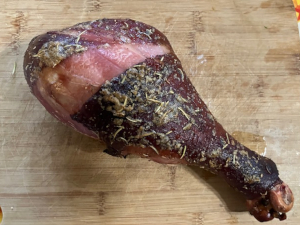
Preheat oven to 360 degrees. Use paper towels to pat turkey dry. Melt butter in small pot, using low-medium heat. Add pepper, garlic powder, rosemary, sage, and sea salt. Mix with fork or whisk until well blended. Brush all of the melted butter over the turkey legs. Spray baking pan with no-stick spray. Add turkey legs to baking pan. Roast turkey for 1 hour 30 minutes at 360 degrees or until internal temperature reaches 175 degrees.
­
TIDBITS
­
1) Late 18th century The United States of America just buzzed with music. And why not? It had just gained its independence by defeating Britain, the greatest empire in the world. At first things looked bleak for the former Thirteen Colonies. British armies would win battle after battle with planned attacks. They would coordinate their assaults by rapping out orders in Picton code on their drums.
­
2) Unfortunately, the Continental Army couldn’t send messages via drums, for Britain had hoarded all the drumsticks. Then just in time for the Battle of Saratoga, Private Carl La Fong observed, “We have plenty of wild turkeys. Why not use turkey drumsticks on our drums?” General Washington ordered this to be done. The Continentals now tapped out orders to a string of victories. Britain gave up fighting and granted America its independence in 1783. As General Cornwallis wrote, “We couldn’t defeat them once they got the turkey drumstick.” So every time we dine on turkey drumsticks or listen to a drum corps, we’re honoring the soldiers who won us our independence.
­
­

– Paul De Lancey, The Comic Chef, Ph.D.

My cookbook, Following Good Food Around the World, with its 180 wonderful recipes, my newest novel, Do Lutheran Hunks Eat Mushrooms, a hilarious apocalyptic thriller, and all my other books, are available on amazon.com.

Categories: Uncategorized | Tags: , , , , , , , , , , , , , , | 1 Comment

Chicken Basquaise

French Entree

CHICKEN BASQUAISE

INGREDIENTS

1 green bell pepper
1 red bell pepper
1 large onion
2 garlic cloves
2 tablespoons fresh thyme
3 tomatoes
2 pounds chicken pieces, bone in or boneless
1 teaspoon salt or fleur de sel*
¼ cup olive oil
3 ounces thinly sliced prosciutto or Bayonne ham*
¾ cup white wine
1 bay leaf
1 cup chicken stock
2 teaspoon Spanish paprika, paprika, or espelette*
1 tablespoon fresh parsley

* = You can find fleur de sel, Bayonne ham, and espelette online, but they can be expensive.

SPECIAL UTENSILS

mandoline
8″ * 12″ casserole dish

Serves 6. Takes 1 hour 15 minutes.

PREPARATION

Preheat oven to 425 degrees. Seed bell peppers. Cut bell peppers and onion into ¼” slices with mandoline or knife. Cut slices in half. Dice garlic and thyme. Cut tomatoes into ½” wedges. If you are using chicken breasts, cut them in two. Rub chicken pieces with salt.

Add olive oil and prosciutto to large pan. Sauté for 2 minutes at high heat or until prosciutto becomes crispy. Stir frequently. Remove and drain on paper towels. Add chicken pieces to large pan. Sauté for 10 minutes at medium heat or until chicken turns golden brown. Flip chicken pieces every 2 minutes. Remove chicken and drain on paper towels. Add bell pepper, garlic, and onion. Sauté for 2 minutes at medium-high heat. Stir frequently. Add white wine and bay leaf. Simmer at low heat for 2 minutes. Stir frequently.

Add contents of pan, thyme, chicken stock, and chicken pieces to casserole dish. Sprinkle chicken pieces with Spanish paprika. Place tomato wedges between chicken pieces. Bake for 20 minutes at 425 degrees or until sauces thickens. While chicken bakes, dice parsley. Remove casserole dish from oven. Remove bay leaf. Place crispy prosciutto slice over chicken. Garnish with parsley.

TIDBITS

1) It is well known fact that the Basque word for basket is saskia

2) The Franks who overran Gaul, modern day France, after the fall of the Western Roman Empire loved peaches.

3) Indeed, they invaded purposefully to pick prized perfect peaches produced by the innumerable peaches orchards to be found there.

4) At first, frenetic fresh Franks gathered peaches with their hands.

5) But one can only carry off two peaches that way.

6) The ravenous ravagers ranged right to the Rhone valley. The Rhone Valley had for reasons unclear to current culinary historians had a surplus of over a million peach baskets.

7) An advance party of Franks plundered the valley and carried off all the peach baskets. Indeed, everyone of the frightening Franks walked away with maybe twelve baskets; we don’t know the exact number.

8) The First Franks never went anywhere without their baskets. The enraged basketless Second Franks chased them to southwest France.

9) The locals called them Saskia after the First Franks word for basket.

10) In time the Saskia lost their original language. A new language required a new name. The medieval French dubbed these people, Basques.

11) The Basques loved sports. In particular, they loved to play Basquaise Boule. The object of this game was to pass a ball around and try to toss it into a peach basket. Sometimes the players fashioned the ball out of chicken breasts, hence the name Chicken Basquaise. Chef Jean Paul La Grange created this dish to honor the new sport.

12) But wait! There’s more! In 1890, YMCA director James Naismith toured the land of the Basques. His synapses fired and he determined bring this sport back home. It’d be just the thing to tire out restless school kids. The game proved popular, at first, in his town of Springfield. But the kids eventually grew bored of having to climb up a ladder to retrieve the ball from the peach basket. Late one night, a gang of hoodlums calling themselves The Epic of Gilgamesh Haters cut the bottom off all the baskets.

13) But far from ruining the game, this vandalism, made the game much faster. Indeed the tempo of pass, shoot, score, pass, shoot, score now prevailed. The kids loved the game now. So did their parents. A year later, a senior taking Basque studies opined that as we’re living in America, why not call the name something American like basketball.

14) America embraced basketball and soon became a superpower. Now you know how.


– Paul De Lancey, The Comic Chef, Ph.D.

My cookbook, Following Good Food Around the World, with its 180 wonderful recipes, my newest novel, Do Lutheran Hunks Eat Mushrooms, a hilarious apocalyptic thriller, and all my other books, are available on amazon.com.
Categories: cuisine, history, international | Tags: , , , , , , , , , , , , , , , , , , , , , , , , , , , , , , , , , , , , , , , , | 2 Comments

Crabmeat Stuffed Avocados

Chilean Entree

CRABMEAT STUFFED AVOCADOS

INGREDIENTS

2 large avocados
6 ounces crabmeat
2 tablespoons minced bell pepper
2 tablespoons minced celery
2 teaspoons lemon juice
¼ cup mayonnaise
⅛ teaspoon pepper
¼ teaspoon salt
1 tablespoon minced shallot or onion
4 leaves lettuce
6 olives

Serves 4. Takes 35 minutes.

PREPARATION

Peel avocados and cut them in half lengthwise. Remove pits. Add crabmeat, bell pepper, celery, lemon juice, mayonnaise, pepper, salt, and shallot to mixing bowl. Mix with fork until crab mix is well blended. Shred lettuce.

Arrange lettuce evenly over 4 plates. Fill avocado hollows with crab mix. Top avocado halves with neat little mounds of remaining crab mix. Cut olives in half. Garnish each avocado half with 3 olive haves. Place filled-and-topped avocado halves on shredded lettuce.

TIDBITS

1) The early peoples of Central America subsisted on avocados. The tribes living along the Pacific coast of South America lived on potatoes. Naturally, no one likes to eat only potatoes or even just avocados. So, soon a lively avocado-potato trade developed. Then culinary ingenuity propelled these peoples into a golden age with the harnessing of corn into tortillas. Before long a brilliant mind, Chef Ozomatli, constructed the first potato taquito with guacamole sauce.

2) This golden age didn’t last. Robbers ambushed the potato and avocado traders. To meet this threat, the great Aztec empire arose around Mexico. Its armies threw volley after volley of avocado pits at the heads of the robber gangs until the thieves broke and fled. The Incan warrior, however, was invulnerable in his suit of potatoes. These innovations were enough to maintain the great empires until the arrival of the musket carrying, metal-armor wearing Conquistadors.

3) In desperation, local chieftains attempted to attack the Spanish fleets by making canoes out of gigantic avocados. Unfortunately, crabs ate these vessels as soon as they put out to sea. Resistance collapsed. Spain would rule this corner of the world for 300 years. This dish commemorates the destruction of the avocado fleets by the crabs. So some good came out of all this turmoil.


Paul De Lancey, The Comic Chef, Ph.D.

My cookbook, Following Good Food Around the World, with its 180 wonderful recipes, my newest novel, Do Lutheran Hunks Eat Mushrooms, a hilarious apocalyptic thriller, and all my other books, are available on amazon.com.

Categories: cuisine, history, international | Tags: , , , , , , , , , , , , , , , , , , , , , , , , , , , , , , , , | 2 Comments

Medfouna

Moroccan Entree

MEDFOUNA
(Marrakech Pizza)

INGREDIENTS – DOUGH

2¼ teaspoons yeast
¾ cup warm water
1¾ cups all-purpose flour (4 more tablespoons later)
½ cup wheat flour or semolina
¾ teaspoon salt

INGREDIENTS – FILLING
1 onion
1 red chile
⅓ cup fresh parsley
1 teaspoon coriander
½ teaspoon cumin
½ teaspoon pepper
¼ teaspoon sea salt or salt (¼ teaspoon more later)
1 pound steak or lamb (minced or ground)

INGREDIENTS – FINAL

2 tablespoons all-purpose flour (2 more tablespoons later)
2 tablespoons all-purpose flour
1 egg
¼ teaspoon sea salt or salt

SPECIAL UTENSILS

electric beater
plastic wrap or kitchen towels
baking sheet
parchment paper

Serves 4. Takes 1 hour 45 minutes.

PREPARATION – DOUGH

Add yeast and warm water to 1st large mixing bowl. Stir with fork until yeasts dissolves. Let sit for 10 minutes or until yeast becomes bubbly. Gradually add in 1¾ cups all-purpose flour, wheat flour, and salt. Stir with fork until well blended. Use medium setting for electric beater on flour/yeast mix until you get a smooth and elastic ball of dough.

Divide dough into two equal balls. Place in bowls and cover with plastic wrap or kitchen towels. Let rise for 45 minutes or until dough doubles in size.

PREPARATION – FILLING

While dough rises. mince onion. Seed and dice red chile. Dice parsley. Add all filling ingredients to 2nd large mixing bowl. Mix well with hands until well blended.

PREPARATION – FINAL

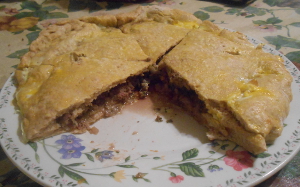
Preheat oven to 360 degrees. Dust flat surface with 2 tablespoons all-purpose flour. Roll out one dough ball until it’s a circle 11″ across. Cover baking sheet with parchment paper. Put 11″ dough circle on parchment paper. Poke the circle 10 times with a fork. Spread filing over 11″ circle, leaving 1″ uncovered around the edges.

Dust flat surface with 2 tablespoons all-purpose flour. Roll out remaining dough ball into an 11″ circle. Place this 11″ dough circle on top of filling. Dip fingers in water and press edges together to form a seal. Beat egg. Spread egg on top. Sprinkle with sea salt. Bake at 360 degrees for 25 minutes or until golden brown.

TIDBITS

1) In 1801, William Playfair ordered medfouna in a small cafe in while in Marrakech. He sliced his pizza into four pieces. He ate a slice. It was delicious. Playfair gazed at the three remaining pieces. The proportion of the slices equaled the ratios of the Ottoman Empire that were in Europe, Asia, and Africa! He called his startling idea the “pizza-pie chart,” shortened afterward to “pie chart.”

2) You might think his idea would have sparked little interest among Britain’s scientific community. But no, that’s all the island nation’s greatest minds could talk about. They’d gone pie-chart mad.

4) So much so that the British scientists abandoned all research on the not as sexy topic of time travel. That’s too bad for King George III’s redcoats. For if Britain had had time travel, they could have gone forward to the 20th century and bought back machine guns, howitzers, jet fighters, and all sorts of bombers. It’s difficult to see how the French army of the early 19th century could have stood up to all of that, even with the element of surprise.

5) But the pie-chart mania precluded the development of all modern weaponry. The Napoleonic Wars dragged on for fourteen more bloody years. The British public blamed the pie chart. Whereas, pie charts were once found on every street in London, by 1816 they were all gone.

7) Pie charts came back during the Crimean War when Nurse Florence Nightingale taught the idea to her bandaged patients. It was her way of helping them pass the time. Pie charts died out when the war ended and Britain closed all its pie-chart hospitals in Crimea.

8) Pie charts remained unloved when World War II rolled around. With no pie charts to distract them, British boffins created one dazzling breakthrough after another, such as radar and the Spitfire. Enabled by this technology, the British defeated the Nazi War machine. Now, of course, we have both spiffy weapons and pie charts, but only because today’s scientists have learned to specialize.

– Paul De Lancey, The Comic Chef

My cookbook, Following Good Food Around the World, with its 180 wonderful recipes, my newest novel, Do Lutheran Hunks Eat Mushrooms, a hilarious apocalyptic thriller, and all my other books, are available on amazon.com.

Categories: cuisine, history, international | Tags: , , , , , , , , , , , , , , , , , , , , , , , , , , | 2 Comments

Flatbread From Somalia (Sabaayad)

Somali Appetizer

FLATBREAD
(sabaayad)

INGREDIENTSFlatbread-

2⅓ cups flour
⅔ cup wheat flour (another ⅓ cup later)
½ teaspoon salt
2 tablespoons ghee or vegetable oil
1 to 1½ cups water
4 tablespoons vegetable oil (another 4 teaspoons later)
⅓ cup flour
4 teaspoons vegetable oil

SPECIAL UTENSIL

electric skillet

PREPARATION

Add flour, wheat flour, and salt to large mixing bowl. Mix with whisk. Add ghee. Mix again with whisk. Gradually add water to bowl. Knead flour and water by hand each time. Add water until dough becomes smooth and flexible. Let dough sit for 45 minutes.

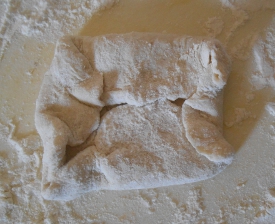
Make 8 equal dough balls. Dust hard surface with ⅓ cup flour. Roll out dough ball into a circle 8″ wide. Spread ½ tablespoon oil evenly over dough circle. Fold edges of dough circle in so that four parts meat in the square. You should now have a square.FlatbreadDough-

Roll out square until it is again 8″ wide. (This gives the bread layers and makes it flakier.) Repeat for 7 remaining dough circles.

Set skillet to 325 degrees or medium. Place 8″ dough square in skillet. Let dough square cook for 1 minute or until dough square starts to puff. Flip the dough square and add ½ teaspoon oil evenly to the top. Cook for 1 minute. Continue to cook 1 minute per side until each side turns golden brown Repeat for the remaining 7 dough squares. Drain the golden brown flat breads of paper towels.

Serve warm with: fried eggs, honey, curries, or other stews

TIDBITS

1) The top picture on the previous page looks like a sock. The bottom picture on that page appears to be a sock puppet. These similarities are not an accident. There are an homage to the great Rome-to-Somalia olive-oil-for-socks trade.

2) This trade started in 31 BC after Caesar Augustus secured his position as emperor with his victory over Mark Anthony in the battle of Actium.

3) Rome desperately needed a new source of socks for its vaunted army. Without good socks, the legionnaires developed foot blisters. No soldier can march far with blistered feet. If the Roman legionnaires couldn’t march, they couldn’t catch the invading barbarian hordes before they looted and fired the Roman towns. Unfortunately, the long series of Roman civil wars, 83 BC – 31 BC had completely destroyed the once vibrant sock industry. Things looked grim. The Roman Empire was readt to collapse. The plays of Plautus, Terrance, and Maccius would have been replaced by barbarian reality plays.

6) Fortunately, in 18 BC, Primus Secundus Tertius, a goat herder set out from the tiny village of Perdiem in the southern Egypt to find a missing goat. He headed south, because all good goat herders know that goat only go missing in the south.

7) He walked for years looking for that goat. He was no quitter. Finally, he came across some villagers in Somalia. They were cooking lamb stew. The villagers didn’t give their real names upon meeting Primus for the first time. After all, Somalia is an anagram for Mo’ Alias.

8) While enjoying a delicious meal, Sam and the villagers engaged in pleasant conversation and swapped witty and urbane anagrams. Eventually, Sam handed his empty bowl to the villagers; his mother had raised him to always bring his dirty dishes to the sink. As he did so, he noticed a goat tag at the bottom of his bowl. It read, “Daphne, owned by Primus Secundus Tertius.” The villagers had killed his own goat. The fact that Daphne tasted great after being marinated in lemon juice and pepper only eased his rage a tiny bit.

9) With all the wonderful books deliberately burned in Alexandria’s magnificent library in 395 AD, it’s amazing and perhaps ironic that we have amazing that we have a partial, written record of the following conversation:

Primus: You killed my Daphne?
Villager #1: Who is this Daphne? No woman around here is called Daphne.
Villager #2: I think he means his goat. Roman goat herders like to name their goats Daphne.
Villager #3, Good Primus, are referring to the goat that was in this stew?
Primus: (Shows the goat tag.) I am.

10) The villagers, as was their custom, agreed to compensate Primus with ten pairs of socks. Primus was ecstatic. Emperor Augustus had promised to give a million denarii to any one securing a sock source for the empire. So Primus became fabulously wealthy, the legionnaires got their socks, and the empire became well defended again. It was only when the olive-oil-for-socks trade route got permanently disrupted in 476 AD, that Rome fell. Today, the production of socks is protected everywhere by an international treaty.

– Paul De Lancey, The Comic Chef

My cookbook, Following Good Food Around the World, with its 180 wonderful recipes, my newest novel, Do Lutheran Hunks Eat Mushrooms, a hilarious apocalyptic thriller, and all my other books, are available on amazon.com.
Categories: cuisine, history, humor, international | Tags: , , , , , , , , , , , , , , , , , , , , , , , , | Leave a comment

When My Family Stopped Ruling the World

Napoleon

200 years ago my great, great, great, great grandfather, Napoleon I, lost the battle of Waterloo. In doing so, he lost control of Europe, his position as emperor of France, and my birthright to rule France and intimidate the rest of the world. Bummer. But it’s fun to speculate what I would do if I were emperor. Let’s go! I’d:

1) Ban lutefisk. How how did we allowed this atrocity to go unchecked?

2) Abolish all Federal income taxes.

3) Impose imperial income taxes. We’re an empire now, remember?

4) Coffee trucks will cruise by the millions around all neighborhoods in the morning. This will increase productivity to an amazing extent, heralding in a new era of prosperity.

5) The Cubs will win the World Series. Imperial decree seems to be the only way to bring this about. Besides, Cub fans have suffered a lot.

6) Grade inflation will stop in schools. Teachers will get paid more. Bacon & Chocolate will be part of school lunches.

7) It will be illegal to advertise any story or post on the internet with, “You won’t believe” or “what happens next will shock you.

8) Twizzlers will become the world’s currency.

9) Tacos will be free everywhere on my birthday.

10) Computers will no longer freeze.

11) Spammers will be charged a penny for every person they spam. This will eliminate the need for income taxes. Yay!

12) People who don’t signal before they turn will spontaneously combust.

13) Air travel will be fun. Okay this last one is a stretch.

– Paul R. De Lancey, Emperor of the World

My cookbook, Following Good Food Around the World, with its 180 wonderful recipes, my newest novel, Do Lutheran Hunks Eat Mushrooms, a hilarious apocalyptic thriller, and all my other books, are available on amazon.com.


Categories: humor, international | Tags: , , , , , , , , , , , , , , , , , | Leave a comment

Danish Meatballs in Curry (boller i karry)

Danish Entree

MEATBALLS IN CURRY
(boller i karry)

INGREDIENTS – MEATBALLSMeatballsCurry-

4 garlic cloves
2 small onions
½ pound ground beef
½ pound ground pork
1 cup bread crumbs
1 egg
1/4 teaspoon pepper
1/4 teaspoon salt
5 cups beef stock

INGREDIENTS – CURRY SAUCE

2 tablespoons butter
2 tablespoons curry powder
1 leek
1 medium onion
4 tablespoons flour
3/4 cup cream
1 teaspoon chives
1 teaspoon parsley

Serves 6, particularly if everyone eats 1/6th of this.

PREPARATION – MEATBALLS

Mince garlic cloves and 2 small onions. Mix ground beef, ground pork, bread crumbs, garlic, onion, egg, pepper, and salt with hands in mixing bowl. Make 1″ meatballs.

Add beef stock to large pot. Bring beef stock to boil on high heat. Carefully add meatballs to pot. Reduce heat to low and simmer for about 20 minutes or until meatballs begin to float. Remove meatballs from pot and set aside. Save the beef broth in pot.

PREPARATION – CURRY SAUCE

While meatballs simmer, dice leek, and medium onion. Add butter, curry powder, leek, and diced medium onion. Sauté on medium-high heat for 5 minutes or until diced medium onion softens. Stir frequently. Add flour. Mix well with spoon. Gradually mix in 2 1/2 cups of broth taken from pot or until sauce thickens. Add cream and meatballs. Reduce heat to low. Simmer for 10 minutes. Stir occasionally. Sprinkle chives and parsley on top. This dish goes well over rice.

TIDBITS

1) The meatball is really a smaller version of meatloaf. Some people have meatballs as a topping for their pizzas.

2) Wouldn’t a meatloaf pizza be exciting? Imagine getting a 16″ pizza topped with three 9″ by 6″ meatloaves. It would feed an army.

3) The Roman Empire is known for its all conquering armies. It’s less known for its culinary achievements. That’s a shame as Rome is the birthplace of the meatball. Rome rocks.

4) Okay, ancient Rome didn’t rock for everyone, the slaves, for example, come to mind as do the people of the many conquered nations.

5) One might wonder how the Roman Empire kept all its conquered peoples from continually revolting. After all, the legions marched everywhere and took longer than waiting in lines at Disneyland to get from their barracks to disaffected regions.

6) The answer is in the massive stockpiles of meatballs kept at all the crossroads of the Empire. As long as the Roman authorities could rush meatballs to its conquered peoples, no riot ever grew so large the slowly arriving legionnaires couldn’t handle it.

7) Rome almost fell to barbarians, in the third century A.D., when they lost the province of Dacia with its rich cattle lands. Fewer cattle, fewer meatballs. Fewer meatballs, more riots. More riots not stopped with meatballs, more revolts. And that meant legions got withdrawn from the frontiers to put the revolts. Barbarians poured across the sparsely defended border.

8) It really appeared as Rome was going to fall. Fortunately the cattlemen of Dacia organized cattle drives to still safe provinces such as Cisalpine Gaul and Thracia. “Head ‘em up, move ‘em out.” Meatball production bounced back within a few decades and the Empire recovered.

9) In 405, however, the health sage, Atticus Bananicus, convinced the legionnaires to go vegetarian. As a result, many of Rome’s cattlemen switched to raising free-range chickens.

10) But in 406, Bananicus was seen by legionnaires eating a meatball pizza. The dormant meatball tastes of the Roman soldiers came out of hibernation. All at once, every soldier demanded meatballs. But there were no longer enough meatballs for the army and the peoples of Rome. The army garnered all the meatballs, leaving none for the restive populace. Unquenchable revolts erupted everywhere. The entire Roman army abandoned the frontier, getting decimated putting down the ferocious uprisings.

12) Alaric and the Visigoths–that sounds like a 60s rock band doesn’t it?–sacked Rome in 410 A.D.. The Roman Empire never rebounded from this disaster and soon collapsed. Always keep meatballs in your refrigerator. It’s frightening to contemplate what would happen if our supermarkets ran out of that peace-ensuring food.

13) Food connoisseurs are invited to read book II of Marcus Gavius Apicus’ “De re coquinaria libri decem (Cuisine in Ten Books)” to see the world’s first recipe for meatballs. And feel at peace.

– Paul De Lancey, The Comic Chef

My cookbook, Following Good Food Around the World, with its 180 wonderful recipes, my newest novel, Do Lutheran Hunks Eat Mushrooms, a hilarious apocalyptic thriller, and all my other books, are available on amazon.com.
Categories: Uncategorized | Tags: , , , , , , , , , , , , , , , , , , , , , , , , , | Leave a comment

Blog at WordPress.com.