Posts Tagged With: historians

Oklahoma Venison Burger

American Entree

­

OKLAHOMA VENISON BURGER

­
INGREDIENTS­
­
1 onion
1 pound ground venison or ground beef
⅛ teaspoon pepper
¼ teaspoon salt
4 hamburger buns
1 ½tablespoon vegetable oil
4 slices American or cheddar cheese
1 tablespoon vegetable oil
­
SPECIAL UTENSIL
­
mandoline
­
Serves 4. Takes 35 minutes.
­
PREPARATION
­
Use mandoline to cut onion into slices 1/16″ thick. Add venison, pepper, and salt to mixing bowl. Mix with hands until well blended. Divide venison into 4 balls..
­
Add venison balls to flat surface. Top venison balls with equal amounts of onion slices. Use large spatula to smash venison balls into patties ¼” thick. (Make sure the onion slices are totally smashed into the patty.)
­
Add vegetable oil to pan. Use spatula to add as many flattened patties to pan ast will fit without touching. (You might to cook in batches.) Cook patties at medium heat for 4 minutes or until the bottom of the patties brown and the edges start to crisp.
­
Use large spatula to carefully turn over patties. Cook for another 3 minutes or until onion bits turn golden brown, or caramelize, and patties reach desired level of doneness. Top patties with a cheese slice. Cook for 1 minute more or until cheese melts. While venison patties cook, toast buns. Assemble burger with your favorite toppings and dig in. Yum.
­
TIDBITS
­
1) Smashing onion into burgers during the Great Depression was a way to stretch expensive beef. This idea is credited by culinary historians for lifting America of the Great Depression.
­­
2) On the other hand, their cousins, the culinary physicists, are using particle accelerators to test the properties of Oklahoma Venison Burgers, OVB, under extreme conditions. What do they hope to find? They’re not saying. We should worry.
­

My cookbook, Following Good Food Around the World, with its 180 wonderful recipes, my newest novel, Do Lutheran Hunks Eat Mushrooms, a hilarious apocalyptic thriller, and all my other books, are available on amazon.com.

­

Categories: cuisine, history | Tags: , , , , , , , , , , , , , , | Leave a comment

On This Day


­

– Paul De Lancey, The Comic Chef, Ph.D.

My cookbook, Following Good Food Around the World, with its 180 wonderful recipes, my newest novel, Do Lutheran Hunks Eat Mushrooms, a hilarious apocalyptic thriller, and all my other books, are available on amazon.com.


Categories: This day in history | Tags: , , , , , , , , , , , , , , | Leave a comment

Origin of Our Obesity Epidemic

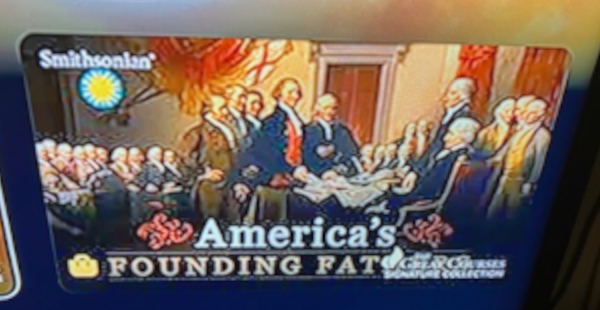
Many people worry about America’s obesity epidemic (AEO) Blame for this health crisis generally falls on processed food and sedentary lifestyles. Culinary historians, however, point to the signing of the Declaration of Independence as the trigger event of the march to obesity. The previously thin founding fathers put on such a lavish, after-signing pot luck that all put on a layer of founding fat. Some of the signers did go on diets to lose their signing blubber. Many of the other great kept piling on the gravy, the turkey dinners and got fatter. Ben Franklin exclaimed later, “I can’t for the life of me lose this founding fat. It’s turned to hard fat.”

During the early 1810s the British made such, unrelenting fun of our tubby politicians that we felt a moral imperative to chastise them in the War of 1812. And so concludes today’s history lesson.


­


– Paul De Lancey, The Comic Chef, Ph.D.

My cookbook, Following Good Food Around the World, with its 180 wonderful recipes, my newest novel, Do Lutheran Hunks Eat Mushrooms, a hilarious apocalyptic thriller, and all my other books, are available on amazon.com.

Categories: explanations, food, history | Tags: , , , , , , , , , , , , , , | Leave a comment

Cinnamon Shea Butter Soap

CINNAMON SHEA BUTTER SOAP

­
INGREDIENTS
­
½ teaspoon brown mica powder
1 tablespoon isopropyl alcohol
2 pounds shea butter base
2 teaspoons cinnamon
1 teaspoon cinnamon essential oil
isopropyl alcohol
­
SPECIAL UTENSIL
­
soap mold
spray bottle
soap slicer (optional)
­
Makes 10½ bars, 1″ wide. Takes 3 hours.
PREPARATION
­
Add brown mica and 1 tablespoon isopropyl alcohol to small mixing bowl. Mix with fork until well blended.
­
Cut shea butter base into 1″ cubes. Add shea butter base to large glass measuring cups. Melt base in 30 second intervals. Stir after every time. Add pale brown mica powder/isopropyl mix and cinnamon essential oil. Stir with knife until well blended. Let sit for 15 minutes. (This inhibits cinnamon from settling to the bottom of the soap mold.) Add cinnamon. Mix with knife until well blended.
­
Spray silicon mold with isopropyl alcohol. Pour melted soap into soap mold. If desired, lightly spray bubbles with isopropyl alcohol to make them disappear. Let soap sit for 3 hours. Use soap slicer to cut soap into slices 1″ wide.
­
Let sit for 3 hours. Use soap slicer to cut soap into bars 1″ wide.
­
TIDBITS
­
1) The New York Mets played baseball in Shea Stadium from 1964 to 2008. Most people agree that Shea Stadium was named after William A. Shea the man who led the effort to bring National League baseball back to New York.
­
2) Culinary historians disagree. They maintain the stadium got its name because it was built mainly from cinnamon. Indeed, culinary engineers tell us that cinnamon sticks when subjected to enough pressure will be stronger than steel. Unfortunately, the cost of producing super strong I beams and pillars out of cinnamon proved to be prohibitive. All future stadiums would employ steel for all sorts of things. Now you know.
­
­

– Paul De Lancey, The Comic Chef, Ph.D.

My cookbook, Following Good Food Around the World, with its 180 wonderful recipes, my newest novel, Do Lutheran Hunks Eat Mushrooms, a hilarious apocalyptic thriller, and all my other books, are available on amazon.com.

Categories: soap | Tags: , , , , , , , , , , , , , , | Leave a comment

Tomato Soup

American Soup

­

TOMATO SOUP

­
INGREDIENTS
­
3 garlic cloves
1 small onion
2 tablespoons olive oil
1 bay leaf
1¾ cups chicken or vegetable broth
1 teaspoon oregano
1 teaspoon salt
2½ pounds tomatoes
3 tablespoons butter
2½ tablespoons flour
½ tablespoon fresh basil
­
SPECIAL UTENSILS
­
large food processor or electric blender
colander
­
Serves 6. Takes 40 minutes.
­
PREPARATION
­
Dice garlic and onion. Add garlic cloves, onion, and olive oil to large pot. Sauté at for 5 minutes at medium-high heat or until onion softens. Add bay leaf, broth, oregano, salt. and tomatoes. Bring to boil using medium-high heat. Stir frequently. Cover. Reduce heat to low and simmer for 20 minutes or until tomatoes begin to disintegrate. Remove bay leaf.
­
While tomato/broth mixture simmers, add butter to pan. Melt butter using medium heat. Add flour gradually, stirring always. Cook for 1 minute or until mixture turns brown.
­
Add ingredients in pot to food processor. Blend using puree setting until ingredients become tomato soup. (You might to blend in batches.) Strain soup through colander into bowl. Discard bits in colander. Gradually stir in brown flour mixture. Stir with fork or whisk until any lumps disappear.
­
Dice fresh basil. Garnish soup with fresh basil. Other garnishes that go well with this soup are: croutons, parsley, and Parmesan cheese.
­
TIDBITS
­
1) Writing first appeared 5,400 years ago in Mesopotamia. But the land had no tomatoes, so no tomato-soup recipes. Humans first domesticated tomatoes in South America on April 12, 4976 BCE, but the natives didn’t write, so again no tomato-soup recipes Then one glorious day in 1832 saw the first published tomato-soup recipe. Culinary historians say this is humanity’s greatest deed.
­

– Paul De Lancey, The Comic Chef, Ph.D.

My cookbook, Following Good Food Around the World, with its 180 wonderful recipes, my newest novel, Do Lutheran Hunks Eat Mushrooms, a hilarious apocalyptic thriller, and all my other books, are available on amazon.com.

Categories: Uncategorized | Tags: , , , , , , , , , , , , , , , , , , , | 1 Comment

Francesinha

Portuguese Entree

­

FRANCESINHA

­
INGREDIENTS – STEAK AND SAUSAGE
­
¾ pound flank steak or flap steak
1 tablespoon olive or vegetable oil
2 linguica or andouille sausages
­
INGREDIENTS – SAUCE
­
1½ tablespoons butter (½ tablespoon more later)
½ teaspoon minced garlic
2 tablespoons minced onion
¾ teaspoon piri piri or red pepper flakes
¼ cup beef broth
6 tablespoons  crushed tomatoes
¼ cup beer
½ tablespoon port or red wine
­
INGREDIENTS – FINAL
­
4 slices bread
1 cup frozen French fries
½ tablespoon butter
1 egg
4 slices (about 1 ounce each) Pecorino, Parmesan, Asiago, Romano, or your favorite cheese
4 slices ham, sliced medium thick
Serves 4. Takes 1 hour.
­
PREPARATION – STEAK AND SAUSAGE
­
Cut sausages in half lengthwise. Toast bread. Add oil to pan. Heat using medium-high heat. Oil is hot enough when a bit of bread in the oil starts to dance. Add flank steak. Sauté for 2-to-5 minutes, depending on how you like your steak. Flip. Sauté for 2-to-5 minutes more. It should be browned on both sides. Remove steak and cut in half, and set aside.
­
Add sausage halves to pan. Sauté for 2 minutes. Flip. Sauté for 2 minutes more. It should be browned a little on both sides. Remove sausage halves and set aside.
­
PREPARATION – SAUCE
­
Add 1½ tablespoons butter, garlic, and onion to large, 2nd  pan. Sauté at medium-high heat for 5 minutes or until onion softens. Stir frequently. Add beef broth, crushed tomatoes, and piri piri flakes. Bring to boil. Stir occasionally. Reduce heat to low and simmer for 10 minutes. Stir occasionally. Add beer and wine. Let simmer on low for 12 minutes. Stir occasionally.
­
PREPARATION – FINAL
­
While sauce simmers, cook French fries according to instrustions on package Melt ½ table-spoon butter at medium heat in 3rd pan. Add egg and fry until done to your liking. Cut egg in half.
­
Top bread slice with 2 cheese slices. Top cheese with ½ of the ham. Place steak half on ham. Place 2 sausage halves on steak. Place bread slice on sausage. Put egg half on top slice of bread. Cut sandwich in half. Ladle sauce over sandwich halves. Repeat for 2nd sandwich. Serve with fries on the side..
­
TIDBITS
­
1) Pablo Picasso was born in 1881. He was a great painter. The best. He earned the moniker the “The Big Man of Painting.” His friends called him Big Bad Pablo, or simply Big Bad.
­
2) Culinary art historians credit Picasso with founding the Cubist Movement in 1870.
­
3) Since 1870 was a full eleven years before Big Bad’s birth, I’m sure you will agree this was quite the achievement.
­
4) Observers, some sane and some not,. hold that the Cubist Movement inspired the creation of the sugar cube, Rubik’s(tm) cube, and the car called the Cube(tm).
­
5) Oh, and cube roots The cube root of 343 is 7.
­
6) To the right is one of Picasso’s most famous paintings. It sold for 13.5 pounds.
­
7) Oops, that’s 13.5 millions pounds. Editors are important.
­
8) However, Pablo’s best painting is the still life, “Francesinha,” painted during his Portugese years. Francesinha is a Portuguese sandwich. Big Bad loved it. That’s why he moved to Portugal for six years. You can see the painting below and to the right
­
9) I have never have made it as big as Picasso in the art world*. However, I’m proud of my recipes, food blogs, and cookbooks. And it’s all because his “Francesinha” spurred me to take up cooking.
* = As of press time.
­
10) Picasso’sfirst name, Pablo, translates to Paul in English. Paul is my first name. So, that’s another connection between the renowned artist and me.
­
11) For more information on Picasso’s life and artistic influence, you would do well to purchase a copy of Asa Metrics’, Pablo Picasso, A Life Lived from Birth to Death.
­

– Paul De Lancey, The Comic Chef, Ph.D.
­
­My cookbook, Following Good Food Around the World, with its 180 wonderful recipes, my newest novel, Do Lutheran Hunks Eat Mushrooms, a hilarious apocalyptic thriller, and all my other books, are available on amazon.com.

Categories: cuisine, history, international | Tags: , , , , , , , , , , , , , , , | Leave a comment

Slow Cooker Kalua Pork With Cabbage

Hawaiian Appetizer

.

SLOW COOKER KALUA PORK WITH CABBAGE

.
INGREDIENTS
2½ pounds pork, butt, roast, or shoulder
4 teaspoons Hawaiian salt or Himalayan pink salt, fleur de sel, or coarse sea salt
1 tablespoon liquid smoke
½ head cabbage
­
Serves 8. Takes 4 hours 50 minutes.
.
PREPARATION
.
Rub pork with Hawaiian salt. Add pork to slow cooker. Use fork to poke holes in pork. (This helps get liquid smoke into pork.) Pour liquid smoke onto pork. Cover and cook at high setting for 2 hours. Flip pork. Cover and cook at 2nd time at high setting for 1 hours 30 minutes.
.
While pork cooks a 2nd time, cut cabbage into 1½” cubes. Place cabbage to side of pork. Cover again and cook a 3rd and final time at high setting for 30 minutes or until cabbage becomes tender. Use slotted spoon to add pork to serving bowl. Shred pork with two forks. Use slotted spoon to add cabbage to serving bowl. Mix with spatula or fork.
.
Goes well with macaroni salad or rice.
.
TIDBITS
.
1) Norse mythologists hold the primary head god of the Vikings was Odin. Nose mythologists hold their noses. Culinary Norse mythologists believe that Kalua ruled Valhalla before Odin.
.
2) Kalua cooked slowly, hence “Slow Cooker Kalua.” Kalua retorted that he cooked slowly because he cooked with a slow cooker. The other Norse gods yelled, “Na, na, poo, poo. We don’t care. Serve us now.”
.
3) Kalua said, “I will serve my pork with cabbage when it’s ready and no sooner.”
.
4) This didn’t sit well with the surly gods. Alternative lineages were given. The assemblage bandied about all sorts of words. The more irate divinities even conjugated Portuguese verbs incorrectly. Truly, Valhalla was ripe for revolution. The insurgents toppled Kalua, replacing him with Odin. The new All Father learned his lesson well. Out with slow cookers. In with the Valhalla caterers.
.
5) Slow cookers would not reappear until the late 20th century. The Norse gods didn’t live to see it. Culinary historians say they disappeared with the onset of fast-cooking Christian missionaries. Something to remember when dining on this entree.
.

– Paul De Lancey, The Comic Chef, Ph.D.
.
My cookbook, Following Good Food Around the World, with its 180 wonderful recipes, my newest novel, Do Lutheran Hunks Eat Mushrooms, a hilarious apocalyptic thriller, and all my other books, are available on amazon.com.

Categories: cuisine, history | Tags: , , , , , , , , , , , , , , , , , , , | Leave a comment

Brined Turkey Breast.

American Entree

BRINED TURKEY BREAST

INGREDIENTS – BRINE

1 gallon ice-cold water
2 bay leaves
2 garlic cloves
1 teaspoon peppercorns
1 teaspoon allspice
½ teaspoon mustard
1 teaspoon rosemary
1½ cups coarse salt
½ cup light brown sugar
½ cup white sugar
½ teaspoon thyme
8 pounds thawed turkey breast (for love of God, Montressor, the turkey must be thawed)

INGREDIENTS – COOKING TURKEY

¼ cup butter
¼ teaspoon pepper
½ teaspoon salt
2-to-3 cups chicken broth

SPECIAL UTENSILS

really big pot, 8+ gallons, or turkey bag
spice grinder
large oven-safe pan or casserole dish
wire rack
meat thermometer

Serves 12. Takes 15-to-24 hours

PREPARATION – THAWING TURKEY

A large frozen item like a turkey requires at least a day (24 hours) to defrost in the refrigerator for every 5 pounds of weight.

If you are pressed for time, use this quicker defrosting method. Keep turkey in packaging and add it to a large pot. Cover turkey with ice-cold water. Let turkey sit in cold water for 30 minutes per pound. In this recipe, that would be 4 hours. Pour out water.

But the turkey must be thawed before cooking. Or there will be much wailing and gnashing of teeth.

PREPARATION – BRINE

Crumble bay leaves. Mince garlic cloves. Grind peppercorns. Remove packaging from turkey and rinse in cold water. Add brine ingredients except turkey to pot. Stir until salt and sugar dissolve. Add turkey. Add ice-cold water as needed to cover turkey. Cover pot or close turkey bag and refrigerate for at least 12 hours but not more than 24.

PREPARATION – COOKING TURKEY

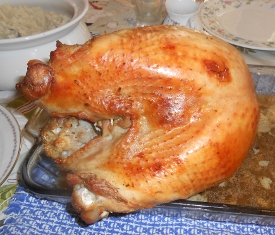
Remove turkey from brine and pat dry. Preheat oven to 400 degrees. Put turkey in large pan. Melt butter. Brush melted butter onto turkey. Sprinkle pepper and salt onto turkey. Place wire rack in pan. Put turkey on rack. Put meat thermometer in thickest part of turkey. Bake at 400 degrees for 20 minutes. Reduce heat to 325 degrees. Bake for 2-to-3 hours or until meat thermometer reads 165 degrees. Baste with ½ cup of chicken broth after every 30 minutes of baking at 325 degrees.

TIDBITS

1) Wild turkeys hide in trees at night. Just like human ninjas.

2) Wild turkeys can fly. That’s better than human ninjas.

3) All turkeys have periscopic vision. This means they can twist their heads around to see everything. Can human ninjas do that? I think not.

4) Female turkeys do not gobble. This stealthiness makes them the perfect silent warriors.

5) Our founding father, Benjamin Franklin, wanted to make the turkey our national bird. Why? Culinary historians suspect that turkey ninjas fought on the colonists’ side during the American Revolution.

6) How do they know this? The British soldier was far better trained than the American militiaman. The British king had many more soldiers under his autocratic command than did our fractious Continental Congress. King George’s army possessed thousands of cannon and could boast of the biggest and best navy in the world.

7) America could only have won if it had ninja turkeys swooping down, dealing quick, silent death out of the pitch-black night. Historians think American units coordinated ambushes by using bird calls. Culinary historians know better. These were turkey calls, made by fierce turkey warriors.

8) Britain finally countered with the King’s Bear Battalion in 1782. These bears could climb up any tree and were paid in honey. America’s ninja turkeys wouldn’t have stood a chance against the bears’ great strength and massive, sharp claws. Fortunately for America, Britain’s will to continue the war had already been shattered by the decisive battle of Yorktown during the previous year.

9) America disbanded its turkey ninjas in 1806. This is why it didn’t win the War of 1812.

10) America might be using turkey ninjas in covert operations. Who can say? Washington remains mute on the subject.


My cookbook, Following Good Food Around the World, with its 180 wonderful recipes, my newest novel, Do Lutheran Hunks Eat Mushrooms, a hilarious apocalyptic thriller, and all my other books, are available on amazon.com.

Categories: cuisine, history, international | Tags: , , , , , , , , , , , , , , , , , , , , , , , , , , , | Leave a comment

Chicken Basquaise

French Entree

CHICKEN BASQUAISE

INGREDIENTS

1 green bell pepper
1 red bell pepper
1 large onion
2 garlic cloves
2 tablespoons fresh thyme
3 tomatoes
2 pounds chicken pieces, bone in or boneless
1 teaspoon salt or fleur de sel*
¼ cup olive oil
3 ounces thinly sliced prosciutto or Bayonne ham*
¾ cup white wine
1 bay leaf
1 cup chicken stock
2 teaspoon Spanish paprika, paprika, or espelette*
1 tablespoon fresh parsley

* = You can find fleur de sel, Bayonne ham, and espelette online, but they can be expensive.

SPECIAL UTENSILS

mandoline
8″ * 12″ casserole dish

Serves 6. Takes 1 hour 15 minutes.

PREPARATION

Preheat oven to 425 degrees. Seed bell peppers. Cut bell peppers and onion into ¼” slices with mandoline or knife. Cut slices in half. Dice garlic and thyme. Cut tomatoes into ½” wedges. If you are using chicken breasts, cut them in two. Rub chicken pieces with salt.

Add olive oil and prosciutto to large pan. Sauté for 2 minutes at high heat or until prosciutto becomes crispy. Stir frequently. Remove and drain on paper towels. Add chicken pieces to large pan. Sauté for 10 minutes at medium heat or until chicken turns golden brown. Flip chicken pieces every 2 minutes. Remove chicken and drain on paper towels. Add bell pepper, garlic, and onion. Sauté for 2 minutes at medium-high heat. Stir frequently. Add white wine and bay leaf. Simmer at low heat for 2 minutes. Stir frequently.

Add contents of pan, thyme, chicken stock, and chicken pieces to casserole dish. Sprinkle chicken pieces with Spanish paprika. Place tomato wedges between chicken pieces. Bake for 20 minutes at 425 degrees or until sauces thickens. While chicken bakes, dice parsley. Remove casserole dish from oven. Remove bay leaf. Place crispy prosciutto slice over chicken. Garnish with parsley.

TIDBITS

1) It is well known fact that the Basque word for basket is saskia

2) The Franks who overran Gaul, modern day France, after the fall of the Western Roman Empire loved peaches.

3) Indeed, they invaded purposefully to pick prized perfect peaches produced by the innumerable peaches orchards to be found there.

4) At first, frenetic fresh Franks gathered peaches with their hands.

5) But one can only carry off two peaches that way.

6) The ravenous ravagers ranged right to the Rhone valley. The Rhone Valley had for reasons unclear to current culinary historians had a surplus of over a million peach baskets.

7) An advance party of Franks plundered the valley and carried off all the peach baskets. Indeed, everyone of the frightening Franks walked away with maybe twelve baskets; we don’t know the exact number.

8) The First Franks never went anywhere without their baskets. The enraged basketless Second Franks chased them to southwest France.

9) The locals called them Saskia after the First Franks word for basket.

10) In time the Saskia lost their original language. A new language required a new name. The medieval French dubbed these people, Basques.

11) The Basques loved sports. In particular, they loved to play Basquaise Boule. The object of this game was to pass a ball around and try to toss it into a peach basket. Sometimes the players fashioned the ball out of chicken breasts, hence the name Chicken Basquaise. Chef Jean Paul La Grange created this dish to honor the new sport.

12) But wait! There’s more! In 1890, YMCA director James Naismith toured the land of the Basques. His synapses fired and he determined bring this sport back home. It’d be just the thing to tire out restless school kids. The game proved popular, at first, in his town of Springfield. But the kids eventually grew bored of having to climb up a ladder to retrieve the ball from the peach basket. Late one night, a gang of hoodlums calling themselves The Epic of Gilgamesh Haters cut the bottom off all the baskets.

13) But far from ruining the game, this vandalism, made the game much faster. Indeed the tempo of pass, shoot, score, pass, shoot, score now prevailed. The kids loved the game now. So did their parents. A year later, a senior taking Basque studies opined that as we’re living in America, why not call the name something American like basketball.

14) America embraced basketball and soon became a superpower. Now you know how.


– Paul De Lancey, The Comic Chef, Ph.D.

My cookbook, Following Good Food Around the World, with its 180 wonderful recipes, my newest novel, Do Lutheran Hunks Eat Mushrooms, a hilarious apocalyptic thriller, and all my other books, are available on amazon.com.

Categories: cuisine, history, international | Tags: , , , , , , , , , , , , , , , , , , , , , , , , , , , , , , , , , , , , , , , , | 2 Comments

Lime Cookies From Guyana

Guyanese Dessert

LIME COOKIES

INGREDIENTS

1¼ teaspoons baking powder
½ teaspoon cinnamon
2¼ cups flour
½ teaspoon nutmeg
¼ teaspoon salt
¾ cup butter, softened
1½ cup sugar
3 tablespoons lime juice
1¼ teaspoons lime zest (You might need to buy limes and a zester)

SPECIAL UTENSILS

electric beater
2 baking sheets
parchment paper

Makes 36 cookies. Takes 1 hour 15 minutes.

PREPARATION

Preheat oven to 350 degrees. Add baking powder, cinnamon, flour, nutmeg, and salt to medium mixing bowl. Mix with fork or whisk until well blended. Add butter and sugar to large mixing bowl. Mix with electric beater set on high until well blended and fluffy.

Gradually add in lime juice, lime zest, and flour/baking powder mix from medium mixing bowl into large mixing bowl. Mix with electric beater set on high until cookies dough is well blended and fluffy.

Cover baking sheets with parchment paper. Take cookie dough and roll it into a 36 1″ balls. Place cookie-dough balls 1″ apart on parchment paper. Flatten dough balls slightly with hand. Bake at 350 degrees for 14 minutes or until cookie edges turn golden brown. Cool on racks for 20 minutes or as long as you can wait.

TIDBITS

1) Historians call the fixed defensive system along the borders of the Roman Empire, “limes.”. Why did the Roman Empire need to defend itself so vigorously? Because the barbarian hordes lurking outside the Roman world wanted the plunder the Romans’ limes. Why did the barbarians yearn so for limes? For its vitamin C, of course. Also, it impossible to make Lime Cookies without limes. Everybody loves lime cookies, whether civilized or barbarians and the Romans prized their Lime Cookies, even to the death. Hence, the “limes” defensive system. Can you blame them?


Paul De Lancey, The Comic Chef, Ph.D

My cookbook, Following Good Food Around the World, with its 180 wonderful recipes, my newest novel, Do Lutheran Hunks Eat Mushrooms, a hilarious apocalyptic thriller, and all my other books, are available on amazon.com.

Categories: cuisine, history, international | Tags: , , , , , , , , , , , , , , , , , , , , , | 5 Comments

Blog at WordPress.com.