history

Barbajuan From Monaco

Monegasque (Monaco) Entree

BARBAJUAN

INGREDIENTS – DOUGH

2¼ cups flour (3 more tablespoons later)
1 tablespoon olive oil (1 tablespoon and 3 more cups later)
½ cup water

INGREDIENTS – FILLING

1 bunch chard leaves (maybe ¾ pound)
enough water to cover chard leaves
1 small white onion
1 tablespoon olive oil (3 more cups later)
⅔ cup grated Parmesan cheese
2 eggs (1 more egg later)

INGREDIENTS – ASSEMBLY

1 egg
3 tablespoons flour
3 cups olive oil

Serves 4. Takes 1 hour 30 minutes.

PREPARATION – DOUGH

Add 2¼ cups flour to large mixing bowl. Gradually add oil and water. Knead by hand with each addition. Stop adding water when you form a dough ball that isn’t sticky. Put in refrigerator for 30 minutes.

PREPARATION – FILLING

Remove chard leaves from stems. Slice chard leaves into ½” squares. Add enough water to cover chard to large pot. Bring to boil using high heat. Add chard to pot. Blanch chard for 5 minutes. Drain. Mince onion. Add onion and 1 tablespoon olive oil to pan. Sauté at medium-high heat for 5 minute or until onion softens. Add chard leaves, onion, Parmesan, and 2 eggs to 2nd large mixing bowl. Mix with fork, or by hand until thoroughly mixed.

PREPARATION – ASSEMBLY

Add 1 egg to cup. Beat egg with whisk. Dust flat surface with 3 tablespoons flour. Roll dough out on flat surface to 0.1″ thickness. Make 3″-wide circles from dough. (A glass cup works well for this.) Add 1 teaspoon filling to the middle of each circle. Fold dough circles in half to make half moons. Brush edges with egg. Press down on edges to seal half moons. Add 3 cups olive oil to deep, large pot. Heat oil using medium-high heat. Oil is hot enough when a bit of dough dances in the oil. Carefully add half moons to pot. Fry half moons until they turn brown and blister. Flip half moons enough to prevent burning. Drain on paper towels.

TIDBITS

1) The little known opera, The Barber Juan, also known as Barbajuan, opened and closed on May 5, 1795,

2) The great opera, The Barber of Seville, by Rossini, premiered in 1815.

3) Europe’s decades long, Napoleonic Wars ended in 1815.

4) Coincidence?

5) Perhaps.

6) Look! Look! Two one-word tidbits in a row.

7) Alas, the single-word tidbit streak was broken by the tidbit immediately above.

8) Let this be a lesson to us all. Think before you type.

9) Think before you drink and drive.

10) If you really must do something after getting pickled to the gills, may I suggest drinking and typing?

11) The great American novelist, Ernest Hemingway was supposed to have said, “Write drunk. Edit Sober.”

12) But, in fact, he never said that. Indeed, he always wrote while he was sober.

13) Why?

14) He probably knew that if he wrote while drunk, the quality of his writing would plummet.

15) How far would his prose fall?

16) Probably to the point where he’d be writing such memorable lines as, “Iggy piggy poo. Q1c3 4fvt, 7jmk, UIo97*.”

17) It is worth nothing that any human could type the bon mots, “Iggy piggy poo, and the illustrious Hemingway certainly thought he could write better than any human.”

18) But even more damning to Hemingway’s literary soul was the undeniable fact that all the words after “Iggy piggy poo” could have been made by one of his cats walking from left to right across his typewriter. And Papa Hemingway was certainly vain enough to want to out write his cats. So, he always wrote sober. Now you know.

Categories: cuisine, history, international | Tags: , , , , , , , , , , , , , , , , , , , , , , , , , , | 2 Comments

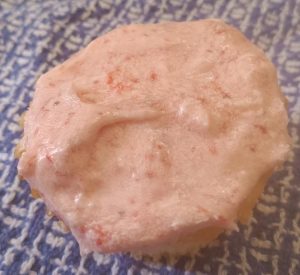
Strawberry Frosting

American Dessert

STRAWBERRY FROSTING

INGREDIENTS

1 cup strawberries
1 cup butter, softened
½ teaspoon vanilla extract
3 cups confectioners’ sugar

SPECIAL UTENSILS

food processor
electric beater
no-stick pan

Frosts 1 double-layer cake or 24 cupcakes. Takes 1 hour.

PREPARATION

Remove green leaves and stems from strawberries. Puree strawberries in food processor. Add butter and vanilla extract to mixing bowl. Mix with electric beater set on medium until fluffy. Set electric beater to medium while gradually add in confectioners’ sugar. Mix until fluffy and completely blended.

Add pureed strawberry to no-stick pan. Cook at medium high until puree starts to boil. Stir constantly. Remove heat to low-medium. Simmer until strawberry puree reduces to ⅓ cup. Stir constantly. Remove thickened puree and put in refrigerator until puree cools to room temperature.

Use spatula to gradually fold strawberry puree into bowl with butter/confectioners’ sugar mix. If frosting turns out a bit thin, thicken it by putting it in the refrigerator for 30 minutes.

TIDBITS

1) Strawberries are great. They are ever so tasty. One of baseball’s greatest star was Darryl Strawberry. He played for the 1986 world champion New York Mets. One of music’s greatest bands was The Strawberry Alarm Clock.

2) Strawberries are part of the rose family. Who knew

3) Ancient Romans believed strawberries cured depression, kidney stones, and a sore throat. The Roman Empire was one of the world’s mightiest and longest living empires, so they might be right.

4) See the Strawberry Museum in Wépion, Belgium to learn everything about this wondrous fruit.

5) All hail, the strawberry.


Paul De Lancey, The Comic Chef, Ph.D.

My cookbook, Following Good Food Around the World, with its 180 wonderful recipes, my newest novel, Do Lutheran Hunks Eat Mushrooms, a hilarious apocalyptic thriller, and all my other books, are available on amazon.com.

Categories: cuisine, history | Tags: , , , , , , , , , , , , , , , , , , , , , , , , | 2 Comments

Costa Rican Chifrijo

Costa Rican Entree

CHIFRIJO

INGREDIENTS – PICO DE GALLO

4 Roma tomatoes
1 medium white onion
1 tablespoon fresh cilantro
1 jalapeno pepper (or ½ if you like it milder)
4 teaspoons lime juice
½ teaspoon salt (½ teaspoon more later)

INGREDIENTS – MAIN

1⅓ cups rice
1 pound pork belly*
2 garlic cloves
1 medium yellow or white onion
¼ teaspoon cumin
¼ teaspoon pepper
½ teaspoon salt
1 tablespoon olive oil (2 tablespoons more later)
2 tablespoons olive oil
1 15-oz can red kidney beans, drained
2 tablespoons salsa Lizano* or Worcestershire sauce

INGREDIENTS – FINAL

2 avocados
1 cup tortilla chips

* = Pork belly can be found at CostcoTM. They tend to sell in 5-to-6 pound packages. However, what you don’t use, can be sliced to make bacon.
* = Salsa Lizano can be found online and in ethnic supermarkets.

Serves 4. Takes 1 hour.

PREPARATION – PICO DE GALLO

Dice tomatoes, white onion, and cilantro. Seed and dice jalapeno. (Wash hands afterward. If you touch your face before washing, it will burn.) Put tomato, white onion, cilantro, jalapeno, lime juice, and ½ teaspoon salt in bowl. Mix with spoon until well blended.

PREPARATION – MAIN

Cook rice according to instructions on package. Cut pork belly into ½” cubes. Dice garlic cloves and yellow onion.

Add pork-belly cubes, garlic, cumin, pepper, and ½ teaspoon salt to small mixing bowl. Mix by hand until pork-belly cubes are well coated. Add 1 tablespoon olive oil to pan. Heat olive oil using high heat until a tiny bit of garlic starts to dance in the oil. Add coated pork belly cubes. Sauté cubes for 10 minutes or until cubes turn golden brown and become mostly crispy. Stir frequently, especially so when they start to brown.

While pork belly sautés, add 2 tablespoons olive oil and yellow onion to pot. Sauté at medium-high heat for 5 minutes or until yellow onion softens. Stir frequently. Add red kidney beans and salsa Lizon. Reduce heat to medium. Cook until beans are warm. Stir occasionally

PREPARATION – FINAL

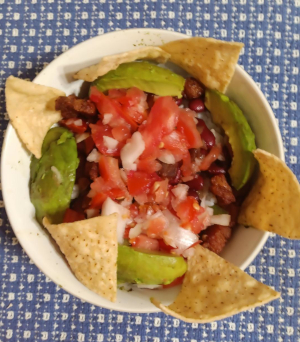
Peel avocados and cut them in half lengthwise. Remove pits. Cut avocado halves into 4 slices each. Add equal amounts of cooked rice to 4 serving bowls. Top rice with red kidney beans and yellow onion,. Top red kidney beans with pork belly cubes (chicharrone). Finally, top chicharrone with pico de gallo. Garnish with avocado slices and tortilla chips.

TIDBITS

1) This dish uses Roma tomatoes.

2) Roma is Latin for Rome. The Romans had a word for everything.

3) The Roman legionnaires carried Roma tomatoes into battle.

4) When the Roman soldiers got close to the enemy’s forces, they’d hurl Roma tomatoes.

5) The tomatoes splattered on the faces of the opposing infantry. Tomato juice got into the eyes of the foe.

6) Clear-sighted Romans charged into the ranks of the blinded enemy. The professional Roman army would gain a decisive victory within minutes.

7) “LycopersiciSusceptibility et gladii,” “Tomatoes and Swords.” was the slogan of the Roman soldiers.

8) Indeed, early Roman emperors wore a purple robe with vivid red Roma tomatoes on it.

9) But in late 405, extreme frost conditions totally destroyed the entire Roman Empire’s crop of tomatoes. Barbarian hordes crossed the frozen Rhine River and plunged into the heart of the empire.

10) It had been quite a long time since the legionnaires had fought without tomatoes. They didn’t know how to fight without them. The confused Roman army could no longer hold the barbarian forces at bay.

12) So Rome lost battle after battle. The barbarian conquered everything. Mighty Rome was no more. This is why you should stock your pantry with tomatoes.


Paul De Lancey, The Comic Chef, Ph.D.

My cookbook, Following Good Food Around the World, with its 180 wonderful recipes, my newest novel, Do Lutheran Hunks Eat Mushrooms, a hilarious apocalyptic thriller, and all my other books, are available on amazon.com.

Categories: cuisine, history, international | Tags: , , , , , , , , , , , , , , , , , , , , , , , | Leave a comment

Dutch Broodje Hagelslag

Dutch Breakfast

BROODJE HAGELSLAG

INGREDIENTS

1 slice white bread
2 teaspoons butter, softened
1 tablespoon chocolate sprinkles or Dutch chocolate sprinkles, hagelslag, if you can find it

Serves 1. Takes 3 minutes.

PREPARATION

Spread butter all over bread. Sprinkle with sprinkles.

Ponder on what an amazingly versatile and speedy chef you’ve become.

TIDBITS

1) In 1633, little Pieter van Voorburg went outside to play.

2) He got hungry. He went inside for food. Mama took time to give Pieter a slice of bread.

3) He ate the bread. Little bits of bread fell from his mouth on to an ant hill.

4) The black ants swarmed the crumbs and took them back to their hill. The ants’ antics entranced the little boy for over an hour. Then he grew hungry once more. He went inside for more food.

5) “Oh Pieter!” cried his very busy mother, “Here, have two slices and some butter too. Now leave me be.”

6) Pieter buttered the bread with his fingers. But now he also wanted meat on his bread. He started back to the house. Then he remembered how cross Mama had been. What to do? Aha! Ants were meat, weren’t they?

7) He grabbed some ants and spread them on the buttered bread. Pieter, ate his slice. It was good. He’d give the other ant-smeared slice to Mama. She’d be pleased at his thoughtfulness.

8) Mama’s scream told Pieter she thought otherwise. Once the shrieking abated, she said in between sobs, “There’s so many black ants that they look like chocolate sprinkles..”

9) Pieter and Mama looked at each other. Looked again. Mama said, “Why I declare, bread with butter and chocolate sprinkles would be very tasty.” And so, a national breakfast was born.


Paul De Lancey, The Comic Chef, Ph.D.

My cookbook, Following Good Food Around the World, with its 180 wonderful recipes, my newest novel, Do Lutheran Hunks Eat Mushrooms, a hilarious apocalyptic thriller, and all my other books, are available on amazon.com.

Categories: cuisine, history, international | Tags: , , , , , , , , , , , , , , , , , , , | Leave a comment

Kazakhstani Beshbarmak (Boiled Meat with Noodles)

Kazakhstani Entree

BESHBARMAK
(Boiled Meat with Noodles)

INGREDIENTS

1 small onion (1 more later)
1¼ pounds lamb or beef steak
1 bay leaf
¼ teaspoon pepper
water to cover steak, about 4 cups
½ teaspoon salt
1 egg
½ cup water (about)
1¼ cups flour (2 more tablespoons later)
2 tablespoons flour
1 medium potato (optional)
1 tablespoon ghee or butter
1 small onion

Serves 4. Takes 2 hours 30 minutes.

PREPARATION

Cut 1 small onion into slices ¼” thick. Add onion slices, steak, bay leaf, pepper, and enough water to cover steak and 1″ more. Bring to boil using high heat. Reduce heat to low and simmer for 1½ hours. Stir every 20 minutes. Keep steak covered with water.

While meat simmers, add salt and 1¼ cups flour to large mixing bowl. Mix with fork. Whisk egg in cup. Add egg to mixing bowl. Mix with fork until well blended. Gradually add ½ cup water, as needed, until you get a smooth dough. Mix with hands each time you add water. Knead dough for 5 minutes. Cover dough and let it sit for 20 minutes.

Sprinkle flat surface with 2 tablespoons flour. Divide dough into 2 dough balls. Roll out a dough ball on flat surface until it is about ⅛” thick. Cut flatten dough into 3″ squares. Repeat for each dough ball.

When meat has been simmering for 1½ hours, cut potato into ½” cubes. Add potato to pot. Simmer on low for 35 minutes or until meat and potato are tender to the fork. Keep potato and steak covered with water. Remove simmered onion and potato and set aside on 2 different plates. Cover to keep warm. Keep broth in pot.

While steak still simmers, cut 1 small onion into slices ¼” thick. Add onion slices and ghee to pan. Sauté at medium-high heat for 5 minutes or until onion softens. Remove sautéed onion slices from heat.

Divide broth into 2 pots. (This will speed things up and keep meat and potato from getting cold.) Bring broth to boil using high heat. Add ¼ of the dough squares each to the 2 pots. (Add squares one at time to prevent sticking. Reduce heat to medium. Simmer for 4 minutes. Remove dough squares with slotted spoon. Repeat for remaining 2 portions of dough squares.

While dough square boil, cut steak into 1″ cubes. Cover again to keep warm. Remove bay leaf. Divide pasta squares between 4 plates. Top pasta squares with meat cubes. Top meat with simmered onion slices and potato cubes. Garnish with sautéed-onion slices. Spoon remaining broth over sautéed onion. Serve immediately.

TIDBITS

1) This dish, Beshbarmak, is undeniably tasty. This is why some many Kazakhstanis eat it so often.

2) However, take a look at the picture at the above picture. The tablecloth depicts, among other things, an oversized pineapple.

3) This is because all Kazakhstanis love pineapple. I mean, who doesn’t it?

4) But the inhabit of Kazakhstan really, really love the pineapple.

5) Whence sprang this deep and abiding taste?

6) From Genghis Khan.

7) Here how it started. It’s remarkable that we all the words in the following conversation.

8) Genghis Khan: Yo ho, Beshbarmak tastes great, but I really have a yearning for something sour and tart.

Kublai: And something with lots of Vitamin C to ward off colds. I do so hate the sniffles.

Subotai: How do you know about Vitamin C?

Kublai: I went to a fortune teller. She told me that 1,000 years from now, people would be eating pineapples to fight off sniffles.

Genghis: Well, there’s nothing more useless than a sniffling warrior. By heavens, we’ll get us some pineapples even if we have to destroy entire civilizations to do so.

All the Mongols: Yay! Yay!

9) But pineapples, back then, grew only in Brazil. So the Mongols conquered their way ever westward, stopped only in Hungary when their pineapple-lacking army came down with sniffles.

10) But in return for widespread destruction of Kazakhstan, the Mongols gave the locals the recipe for Beshbarmak. So, some good came out of the invasion. The Mongols also passed on their hunger for pineapples. Hence, the frequent pineapple imagery seen in Kazakhstan.


Paul De Lancey, The Comic Chef, Ph.D.

My cookbook, Following Good Food Around the World, with its 180 wonderful recipes, my newest novel, Do Lutheran Hunks Eat Mushrooms, a hilarious apocalyptic thriller, and all my other books, are available on amazon.com.

Categories: cuisine, history, international | Tags: , , , , , , , , , , , , , , , , , , , , | Leave a comment

Fragrant Beef Stew From Vietnam

Vietnamese Entree

FRAGRANT BEEF STEW

INGREDIENTS – MARINADE

2¼ pounds beef, chuck, top round
3 garlic cloves
3 lemongrass stalks or 1 tablespoon lemongrass paste
¼ teaspoon annatto powder
2 teaspoons Chinese five spice
½ tablespoon minced ginger
½ teaspoon pepper
1 teaspoon salt
2 teaspoons fish sauce
1½ tablespoons soy sauce
1 tablespoon palm sugar or brown sugar

INGREDIENTS – STEW

3 carrots
3 shallots
1 tomato
1 green chile or Thai chile
2 tablespoons vegetable oil
1 cinnamon stick
3 kaffir, curry, or bay leaves
3 star anise pods
2⅓ cups coconut water, beef stock, or beer
¼ cup fresh* Thai basil or basil
⅓ cup fresh** mint leaves

* = or 4 teaspoons dried Thai basil
** = 5¼ teaspoons dried mint

Serves 4. Takes 2 hours 10 minutes.

PREPARATION – MARINADE

Cut beef into 1″ cubes. Mince garlic cloves. Remove white outer leaves from lemongrass stalks. Mince remaining green part of lemongrass. Add all marinade ingredients to mixing. Mix with hands until well blended and beef cubes are well coated. Marinate for 30 minutes.

PREPARATION – STEW

Dice carrots, shallots, and tomato. Seed and mince chile. Dice Thai basil and mint. Add vegetable oil to large pot. Heat oil using medium-high heat. Oil is hot enough when a little bit of shallot starts to dance in the oil. Add marinated beef cubes. Sauté at medium-high heat until beef cubes turn completely brown. Stir enough to ensure even browning. Add shallot. Sauté at medium-high heat until shallot softens.

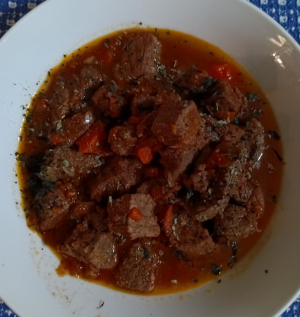
Add tomato, chile, cinnamon stick, kaffir leaves, and star anise. Stir until well blended. Add coconut water. Bring to boil using high heat. Stir occasionally. Stir until well blended. Reduce heat to low. Simmer for 30 minutes. Stir occasionally. Add carrot. Simmer for 30 minutes more or until beef cubes and carrot become tender. Remove cinnamon stick, kaffir lime leaves, and star anise pods. Garnish with Thai basil and mint.

1) The Western Roman Empire fell in 476.

2) Too many barbarian armies attacked Rome for its vast supply of eggs.

3) The barbarians loved to eat Pionono.

4) For every single meal.

5) This meant they needed Rome’s eggs.

6) Rome had lots of eggs and chickens. All civilizations have them.

7) So, the invading hordes destroyed Rome. The lands descended into anarchy.

8) With the collapse of Western Civilization, came the disappearance of the poultry industry.

9) Hardly anyone had eggs.

10) If word got out that you had a chicken ranch, cutthroat gangs would raid your lands and carry you off to lead a hard existence in some faraway land.

11) And you’d never eat another egg.

12) Not ever. And without eggs, you could never eat Pionono again. Who’d want to go through life knowing that?

13) Clearly, this was an untenable existence.

14) But would could be done?

15) As we all know, the gene that directs some people to chicken ranching, also makes them extremely poor fighters. These ranchers needed brave, sturdy fighters to protect them.

16) Indeed in the sixth century, strongmen emerged all over Western Europe to protect the chicken ranchers in return for eggs. This arrangement soon extended to all aspects of agriculture. This system became known as feudalism.

17) Now, no inventions occurred under feudalism as thinking stagnated. But hey, eggs.


Paul De Lancey, The Comic Chef, Ph.D.

My cookbook, Following Good Food Around the World, with its 180 wonderful recipes, my newest novel, Do Lutheran Hunks Eat Mushrooms, a hilarious apocalyptic thriller, and all my other books, are available on amazon.com.

Categories: cuisine, history, international | Tags: , , , , , , , , , , , , , , , , , , , , , , , , , , , , , , | Leave a comment

Crabmeat Stuffed Avocados

Chilean Entree

CRABMEAT STUFFED AVOCADOS

INGREDIENTS

2 large avocados
6 ounces crabmeat
2 tablespoons minced bell pepper
2 tablespoons minced celery
2 teaspoons lemon juice
¼ cup mayonnaise
⅛ teaspoon pepper
¼ teaspoon salt
1 tablespoon minced shallot or onion
4 leaves lettuce
6 olives

Serves 4. Takes 35 minutes.

PREPARATION

Peel avocados and cut them in half lengthwise. Remove pits. Add crabmeat, bell pepper, celery, lemon juice, mayonnaise, pepper, salt, and shallot to mixing bowl. Mix with fork until crab mix is well blended. Shred lettuce.

Arrange lettuce evenly over 4 plates. Fill avocado hollows with crab mix. Top avocado halves with neat little mounds of remaining crab mix. Cut olives in half. Garnish each avocado half with 3 olive haves. Place filled-and-topped avocado halves on shredded lettuce.

TIDBITS

1) The early peoples of Central America subsisted on avocados. The tribes living along the Pacific coast of South America lived on potatoes. Naturally, no one likes to eat only potatoes or even just avocados. So, soon a lively avocado-potato trade developed. Then culinary ingenuity propelled these peoples into a golden age with the harnessing of corn into tortillas. Before long a brilliant mind, Chef Ozomatli, constructed the first potato taquito with guacamole sauce.

2) This golden age didn’t last. Robbers ambushed the potato and avocado traders. To meet this threat, the great Aztec empire arose around Mexico. Its armies threw volley after volley of avocado pits at the heads of the robber gangs until the thieves broke and fled. The Incan warrior, however, was invulnerable in his suit of potatoes. These innovations were enough to maintain the great empires until the arrival of the musket carrying, metal-armor wearing Conquistadors.

3) In desperation, local chieftains attempted to attack the Spanish fleets by making canoes out of gigantic avocados. Unfortunately, crabs ate these vessels as soon as they put out to sea. Resistance collapsed. Spain would rule this corner of the world for 300 years. This dish commemorates the destruction of the avocado fleets by the crabs. So some good came out of all this turmoil.


Paul De Lancey, The Comic Chef, Ph.D.

My cookbook, Following Good Food Around the World, with its 180 wonderful recipes, my newest novel, Do Lutheran Hunks Eat Mushrooms, a hilarious apocalyptic thriller, and all my other books, are available on amazon.com.

Categories: cuisine, history, international | Tags: , , , , , , , , , , , , , , , , , , , , , , , , , , , , , , , , | 2 Comments

Cantonese Ginger Beef

Chinese Entree

CANTONESE GINGER BEEF

INGREDIENTS – MARINADE

¾ pound sirloin steak or flank steak
2 teaspoons sesame oil or vegetable oil
1 tablespoon mirin or rice wine
1 tablespoon light soy sauce or soy sauce
2 teaspoons cornstarch

INGREDIENTS – SAUCE

¼ cup chicken stock
4 teaspoons oyster sauce or hoisin sauce
¾ teaspoon light soy sauce or soy sauce
1 teaspoon cornstarch

INGREDIENTS – FINAL

1½” ginger root
3 scallions or green onions
1 cup peanut oil or vegetable oil

SPECIAL UTENSILS

wok (optional, not to be confused with an EwokTM. Although having an Ewok would be cool.)

Serves 4. Takes 45 minutes.

PREPARATION – MARINADE

Cut steak against the grain into as thin as possible slices. Cut these slices into 1″ squares. Add all marinade ingredients to large mixing bowl. Stir with hands until cornstarch is no longer visible and steak squares are well coated. Let sit for 20 minutes.

PREPARATION – SAUCE

While steak marinates, Add all sauce ingredients to small mixing bowl. Stir with fork until cornstarch is no longer visible.

PREPARATION – FINAL

Peel ginger root. Cut ginger root into thin strips or rounds. Cut scallions into ½” long pieces. Add peanut oil and marinated steak squares to wok. Sauté at medium-high for 3 minutes or until steak squares brown. Stir enough to ensure even browning. Remove steak squares and drain on paper towels. Remove all but 1 tablespoon oil from work.

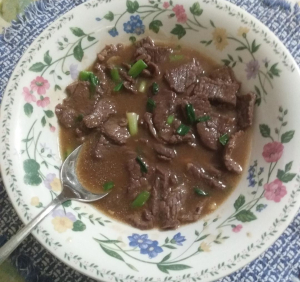
Add ginger strips and scallion pieces to work. Sauté for 30 seconds. Stir frequently. Return steak squares and add sauce to wok. Stir fry using medium-high heat until liquid starts to boil and steak squares are cooked through. Stir frequently.

TIDBITS

1) America has the Easter Bunny. It is both a symbol of the Resurrection and of fertility.

2) Britain also has the Easter Bunny.

3) The Easter originally came to America from Germany.

4) But Germany hasn’t really celebrated the Easter Bunny for a long time.

5) Germany also started two world wars.

6) Coincidence? Perhaps.

7) Australia doesn’t have an Easter Bunny either. In 1859 or so, someone released rabbits into the wilds. The rabbits bred like rabbits. Soon, rabbits were displacing all sorts of native critters and munching acres upon acres of crops. Farmers hated that. So, Australia periodically wages a campaign against the rabbit hordes. But the rabbits keep coming back. Farmers still hate them.

8) Thus, the land Down Under doesn’t have an Easter Bunny. It has the Easter tilby. A tilby looks a bit like a rabbit. The tilby has great sex, producing eight babies a year. This number is apparently, less than what the rabbit can do. But even so, the Easter tilby isn’t as celebrated as the Easter Bunny is in other lands.

9) America, Britain, Germany, and even Australia aren’t the only nations with a rabbitish animal celebrating fertility.

10) Oh no, the Cantonese region of China honors fecundity through cattle.

11) What is the singular form of cattle? Technically, there isn’t one. However, extensive research –Watching hours of the TV show Rawhide–gives us “beeves” as an alternative word for “cattle.” “Beef” is the singular form of “Beeves.” There you go.

12) It might seem strange for a beef to symbolize fertility. Would a bee have been a much better representative for reproduction?

13) Yes, it would have. Except that in 1884, a British newspaper, The Lion, wrote an article about Canton’s annual Bee Festival. Only The Lion didn’t say that. A misprint turned the celebration into the Beef Festival.

14) Hundreds of thousands of tourists thronged Canton to honor beef., spending millions of pounds while there. The Cantonese government knowing a good thing when they saw it, officially renamed the event, The Beef Festival. Local restaurateurs developed this dish to serve their British guests. Now you know.


Paul De Lancey, The Comic Chef, Ph.D.

My cookbook, Following Good Food Around the World, with its 180 wonderful recipes, my newest novel, Do Lutheran Hunks Eat Mushrooms, a hilarious apocalyptic thriller, and all my other books, are available on amazon.com.

Categories: cuisine, history, international | Tags: , , , , , , , , , , , , , , , , , , , , , , , , , | Leave a comment

Georgian Lobio (Bean Stew)

Georgian Entree

LOBIO
(Bean Stew)

INGREDIENTS

1 pound dried red kidney beans*
6 cups water
8 cups water
2 bay leaves
½ teaspoon salt
3 garlic cloves
1 medium onion
⅓ cup fresh cilantro
½ cup walnut halves
2 tablespoons olive oil
½ tablespoon ground fenugreek**
1½ tablespoons pomegranate molasses or juice
¾ teaspoon pepper

* = Red kidney beans MUST be properly boiled. Eating kidney beans that haven’t been boiled for 10 minutes can make you quite sick. They’re quite safe and tasty once sufficiently boiled them. Discard the water used to soak the beans.
** = To be authentic, this recipe should use blue fenugreek. It’s widely available in its native country and extremely difficult to find elsewhere. Please let me know if you discover a source. Thank you.

SPECIAL UTENSILS

spice grinder
potato masher

Serves 4. Takes 2 hours 20 minutes 24 hours to soak beans.

PREPARATION

Add red kidney beans and 6 cups water to large pot. Let sit for 24 hours.

Drain beans. Add 8 cups water, beans, bay leaves, and salt to large pot. Bring water to boil using high heat. Boil for 12 minutes. Stir enough to keep beans from burning. Reduce heat to low-medium and simmer for 1 hour 40 minutes or until beans become tender. (They really must tender.) Check pot every 10 minutes and add 1 cup water, if needed, to keep at least 1½ cups of liquid in the pot. Stir enough to keep beans from burning. Drain water, saving 1½ cups liquid for later use.

While beans cook, dice garlic, and onion. Mince cilantro. Grind walnut halves in spice grinder until you get walnut powder. Add garlic, onion, and olive oil to pan. Sauté at medium-high heat for 5 minutes or until garlic and onion soften. Stir frequently. Add fenugreek, cilantro, and walnut powder. Reduce heat to medium and cook for 1 minute or until mixture becomes fragrant.

Add beans and reserved 1½ cups liquid to large pot. Mash beans with potato masher until only ¼th of the beans remain whole. Stir with spoon until thoroughly blended and the beans and water achieve the consistency of a thick stew.

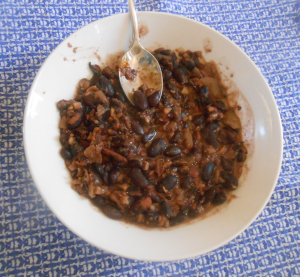
Add garlic/onion/walnut mixture, pomegranate molasses, and pepper to beans in large pot. Mix with spoon until well blended. Cook at medium heat for 5 minutes. Stir occasionally. Remove bay leaves and serve hot.

TIDBITS

1) Desperadoes, bandits, and gunslingers terrorized the Old West.

2) Everyone’s heard of Billy the Kid, Jesse James, and the Dalton Gang.

3) But no one knows anything the greatest outlaw of them all. Giorgi Beridze.

4) Beridze terrorized the Great Western Ailroad, GWA, from 1869 to 1875.

5) It should have been called the Great Western Railroad, But the typesetter made a mistake when publicizing the railroad’s inaugural run. Thereafter, passengers called it Typo Road. Many, however, figured Ailroad to be a startling bit of honesty from GWA’s president.

6) Anyway, Mr. Beridze who has been waiting patiently since Tidbit 1 to have his exploits related to recipe-reading world, so disrupted Great Western’s schedules that the company thought it was about to go under.

7) Then on May 10, 1875, Beridze’s Gang’s raided one last time. The outlaws swarmed the train as it huffed its way to the top of Willow Summit, Texas. They expertly and efficiently rounded up all the train’s employees. The bad men forced the conductor to open the doors to the baggage car.

8) In swarmed Hercules Smith. This desperado grunted as he hurled one heavy sack after another to men waiting on the ground. Down to the hard ground fell the bandits below. Sure they caught the sacks, but the savvy railroad had filled the bags with anvils. Irate passengers quickly overwhelmed the lone anvil tosser. A scant hour late, lawmen easily rounded up the concussed Beridze and gang. Judge Noah Moore sentenced Beridze to hang.

9) His jailers asked Beridze what he wanted for his last meal. He requested this dish, Lobio. His jailers road off to find the ingredients: red kidney beans, water, bay leaves, salt, garlic cloves, cilantro, walnuts, olive oil, blue fenugreek, pomegranate molasses, and pepper. A number of those fixings proved impossible to find in 1875 Texas. They had to travel to Beridze’s home country, Georgia. Beridze’s buddies busted him out two months before the jailers returned.

10) Beridze, now anvil shy, fled the country. Embarrassed GWA officials decided the best thing to do was to hush up the whole affair. That’s why we never hear about the daring Beridze.


Paul De Lancey, The Comic Chef, Ph.D.

My cookbook, Following Good Food Around the World, with its 180 wonderful recipes, my newest novel, Do Lutheran Hunks Eat Mushrooms, a hilarious apocalyptic thriller, and all my other books, are available on amazon.com.

Categories: cuisine, history, international | Tags: , , , , , , , , , , , , , , , , , , , , , , , , , , , , , , , , , , | Leave a comment

German Bee Sting Cake (Bienenstich Kuchen)

German Dessert

BEE STING CAKE
(Bienenstich Kuchen)

INGREDIENTS – ALMOND TOPPING

½ cup butter (6 tablespoons more later)
5 tablespoons sugar (3 tablespoons more later)
1 tablespoon honey
1½ tablespoons heavy whipping cream (½ cup more later)
1⅓ cup slivered almonds
½ teaspoon vanilla extract

INGREDIENTS – CAKE

2¾ teaspoons yeast
2⅔ cups flour
5 tablespoons butter (1 tablespoon more later)
3 tablespoons sugar
⅔ cup milk, lukewarm (2 cups more later)
1 egg
¼ teaspoon salt
1 tablespoon butter
parchment paper

INGREDIENTS – FILLING

6 tablespoons vanilla pudding powder
1 cup milk
½ cup heavy whipping cream
1 teaspoon vanilla extract (½ teaspoon more later)

SPECIAL UTENSILS

electric beater
8″ * 12″ baking pan
parchment paper

Serves 16. Takes 3 hours 30 minutes.

PREPARATION – ALMOND TOPPING

Add ½ cup butter to pot. Melt butter using low-medium heat. Stir gently and frequently. Add 5 tablespoons sugar and honey. Stir constantly until sugar melts and liquid is well blended. Add 1½ tablespoons heavy whipping cream and ½ teaspoon vanilla extract. Stir with spatula until well blended. Remove from heat. Fold in slivered almonds. Just before cake is ready to be bake, use low heat to make topping lukewarm and spreadable.

PREPARATION – CAKE

Add all cake ingredients except 1 tablespoon butter to mixing bowl. Mix with hands until well blended. Knead for 15 minutes or until mix becomes a smooth and pliable dough. Remove dough. Grease mixing bowl with 1 tablespoon butter. Return dough ball to mixing bowl. Cover with cloth and let rise for 1 hour or until dough doubles in size. 15 minutes before dough has finished rising, preheat oven to 350 degrees.

Cover baking pan with parchment paper. Add dough to baking pan. Smooth dough until it is level. Use spatula to spread almond topping over dough. Bake for 30 minutes at 350 degrees or until cake turns golden brown and a toothpick inserted into middle of cake comes out clean. Remove from heat and let cool for10 minutes. Grab opposite sides of parchment paper, remove cake, and place on serving plate.

Let cool for another 15 minutes. Cut cake into 16 rectangles, 2″ * 3″. Use serrated knife to cut each rectangle lengthwise into 2 thin layers.

PREPARATION – FILLING

While cake cools, add pudding powder 1 cup milk and ½ cup heavy whipping cream to mixing bowl. (Prepare according to instructions on package.) Cover with plastic wrap and chill in refrigerator for 1 hour.

PREPARATION – ASSEMBLY

After filling has chilled, use spatula to carefully spread equal amounts of filling on bottom half of the cake rectangles. (The ones without the slivered-almond topping.) Place cake rectangles with slivered-almond topping on rectangles covered with filling.

A forgotten episode from the Great War

TIDBITS

1) World War I was mostly a static affair as it became incredibly difficult to dislodge the enemy infantry defending their trenches.

2) Then a German beekeeping general thought, why not use bees? After all, everyone flees bees.

3) So, on March 13, 1915 the Germans sent boys and girls carrying this cake to the British lines. The Tommies loved this dessert. So did the bees. The bees dive bombed the British soldiers who fled en masse. The Germans were on the verge of total victory. Then the wind shifted toward the German lines. Countless soldiers on both sides suffered repeated stings. The Great Bee Sting Truce was agreed upon and lasted for two weeks. After that, Bee Sting Cake got banned as a weapon of war.


Paul De Lancey, The Comic Chef, Ph.D.

My cookbook, Following Good Food Around the World, with its 180 wonderful recipes, my newest novel, Do Lutheran Hunks Eat Mushrooms, a hilarious apocalyptic thriller, and all my other books, are available on amazon.com.

Categories: cuisine, history, international | Tags: , , , , , , , , , , , , , , , , , , , , , , , , | Leave a comment

Create a free website or blog at WordPress.com.