history

The Wonder Dog – Part 2

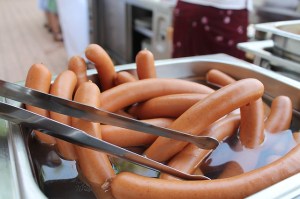
Captain Pizarro surveyed the yellow-orange expanse and announced that we were going to eat those hot dogs or die. Pale-faced Lieutenant Kelso staggered to his feet to voice his support before pitching forward into a huge bowl of papaya-bisque soup. Corporal Conigliaro timidly suggested that eating rotting hot dogs might kill us, or worse, give us diarrhea. Sergeant Gagliano put both of his powerful hands on Conigliaro and volunteered the Corporal for the honor of tasting the hot dogs.

Conigliaro said that although he was aware of the immense honor, he was reasonably sure that army regs stated that a certified medical doctor had to test all suspect foods. He was only an unregistered quack and so, respectfully declined.

It appeared that some stupid health regulation written by some desk-bound, pencil pusher in the Pentagon was going to deny us this wondrous, alternate source of food. However, our Sarge immediately volunteered Private Romero, a veterinarian, to taste the frankfurters.

Bilko accepted the assignment but said that he was such a good vet that he could determine the quality of the franks just by looking at them. He headed straight to the Hut of Hell, stopping only at the infirmary to put on a gas mask. Moments later he returned, ashen and trembling, stating that they were safe to eat. Though I did hear him mumble as he headed back to his tent hot dogs should not display internal movement. The other airmen just heard our cook announce hot dogs for tomorrow’s lunch.

Around eleven o’clock Cookie started boiling the franks. Fortunately, a strong wind from the south blew the fumes away from the camp toward the town of Lake Harbor. About that time in an unrelated incident, Bert Taylor, a tea tester from that town, suddenly pulled his own head off and died.

We all lined up at the mess tent to eat our hot dogs in shifts of one hundred which was also the number of gas masks on hand. Well, the first shift manfully ate their hot dogs and immediately fell to the floor suffering from violent convulsions. Then Private Owchinko’s stomach burst open flinging his guts all over the mess hall. Soon, everyone’s guts erupted just like cooking popcorn. Owchinko turned his hideously contorted face toward me and said, “Dang, at least it wasn’t papaya.” He then died with a look of complete serenity on his face; well, at least as serene as one could get with an exploded stomach.

We carried the men outside and buried them properly. We put on all their tombstones, “He wouldn’t eat papaya.” Since bullets were scarce at our base, we gave our departed comrades ten hot-dog salutes. Most of these franks exploded in air giving off the same noise as rifle shots. However, some didn’t explode until they hit the ground. One hot dog, in particular, landed on a latrine and exploded, scattering its contents for hundreds of yards. Private Franco noted that the smells of the latrine improved the smell of the hot dog. However, Captain Pizarro displayed true genius when he stated these franks could be terrible weapons of war.

We drifted along in papaya hell until we received orders to fly over to Europe. The Germans had just broken through our lines in a massive offensive now known as the Battle of the Bulge. Disaster loomed and every airman was needed. We armed our bombers with our hot dogs, which now had been rotting for an additional four months in the hot, humid Hut of Hell.

Our 800th Bomber Group arrived just as the Germans seemed poised to overrun the heroic defenders of Bastogne. None of our infantry or armored divisions could get to them in time. None of the other bomber groups could get off the ground due to bad weather. However, we could and we did.

We bombed the hell out of those Nazis. A Tiger tank can take a direct hit from a Sherman tank just twenty yards away and drive away only mildly annoyed, but just one hit from our franks just ripped those tanks to bits. Down they fell, ton after ton of freedom franks. The foul, poisonous vapors from the exploding dogs suffocated the supporting German infantry. Our hot dogs created a huge hole in the German lines into which poured General Patton’s troops. Patton, that glory hog, claimed full credit for the American victory at Bastogne.

However, we knew better and so did many others. In fact, Winston Churchill, Prime Minister of Great Britain praised us saying, “This was their finest meat product.”

– Paul De Lancey, The Comic Chef

My cookbook, Following Good Food Around the World, with its 180 wonderful recipes, my newest novel, Do Lutheran Hunks Eat Mushrooms, a hilarious apocalyptic thriller, and all my other books, are available on amazon.com.

Categories: food, history, humor, short story | Tags: , , , , , , , , , , , , , , , , , , , , , , | Leave a comment

Nidi di Rondini

San Marinese

NIDI DI RONDINI

INGREDIENTS

1 12-ounce package lasagna noodles
2 tablespoons butter
2 tablespoons flour
1 cup milk
⅛ teaspoon salt
⅔ cup marinara sauce (⅓ cup more later)
1¼ cups grated mozzarella
½ pound prosciutto or deli-sliced ham
⅓ cup marinara sauce
¼ cup grated Parmesan cheese

SPECIAL UTENSILS

8″-x-8″ casserole dish
kitchen scissors or scissors
aluminum foil

Serves 5. Takes 1 hours 45 minutes.

PREPARATION

Preheat oven to 350 degrees. Cook lasagna noodles according to directions on package. (Do not let noodles stick together. You might need to cook them in batches.) Drain noodles. Spray flat surface. Place lasagna noodles flat on flat surface. (Do not let them touch each other.)

While noodles cook, add butter to pan. Melt butter using medium heat. Gradually add in flour. Stir frequently until well blended. Gradually add milk until the sauce thickens. Stir frequently. Add salt. Stir until blended. This is the bechamel sauce. Remove pan from heat.

Pour ⅔ cup marinara sauce into casserole dish. Smooth with spatula. Spread bechamel sauce evenly over all the noodles. Sprinkle mozzarella evenly over the bechamel sauce. Place proscuitto strips over the bechamel-mozzarella lasagna noodles. (If necessary, trim or fold prosciutto strips so that they are narrower than the noodles.)

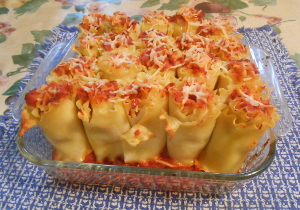
Roll up lasagna noodles so that they form a tight cylinder. Place lasagna cylinders upright and close together in casserole dish. (If necessary, place wadded-up balls of tin foil in casserole dish to keep lasagna cylinders from falling over.) Make four ½” cuts at the top of each lasagna cylinders. Pull the lasagna between the cuts down and out a bit. so that they look like rose petals.

Drizzle ⅓ cup marinara sauce over the lasagna cylinders. Sprinkle cylinders with Parmesan cheese. (Not so much that you can’t see the rose-petal design of the lasagna cylinders.) Bake for 35 minutes or until the tops of the cylinders turn crisp and golden brown.

TIDBITS

1) Nidi di rondini tastes great. Anyone making this entree will be immediately be hailed as an amazing chef and host.

2) If you are up for a Nobel Prize, you would do well to serve this dish to the judges.

3) As of press time, it is not illegal to do this.

4) So, what are you waiting for?

5) Nidi di rondini comes from the great, but tiny country of San Marino.

6) Despite being the size of a rather large postage stamp (24 square miles, 61 square kilometers), the San Marinese have preserved their independence for 1,816 years.

7) The above number is accurate as of the time of writing. Please increase the above number by one for every year after 2021.

8) Anyway, how did this tiny country maintain its independence from many other countries with much bigger armies such as: the Roman Empire, the Papal States, the French Empire under Napoleon, Italy, and Hitler’s Germany?

9) Simple. As culinary historians will tell you, soldiers with red hair make the fiercest warriors in the world. San Marino has always had fighting redheads. The chefs of this happy land commemorates their heroes with these rolled-up lasagna rolls topped with marinara sauce.

10) However, the most famous fighters in the world come from Scotland. Neighboring England failed for centuries to conquer the Scots, The English armies quailed, broke ranks and fled in terror whenever they caught sight of all that Scottish red hair.

11) The only success the English had came from their archers. But, of course, the archers were to far away to see the hair color of the Scottish pikemen.

12) One wonders why the English army never colored their hair red. Then the Scottish warriors would have fled whenever came in contact with the English.

13) What if? What if all the countries of the world made their soldiers die their hair?

14) All armies fear fighting fierce redheads. With all armies comprised of gingers, no army would dare attacking any other.

15) Peace would break out.

16) There you have it. Dye the hair of all combatants red.

17) I see a Nobel Peace Prize in my future, as long as I remember to serve nidi di rondini to the judges.

– Paul De Lancey, The Comic Chef

My cookbook, Following Good Food Around the World, with its 180 wonderful recipes, my newest novel, Do Lutheran Hunks Eat Mushrooms, a hilarious apocalyptic thriller, and all my other books, are available on amazon.com.

Categories: cuisine, history, international | Tags: , , , , , , , , , , , , , , , , , , , , , , , , , , , , , , , | 3 Comments

The Great Chicken Invitational – Part 2

But the reason for their poor performances lay in the chickens themselves. Remarkably, no one had considered the possibility that a twenty-ounce chicken using a four-inch club would drive a regulation golf ball a considerably shorter distance than would a two-hundred-pound man with a regulation club. Furthermore, for all their attentiveness to their swings, the chickens’ lack of hands proved to be a major obstacle to getting firm grips on their clubs.

Two weeks later, eighteen hardy chickens reached the green. Two chickens hit their balls into sand traps and couldn’t get out even though they remembered to use their chicken-sized wedges. Ten other chickens ended their brief golf careers by running into the adjacent woods to search for worms, and disappeared forever.

Play picked up considerably on the green. It turned out that chickens are natural born putters. Aided by cleverly-designed putters, made small enough to be held in their beaks, they dazzled the crowd with one precise putt after another. “I wish I could putt like those chickens,” said Norm Gregson of the PGA.

Observant golfers noticed that the chickens stand so close to the ground that they can figure out exactly which way their putts would break. One of these golfers, John Hona, later suggested to the PGA that chickens be used as “designated putters” in human-golf tournaments. It turned him down flat, “The answer is no.”

Official scorers added up the strokes at the end of the first hole. Roxanne led the pack by thirteen strokes with a score of 397. Technically, Roxanne shot a tricentinonadecadouble bogey, but the press just called it a “chicken bogey.”

Around the third week, while the chickens were half way through the second hole, sarcastic geeks ruffled the plucky poultry by yelling, “Cacciatore,” “Southern Fried,” or by calling their clubs “drum sticks.” The chickens flinched under the pressure of these specieist remarks, slicing more balls than usual. The organizers resorted to handing out free, fresh eggs from the competitors to keep them quiet.

Froussard golf club celebrated the Fourth of July in grand style. Organizers labored all week setting up a spectacular fireworks display. The remaining eleven chickens then contributed to the crowd’s enjoyment when they put on a snappy, morality play based on the daily life of a chicken. Afterwards, all sorts of chicken dishes were served to a hungry audience. “That’ll teach you to miss the cut,” growled Bob Banks as he bit into a hot-and-spicy chicken wing.

Three chickens exited the tournament in August. Vain and high-strung, Sandra, up and left the course clucking about a bad feather day. Nadine, suddenly felt the need to establish her roots and departed to seek her biological mother. Spontaneous combustion claimed the life of Martha as she prepared to putt out the eighth hole. “If she was going to blow up, she should have done it during last-month’s fireworks display,” sniffed organizer, Beverly Hatcher.

Rain fell heavily in late October. The downpour bothered none of the chickens, who clucked, drove, and putted as if nothing was wrong. Seeing this, a golfer’s wife remarked, “They’re just like human golfers.”

Snow fell heavily in the middle of December, and so, play deteriorated rapidly when chickens swung their clubs with difficulty through snow that came up to their beaks. Many chickens could no longer find their balls in the snow drifts. Indeed, the tournament’s officials lost several chickens in the deep snow.

By New Year’s Day, only two chickens remained, Agatha and Roxanne. These two had reached the green and were within only a few hours of finishing the course. Tension and excitement coursed throughout the golfing world as the two chickens were tied, each having a score of 6,127.

Interest in this tournament had grown so feverish that the television networks pushed the New Year’s Day bowl games back one week. Tens of thousands of people lined the rope around the eighteenth hole while helicopters from scores of television stations, domestic and foreign, circled above. “Those chickens upstaged us,” complained Bob Gallina, quarterback of the top ranked, LSU Tigers.

The crowd cheered every well-executed putt of the dueling chicks. Excitement reached a peak when Roxanne holed out with a score 6,157. But Agatha was only four inches from the cup, needing to make her putt for a sudden-death tie.

Agatha intently bent down, surveyed the green, picked up her putter, and set herself to putt. Then, disaster struck! A red fox burst onto the green and snatched Agatha in his hungry jaw. Hundreds of people ran after the fox into the trees to save Agatha, but found only a pile of feathers and a tiny putter.

The crowded peeled away from the course in horror and rage. Its hero had been eaten, an unprecedented event in golf. Things got ugly when many yelled threats at the tournament’s organizers. The more rabid fans produced nooses and proposed hanging the hated organizers. Hearing this, the objects of their hate took off in a flash, jumped into their cars, and sped away.

That was the end of the Great Chicken-Golf Invitational. From nearby Canby, Montana, the organizers declared Roxanne the winner, by default.

The carnage of the tournament appalled golfers and people everywhere. The American Wildlife Federation and corporations withdrew their sponsorships of a proposed second tournament. Interest in chicken golf died off rapidly after that. Now only a few people still think back to the days when chickens had a tournament of their own.

– Paul De Lancey, The Comic Chef

My cookbook, Following Good Food Around the World, with its 180 wonderful recipes, my newest novel, Do Lutheran Hunks Eat Mushrooms, a hilarious apocalyptic thriller, and all my other books, are available on amazon.com.
Categories: history, short story, sports | Tags: , , , , , , , , , , , , , , , , | Leave a comment

Gibanica (Serbian Cheese Pie)

Serbian Dessert

GIBANICA
(Cheese Pie)

INGREDIENTS

6 eggs
2 cups cottage cheese
1 cup crumbled feta cheese
1 cup sour cream
¾ cup (1½ sticks) butter
1 pound filo (phyllo) dough

SPECIAL UTENSILS

9″-x-13″ baking pan or casserole dish

Serves 8. Takes 1 hour 30 minutes.

PREPARATION

Separate eggs. Beat egg whites until fluffy. Add egg yolks, cottage cheese, feta cheese, and sour cream to mixing bowl. Blend thoroughly with whisk or fork. Fold in egg whites. Preheat oven to 360 degrees. Melt butter using low heat. Brush baking pan with 2 tablespoons melted butter.

Place 2 sheets filo dough in baking pan. Drizzle 2 tablespoons melted butter over filo. Spread ¼ cup egg/cheese mix on top. Gently crinkle 2 filo sheets into accordion-like balls. Dip accordion balls into cheese/egg mix from bowl until lightly coated. Place coated accordion-like filo balls over flat filo sheets in pan. Repeat until you have 2 filo sheets remaining.

Top with remaining 2 filo sheets. Brush top filo sheets with remaining butter and cheese/egg mix. Bake in over at 360 degrees for 50 minutes or until top is reddish, golden brown. Serve warm or let cool.

TIDBITS

1) Many different groups of people settled America’s Old West. The most obvious types were men and women. It’s obvious now, but no historian before me had ever mentioned it.

2) Chinese settled Western America, but Irish, Swedes, and Germans left Europe to come to the New World’s eastern shores and kept going until they hit the Great American Plains. For a body in motion tends to stay in motion. Long-ago settled Americans from the east pulled up stakes and joined those traveling west. For such a drastic measure as the only way to avoid house calls from salesmen offering to extended their wagon’s extended warranty.

3) However, Serbian cheese pie makers did not participate in the Great Western Movement as their eggs, cottage cheese, feta cheese, and sour cream never survived the months-long journey.

– Paul De Lancey, The Comic Chef

My cookbook, Following Good Food Around the World, with its 180 wonderful recipes, my newest novel, Do Lutheran Hunks Eat Mushrooms, a hilarious apocalyptic thriller, and all my other books, are available on amazon.com.

Categories: cookbook, cuisine, history, international | Tags: , , , , , , , , , , , , , , , , , , , , , , , , | Leave a comment

Chicken Kebabs from Lebanon

Lebanese Entree

CHICKEN KEBABS

INGREDIENTS

3 boneless chicken breasts
7 garlic cloves
1 green bell pepper
1 small onion
¼ cup lemon juice
6 tablespoon Greek or plain yogurt
3 tablespoons olive oil
¾ teaspoon cumin
1 teaspoon ginger
1 teaspoon oregano
1 teaspoon salt
1 teaspoon turmeric
½ teaspoon white pepper or pepper
2 tablespoons red vinegar or apple cider vinegar
¾ teaspoon tomato paste
6 pita loaves

SPECIAL UTENSILS

outdoor grill
6 skewers (If wooden, soak in water for 20 minutes.)

Serves 6. Takes 3 hours.

PREPARATION

Cut chicken into 1″ cubes. Crush garlic cloves. Seed and chop green bell pepper into 1″ squares. Chop onion into 1″ squares. Add all ingredients to large mixing bowl. Mix with hands until chicken cubes are well coated. Cover and let marinate in refrigerator for 2 hours.

Thread chicken cubes, bell pepper squares, and onion squares onto skewers. Turn heat on grill to medium. Add skewers to grill. Heat all sides for 3 minutes each. Place skewers in large pot and cover. Let rest for 10 minutes. (This step helps keep the chicken cubes moist.) Serve on skewers or if using pita loaves, remove all ingredients from skewers and place on pita loaves.

TIDBITS

1) Kebabs have been around since Ancient Greece. See Herodotus’s History of Greek Kebabs. You might think it should have been called History of Ancient Greek Kebabs. However, he lived in ancient times only to us. He thought he was being quite modern. Anyway, Herodotus noticed the shape of the pita bread would make a nifty shield and the skewer would make a spiffo spear. Ancient Greek warriors, hoplites, adopted both ideas and would become their era’s fiercest warriors. Now you know.

– Paul De Lancey, The Comic Chef

My cookbook, Following Good Food Around the World, with its 180 wonderful recipes, my newest novel, Do Lutheran Hunks Eat Mushrooms, a hilarious apocalyptic thriller, and all my other books, are available on amazon.com.

Categories: cuisine, history, international | Tags: , , , , , , , , , , , , , , , , , , , , , , | Leave a comment

Chilli Taiyo (Spicy Tuna Casserole)

Solomon Islander Entree

CHILLI TAIYO
(Spicy Tuna Casserole)

INGREDIENTS

½ pound thin noodles (Chinese or Italian)
2 garlic cloves
1 onion
1 tablespoon vegetable oil
1 12-ounce can tuna*
4 ounces chili paste*
2 tablespoons lime juice.
¼ teaspoon pepper
¼ teaspoon salt
8 fresh basil leaves

* = If you are willing to order from Australia, you can buy cans of chilli taiyo instead of getting the first two ingredients. You can also substitute the chili paste with 6 very small but quite spicy hot peppers. Do you feel lucky?

Serves 4. Takes 40 minutes.

PREPARATION

Cook noodles according to instructions on package. Drain and reserve noodles.

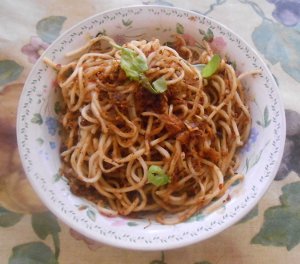
Mince garlic cloves. Dice onion. Add garlic, onion, and vegetable oil to pan. Sauté at medium-high heat for 5 minutes or until garlic and onion soften. Add tuna and chili paste to pan. Stir with spoon until well blended. Flatten the tuna. Cook at medium heat for 15 minutes. Stir frequently enough to prevent burning. Add lime juice, pepper, and salt. Stir until blended. Cook for an additional 7 minutes or until tuna reaches your desired level of crispiness. Stir frequently enough to prevent burning.

Add noodles to tuna in pan. Simmer at low-medium heat for 3 minutes. Stir frequently enough to prevent burning. Garnish with basil leaves.

TIDBITS

1) This entree is served in a round bowl.

2) Have bowls always been round?

3) No, although culinary archeologists have found many round bowls in Cro-Magnon burial grounds, the evidence shows that Neanderthals used rectangular bowls.

4) Moreover, when experts say that Neanderthalic bowls were rectangular, they were being generous. Not a single bowl fashioned by a Neanderthal boasts of having a straight edge. It’s almost as if the neanderthals didn’t care if their bowls made a fashion statement. In fact, the Neanderthals often made bowls with more than four angles, with hardly any of them being 90 degrees.

5) Please refer to the definitive study on this matter: von Kartofflen, Otto, Ph.D., “Lack of Geometric Precision in Neanderthalic Bowls, Indifference or Straight-Edge and Right-Angle-Tool Technology Deprivation, Prehistoric Research, August, 1973.

6) Many culinary researchers believe possession of round bowls enabled the Cro Magnons to overcome their Neanderthal cousins. Perhaps the round bowls could be hurled farther, like a discus.

7) This discus-bowl theory is gaining more and more credence. One only has to look at Ancient Greek paintings on vases. The earliest depictions show the athletes flinging round bowls. As time went on, discuses supplanted the bowls.

8) In 1673 B.C., geometricians of Sumer-Akkad develop the first straight edges and right angles. People could now dine out and eat off tables! It was the first golden age of dining out.

9) But this golden age of eating, did not last for ever. For in the times of legend, knights all wanted to be seated nearest to the king while feasting. The closer you were to your liege lord’s chair, the more prestige you had. If you sat far away, the more prestigious knights would laugh at you and say “Na na na poo poo” to say and you would hang your head in shame.

10) But then the quite possibly fictitious ruler, King Arthur, thought why not make a round table? With such a table, there is no specific king’s chair, so no one will know how far, in advance, how much or little prestige they have when sitting down to sup. This idea worked marvelously well. Jockeying for position and status by the knights in the feasting hall disappeared.

11) Hundreds of years later, a knight noticed that you could count how many spots you sat away from the king. War, born out of rivalry, would have broken out but for the soothing round shapes of their soup bowls. It was a near run thing. This is why bowls, to this day, are always round.


Round shape brings peace.                                                                       Rectangular shape brings war.


– Paul De Lancey, The Comic Chef

My cookbook, Following Good Food Around the World, with its 180 wonderful recipes, my newest novel, Do Lutheran Hunks Eat Mushrooms, a hilarious apocalyptic thriller, and all my other books, are available on amazon.com.

Categories: cuisine, history, international | Tags: , , , , , , , , , , , , , , , , , , , , , , , , , , , , | 2 Comments

Beef Smore From Sri Lanka

Sri Lankan Entree

BEEF SMORE

INGREDIENTS

2 pound piece of sirloin or beef chuck
2 tablespoons vinegar
½ teaspoon pepper
3 garlic cloves
1″ ginger root
1 large onion
1 small green chile
1 stalk lemongrass (tender inner bottom part only)
2½ tablespoons ghee or vegetable oil
2″ cinnamon stick
¼ teaspoon fenugreek seeds
10 fresh curry leaves or ½ teaspoon dry curry leaves or curry powder
1 teaspoon red pepper flakes
1¼ cups coconut milk
1 tablespoon lemon or tamarind juice

Serves 6. Takes 2 hour 30 minutes

PREPARATION

Make holes in beef with fork. (This will aid in marinating.) Add beef, vinegar, and pepper to bowl. Marinate for 1 hour.

While beef marinates. Mince garlic cloves, ginger root, green chile, and onion. Seed and mince green chile. Thinly slice lemongrass. Add ghee to pan. Heat ghee at high heat until is hot enough to make a fenugreek seed dance. Carefully add beef to pan. Sauté for 2 minutes on each side or until browned all over. Remove meat to plate. Leave beef juices in pan.

Add garlic, ginger, green chile, onion, cinnamon stick, fenugreek seeds, fresh curry leaves. and lemongrass. Sauté for 3 minutes on medium heat. Stir frequently. Add beef back to pan. Add beef, red pepper flakes, coconut milk, and lemon juice. Lower heat to low and simmer 40 minutes or until the beef reaches your desired level of doneness and coconut milk reduces to a gravy. Turn beef over every 10 minutes. Slice beef to your desired thickness. Spoon onion gravy over beef slices.

TIDBITS

1) At first, Sri Lankan Beef Smores were cooked on a handy twig over an open flame.

2) But the weight of the meat made the twig snap

3) The sirloin would fall into the ashy fire pit.

4) Chefs then shouted, “I need more sirloin.”

5) So many sirloins landed on ashes that this requested shortened to, “I need smore sirloin.”

6) Then eventually to “Smore” by the Monosyllabic Chef Association (MCA).

7) And so it went. Sirloin after sirloin fell into one campfire pit after another.

8) This food wastage bankrupted one restaurant after another.

9) Clearly, the food-service industry needed a new idea.

10) And in 1619, Chef Kasun Perera revolutionized everything when he said, “Why not move this meal indoors? We won’t get rained on.”

11) “Or even stampeded by elephants.”

12) Sure, moving the meal to avoid getting crushed by wild beasts seems obvious now.

13) But isn’t the way with all new ideas?

14) No, not all new ideas arise from Stampeding Elephant Fear Syndrome (SEFS). Rather, all new ideas will eventually seem obvious.

15) You could have skipped to this tidbit from tidbit 11, but it wasn’t obvious then. It is now. See?

16) Or even have skipped to here. Any way, moving fire pits inside dramatically lessened the number of deaths due to elephants.

17)However, way too many restaurants burned to the ground from the flames in the open pits.

18) Customers look askance at fleeing a burning restaurant.

19) The restaurant industry needed another fertile mind.

20) It got with Tharindi Bandari, when in 1878, he said, “How about cooking things on a pan on a metal stove?” They will be no fires when we cook our beef smores this way.”

21) It’s impossible to overstate how this brainstorm transformed cooking.

22) Now, the entire world enjoys fire-storm free dining.

23) America came up with a different solution to the ashy sirloin problem. In 1958 little Timmy Perkins replaced the ingredients of the Sri Lankan Beef Smore with marshmallows, graham crackers, and chocolate saying, “The weight of melting marshmallow will never break our twig.” It worked! It tasted great. “I’ll have smore,” said Timmy’s dad. And in 1997, Timmy’s brilliance would win him the Noble Price for Culinary Achievement.

– Paul De Lancey, The Comic Chef

My cookbook, Following Good Food Around the World, with its 180 wonderful recipes, my newest novel, Do Lutheran Hunks Eat Mushrooms, a hilarious apocalyptic thriller, and all my other books, are available on amazon.com.
Categories: cuisine, history, international | Tags: , , , , , , , , , , , , , , , , , , , , , , , , , , | 2 Comments

Mocha Coffee Creamer

American Appetizer

MOCHA COFFEE CREAMER

INGREDIENTS

4 cups half and half
6 tablespoons sugar
6 tablespoons cocoa powder
2 teaspoons vanilla extract

SPECIAL UTENSILS

2-to-3 screw-top bottles or jars.

Makes 4 cups. Takes 15 minutes plus 30 minutes cooling in refrigerator

PREPARATION

Add half and half and sugar to pot. Warm on low-medium heat until sugar dissolves. Stir constantly. Don’t let it boil. Remove from heat. Add cocoa powder and vanilla. Stir until cocoa powder dissolves and liquid is well blended. Pour into bottles and refrigerate. This creamer will stay fresh up to 7 days.

TIDBITS

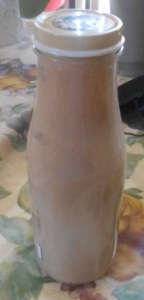
1) The bottle in this picture looks tall. It is tall! How tall is it? It’s as tall as Mount Everest. In fact, it was constructed right next to the world’s highest mountain. That’s how we know the bottle’s height.

2) Wow, how did I not notice it? You did. The Tall Bottle Filled With Mocha Creamer Next To Mount Everest story dominated the news for a week.

3) Then thieves stole the bottle for its recycling value. The epic journey of the bottle to a recycling center in Manchester, England became news as well.

4) How do I not remember any of this? Well, other things happened in the world, sports, politics, etc. On Facebook, pictures of kittens and puppies crowded out all other items.

5) Oh, and when the thieves emptied the bottle, they created a vast mocha-creamer glacier right there in Tibet. Inspired culinary scientists are now looking to making sheets made of mocha-creamer to replace the disappearing polar-ice shelves. This is why you can’t find any mocha creamers on your supermarket shelves.

– Paul De Lancey, The Comic Chef

My cookbook, Following Good Food Around the World, with its 180 wonderful recipes, my newest novel, Do Lutheran Hunks Eat Mushrooms, a hilarious apocalyptic thriller, and all my other books, are available on amazon.com.

Advertisements
Categories: cuisine, history, humor, recipes | Tags: , , , , , , , , , , , , , , , , , , , , , , , | 3 Comments

Beef Rendang

Indonesian Entree

BEEF RENDANG

INGREDIENTS

4 red chiles
1 inch galangal or ginger root
5 garlic cloves
¾ teaspoon peppercorns
6 shallots
1 inch turmeric root
1 stalk lemongrass
2 pounds beef tenderloin or top round
2 tablespoons oil
1 inch cinnamon stick
½ tablespoon salt
3 kaffir lime leaves or ½ teaspoon lime zest
1 salam leaf or bay leaf
3 13-ounce cans coconut milk

SPECIAL UTENSIL

spice grinder

Serves 4. Takes 2 hours 45 minutes.

PREPARATION

Seed red chiles. Add red chile, galangal, garlic cloves, peppercorns, shallots, and turmeric to spice grinder. Grind until these spices become paste. Remove and discard upper ⅔rd of lemongrass stalk. Remove and discard the three outer layers. Dice remaining lemongrass. Cut beef into 1″ cubes.

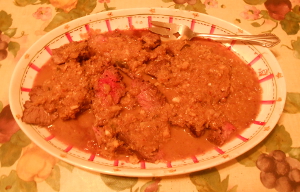
Add spice paste and oil to work or large pan. Sauté at medium-high heat for 2 minutes or until paste becomes fragrant. Stir constantly. Add all remaining ingredients to wok. Bring to boil using high heat. Stir frequently. Reduce heat to medium and cook for 1 hour. Stir enough to prevent burning. Reduce heat to low and simmer for 45 minutes or until the milky part of the liquid is gone, leaving a little bit of coconut oil. (Most of the liquid should be evaporated.) Stir enough to prevent burning. Simmer on low for another 15 minutes or until beef and sauce turn brown. Remove cinnamon stick, bay leaf, and kaffir lime leaves. Goes well with rice.

TIDBITS

1) The dish into the above picture is served on, well, a dish. The dish is round.

2) Why is it not square?

3 )Because you cannot roll something is square

4) Why does it matter if you can roll a dish? After all, if you rolled the above dish before you ate, you lost the food.

5) Clearly, the round shape was designed for something else in mind.

6) What was that?

7) One theory, advanced by culinary, archeologists, is that primitive caveman invented the stone FrisbeeTM.

8) They didn’t call it the Frisbee, of course. It’s named after the Frisbee Pie Company which sold its wares in round pie dishes.

9) Culinary historians believe most prehistoric companies were called Ogg, Inc. because nearly all cavemen were named Ogg. Cavewomen were called Ogg.

10) Therefore, these ancient humans probably named their invention the OggTM.

11) Isn’t surprising early humankind possessed the knowledge to incorporate and trademark things?

12) Alas though, the Ogg proved a dismal failure. If you didn’t catch it, it hit you in the head and that was that.

13) Indeed, culinary historians believe widespread Ogg playing extinguished the Neanderthals.

14) After a much briefer fling with the sport, the Cro Magnons abandoned Ogg tossing.

15) Tossing the Ogg around was supposed to be a fun leisure time activity. But making the circular Ogg took up all their free time. So, what was the point of making Oggs?

16) None, the Cro Magnons concluded. So, they went on to make spears, axes, animal skins, and the like. Humanity went on not quite a talc age, which is a bit below a golden age.

17) Throwing round things became a popular sport in Ancient Greek Olympics. Physically fit from throwing the much lighter and metallic Ogg–by then called the discus–Greeks explored the entire known world.

18) The Romans, inheritors of Greek civilization, conquered the entire Mediterranean and much of northwestern Europe. The Roman built roads to facilitate rapid deployment of legions from crisis point to another. And we all know, the Roman legionnaire loved to throw the discus.

19) The Roman army passed on discuss throwing to the natives wherever they went. The natives became buff as well. So, the Roman conquest proved to be quite the good thing for the locals once everybody got past the initial wholesale slaughter-and-enslavement phase. And ever since then we have lived in a round-thingy-throwing golden age.

20) But it’s sobering to think how the Cro Magnons, the last remaining branch of humankind, came to throwing themselves into extinction.

– Paul De Lancey, The Comic Chef

My cookbook, Following Good Food Around the World, with its 180 wonderful recipes, my newest novel, Do Lutheran Hunks Eat Mushrooms, a hilarious apocalyptic thriller, and all my other books, are available on amazon.com.

Categories: cuisine, history, international | Tags: , , , , , , , , , , , , , , , , , , , , , , , , , , , , , , , | Leave a comment

Medfouna

Moroccan Entree

MEDFOUNA
(Marrakech Pizza)

INGREDIENTS – DOUGH

2¼ teaspoons yeast
¾ cup warm water
1¾ cups all-purpose flour (4 more tablespoons later)
½ cup wheat flour or semolina
¾ teaspoon salt

INGREDIENTS – FILLING
1 onion
1 red chile
⅓ cup fresh parsley
1 teaspoon coriander
½ teaspoon cumin
½ teaspoon pepper
¼ teaspoon sea salt or salt (¼ teaspoon more later)
1 pound steak or lamb (minced or ground)

INGREDIENTS – FINAL

2 tablespoons all-purpose flour (2 more tablespoons later)
2 tablespoons all-purpose flour
1 egg
¼ teaspoon sea salt or salt

SPECIAL UTENSILS

electric beater
plastic wrap or kitchen towels
baking sheet
parchment paper

Serves 4. Takes 1 hour 45 minutes.

PREPARATION – DOUGH

Add yeast and warm water to 1st large mixing bowl. Stir with fork until yeasts dissolves. Let sit for 10 minutes or until yeast becomes bubbly. Gradually add in 1¾ cups all-purpose flour, wheat flour, and salt. Stir with fork until well blended. Use medium setting for electric beater on flour/yeast mix until you get a smooth and elastic ball of dough.

Divide dough into two equal balls. Place in bowls and cover with plastic wrap or kitchen towels. Let rise for 45 minutes or until dough doubles in size.

PREPARATION – FILLING

While dough rises. mince onion. Seed and dice red chile. Dice parsley. Add all filling ingredients to 2nd large mixing bowl. Mix well with hands until well blended.

PREPARATION – FINAL

Preheat oven to 360 degrees. Dust flat surface with 2 tablespoons all-purpose flour. Roll out one dough ball until it’s a circle 11″ across. Cover baking sheet with parchment paper. Put 11″ dough circle on parchment paper. Poke the circle 10 times with a fork. Spread filing over 11″ circle, leaving 1″ uncovered around the edges.

Dust flat surface with 2 tablespoons all-purpose flour. Roll out remaining dough ball into an 11″ circle. Place this 11″ dough circle on top of filling. Dip fingers in water and press edges together to form a seal. Beat egg. Spread egg on top. Sprinkle with sea salt. Bake at 360 degrees for 25 minutes or until golden brown.

TIDBITS

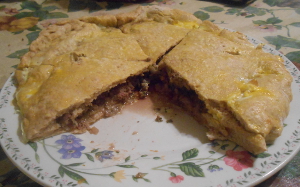
1) In 1801, William Playfair ordered medfouna in a small cafe in while in Marrakech. He sliced his pizza into four pieces. He ate a slice. It was delicious. Playfair gazed at the three remaining pieces. The proportion of the slices equaled the ratios of the Ottoman Empire that were in Europe, Asia, and Africa! He called his startling idea the “pizza-pie chart,” shortened afterward to “pie chart.”

2) You might think his idea would have sparked little interest among Britain’s scientific community. But no, that’s all the island nation’s greatest minds could talk about. They’d gone pie-chart mad.

4) So much so that the British scientists abandoned all research on the not as sexy topic of time travel. That’s too bad for King George III’s redcoats. For if Britain had had time travel, they could have gone forward to the 20th century and bought back machine guns, howitzers, jet fighters, and all sorts of bombers. It’s difficult to see how the French army of the early 19th century could have stood up to all of that, even with the element of surprise.

5) But the pie-chart mania precluded the development of all modern weaponry. The Napoleonic Wars dragged on for fourteen more bloody years. The British public blamed the pie chart. Whereas, pie charts were once found on every street in London, by 1816 they were all gone.

7) Pie charts came back during the Crimean War when Nurse Florence Nightingale taught the idea to her bandaged patients. It was her way of helping them pass the time. Pie charts died out when the war ended and Britain closed all its pie-chart hospitals in Crimea.

8) Pie charts remained unloved when World War II rolled around. With no pie charts to distract them, British boffins created one dazzling breakthrough after another, such as radar and the Spitfire. Enabled by this technology, the British defeated the Nazi War machine. Now, of course, we have both spiffy weapons and pie charts, but only because today’s scientists have learned to specialize.

– Paul De Lancey, The Comic Chef

My cookbook, Following Good Food Around the World, with its 180 wonderful recipes, my newest novel, Do Lutheran Hunks Eat Mushrooms, a hilarious apocalyptic thriller, and all my other books, are available on amazon.com.
Categories: cuisine, history, international | Tags: , , , , , , , , , , , , , , , , , , , , , , , , , , | 2 Comments

Blog at WordPress.com.