cuisine

Hokey Pokey Ice Cream

New Zealander Dessert

HOKEY POKEY ICE CREAM

INGREDIENTS – HOKEY POKEYHokeyPokey-

2 tablespoons golden syrup
¼ cup sugar
1 teaspoon baking soda

INGREDIENTS – ICE CREAM

1½ cups heavy whipping cream
½ teaspoon vanilla extract
¾ cup confectioner’s sugar
4 egg yolks

SPECIAL UTENSILS

Waxed parchment paper or cookie sheet
No-stick spray
electric beater
1 gallon plastic container with tight lid

Makes 3 quarts. Takes 45 minutes plus about 6 hours in freezer.

PREPARATION – HOKEY POKEY

Put waxed parchment paper on cookie sheet. Spray waxed parchment paper with no-stick spray. Add golden syrup and sugar to pan. Cook at low-medium heat until mixture melts and then boils. Stir constantly. Reduce heat to low and cook for 5 minutes. Stir constantly to avoid burning the sugar. Remove from heat. Add baking soda. Stir with fork until mixture becomes pale and frothy. Pour mixture onto waxed parchment paper. Let sit for 30 minutes or until mixture solidifies into hokey pokey. Break hokey pokey with hands, bash with kitchen mallet, or cut with kitchen scissors until you have chunks no longer than ½” long.

PREPARATION – ICE CREAM

While hokey pokey sets, add cream to large mixing bowl. Whip with electric beater set on cream, or high, until cream becomes thickens and soft peaks form. Add vanilla extract, confectioner’s sugar, and egg yolks to second mixing bowl. Mix with electric beater set on cream, or high, until creamy. Fold confectioner’s sugar/egg mixture from second mixing bowl into first mixing bowl with cream.

PREPARATION – FINAL

Add hokey pokey chunks and ice cream to plastic container. Stir gently with spoon until hokey pokey is evenly distributed. Cover and put in refrigerator for 6 hours or ice cream is firm.

TIDBITS

1) The hokey pokey is a dance where a leader names a part of the body. The participants then put that part in, take part out, put that part in, shake it all about, turn themselves around. That’s what it’s all about.

2) The hokey pokey was used to devastating effect by English forces in the battle of Waterloo in 1815. In a desperate gamble, the French Emperor Napoleon hurled his vaunted Old Guard at the center of the English infantry line. Onward, ever onward they marched, their jaws clenched tightly together by glue-like oatmeal. The English line buckled. One more push and the French would triumph. Napoleon would remain emperor. He would continue to march his armies all over Europe. Europe would continue to be drenched in blood as Napoleon engaged in ceaseless conquest and pursuit of La Gloire.

3) Private Henry Tavert of the English tenor-infantry brigade began to shake in terror. His sergeant growled. “Pull yourself together, man.”

4) “I can’t.” said Henry. “You must,” said the sergeant. “For God, king, and country.”

5) “I still can’t.” The sergeant rolled his eyes. “All right then, do it for your mum.”

6) Henry managed a weak smile. “I can do that. Me mum used to sing the hokey pokey to me whenever I got afraid. It gave me courage, it did.”

7) “Then private, sing the hokey pokey.”

8) And so Henry did, weakly at first, but with increasing conviction and volume with each successive word. The rest of the tenor brigade joined in. When they all got to the part about turning “yourself about,” the song could be heard by the bilingual sergeants of France’s Old Guard.

9) These bilingual sergeants upon hearing the words “turn yourself about,” turned themselves about. The privates taking their cue from their sergeants turned themselves about as well.

10) “D___ me,” shouted the sergeant, “The Frenchies are fleeing. Fix bayonets!” He pointed to the retreating French. “England, put your whole selves out.”

11) The tenor brigade charged. Brigades to their left and right advanced as well. Pretty soon, the entire English army rushed the French. The French retreat became a rout. Napoleon’s once mighty Grande Armée disintegrated never to reform. Europe was finally at peace.

12) Europe stayed at peace for another 99 years. Whenever a country poured it armies across its neighbor’s borders, the defenders would sing the hokey pokey and make the attackers turn themselves about. War became pointless and boring.

13) Until 1913, when countries issued ear plugs to their armies. Soldiers couldn’t hear the hokey pokey and so would no longer turn themselves about. World War I, a horrific bloodbath, commenced only one year later. We need to come up with a countermeasure to ear plugs.

– Paul De Lancey, The Comic Chef

My cookbook, Following Good Food Around the World, with its 180 wonderful recipes, my newest novel, Do Lutheran Hunks Eat Mushrooms, a hilarious apocalyptic thriller, and all my other books, are available on amazon.com.
Categories: cuisine, history, humor, international | Tags: , , , , , , , , , , , , , , , , , , , , , | Leave a comment

Steak Diane

American Entree

STEAK DIANE

INGREDIENTSSteakDiane-

1½ pounds beef tenderloin, rib eye, or flank
¼ teaspoon pepper
¼ teaspoon salt
¼ cup butter
2 shallots
¼ cup cognac or brandy
1 tablespoon Worcestershire sauce
½ teaspoon lemon juice
2 teaspoons parsley

Makes 6 plates. Takes 40 minutes.

PREPARATION

Slice tenderloin into 36 strips. Rub pepper and salt into tenderloin. Let sit for 10 minutes. Add butter to pan. Melt butter using medium heat. Stir frequently. Add as many tenderloin strips to pan as will fit in a single layer. Sear tenderloin using high heat for about 1 minute until strips are completely brown on bottom. Flip slices over and sear other side. Remove tenderloin from pan and set aside. Remove and set aside melted butter.

Mince shallots. Add shallot, cognac, and Worcestershire sauce to second pan. Sauté at medium heat for 2-to-3 minutes or until liquid has been reduced by half. Stir frequently. Add lemon juice, parsley, and melted butter from first pan. Reduce heat to low and simmer for 3 minutes or until sauce thickens. Stir occasionally. Add tenderloin strips to plates. Ladle sauce over tenderloin slices. Guests who ooh and aah the loudest get the most strips.

TIDBITS

1) Steak Diane is often prepared at restaurants by lighting the alcohol in it. The flames burn off the alcoholic content while preserving the taste. Diners ooh and aah over the pyrotechnics.

2) The waiters who prepare this dish for you at your table are highly trained. Except, of course, for the ones without eyebrows. They are new.

3) Restaurants also have overhead sprinkles and fire extinguishers handy. Most homes do not. This is why this recipe is prepared without flames. Too dangerous.

4) Unless you are faced with a ravenous, blood-thirsty intruder. In that case, invite him to the kitchen for steak Diane. Use a liberal amount of cognac. Encourage the thug to take in the wonderful aroma of the steak strips. Then, pow, set the entree and the brute on fire with a propane torch. The thief will flee and you’ll have a nice, impromptu feast. Invite your friends over. Share your adventure and your culinary creation with them. Life is good.

– Paul De Lancey, The Comic Chef

My cookbook, Following Good Food Around the World, with its 180 wonderful recipes, my newest novel, Do Lutheran Hunks Eat Mushrooms, a hilarious apocalyptic thriller, and all my other books, are available on amazon.com.

Categories: cuisine, humor | Tags: , , , , , , , , , , , , , , , , , , | Leave a comment

Swedish Saffransbröd

Swedish Dessert

SAFFRANSBRÖD

INGREDIENTSSaffranBrod-

2¼ teaspoons yeast
⅓ cup warm water
1 cup milk
½ cup butter
¼ teaspoon salt
1 teaspoon sugar (½ cup more later)
½ teaspoon (1 gram) saffron threads
⅓ cup raisins
½ cup sugar
2 eggs (1 more egg later)
4 cups flour (2 more tablespoons later)
2 tablespoons flour
1 tablespoon vegetable oil
no-stick spray

SPECIAL UTENSILS

tin foil
cookie sheet

Makes 4 6″ buns. Takes 2 hours 40 minutes.

PREPARATION

Preheat oven to 250 degrees. Add yeast and water to large mixing bowl. While yeast dissolves, add milk to small pot. Heat milk at high heat until scalding hot (almost boiling). Stir constantly. Reduce heat to medium. Add butter, salt, and 1 teaspoon sugar to pot. Stir constantly until butter melts. Remove from heat.

Add saffron to tin foil. Bake at 250 for 5 minutes or until saffron is toasted. Add toasted saffron to cup. Crush saffron with fingers. Add 1 teaspoon sugar to cup. Mix with fork. Add crushed saffron/sugar to mixing bowl with dissolved yeast. Add 2 eggs, raisins, ½ cup sugar, and buttery milk to mixing bowl. Stir in 4 cups flour, one cup a time. Mix with whisk or fork.

Dust cutting board with 2 tablespoons flour. Add dough to cutting board. Let dough stand for 10 minutes. Knead with hands until dough stiffens. Add oil and dough to large bowl. Turn dough until it is coated with oil. Cover and let rise for 1 hour or until dough doubles in size.

Preheat oven to 375 degrees. Divide dough into 12 pieces. Use hands to turn each piece into a 12″ rope. Put 3 ropes side by side. Braid the 3 ropes together by crossing the left rope and then the right rope over the center rope until there is one long braid. Join ends of long braid to make a circle or crown. Repeat to make three more crowns. Beat one egg. Brush egg over crowns.
Spray cookie sheet with no-stick spray. Place crowns on parchment-covered cookie sheet. Let crowns rise for 15 minutes or until they puff up into a bun. Bake for 15-to-25 minutes or until golden brown and when a toothpick inserted into buns comes out clean. Let cool on rack.

TIDBITS

1) Böard is Swedish for surfboard. Yes, surfboards were invented by the Swedish baker, Franf. For in 1618, Franf found a large tree trunk washed up on shore. The tree was of a sort unknown to Europe. Franf reasoned it must have come from a large continent to the west.

2) He announced his discovery to the Swedish court and asked royal packing for a proposed voyage of discovery. The Swedish king said Franf was an idiot, noting Christopher Columbus had discovered the New World in 1492, in addition to Basque fishermen, Viking explorers, the third-grade class of Stockholm’s very own Lutefisk academy, Chinese traders, and the people of the great migration across the land bridge from Siberia to Alaska.

3) Franf wondered why entire tribes would assemble in frozen Siberia and then trek eastward into howling blizzards to an unknown land. Perhaps they really had a hankering for a White CastleTM burger. Those tiny delights with their minced onions are really tasty. Perhaps the ancient trekkers honestly thought there be a White Castle in the new land, just like the Spanish conquistadors and their Seven Cities of Gold. We’ll never know. Researchers are still waiting for the Cliff NotesTM to come out.

4) Franf waited patiently for the above long tidbit to end, before he could go home.

5) He moped for countless seconds–there were no stopwatches in 1618–before rebounding with the boundless optimism of all Post-Renaissance Swedish bakers.

6) Fraf went to a dock, sat down, pulled out his pipe, lit a match, and commenced to day dreaming. His long reddish beard burst into a fireball of flame; not applying the burning match to the pipe was a mistake. Howling with pain, Franf dove into the bay to put out the fire.

7) Flame extinguished, Franf immediately inventoried certain gaps in his education and there were many. However, the one that consistently came to the forefront was not learning to swim. Thank goodness, the tree trunk from the first tidbit, by now worn down to a thin board, was right next to him. (Notice the neat foreshadowing?)

8) Franf climbed onto the board and sat down to think. Here he was sitting in Sweden, the top of world, when suddenly, in geological terms, he caught a wave. “Häftig,” he shouted, “this is totally awesome!” People gathered on the shore as Franf rode one rörformig wave after another. They joined in. Surfing totally rocked Sweden. It was totally tubular, man.

11) Then the Thirty Years war broke out. Thousands and thousands of surfing Swedes lost their lives in the battlefields of Germany, never again to catch that perfect Baltic Sea wave. Surfing died out in that no longer care free Nordic land.

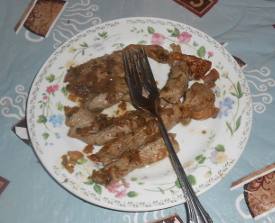
12) But Franf is still remembered in the vibrant culinary, surfing world. This recipe is called Saffransbröd, in anagrammic remembrance, of Franf’s böard.

– Paul De Lancey, The Comic Chef

My cookbook, Following Good Food Around the World, with its 180 wonderful recipes, my newest novel, Do Lutheran Hunks Eat Mushrooms, a hilarious apocalyptic thriller, and all my other books, are available on amazon.com.
Categories: cuisine, history, humor, international | Tags: , , , , , , , , , , , , , , , , , , , , , , , , , , , , , , , , , | Leave a comment

Chicken Banh Mi

Vietnamese Entree

CHICKEN BANH MI

INGREDIENTSChickenBanhMi-

4 8″ baguettes (not overly cripsy)
3 medium carrots
¼ pound daikon
3 tablespoons sugar
½ cup rice vinegar
2 Thai red chiles or jalapeños
1 tablespoon lime juice
1 teaspoon garlic salt
⅛ teaspoon pepper
4 chicken breasts
1 tablespoon vegetable oil                                                                           Not a Van Gogh painting
½ cup aioli sauce (see recipe) or mayonnaise
1 teaspoon sriracha
¼ cup fresh cilantro
1 cucumber
no-stick spray

SPECIAL UTENSIL

cookie sheet

Makes 4 banh mi sandwiches. Takes 1 hour 15 minutes.

PREPARATION

Split baguettes in half along their lengths. Grate, or julienne, carrots and daikon. Add sugar and rice vinegar to pot. Bring to boil using high heat. Stir constantly until sugar dissolves. Remove and let cool. Add carrot and daikon to pot. Marinate in refrigerator for 30 minutes.

While carrots and daikon marinate, preheat oven to 325 degrees. Mince Thai red chiles. Cut chicken breasts into 1″-wide strips. Add Thai red chiles, lime juice, garlic salt, pepper, and chicken to large mixing bowl. Cover and marinate for 30 minutes. While chicken marinates, add aioli sauce and sriracha to small mixing bowl. Blend together with whisk. Dice cilantro. Slice cucumber into thin circles.

Coat chicken breasts with vegetable oil. Spray cookie sheet with no-stick spray. Bake at 350 degrees for 10 minutes. Add baguette halves to oven. Turn chicken over. Bake chicken and baguettes for 10 minutes or chicken is no longer pink inside and baguettes are lightly toasted.

Spread aioli/sriracha sauce on baguette half. Add an equal layer of cucumber circles to each baguette. Add an equal of chicken strips to each baguette, followed by a layer of mixed carrot and daikon. Sprinkle each baguette with diced cilantro.

TIDBITS

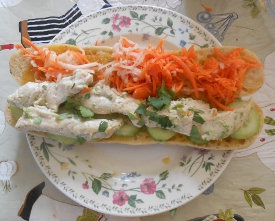
1) Bright, vibrant colors emanate from chicken banh mi. See above photo.

2) The artist Van Gogh (1856-1893) is famous for his bright, vibrant paintings such as Sunflower and starry night. His character is depicted in the well-loved Doctor Who episode, “Vincent and the Doctor,” where he saves the universe. Well done, Vincent.

3) Food always inspired Vincent. His first famous painting is “The Potato Eaters” (1885), known by everyone who has known of it. It was typical of an artistic style called brown gravy, where the only colors on a painter’s palette were: beige, light brown, ecru (remember that for crossword puzzles), brown, dark brown, and chocolate brown.

4) However, Vincent’s magnificent obsession with food developed earlier, certainly after birth and before death.

5) He wrote, during this period of life, wrote many letters to his brother. Food provided the dominant, recurring theme of these epistles.

6) In his letter of September 17, 1875, Vincent worries his brother, Theo, isn’t eating properly. He admonishes his brother to eat lots of bread. Just twelve day later, Vincent tells Theo to eat more bread. On August 18, 1877, the great artist tells his sibling to eat bread as it deters people from suicide. He cites Dickens as his source for this bit of knowledge.

7) Clearly, Vincent did not belong to the gluten-free school of painting.

8) Vincent did take a brief walk on the wild side, when he favored oatmeal over bread. (See his letters of November 9 and November 15, 1875.) Culinary-art historians still debate the reason for this. The dominant view seems to be that his illnesses had been flaring up more than usual. Others maintain that Vincent had simply gone off feed.

9) Then? I don’t know. I cleverly managed to print out only the first nine of Vincent’s twenty-five food-and-drink letters to his brother.

10) Then my friggin’ printer jammed. By the time the cussing had stopped and the printer actually was willing to work again, the mood for research had passed. Hey, don’t judge me.

11) One of Van Gogh’s few non-vegetarian paintings is “Prawns and Mussels” (1886). Everybody loves shrimp and Vincent was no exception. His one true love, however, was potatoes as his many spud painting testify. He did have brief flings with: citrus, cabbage-red and green, onions, grapes, apples, and even quinces!! His one true love, however, was potatoes as his many spud paintings testify.

12) In 2010, the Doctor and Amy Pond visit Vincent with their TARDIS. The Doctor tells Vincent that he shall become the greatest painter of all time. Vincent abandons his bread mania and paints many famous non-culinary paintings. Vincent dies within a year.

13) The great artist would probably have lived long if he had only stayed with still lifes of potatoes. Something to think about for aspiring artists.

– Paul De Lancey, The Comic Chef

My cookbook, Following Good Food Around the World, with its 180 wonderful recipes, my newest novel, Do Lutheran Hunks Eat Mushrooms, a hilarious apocalyptic thriller, and all my other books, are available on amazon.com.

Categories: cuisine, history, humor, international | Tags: , , , , , , , , , , , , , , , | 2 Comments

Beef, Spinach, and Peanut Stew from South Sudan

South Sudanese Entree

BEEF, SPINACH, AND PEANUT STEW

INGREDIENTSSouthSudan-

1¼ pounds chuck steak or round steak
3 garlic cloves
2 medium onions
2½ tomatoes
2 bunches spinach (1 pound)
½ sweet potato
4 tablespoons unsalted, roasted peanuts (4 teaspoons more later)
2 tablespoons peanut oil
3 cups beef stock
½ tablespoon tomato paste
4 teaspoons unsalted, roasted peanuts
½ cup unsweetened peanut butter

SPECIAL UTENSIL

spice grinder
Dutch oven

Makes 6 bowls. Takes 1 hour 45 minutes.

PREPARATION

Cut beef into 1″ cubes. Mince garlic. Dice onions and tomatoes. Remove stems from spinach, then shred. Cut sweet potato into ½” cubes. Use spice grinder to make a paste from 4 tablespoons peanuts.

Add peanut oil and beef cubes to Dutch oven. Cook at medium heat for 6 minutes or until beef browns. Stir occasionally. Add garlic and onion. Raise heat to medium-high and sauté for 5 minutes or until onion and garlic softens. Stir in beef stock and tomato paste. Bring to boil using high heat. Stir occasionally. Reduce heat to low and simmer for 50 minutes or until beef becomes tender and stock is reduced by ½. Stir occasionally. Add sweet potato and 4 teaspoons peanuts. Simmer for 15 minutes. Stir occasionally.

Add peanut paste, and peanut butter. Simmer for 5 minutes or until peanut paste and peanut butter blends completely in. Stir frequently. Add spinach and tomato. Raise heat to low-medium and simmer for 10 minutes or until the oil from the peanut paste and peanut butter makes the stew shiny. Goes well with rice and flatbread.

TIDBITS

1) This entree is a stew. Stew is an anagram for west.

2) The Sun sets in the west.

3) Peanuts hate the Sun, because it’s bad for their complexion.

4) So, they dig into the ground to avoid the piercing rays of light.

5) Peanuts never get very far into the soil, though.

6) They don’t have opposable thumbs. You need opposable thumbs to hold hoes and shovels.

7) Nor do peanuts have any hands to speak of, really.

8) Which is why farmers never hire peanuts during harvest time, only humans.

9) Still, the Sun burns the little ground nuts.

10) The Sun rises in the east and sets in the west.

11) So, the peanuts migrate to the west in the morning and back east in the afternoon. They end up in the same place, which is why no one ever notices them moving.

12) Things get ugly, though, when herds of peanuts cross the same interstate freeway. Traffic halts. The traffic jam grows to includes connecting freeways and highways. The economy halts.

14) That’s not all. Giant herds of peanuts moving back and forth along the ground dislodge the Earth’s plates. Earthquakes result as in San Francisco in 1906

15) Indeed, peanut migrations have caused the Earth’s plates to shift. Before peanuts came on the scene there was only one continent, Pangaea.

16) Something had to be done and in 1939 all the nations gathered in Poway, California to discuss the looming peanutian threat.

17) Then, on September 1, Hitler invaded Poland and World War II broke out. Country after country uprooted their peanut fields to feed their rampaging armies. Fewer migrating peanuts meant fewer earthquakes during the war years. You can look it up.

18) The leaders of the major victorious powers: Roosevelt, Churchill, and Stalin, knew it would be a matter of time before another Hitler would arise or peanuts would make their comeback. Perhaps, the next megalomanic dictator would even gather the peanuts of the world to his standard.

19) The United Nations was formed in 1945 to gather this very threat. An elite anti-peanut battalion was formed and peanut farming within 100 miles of fault lines was banned forever.

20) Something to think about when you have your next peanut-butter-and-jelly sandwich.

– Paul De Lancey, The Comic Chef

My cookbook, Following Good Food Around the World, with its 180 wonderful recipes, my newest novel, Do Lutheran Hunks Eat Mushrooms, a hilarious apocalyptic thriller, and all my other books, are available on amazon.com.
Categories: cuisine, history, humor, international | Tags: , , , , , , , , , , , , , , , , , , , , , , | Leave a comment

Yellow Pea Soup With Pork (Ärter med fläsk)

Swedish Soup

YELLOW PEA SOUP WITH PORK
(Ärter med fläsk)

INGREDIENTSYellowPeaSoup-

1¼ pounds yellow split peas
6½ cups water
8 ounces salt pork
1 carrot
1 large yellow onion
¾ teaspoon fresh ginger (about ⅔”)
3 cloves
1 bay leaf
1 teaspoon marjoram
¼ teaspoon salt
1 teaspoon thyme
¼ teaspoon white pepper

Makes 8 bowls. Takes 3 hours in addition to the time spent soaking peas overnight.

PREPARATION

Rinse peas in colander to remove grit. Add peas to large pot. Add enough water to cover with 1″ to spare. Let peas soak overnight.

Drain and rinse peas. Add peas and 6½ cups water back to large pot. Add pork to pot. Bring to boil using high heat. Let boil for 2 minutes. Stir occasionally, enough to keep peas from sticking to bottom of pot. Reduce heat to warm, cover, and simmer for 1 hour. Stir gently and occasionally. Skim off any form and pea skins.

While peas and pork simmer, dice carrot. Mince ginger. Divide onion in three. Stick cloves into each onion third. Add carrot, onion, ginger, bay leaf, and cloves. Let soup simmer for another 1 hour. Stir occasionally. Add bay leaf, marjoram, salt, thyme, and white pepper. Cover and reduce heat to low. Simmer for 30 minutes more or until peas are completely soft. Stir occasionally.

Remove pork and onion from pot using slotted spoon. Dice about ¼th of the pork. Cut remaining pork into slices ¼” thick. Remove cloves from onion. Mince onion. Return diced pork and minced onion back to pot.. Stir with whisk until well blended. Remove bay leaf.

Add ⅛th of the pork slices to each serving bowl. Ladle soup from pot into serving bowls. This soup goes well with potatoes and Swedish mustard.

TIDBITS

1) The light emitted from stars appears to be red. That means they are moving away from us. Scientists used this knowledge to formulate the Big Bang Theory.

2) The Big Bang Theory holds that everything in the universe started from a teeny, tiny point, then pow! it exploded like an egg in the microwave.

3) Or like popping popular popcorn in a popcorn popper without the popcorn popper’s lid on.

4) I did that experiment in my college dorm. While I found that the kernels did indeed pop outward, they did not travel far and certainly not fast enough to exhibit a red shift.

5) Which would have been cool, although I wonder about the damage to the dorm walls caused by popcorn traveling at 100,000 miles per second. Probably would have gotten me kicked out of college.

6) On the other hand, NASA certainly would have contacted me. I mean they spend billions and billions on launch rockets that can only achieve about 7 miles per second.

7) Of course, sending a manned space station to the outer reaches of our galaxy at such a terrifying speed would require a really big popcorn popper.

8) But America is a land of ingenuity, and a relentless dedication to innovation. If we want to build a popcorn popper that can fling a space station into outer space at 100,000 miles, we will do so. After all, we have invented sliced peanut butter.

9) Sweden, however, is certainly way ahead of America in the race to invent the near-light speed popcorn popper.

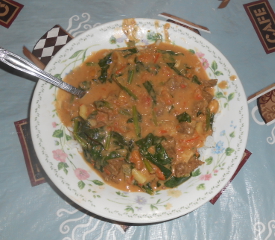
10) Look at the title of this recipe. Look at the above picture. The Swedes like yellow split peas. This means they prefer this color of split peas over green ones. Or . . .

11) Swedish have discovered a way to hurl their split peas at such a prodigious rate that the light emanating from their legumes appears yellow. That’s not quite as impressive as a red shift sure, but it’s some million times faster than the speediest military jet.

12) Sweden has not been at war for 200 years, even though two world wars raged all around it in the twentieth century. Why?

13) Sure Germany and Russia built impressive tanks, fighter planes and bombers. But no country’s military stands a chance against a nation that can fling hot, nearly molten split-pea soup toward it at over 100,000 miles an second.

14) Or even 50,000 miles a second. And Kaiser Wilhelm II, Hitler, and Stalin knew it. So they left it alone, even though that happy Nordic land has such wonderful pastries.

15) You can order this tasty soup when visiting Sweden, but I wouldn’t recommend it. Soup that travels that fast is impossible to eat. Best try making yellow pea soup from this recipe. Just be sure to buy yellow split peas that are stationary. Doing so isn’t always obvious. You might have to read the packaging for the peas.

– Paul De Lancey, The Comic Chef

My cookbook, Following Good Food Around the World, with its 180 wonderful recipes, my newest novel, Do Lutheran Hunks Eat Mushrooms, a hilarious apocalyptic thriller, and all my other books, are available on amazon.com.
Categories: cuisine, history, humor, international | Tags: , , , , , , , , , , , , , , , , , , , , , , , , , | Leave a comment

Mozzarella En Carrozza

Italian Appetizer

MOZZARELLA EN CARROZZA

INGREDIENTS – SAUCE*MozzellaEnCarrozza-

½ cup butter
3 anchovy fillets or ½ tablespoon anchovy paste or .3 ounces nori (seaweed)
2 tablespoons drained capers
2 teaspoons lemon juice
2 teaspoons parsley

* = Use marinara sauce instead, if you find both anchovies and seaweed to be icky.

INGREDIENTS – SANDWICH

12 slices ¼”-thick white Italian bread
1 pound mozzarella cheese
1 cup flour
½ cup milk
¾ cup fine bread crumbs
6 tablespoons olive oil
4 eggs

SPECIAL UTENSIL

parchment paper

Makes 12 little sandwiches. Takes 1 hour.

PREPARATION – SAUCE

Add butter to small pot. Melt butter using medium heat. Do not let it bubble. Stir frequently. Add anchovies, capers, lemon juice, and parsley. Stir until well blended. Turn off heat and cover.

PREPARATION – SANDWICH

Trim edges off bread slices so that you 5″ squares. Cut mozzarella into 6 equally thick slices. Slices should be square with 3″ edges. Put mozzarella squares on half of the bread squares. Put remaining bread slices on top of mozzarella squares.

Add flour to mixing bowl. Thoroughly coat sandwiches with flour. Add bread crumbs to plate. Add milk to a bowl. Briefly dip both sides of sandwich in milk. Seal cheese in sandwich by pressing the bread edges together. Dredge sandwich through bread crumbs until well coated. Place sandwiches on parchment-lined plate. (This prevents sandwich from sticking to plate.) Repeat for the remaining 5 sandwiches. Chill sandwiches in refrigerator for 40 minutes.

Beat eggs in mixing bowl until well blended. Briefly dip sandwiches into blended eggs. Add oil to frying pan. Heat oil at medium heat until it sizzles when a few bread crumbs are put in it. Put as many sandwiches as will fit in the frying pan. Sauté sandwiches at medium heat for 2-to-3 minutes on each side or until coated bread turns golden brown. (Sauté times tend to shorter a bit for each successive batch of sandwiches.) Repeat until all sandwiches are sautéeed. Drain sandwiches on paper towels. Cut sandwiches in two along the diagonal. Why the diagonal? I don’t know.

Serve immediately with sauce on the side.

TIDBITS

1) Pythagoras, the ancient Greek chef, loved to make grilled cheese sandwiches.

2) As who does not?

3) But Pythagoras made really, really good grilled cheeses. Philosophers from all over the Hellenic world flocked to his restaurant, Το Ψητό Τυρί.

4) The philosophic debates were of the highest order. Concepts such as: democracy, equal rights, rule of law, and cheese making got bandied about. Indeed, these debates made Greece the envy of the ancient Mediterranean world.

5) So much so that in the 2nd century B.C. Rome subjugated Greece for its grilled cheese sandwiches and democratic principles. For a long time, culinary historians remained divided on this conquests. Some held subjugating a people for democratic principles is an oxymoron like customer service or a working printers. Others averred that conquest is always a good thing as it facilitates the movement of great appetizers, entrees, and desserts to the conquering nation. As we all know, the Treaty of Versailles in 1919 settled this debate forever.

5) In 1776, America’s founding fathers emulated the Greek philosophers when they framed The Declaration of Independence and baked the first apple pie.

6) In 1812, Zorba of Piraeus found a clay tablet will plowing his field. The tablet showed how to prove the Pythagorean Theorem, i.e., α^2 + β^2 = γ^2.

7) This theorem revolutionized the world by making more students more students hate mathematics than ever before.

8) In 1820, the Turkish Sultan Abim Bam Bu decreed that Pythagorean theorem would henceforth be written using the Arabic alphabet.

9) Instructing Greek students in Arabic and Turkish had been tolerated. So had the Pythagorean theorem. But teaching the young ones the Pythagorean theorem in Arabic pushed the Greek parents over the edge and in 1821 the Greek populace revolted against their Turkish overlords.

10) The Greeks finally gained their independence in 1833, permitting the free travel of Greek chefs all over the world. We live in a golden age.

– Paul De Lancey, The Comic Chef

My cookbook, Following Good Food Around the World, with its 180 wonderful recipes, my newest novel, Do Lutheran Hunks Eat Mushrooms, a hilarious apocalyptic thriller, and all my other books, are available on amazon.com.

Categories: cuisine, history, humor, international | Tags: , , , , , , , , , , , , , , , , , , , , , , | 2 Comments

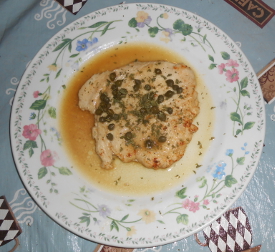
Chicken Piccata

Italian Entree

CHICKEN PICCATA

INGREDIENTSChickenPiccata-

4 (6 ounce) chicken breasts
3 tablespoons flour
⅛ teaspoon pepper
¼ teaspoon salt
¼ cup butter
2 tablespoons olive oil
2 table spoons chicken broth
¼ cup white wine
3 tablespoons lemon juice
2 tablespoons drained capers
1 tablespoon parsley

SPECIAL UTENSIL

kitchen mallet

Makes 4 plates. Takes 25 minutes

PREPARATION

Pound chicken breasts with kitchen mallet until they are ½” thick. Add flour, pepper, and salt to mixing bowl. Mix with fork or whisk. Dredge chicken through flour mixture.

Add butter to pan. Melt butter on medium heat. Stir frequently. Add olive oil. Add as many chicken breasts that will fit. Cover and sauté at medium heat for 2 minutes on each side or until chicken is cooked through. Repeat for remaining chicken breasts. Remove chicken breasts to serving plates. Add chicken broth. wine, and lemon juice to pan. Bring to boil at high heat. Boil for 2 minutes or until sauce starts to thicken. Stir frequently. Ladle sauce evenly over chicken breasts. Sprinkle capers and parsley evenly over sauce.

TIDBITS

1) The Gold Rush of 1849 drew poodles and oodles of French prospectors to California. Nineteenth-century French prospectors loved escargots. (Escargot is snail in English. The French have a word for everything.)

2) But California’s snails did not please the refined Gallic pallets. Mais non, suitable escargots had to be brought in from far-away New Orleans. Escargot trail drives were out. Snails do not last long under the hot Western Sun, especially before the invention of hydrating GatoradeTM. The Escargot Express was born. The most famous driver on this route was none other than Cacti Pa. Cacti loved chicken, wine, lemon juice, and capers. Station chefs along the route served him this entree, calling it “Piccata” in honor of the anagram loving Cacti Pa. And so it goes.

– Paul De Lancey, The Comic Chef

My cookbook, Following Good Food Around the World, with its 180 wonderful recipes, my newest novel, Do Lutheran Hunks Eat Mushrooms, a hilarious apocalyptic thriller, and all my other books, are available on amazon.com.

Categories: cuisine, history, humor, international | Tags: , , , , , , , , , , , , , , , , , , | Leave a comment

Basil Pesto Pizza

Italian Entree

BASIL PESTO PIZZA

INGREDIENTSBasilPestoPizza-

2 cups fresh basil
4 garlic cloves
3 tablespoons ground walnuts
¾ cup olive oil
¾ cup grated Parmesan cheese
¼ teaspoon white pepper

1 tablespoon flour
no-stick spray
1 pizza crust (bought or from below recipe)
1 cup grated mozzarella cheese

SPECIAL UTENSIL

pizza pan
pizza cutter

Makes 1 pizza. Takes 30 minutes plus time needed to preheat oven. Allow 2 hours 15 minutes total if you are making your crust.

PREPARATION

Preheat oven to 400 degrees. While oven heats, make basil pesto by dicing basil, garlic cloves, and walnuts. Add olive oil, basil, garlic, walnuts, Parmesan, and white pepper to pan. Sauté for 5 minutes at medium-high heat or until garlic softens. Stir pesto frequently. Remove from heat.

Dust pizza pan with flour and spray with no-stick spray. Put pizza crust on pizza pan. Spread basil pesto evenly over the pizza crust. Sprinkle mozzarella evenly over pizza. Put pizza in oven and bake at 400 degrees for 10-to-15 minutes or until cheese or crust is golden brown.

TIDBITS

1) Culinary historians say young Basil Rathbone was named after the herb, basil. Old Basil Rathbone was still named after the herb. In between, he got teased a lot. He took up acting in desperation, for no one cares if a successful actor acts weird or has a strange name. His brilliant performances in the Sherlock Holmes movies gave him that success. The teasing stopped.

2) But the inner anguish from his teasing did not. Then one day while in Spain filming for the movie, The Name Escapes Me, he met a little boy selling basil pesto pizza. It was excellent. Basil Rathbone spread the delicious recipe everywhere he went.. No longer would the little Basils of the world be teased. The actor was even nominated for a Nobel Peace Prize. And the little boy? Why, he became Juan Carlos I of Spain, the man who ended Generalísimo Franco’s brutal dictatorship.

– Paul De Lancey, The Comic Chef

My cookbook, Following Good Food Around the World, with its 180 wonderful recipes, my newest novel, Do Lutheran Hunks Eat Mushrooms, a hilarious apocalyptic thriller, and all my other books, are available on amazon.com.
Categories: cuisine, history, humor, international | Tags: , , , , , , , , , , , , , , , , , , , , , , | Leave a comment

Quiche Lorraine

French Entree

QUICHE LORRAINE

INGREDIENTSQuiche Lorraine-

1 pastry pie shell (follow instructions)
8 ounces bacon (leanest is best)
4 ounces Gruyère cheese
4 eggs
1½ cups heavy whipping cream
¼ teaspoon nutmeg
⅛ teaspoon pepper
¼ teaspoon salt

SPECIAL UTENSIL

pie tin

Makes 1 quiche. Takes 1 hour. A quiche is not a quickie.

PREPARATION

Preheat oven to 375 degrees. Trim excess fat from bacon. Fit puff pastry into pie tin. Use knife to trim all pastry that goes beyond the top edge of the pie tin. Add bacon to pan. Fry bacon using medium-high heat for 10 minutes or until bacon is cooked but not yet crispy. Remove and put on towel-covered plate to remove grease. Cut bacon into ½ squares. Sprinkle bacon squares onto puff pastry in pie tin. Grate cheese. Sprinkle cheese over bacon squares.

Add eggs, whipping cream, nutmeg, pepper, and salt to large mixing bowl. Blend thoroughly with whisk. Pour the egg/cream/spice mix over the cheese. Bake quiche in over at 375 degrees for 45 minutes or until toothpick inserted into the middle of the quiche comes out clean. Let quiche cool for about 10 minutes.

TIDBITS

1) In May, 1789, inmates of L‘Andouille Prison in Lorraine, France petitioned the Supreme Court to stop whipping, because it hurt even more than a stubbed toe. The judges, having lost their heads in affirming the use of the guillotine against jaywalkers, decided a bit of mercy wouldn’t be amiss. They ordered that prisoners be coated with cream before being whipped to take out the sting.

2) Whipping the cream coated convicts made whipping cream. Pierre Le Fou added this whipping cream to his daily ration–French prison life was not all bad–of bacon, Gruyère cheese, eggs, nutmeg, pepper, and salt and made the fist quiche Lorraine. Next time, he poured the mix not on his hand, but in a pastry pie shell. This was the first quiche Lorraine. The recipe spread to the Bastille prison. On July 14, food lovers stormed the Bastille for the convicts’ quiche Lorraines. King Louis XVI repressed the mob with muskets. The Parisians reacted with fury. The French Revolution was born. Blood would flow. Excesses would happen, but quiche Lorraine became available for all.

– Paul De Lancey, The Comic Chef

My cookbook, Following Good Food Around the World, with its 180 wonderful recipes, my newest novel, Do Lutheran Hunks Eat Mushrooms, a hilarious apocalyptic thriller, and all my other books, are available on amazon.com.

Categories: cuisine, history, humor, international | Tags: , , , , , , , , , , , , , , , , , , , , , | Leave a comment

Blog at WordPress.com.