international

Provoleta

Argentinian Appetizer

PROVOLETA

INGREDIENTS

8″ baguette (optional)
1½ pounds provolone cheese
¼ cup olive oil
1 tablespoon oregano
½ teaspoon red pepper flakes
¾ teaspoon salt
grill spray or cooking spray

SPECIAL UTENSIL

outdoor grill

Serves 4. Takes 20 minutes plus optional 5 hours.

PREPARATION – OPTIONAL

Dry cheese out on a rack for 5 hours. This helps the cheese keep its shape when grilled.

PREPARATION – MAIN

Cut baguette into circles 1″ thick. Cut cheese into slices ¾” thick. Place olive oil into mixing bowl. Add cheese slices. Turn cheese slices until they are thoroughly coated with oil. Sprinkle cheese, then gently press oregano, red pepper flakes, and salt into cheese slices.

Spray grill liberally with grill spray. Set grill to 450 degrees or medium heat. Grill for 2 minutes or until bottom side browns. Lift cheese slices off grill and spray grill again. Flip cheese slices. Grill for another 2 minutes or until the new bottom browns. DO NOT let cheese slices fall apart or even lose their shape.

While cheese browns on both side, toast both sides of the baguette slices. Eat cheese by itself or on toasted baguette slices. Provoleta goes well with Argentinian chimichurri sauce,

TIDBITS

1) The Mormons first settled Utah in 1847. Mormon leaders soon realized that their colony needed many more settlers to survive. The word went out from Utah for Mormons in the U.S. and around the globe to make their way to this new dessert sanctuary. Indeed, many Mississippian Mormons mounted covered wagons and headed west. But the original message became more and more corrupted the farther it went. By the time it reached Leta, Argentina, the decree simply said, “More men.” So lusty, Argentinian cheese making men headed to Provo, Utah thinking the message meant Utah had too many unwed señoritas. The cheese makers liked what they saw in Provo and decided to stay. They made a new cheese which they called Provoleta to honor their new and old homes.


– Paul De Lancey, The Comic Chef, Ph.D.

My cookbook, Following Good Food Around the World, with its 180 wonderful recipes, my newest novel, Do Lutheran Hunks Eat Mushrooms, a hilarious apocalyptic thriller, and all my other books, are available on amazon.com.

Categories: cuisine, history, international | Tags: , , , , , , , , , , , , , , , , , , , , , , | Leave a comment

Indio Viejo From Nicaragua

Nicaraguan Entree

INDIO VIEJO

INGREDIENTS

1 green bell pepper (1 more later)
10 garlic cloves
2 pounds skirt steak, flank steak, chuck, or chicken breast
1 onion (2 more later)
1 green bell pepper
2 onions
5 tomatoes
2 tablespoons vegetable oil
2⅓ cups masa harina or 12 corn tortillas
3 tablespoons sour orange juice or lemon juice
1 teaspoon achiote powder or sweet paprika
1 teaspoon pepper
1 teaspoon salt
2 tablespoons fresh mint, spearmint, or cilantro

SPECIAL UTENSIL

sonic obliterator

Serves 6. Takes 1 hour 50 minutes.

PREPARATION

Seed 1 green bell peppers. Cut each garlic clove into four pieces. Add meat, garlic cloves, 1 green bell pepper, 1 onion, and enough water to cover to large pot. Bring to boil using high heat . Reduce heat to low and simmer for 1 hour 30 minutes or until meat is tender to the fork. Strain and reserve meat/garlic/bell pepper/onion. Save broth.

30 minutes before meat should be tender, seed 1 green bell pepper. Dice 1 green bell pepper, 2 onions, and tomatoes. Add diced bell pepper, onion, tomatoes, and vegetable oil to large pan. Sauté at medium-high heat for 5 minutes or until bell pepper and onion soften. Add reserved meat/garlic/bell pepper mix, masa harina, sour orange juice, achiote, pepper, and salt. Stir constantly while adding enough reserved broth it obtains the consistency of a thick stew. Simmer on low for 10 minutes or until there are no flour lumps. Stir constantly. Dice mint. Garnish with mint. Use sonic obliterator on guests, who after you’ve cooked for three hours, complain that this dish would go well with rice or fried plantains.

TIDBITS

1) Your kitchen needs a sonic obliterator, like the one here. Buy one now.


– Paul De Lancey, The Comic Chef, Ph.D., travel guru

My cookbook, Following Good Food Around the World, with its 180 wonderful recipes, my newest novel, Do Lutheran Hunks Eat Mushrooms, a hilarious apocalyptic thriller, and all my other books, are available on amazon.com.


Categories: cuisine, international | Tags: , , , , , , , , , , , , , , , , | Leave a comment

Bragioli (Maltese Stuffed Beef Rolls)

Maltese Entree

BRAGIOLI
(Stuffed Beef Rolls*)

INGREDIENTS – BEEF ROLL

2 pounds topside, bottom, or round steak
6 slices bacon
2 garlic cloves (3 more cloves later)
⅔ cup fresh parsley
2 hard boiled eggs
¼ cup bread crumbs
½ teaspoon pepper
¾ teaspoon salt
2 tablespoons olive oil (2 tablespoons more later)

INGREDIENTS – SAUCE

1 carrot
3 garlic cloves
3 medium onions
3 medium tomatoes
2 tablespoons olive oil
2 bay leaves
⅔ cup red wine

Serves.4. Takes 2 hours 40 minutes.

SPECIAL UTENSILS

kitchen mallet
kitchen twine or toothpicks
sonic obliterator (Why is this not in your kitchen?)

* = The best, or at least most common, translation is really “Beef Olives.” Apparently, many people think rolls look like olives. This interpretation has over 500 years of history behind it Indeed, the word olive was sometimes used a verb, as in to olive, roll up, some ingredient. Now you know.

PREPARATION – BEEF ROLL

Cut steak into 12 slices. Pound beef slices with mallet to make them thinner and flatter. Dice bacon. Dice 2 garlic cloves and parsley. Cut each egg into 6 slices. Add bacon, 2 diced garlic cloves, bread crumbs, parsley, pepper, and salt to mixing bowl. Mix with hands until this stuffing is thoroughly blended.

Top a beef slice with 2 tablespoons stuffing. Place 1 egg slice on bacon/bread crumb mixture. Roll up beef slices lengthwise over stuffing. Secure rolled-up steak, bragioli with kitchen twine or toothpicks. Repeat for each bragioli Add 2 tablespoons olive and bragiolis to large pot. Sauté at medium-high heat until bragiolis turn slightly brown. Turn bragiolis enough to ensure even browning. Remove bragiolis from pot.

PREPARATION – SAUCE

Dice carrot, 3 garlic cloves, onions, and tomatoes. Add 2 tablespoons olive oil, 3 diced garlic cloves, and onion to same pot. Sauté at medium-high heat for 5 minutes or until onion softens. Stir frequently. Add carrot, tomato, bay leaves, and red wine. Simmer at low heat for 10 minutes. Stir enough to prevent burning. Add bagiolis back to pot.

Bring to boil using high heat. Stir enough to prevent burning. (Gently, don’t break open the bagiolis.) Simmer at low-medium heat for 45 minutes or until sauce thickens. Remove bay leaves. Serve to adoring quests. Zap unappreciative ones with your sonic obliterator. You don’t need negativity in your kitchen.

TIDBITS

1) This recipe uses eggs. Each egg is to be cut into six slices. This is easy to do if the egg is three inches long. Why, each slice would be one-half-inch thick. That’s easy to measure, but three-inch long eggs are hard to find, especially ones that come from hens.

2) Okay, what about an egg that is 1-8/9 inches long. Divide that by six and you get slices that should 17/54 inches wide. How the heck, do we measure that on a standard ruler? I’ll bet no ruler has ever been made that divides inches into 54 equal parts.

3) So what do we do? I’m glad you asked. 17/9 inches equals 4.8 centimeters. Divide that by six and you get 0.8. It’s a snap to measure that on a metric ruler. But how did we get the metric system?

4) From the French Revolution. French chefs everywhere ran into considerable delays when the aristocrats suddenly wanted their meal portions to include exactly one sixth of an egg. We don’t have rulers that measure in fifty-fourths now. It’s certain that pre-revolutionary chefs didn’t either. So cutting eggs became much problematic.

5) Problems in dividing eggs meant long delays in making the aristocrats’ favorite dishes. This enraged the impatient French nobility. Gourmet chefs all over Paris found themselves chucked into prisons especially the Bastille.

9) The French elite still clamored for their exquisite meals But there were no more gourmet chefs. But where would the aristocracy find new chefs? From the bakeries. This action, however, meant a shortage of bakers to mean bread.

10) So Paris suffered a bread shortage. Incensed Parisian mothers stormed the bakeries for anything they could find. A hungry mob gathered. It stormed the Bastille to release the imprisoned chefs. The French Revolution had begun. Desiring stability, the Revolutionary government of France converted to the metric system. France is now a stable country.

12) America is not metric. We are sitting on a powder keg.


Paul De Lancey, The Comic Chef, Ph.D.

My cookbook, Following Good Food Around the World, with its 180 wonderful recipes, my newest novel, Do Lutheran Hunks Eat Mushrooms, a hilarious apocalyptic thriller, and all my other books, are available on amazon.com.

Categories: cuisine, history, international | Tags: , , , , , , , , , , , , , , , , , , , , , , , , , | Leave a comment

Gado Gado

Indonesian Appetizer

GADO GADO
(Vegetable Salad)

INGREDIENTS
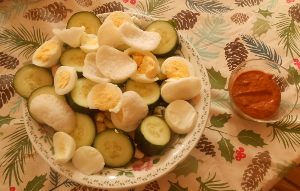
¾ pound Yukon gold or new potato
3 eggs
½ head Chinese cabbage or Napa cabbage
1¼ cups spinach
1¼ cups bean sprouts (aka mung beans)
½ pound tofu
2 tablespoons peanut oil or sesame oil
½ cucumber
8 prawn crackers*
1 cup peanut sauce or satay sauce

Serves 4. Takes 1 hour.

* = Some prawn crackers can be served as is. Others need to be deep fried. If so, please follow instructions on package.

PREPARATION

Add enough water to pot to cover potatoes. Bring to boil. Add potatoes. Boil potatoes for 20 minutes using medium-high heat. Remove potatoes and set aside. While potatoes boil, add enough water to 2nd pot to cover eggs. Bring water to boil using high heat. Carefully add eggs. Boil eggs for 6 minutes if soft-boiled eggs are desired or for 12 minutes if you want hard-boiled eggs. Remove eggs from heat and seat aside.

Add enough water to 3rd pot to cover cabbage, spinach, and bean sprouts. Bring to boil. While water comes to boil, dice or shred cabbage and spinach. Add spinach and bean sprouts to pot. Let boil for 30 seconds. Remove spinach and beansprouts with slotted spoon and transfer to large mixing bowl. Add cabbage to pot. Let boil for 2 minutes. Remove cabbage with slotted spoon and transfer to mixing bowl with spinach and bean sprouts. Add ice cubes and cold water. Let sit for 2 minutes. Remove veggies with slotted spoon and pat dry with paper towel.

Cut tofu into 1″ cubes. Add tofu and oil to pan. Sauté on medium-high heat for 15 minutes or until all sides turn golden brown. Stir frequently to ensure even browning. Remove from heat. Cut cucumber into slices ½” thick. Cut potatoes into ½” cubes. Peel eggs and cut each one into 4 slices.

Add cabbage, spinach, and bean sprouts to large serving bowl. Toss veggies with forks. Arrange potato cubes evenly over veggies. Do the same, one ingredient at a time, for the tofu cubes, cucumber slices, egg slices, and prawn crackers. Divide the peanut sauce into 4 small bowls, 1 for each guest. Guests then add peanut sauce as desired to the top of their salad.

TIDBITS

1) Gado Gado is Indonesian.

2) Gado Gado is anagram for A dog, a dog. It’s also an anagram for A god, a god. And even one for O dga, o dga.

3) Dga is, of course, the plural form for dgum.

4) Only the Latin language changes um to a to make a noun plural. The Ancient Romans spoke Latin. These way-back Romans worshiped gods.

5) They only worshiped gods that looked like people. But they were aware of the gods worshiped in other lands. Such as the dga, the dog gods of what is now Olduvai Gorge.

6) This is a long train of thought, so feel free to have coffee and doughnuts.

7) Anyway, Lucy of Olduvai Gorge is the first known human. Dr. Mary Leakey discovered Lucy’s skull on July 17, 1959. Lucy had a pet dog. She called it Dgma. It’s skeleton was discovered 42 years later under a rusty lunch box left behind by the site’s original excavators.

8) Okay, we now have enough information to trace humanity’s history from then to now.

9) Lucy’s tribe, possessing a limited vocabulary, took to calling all dogs Dgma.

10) Over the millennia, Lucy’s and Dgum’s descendants traveled ever northward. Along the way, because there really nothing else to do but walk, these hardy trekkers decided to worship dogs. Prehistoric shrines to Dgma trace the great northward walk.

11) By 1786 BC, the dgma worshipers reached Egypt. Little Osibis, daughter of Ramses II, saw one of the dogs. “Father, would you buy me that dog?” asked Osibis, “I shall call it Annubis.”
“Well okay,” said the ruler of all Egypt, “ but don’t go asking me to make it a god.”
“Ooh, that’s a good idea.” Osibis clapped her hands. “Make it a god or I shall cry.”
And so softy Ramses added Annubis to Egypt’s horde of gods.

12) In 48 BC, Julius Caesar arrived in Egypt, fought a bit, and took the Queen Cleopatra back with him to Rome. Cleo wanted to take all her dogs with her. Caesar said just one.
“Very well,” said Cleopatra, “I shall bring this dgma.”
“No, said Julius, “The singular form of dgma is dgum. The Romans will kill me if I left you butcher their language.”

13) But Cleo never did change the dog’s name to Dgum. This incensed Brutus, an ardent grammarian, so much that he assassinated Caesar. Rome would become an empire and go on to conquer the world.

14) Dog worship did make it to long-ago Indonesia. Those ancient people, all hardy anagramists, changed the chant “O god, o god” to “Gado, gado.” Gado Gado became the name of the food eaten after morning devotions. Then other stuff happened over the centuries and here we are.


– Paul De Lancey, The Comic Chef, Ph.D.

My cookbook, Following Good Food Around the World, with its 180 wonderful recipes, my newest novel, Do Lutheran Hunks Eat Mushrooms, a hilarious apocalyptic thriller, and all my other books, are available on amazon.com.

Categories: cuisine, history, international | Tags: , , , , , , , , , , , , , , , , , , , , , , , , , | 2 Comments

Cut Rounds

British Dessert

CUT ROUNDS

INGREDIENTS

7 teaspoons baking powder
3¼ cups flour (4 tablespoons more later)
⅓ cup milk powder
½ teaspoon salt
¼ cup softened butter
1⅓ cups buttermilk
2 tablespoons flour (2 tablespoons more later)
2 tablespoons flour

SPECIAL UTENSIL

baking sheet

Makes 12. Takes 50 minutes.

PREPARATION

Preheat oven to 400 degrees. Add baking powder, 3¼ cups flour, milk powder, and salt to large mixing bowl. Mix gently with fork until well blended. Rub butter into flour until you get tiny breadcrumbs.

Use fist to make a well in the middle of the tiny breadcrumbs. Knead gently with hands only until you just get a dough ball. (Don’t use electric beater.) If the dough is dry, add just enough extra buttermilk to make dough soft. Dust flat surface with 2 tablespoons flour. Add dough ball to flat surface. Roll dough out into a log that is 3″ wide. Cut round log into 12 pieces. (This is why this dessert is called cut rounds.) Press pieces into a round shape ¾” thick.

Dust baking sheet with 2 tablespoons flour. Place cut rounds on baking sheet. (Don’t let them touch.) Bake in oven at 400 degrees for 20 minutes or until rounds have risen and turned golden brown. Split rounds in half. (This is why they are sometimes called splits.) Rounds go well with cream and jam on them. Use clotted cream if you can get it.

TIDBITS

1) Cut rounds are round. If the jam and the cream that often go inside them were replaced with surveillance devices you could conduct a 360˚ observation. In general, enemy countries are always on the alert for our eavesdropping..

2) But no one would ever suspect a Cut Round. It’s so yummy. So, I propose that the CIA put cameras and listening devices in Cut Rounds and leave them wherever we need to glean foreign intelligence. You could ask the CIA if they already employ Cut Rounds, but they tend not to tell the public things as it is, after all, a top-secret organization.


Paul De Lancey, The Comic Chef, Ph.D.

My cookbook, Following Good Food Around the World, with its 180 wonderful recipes, my newest novel, Do Lutheran Hunks Eat Mushrooms, a hilarious apocalyptic thriller, and all my other books, are available on amazon.com.

Categories: cuisine, international | Tags: , , , , , , , , , , , , , , | Leave a comment

Liboke Ya Mbika (Chicken with Pumpkin Seed Flour)

Congolese Entree
(Democratic Republic of Congo)

LIBOKE YA MBIKA
(Chicken with Pumpkin Seed Flour)

INGREDIENTS

¾ pound boneless chicken parts
1 garlic clove
1 small onion
2 tablespoons olive oil
1 bay leaf
2 cups vegetable stock
1 cup pumpkin-seed flour* or almond or all-purpose flour
1 teaspoon ginger
½ teaspoon nutmeg
1 teaspoon parsley
½ teaspoon red pepper flakes
½ pound fresh banana leaves**

* = Finding pumpkin-seed flour in stores can be difficult. It can be ordered on line.

** = Finding fresh banana leaves is impossible whether you live Fargo, North Dakota or even in my fair city, Poway, California. In this case, buy the frozen banana leaves from specialty markets. If that too is impossible, use tin foil instead. Life can be hard, sorry.

SPECIAL UTENSILS

8-quart pot
aluminum foil, about 10 square feet
cookie sheet
sonic obiliterator

Serves 4. Takes 2 hours 20 minutes.

PREPARATION

Cut chicken into ½” cubes. Mince garlic clove and onion. Add olive oil, chicken, garlic, onion, and bay leaf to 1st large pot. Sauté for 5 minutes at medium-high heat or until garlic and onion soften. Stir frequently. Add 2 cups vegetable stock or enough to covered ingredients in pot. Bring to boil using high heat. Stir occasionally. Remove chicken. Shred or crumble chicken. Reserve broth with garlic and onion. Discard bay leaf.

While vegetable stock boils, add pumpkin-seed flour, ginger, nutmeg, parsley, and red pepper flakes to mixing bowl. Gradually ladle stock from pot to mixing bowl. Mix with hands. Keep adding water until you a firm but pliable dough. Add chicken. Knead dough once more.

Cut banana leaves into 6″ squares. (Use aluminum foil as a substitute.) Add 1½ tablespoons of the chicken/onion dough to each square. Close banana leaves around dough to make a banana-leaf ball. (If banana leaves don’t close well, wrap banana leaves with foil.)

Preheat oven to 225 degrees. Add enough water to pot to cover the banana-leaf balls you will be making. Bring to boil using high heat. Add banana-leaf balls to pot. Let boil using high heat for 45 minutes. (Add water as necessary to cover banana-leaf balls.) Remove banana-leaf balls. Place these balls on cookie sheet. Bake in oven at 225 degrees for 15 minutes to remove moisture from the dough inside the banana leaves.

Serve to appreciative guests. If they give you any guff at all about this magnificent creation of yours, zap them with your sonic obliterator. You don’t need that kind of negativity in your life.

TIDBITS

1) As a chef, you stimulate your creative forces by creating one dazzling dish after another.

2) Cooking is also immensely therapeutic. It simply gives you no time to dwell on all the woes in your life. Those moments where you failed at something and those times where strife entered your life all melt away when you assemble your latest culinary masterpiece. You will lift your face to the heavens and thunder, “Yes. Cooking is good. Life is good. Yes, yes, yes.”

3) Then there are those other culinary moments, the time things go wrong, when guests complain, when the red mist descends upon you. You must disintegrate that stew that accidentally got two cups of salt instead of 2 teaspoons. Or even those cases where you want to off uncouth guests who complained you didn’t use pumpkin flour or fresh banana leaves in your Liboke Ya Mbika.

4) But murder is wrong. You’ve known that most of your life. That’s a major reason why you became a cook. All your murderous impulses sublimate themselves in the pounding of the bread dough, in the slicing of the onion, in and the grating of the cheese brick.

5) But yet some guest will carp over the tin foil you used. You yearn to do him in. Of course, the police will find the guest’s’ body. Unless the officer on the spot is also a cook and knows what you went through, it’s best not to leave a body behind

6) This downward spiral explains why all kitchens carry a sonic obliterator. The sonic obliterator, well, completely obliterates the offending oaf. No body. No jail time. Easy peasy.

7) But in your heart of hearts, you really don’t want to obliterate rude guests. No! Simply obliterate that glass of wine they’re holding. That’ll get their attention. I guarantee they’ll stop complaining. Serenity will return to your kitchen. The now quiet guests will tuck into your Liboke Ya Mbika and, lo and behold, notice how absolutely tasty it really is. “Why, this is the food of the gods,” they’ll say. You will become their best friend. They will become your pals. Together, you will solve all the problems of the world. Life is good. Life is good. And we will all owe it to your judicious use of a sonic obliterator. Now you know.


Paul De Lancey, The Comic Chef, Ph.D.

My cookbook, Following Good Food Around the World, with its 180 wonderful recipes, my newest novel, Do Lutheran Hunks Eat Mushrooms, a hilarious apocalyptic thriller, and all my other books, are available on amazon.com.

Categories: cuisine, international, murder | Tags: , , , , , , , , , , , , , , , , , | Leave a comment

Kachumbari (Kenyan Tomato Onion Salad)

Kenyan Appetizer

KACHUMBARI
(Tomato Onion Salad)

INGREDIENTS

½ cup fresh cilantro
1 medium red onion
4 tomatoes
½ cucumber
1 red chile
1¼ teaspoons salt
1 cup water
1 avocado
1½ tablespoons lime juice
1 tablespoon olive oil

Serves 4. Takes 20 minutes.

PREPARATION

Dice cilantro, red onion, and tomatoes. Peel and dice cucumber. Seed and mince red chile. Add diced red onion and salt to small mixing bowl. Mix with hand until red-onion bits are well coated with salt. Add water. Let red onion soak for 10 minutes. Drain red onion.

Peel, seed, and dice avocado. Add all ingredients to large mixing bowl. Toss with fork until well blended.

TIDBITS

1) One of the most unsung trade routes of the Late Middle Ages, according to culinary, historians, was for Kenyan Kachumbari in exchange for Florentine wool. The Kenyans, or another name for Kenyans as historians had another name for the natives who lived then, prized Florentine wool.

2) For the Kenyans, made excellent KevlarTM type vests out of this most excellent wool. These vests proved impenetrable to all spears, arrows, swords, and knives. Kenya could never be conquered as long as it preserved the secret to making their vests. Unfortunately, in 1632, a kitchen maid, Machupa Mwangi, used the papers containing the secret vest formula to line her pie tins. These papers did not survive the baking. A few years later, Omani Arabs conquered Kenya. Kenya would not regain its independence for over 300 years. Bummer.

3) Florentine painters used Kachumbari to make vibrant landscapes. Unfortunately, these paintings had to be small as the ingredients of Kachumbari were quite perishable. (I don’t know how the Kenyan caravaners kept their avocados, which normally go bad in a few days, fresh on their months-long trek north. Modern scientists are eager to rediscover this lost art.) But one morning, Lorenzo Rotini, discovered paints could be made from minerals and plants. And they would last long enough to produce even the largest paints. The Renaissance began the very next day. Huzzah!


– Paul De Lancey, The Comic Chef, Ph.D.

My cookbook, Following Good Food Around the World, with its 180 wonderful recipes, my newest novel, Do Lutheran Hunks Eat Mushrooms, a hilarious apocalyptic thriller, and all my other books, are available on amazon.com.

Categories: cuisine, history, international | Tags: , , , , , , , , , , , , , , , , , , , , | Leave a comment

Japanese Steak Bowl

Japanese Entree

STEAK BOWL

INGREDIENTS

1⅓ cups rice
2⅔ cups beef broth
¼ teaspoon pepper
1 pound sirloin steak or New York strip steak
1 tablespoon vegetable oil (1 tablespoon more later)
2 tablespoons butter
2 garlic cloves
1 small onion
1 tablespoon vegetable oil
½ tablespoon mirin or sake
3 tablespoons soy sauce
2 teaspoons Worcestershire sauce
1 tablespoon fresh parsley

SPECIAL UTENSILS

rice cooker
mandoline

Serves 4. Takes 45 minutes.

PREPARATION

Add rice and beef broth to rice cooker. Cook rice and beef broth according to instructions that come with rice cooker or on rice package . While rice cooks, rub pepper onto steak. Add steak and 1 tablespoon oil to pan. Cook steak over high heat for 7-to-14 minutes depending on your desired level of doneness. (Steaks resist pressure from a finger ever more as they go from raw to medium well.) Flip 4 times to ensure even cooking. Add butter. Flip steak until it is evenly coated with butter. Cook for 1 minute. Cut steak into ¼” thick slices.

While steak cooks, mince garlic cloves. Use mandoline or knife to onion into slices ⅛” thick. Add garlic, onion, and 1 tablespoon oil to pan. Sauté at medium-high heat for 5 minutes or until onion softens.

While rice and steak cook, add mirin, soy sauce, and Worcestershire sauce to mixing bowl. Stir with whisk or fork until well blended. Dice parsley. Divide rice equally into serving bowls. Ladle sauce from mixing bowl over rice. Garnish rice with parsley. Carefully add beef strip/onion mixture onto rice. Enjoy.

TIDBITS

1) Steaks can’t bowl as they’ve no athletic ability. But they can be served in a bowl like in this dish.


– Paul De Lancey, The Comic Chef, Ph.D.

My cookbook, Following Good Food Around the World, with its 180 wonderful recipes, my newest novel, Do Lutheran Hunks Eat Mushrooms, a hilarious apocalyptic thriller, and all my other books, are available on amazon.com.

Categories: cuisine, international, observations | Tags: , , , , , , , , , , , , , | Leave a comment

Scrambled Eggs (Revoltillo de Huevos)

Dominican Breakfast

SCRAMBLED EGGS
(Revoltillo de Huevos)

INGREDIENTS

1 bell pepper, red or yellow
1 small onion
1 large tomato
2 tablespoons olive or vegetable oil
6 eggs
⅛ teaspoon pepper
½ teaspoon salt

Serves 3. Takes 20 minutes.

PREPARATION

Dice bell pepper, onion, and tomato. Add oil, bell pepper, onion, and tomato to pan. Sauté at medium-high heat for 5 minutes or until onion softens. Stir frequently. Remove pan from heat. Add eggs to mixing bowl. Beat eggs with whisk or fork until well blended. Add eggs to pan. Cook at medium heat until eggs set and are done to your liking. Stir slowly and frequently enough to prevent burning. Sprinkle scrambled eggs with pepper and salt.

TIDBITS

1) This version of scrambled is truly tasty. It’s also visually appealing. This dish was not invented by Andy Warhol, the famous pop artist. No indeed, Pedro Castillo invented Revoltillo de Huevos in the early 1960s. But until then he had been a rather conventional egg scrambler.

2) But one with communist leanings and sympathies. So, he filled his life with everything red including the flags of the USSR and China. And roses. His wife liked the roses but detested his politics. “Your communism constantly brings the government down on us,” said Maria. “The policía shut down our huevoria every week.” This marital discord came to a head when Pedro brought home 100 pounds of red bell peppers to throw during the upcoming anti-government demonstration. “¿Estas loco?” Maria pummeled her husband. “They will surely jail you for this. Get rid of those red veggies or we’re through.”

3) Pedro loved his wife than any people’s revolution, but he was also thrifty. How to use the red bell peppers? Suddenly, lightning struck his head. (Pedro was quite tall.) The bolt’s electrical surge reordered the synapses in his brain. “Aha, “I shall add diced red bell peppers to my scrambled eggs.” And so Revoltillo de Huevos was born. A few days later, Andy Warhol ate this dish at Pedro’s huevoria. The inspired, but unknown Warhol unveiled Revoltillo de Huevos at a museum. He became an instant sensation. Warhol shared his Revoltillo royalties with Pedro. Pedro and Maria lived out their lives as a rich and happy couple. The end.


– Paul De Lancey, The Comic Chef, Ph.D.

My cookbook, Following Good Food Around the World, with its 180 wonderful recipes, my newest novel, Do Lutheran Hunks Eat Mushrooms, a hilarious apocalyptic thriller, and all my other books, are available on amazon.com.

Categories: cuisine, history, international | Tags: , , , , , , , , , , , , , , | Leave a comment

Kulfi Ice Cream

Indian Dessert

KULFI ICE CREAM

INGREDIENTS

10 saffron threads
1 tablespoon hot water
2 cups heavy whipping cream
1 14-ounce can sweetened condensed milk, chilled
½ cup ground cardamom
⅔ cup chopped pistachios
⅓ cup chopped or slivered almonds

SPECIAL UTENSILS

electric beater.
ramekins, small bowls, or popsicle molds

Serves 8. Takes 25 minutes plus at least 6 hours for freezing..

PREPARATION

Add saffron and hot water to cup. Add heavy whipping cream to large mixing bowl. Whip with electric beater until just get whipped cream or soft peaks start to form. (Do not overdo it or you’ll get butter.) Use spatula to gradually fold condensed milk into whipped cream. Use spatula to gradually fold in saffron with its water, cardamom, pistachios, and almonds. Gently pour into ramekins. Cover ramekins with plastic wrap or lids. Freeze for at least 6 hours on until it sets and becomes ice cream.

TIDBITS

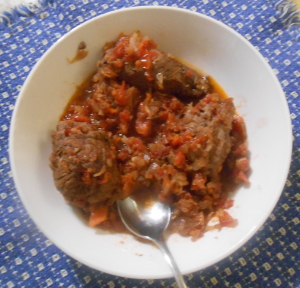
1) Clark KentTM and SupermanTM are never in the same place at the same time. Why? Because they are the same person. Kulfi Ice Cream and the planet Mars are never in the same place at the same time. Why? Because they are one and the same. They certainly look alike. See the photos below.


2) But, I hear you say, Mars is millions of miles away in space and my kulfi is right in front of me. How is this possible? Magic. When you eat kulfi, Mars is in your ramekin. When you look at the night sky, Mars will be there. Mars, however, won’t be in the sky if you take your kulfi outside with you. So be careful. You don’t want to mess with the workings of the Solar System.


– Paul De Lancey, The Comic Chef, Ph.D.

My cookbook, Following Good Food Around the World, with its 180 wonderful recipes, my newest novel, Do Lutheran Hunks Eat Mushrooms, a hilarious apocalyptic thriller, and all my other books, are available on amazon.com.
Categories: cuisine, international | Tags: , , , , , , , , , , , , , , , , , | Leave a comment

Create a free website or blog at WordPress.com.