Posts Tagged With: thriller

Turkish Salad

Turkish Appetizer

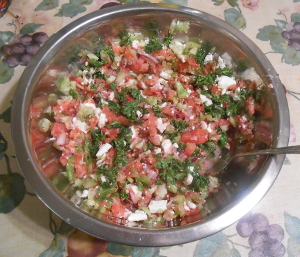
TURKISH SALAD

INGREDIENTS
1 cucumber
1 green bell pepper
1 red onion
3 tomatoes
1 garlic clove
6 ounces feta cheese
2 tablespoons fresh mint
⅔ cup fresh parsley
3 tablespoons lemon juice
2 tablespoons olive oil
⅛ teaspoon pepper
¼ teaspoon salt

Serves 8. Takes 25 minutes.

PREPARATION

Peel cucumber. Seed green bell pepper. Dice cucumber, green bell pepper, red onion, and tomatoes. Mince garlic clove. Crumble feta cheese. Add cucumber, green bell pepper, red onion, and tomato to large serving bowl. Toss ingredients in bowl. Sprinkle feta cheese on top. Toss ingredients lightly.

Mince mint and parsley. Add mint, parsley, lemon juice, olive oil, pepper, and salt to small mixing bowl. Mix with fork until well blended. Pour this dressing over salad in serving bowl. Toss lightly.

TIDBITS

1) It is both enjoyable to eat well. It also necessary to be clean. Clean people needn’t worry about repelling loved ones and friends whenever the wind wafts your scent toward them. But why not have it all? Why not dine well and be squeaky clean? May I suggest a Turkish bath? They’re great fun. You and your 123 closest friends relax in room filled with hot air. This warmth causes healthy perspiring and gives you time to order your meal and sup.* Then cool yourself down with nice, refreshing, cold water.

2) * – But oh my gosh, be sure to tailor you menu choices to the type of Turkish bath. The Islamic hamman variety uses steamy air. This experience lends itself to eating steamed vegetables and steamed hot dogs and buns. When there, do not, do not, order the Turkish salad shown in this recipe. The steamy atmosphere wilts the lettuce something fierce. No if you wish this dish, without having to bolt down, you’d be much better off in a Victorian Turkish bath where the air is dry. Indeed, the well-known British love of salad and bathing, explains why there are only Victorian Turkish baths in that country. Now you know.

Chef Paul

My cookbook, Following Good Food Around the World, with its 180 wonderful recipes, my newest novel, Do Lutheran Hunks Eat Mushrooms, a hilarious apocalyptic thriller, and all my other books, are available on amazon.com.

Categories: cuisine, international | Tags: , , , , , , , , , , , , , , , , , , | Leave a comment

Pabellón Criollo

Venezuelan Entree

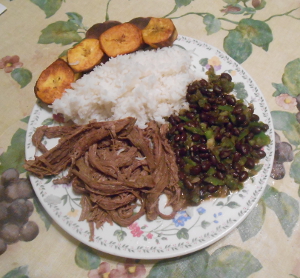
PABELLÓN CRIOLLO

INGREDIENTS – PULLED MEAT

3 garlic cloves (2 more cloves later)
1 medium onion
1 tomato
2 pounds flank steak
1 bay leaf
¼ teaspoon cumin (¼ teaspoon more later)
1 teaspoon oregano
¼ teaspoon pepper (¼ teaspoon more later)
3 quarts water (or enough to cover ingredients)

INGREDIENTS – BLACK BEANS

2 garlic cloves
1 small onion
¼ cup olive oil or oil (¼ cup more later)
1 green bell pepper
1 15-ounce-can black beans
¼ teaspoon cumin
¼ teaspoon pepper
½ teaspoon salt

INGREDIENTS – RICE & PLANTAINS

1⅓ cups rice
2 plantains or bananas
½ cup olive oil or oil

SPECIAL UTENSILS

3-quart pot
4 plates with 3 sections. These are mighty hard to find if you’re looking for them at the last moment.
sonic obliterator

Serves 4. Takes 2 hours 50 minutes.

PREPARATION – PULLED MEAT

Dice 3 garlic cloves, medium onion, and tomato. Add diced garlic, onion, tomato, flank steak, bay leaf, ¼ teaspoon cumin, oregano, ¼ teaspoon pepper, and enough water to cover ingredients. Bring to boil using high heat. Cover and reduce heat to low. Simmer for 2 hours 30 minutes or until meat is tender to the fork. Remove and discard bay leaf. Remove meat and place on plate. Pull flank seat apart with forks. Save stock for future soups.

PREPARATION – BLACK BEANS

While flank steak simmers, mince 2 garlic cloves and small onion. Seed and dice green bell pepper. Add garlic, onion, green bell pepper, and ¼ cup olive oil to pan. Sauté at medium-high heat for 5 minutes or until onion softens. Stir frequently. Add black beans, ¼ teaspoon cumin, ¼ teaspoon pepper, and salt. Reduce heat to low and simmer for 20 minutes. Stir occasionally.

PREPARATION – RICE & PLANTAINS

About 30 minutes before flank steak should be ready to be pulled apart, cook rice according to instructions on package. Peel plantains. Cut plantains into slices 1″ wide diagonally along the length of the plantain. Add plantain and ½ cup oil to pan. Sauté slices for 3 minutes on each at medium heat or until plantain softens and browns.

PREPARATION – FINAL STEP

This step is much easier if you have a plate that is divided into 3 sections. Carefully add enough pulled flank steak to make a pie wedge that takes up ⅓ of the plate. Carefully add enough beans next to the flank steak to make a pie wedge taking up ⅓ of the plate. Carefully add (Yes, you are doing things carefully here.) enough rice to take up the remaining ⅓ of the plate. Add ¼ of the plantain slices to the outside of the rice pie-wedge.

Zap, with your sonic obliterator, any guests who fail to appreciate just how much heart and soul went into the preparation of this dish.

TIDBITS

1) This dish, pabellón criollo, is enormously popular, among Venezuelans. So much so, that Venezuelans will bring the ingredients for this dish wherever they travel or migrate.

2) And boy, they sure have migrated. On May 1, 16,870 BC priests revealed to the proto-Venezuelans that their gods would be having a millennium-long jamboree in a land beyond the Great Mother Sea. Of course, everyone knows the best time to petition gods is when they’ve been drinking, eating pulled beef, and dancing and singing up a storm.

3) So, all the proto-Venezuelans took to their rafts and floated and paddled their way down the east coast of South America, suffered ice storms in the Straights of Magellan, endured fresh-water deprivation, and got eaten by gigantic sharks and whales.

4) All of which sucked, especially when compared to jamboreeing with the gods. So once there, the proto-Venezuelans stayed and planted rice. This is how rice came to India, Vietnam, China, and Japan.

5) The proto-Venezuelans were pretty happy. Then the gods’ beer ran out. The deities became surly and hurled thunderbolts and really hard bread rolls at the humans.

6) Life sucked again. Enough to brave the perils of an ocean voyage back home. This is how peoples from Asia settled the Americas, not by the headline hunters who crossed the land bridge from Siberia to Alaska.

Chef Paul

My cookbook, Following Good Food Around the World, with its 180 wonderful recipes, my newest novel, Do Lutheran Hunks Eat Mushrooms, a hilarious apocalyptic thriller, and all my other books, are available on amazon.com.

Categories: cuisine, history, international | Tags: , , , , , , , , , , , , , , , , , , , , , , , , , | Leave a comment

Gambian Domoda (Peanut Stew)

Gambian Entree

DOMODA
(Peanut Stew)

INGREDIENTS

1 cup rice
1½ pounds chicken breasts or beef
2 green chiles
1 large onion
¾ pound pumpkin, sweet potato, or butternut squash
3 Roma tomatoes
2 tablespoons vegetable oil
2 cups vegetable stock*
1¼ cups smooth peanut butter
3 tablespoons tomato paste
¼ teaspoon pepper

* = To be authentic, try to use MaggiTM bouillon cubes. Maggi is ubiquitous in Africa.

Serves 6. Takes 1 hour 30 minutes.

PREPARATION

Cook rice according to instructions on package. Cut chicken into ½” cubes. Seed chiles. (Or leave them in if you wish a spicier stew.) Dice chiles, onion, pumpkin, and tomatoes.

Add chile, onion, and vegetable oil to pan. Sauté at medium-high for 5 minutes or until onion softens. Stir frequently. Add chicken cubes. Cook at medium-high heat for 5 minutes or until chicken is no longer pink. Stir frequently. Add diced tomato and vegetable stock. Bring to boil using high heat. Stir occasionally. Reduce heat to low for 5 minutes. Stir occasionally. Add peanut butter, pumpkin, tomato paste and pepper. Stir occasionally. Bring to boil using high heat. Stir occasionally. Reduce heat to low and simmer for 40 minutes or until pumpkin is tender. Stir just enough to prevent burning. Serve over rice.

TIDBITS

1) Baby cows say, “moo.” They also have dads. So, you might imagine that little cows would also say, “Moo, Dad.” And you would be right.

2) But only for the cows being raised in Roswell, New Mexico. These are super-intelligent, alien cows. Their spaceship crashed there in 1947. As the US military always takes a keen interest in brilliant bovines, a deal was soon made. In return for regular milking–Cows cannot milk themselves no matter how intelligent they might be–the alien cows showed us how to completely and forever thwart nuclear attack. Something to be grateful for when you pour milk on your morning cereal.

Chef Paul

My cookbook, Following Good Food Around the World, with its 180 wonderful recipes, my newest novel, Do Lutheran Hunks Eat Mushrooms, a hilarious apocalyptic thriller, and all my other books, are available on amazon.com.
Categories: cuisine, history, international | Tags: , , , , , , , , , , , , , , , , , , | Leave a comment

Squid Ink Spaghetti

Italian Entree

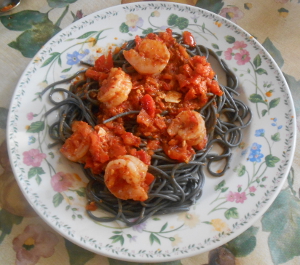
SQUID INK SPAGHETTI

INGREDIENTS

10 ounces squid-ink spaghetti*
4 garlic cloves
3 Roma tomatoes
2 tablespoons fresh basil
½ cup fresh parsley
¼ cup olive oil
6 ounces nduja**
½ cup white wine
1 pound large shrimp, peeled and deveined

* = Sorry, you really need to get squid-ink pasta. You can make your own pasta, but then you’ll need to find squid ink. Squid-ink spaghetti may be found online or in specialty stores.

** = This is a spreadable Italian salami. It may be ordered online or found in specialty stores. In a pinch, puree pepperoni.

Serves 4. Takes 20 minutes.

PREPARATION

Cook squid-ink spaghetti according to directions on package. While spaghetti cooks, mince garlic. Dice tomatoes, basil, and parsley. Add garlic and olive oil to pan. Sauté garlic at medium-high heat for 5 minutes or until garlic softens. Stir frequently.

Add tomato and nduja. Reduce heat to medium. Stir until nduja breaks into little bits and you get a meaty sauce. Add white wine and shrimp. Sauté at medium heat for 4 minutes or until shrimp turns pink or orange. Stir frequently. Garnish with basil and parsley.

TIDBITS

1) Squid ink is hard to locate. However, Milk is easy to find. I remember when milkmen used to deliver milk to our door. It was a golden age for milk drinkers.

2) When I was twelve, I lived in Holland. The milkman there delivered milk, butter, eggs, soup, and beer. It was a global, golden age.

3) Why can’t we have another golden age? Why can’t we have milk, eggs, and beer delivered to our door? Do we want to wake up without milk? Do we want the inebriated driving to the store to get their beer? And may we, pretty please, have the milkmen deliver squid-ink pasta so that all cooks around the world can make this entree at any time? That would truly be the greatest golden age ever.

Chef Paul

My cookbook, Following Good Food Around the World, with its 180 wonderful recipes, my newest novel, Do Lutheran Hunks Eat Mushrooms, a hilarious apocalyptic thriller, and all my other books, are available on amazon.com.

Categories: cuisine, international | Tags: , , , , , , , , , , , , , , , , , , , , | Leave a comment

Lemongrass and Five Spice Tofu

Vietnamese Appetizer

LEMONGRASS AND FIVE SPICE TOFU

INGREDIENTS

2 stalks lemongrass
3 garlic cloves
1¼ pounds firm tofu
1 cup vegetable oil (2 tablespoons more later)
2 tablespoons vegetable oil
½ teaspoon red chile flakes
1 teaspoon Chinese five spice
¼ teaspoon white pepper or pepper
½ tablespoon soy sauce

PREPARATION

Discard all but the tender, inner and lower, green part of the lemongrass stalks. Mince garlic cloves and remaining lemongrass. Slice tofu into 8 long rectangles. Pat dry with paper towel. Add 1 cup vegetable oil to pan. Heat oil at high heat until a tiny bit of tofu in the oil will start to dance. Carefully add tofu rectangles to pan. Fry tofu rectangles for 8 minutes or until golden brown and crispy on the bottom. Turn over once. Fry for 4 minutes or until golden brown and crispy on the new bottom. (Monitor the tofu carefully as the time between golden brown and crispy can be short.) Remove tofu and drain on paper towels.

Add 2 tablespoons vegetable oil to 2nd pan. Add garlic, lemongrass, and red chile flakes. Sauté at medium heat for 2 minutes or until lemongrass is tender and fragrant. Stir frequently. Add Chinese five spice, white pepper, and soy sauce. Mix until well blended. Add tofu rectangles. Sauté at low-medium heat for 2 minutes. Turn over once. Place 2 tofu rectangles on each plate. Carefully spoon sautéed lemongrass/garlic from pan over tofu rectangles.

Serves 4. Takes 45 minutes.

TIDBITS

1) It’s startling to hear this now, but for centuries, perhaps even millennia, lemons grew on grass rather than on trees. The reason for this change and other  ensuing culinary changes was war.

2) The British navy had been losing thousands and thousands of sailors to scurvy. In 1753, the British conducted controlled experiments to find a cure for this dread scourge. They strongly concluded that lemon juice would keep scurvy at bay. A scant forty-two years later, the British Admiralty began issuing daily rations of lemon juice. Scurvy disappeared! The navy could indefinitely blockade Napoleon’s ships and keep him from invading England. It was all so neat. Unfortunately, the Admiralty’s lemon mowers cut so much lemon grass that ground lemons were on the brink of extinction. Botanists stepped in and grafted lemons onto trees. This process worked well that the lemons developed seeds that would sprout into full-blown lemon bearing trees. History is such fun.

Chef Paul

My cookbook, Following Good Food Around the World, with its 180 wonderful recipes, my newest novel, Do Lutheran Hunks Eat Mushrooms, a hilarious apocalyptic thriller, and all my other books, are available on amazon.com.
Categories: cuisine, history, international | Tags: , , , , , , , , , , , , , , , , , , , , , | Leave a comment

Natilla

Colombian Dessert

NATILLA

INGREDIENTS

1 cup whole milk* (4 more cups later)
1¼ cups cornstarch
4 cups whole milk
2 cinnamon sticks
⅛ teaspoon ground cloves
1 panella (Mexican brown sugar) or 2 cups brown sugar
½ cup condensed milk
1 tablespoon butter, softened
½ cup grated coconut
1 teaspoon ground cinnamon

* = Whole milk really is needed. Without it, the cornstarch can’t make this dessert set.

SPECIAL UTENSIL

8″ * 8″ baking dish

Serves 9. Takes 2 hours 40 minutes.

PREPARATION

Add 1 cup whole milk and cornstarch to mixing bowl. Blend with whisk until cornstarch dissolves completely. Set aside. Add 4 cups whole milk, cinnamon sticks, ground cloves, and panella to pot. Cook on medium heat for 10 minutes or until panella melts. Stir often. When mixture starts to boil, add condensed milk. Stir enough to keep mixture from burning.. Remove cinnamon sticks.

Add cornstarch/milk mixture to pot. Reduce heat to low and simmer for 10-to-25 minutes or until liquid is very thick, is hard to stir, and you can see the bottom of the pot when you stir. Stir this natilla mixture constantly. Gently fold in butter and coconut. Pour natilla mixture into baking dish. Sprinkle with ground cinnamon. Refrigerate for 2 hours or until set.

TIDBITS

1) Attila the Hun was originally named Wholemilk the Hun because he loved whole milk. He’d never drank sissy skim milk. In 434, a Byzantine diplomat, seeking to widen Wholemilk’s taste range, gave WTH–Wholemilk the Hun, not What The Heck–100 jars of skim milk. This enraged WTH so much that he invaded the Byzantine Empire. He also invaded Persia, the Western Roman Empire, and various Germanic kingdoms floating around the west; moderation not being one of his strong points. In desperation, Pope Leo I, in 452, offered him the wonderful dish shown here if he’d just go home. WTH liked it so much that he overate and died. Pope Leo became Pope Leo the Great and Wholemilk became Attila, a near anagram of natilla, the saving dessert of Europe.

Chef Paul

My cookbook, Following Good Food Around the World, with its 180 wonderful recipes, my newest novel, Do Lutheran Hunks Eat Mushrooms, a hilarious apocalyptic thriller, and all my other books, are available on amazon.com.

Categories: cuisine, history, international | Tags: , , , , , , , , , , , , , , , , , , , , | 2 Comments

Icelandic Crepes (Pönnukaka)

Icelandic Entree

ICELANDIC CREPES
(Pönnukaka)

INGREDIENTS

4 tablespoons butter
3 eggs
2 cups milk
2 tablespoons sugar
½ teaspoon baking powder
¼ teaspoon baking soda
1 teaspoon ground cardamom
1¾ cups flour
12 ounce jar lingonberry jam
1 cup whipped cream
2 tablespoons confectioner’s sugar
no-stick spray

Makes 16 crepes. Takes 50 minutes.

SPECIAL UTENSIL

crepe pan or skillet

PREPARATION

Melt butter in skillet. Let butter cool. Add cooled butter, eggs, milk, and sugar to large mixing bowl. Mix with whisk for 1 minute or until thoroughly blended. Add baking powder, baking soda, cardamom, and flour to second mixing bowl. Mix these dry ingredients with whisk. Gradually fold in the baking powder/baking soda/cardamom/flour mix into the butter/
eggs/milk/sugar bowl. Mix with whisk. Batter is ready when lumps disappear.

Add drop of water to pan. Turn heat to medium-high. Pan is ready when water sizzles. Spray pan with no-stick spray. Pour ¼ cup batter into pan. Tilt pan or use spatula to make sure batter spreads thinly and evenly. Cook first crepe at medium-high heat for 1 minute or until bottom of crepe turns golden brown. (X-ray vision helps. If you do not possess this skill, gently lift up the edges of the crepe with a spatula and take a peek.) Turn crepe over with spatula, a wide one is helpful, and cook for 1 minute or until golden brown. Or turn over crepe when bubbles break it surface. Remove crepe from pan. Repeat for each crepe. (Note the temperature needed to turn crepes golden brown will go down with each successive crepe.)

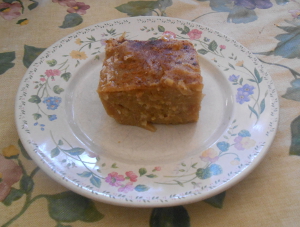
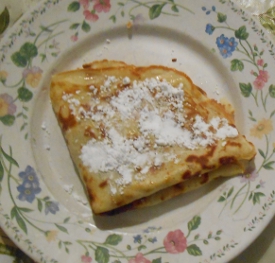
Place 1 tablespoon whipped cream and 1 tablespoon lingonberry jam on the middle of each crepe. Fold in half to make a half-moon shape. Fold in half again to make a pie wedge. Press down gently to spread lingonberry and whipped cream through crepe. Top with ½ teaspoon confectioner’s sugar. Repeat for each crepe. Serve right away.

TIDBITS

1) More than half of all Icelanders believe in elves! Icelandic music companies have a bias in signing musicians who profess to believing in elves. It is said the elves will defend their rocky homes by using magic powers. Bulldozing companies sometimes arbitrate with elves in hopes of getting the wee people to leave. I would love to see this.

2) The Yule Lads are Iceland’s answer to Santa Claus. While the story around Santa Claus originated from a real person, Saint Nicklaus; the Yule Lads descended from evil trolls. Indeed, parents tormented wild children with, “The Yule Lads will get you if you don’t behave.” However, the Powers That Be made this form of parenting illegal in the 18th century. Now, the Yule Lads are relatively benign even though they sport names such as Bowl Licker and Window Peeper.

3) Today, kids are tormented by Internet outages.

4) Britain and Iceland nearly went to war three times over the right to fish for cod near the Icelandic shores. Something to think about when munching on a fish stick.

5) This tidbit did not survive editing.

6) Icelanders love to play midnight golf during June and July when the day is twenty-four hours long. There are lava beds on some Icelandic golf courses. Is there a lava-bed wedge in Icelandic golf bags? I don’t know.

7) Ice melts when dropped into any one of Iceland’s volcanoes.

8) Indeed, ice melts in any of the world’s volcanoes.

9) Cheese sandwiches burn rapidly when placed in an active volcano. That’s a bad way to toast your cheese sandwiches. Indeed, doctors everywhere recommend against this cooking technique, citing near certain incineration of the chef.

10) This is why Iceland has no gourmet toasted-cheese sandwich restaurants close to active volcanoes, not even for tourists.

11) Can Iceland’s magical elves survive the intense heat of an active volcano? If so, they could toast cheese sandwiches. Sure, Iceland’s elven chefs would have to have incredibly quick and skilled hands. But wouldn’t a volcano-fired golden brown cheese sandwich be way cool?

12) I left enough space below for a scratch pad.

Chef Paul

My cookbook, Following Good Food Around the World, with its 180 wonderful recipes, my newest novel, Do Lutheran Hunks Eat Mushrooms, a hilarious apocalyptic thriller, and all my other books, are available on amazon.com.
Categories: cuisine, international | Tags: , , , , , , , , , , , , , , , , , | Leave a comment

Corn On The Cob

American Entree

CORN ON THE COB

INGREDIENTS

¼ cup fresh basil
¼ cup butter, softened
1 tablespoon grated Parmesan cheese
⅛ teaspoon pepper
¼ teaspoon salt
4 ears corn, in their husks

Serves 4. Takes 35 minutes.

SPECIAL UTENSILS

aluminum foil
outdoor grill                                                                                              Modern food, ancient weapons.

PREPARATION

Dice basil. Add all ingredients save corn to mixing bowl. Mix with whisk until well blended. Peel back corn husks most of the way and remove corn silk. Brush corn with buttery blend. Close husks over ears. Tightly wrap corn in aluminum foil. Preheat outdoor grill to medium-high heat. Place foil-wrapped corn on grill. Grill for 20 minutes or corn is tender to the fork. Remove corn and place on plate. Let sit for 5 minutes or until cool enough to handle. Remove husks.

TIDBITS

1) Since the dawn of time, people have been trying to hurt each other. At first, combatants made scary faces. However, all cavemen had scary faces and all fights ended in draws. Then Ogg, an intellectual giant for his time, dislodged the bugs in his hair and let a stiff wind carry the little critters onto his opponents’ face. Exactly, 1,217 years later Ogg LXII found if he lifted up his arms, the wind would waft the ripe odor from his armpits toward his foes, knocking them out instantly.

2) However, this Oggian technique relied rather heavily upon getting the wind at one’s back. However, this secret would soon be discovered by all cavemen a scant two millennia later. Cavemen would dance around each other trying to get the wind advantage. Indeed, Ogga, Ogg CXI’s wife, found herself grabbing Ogg and whirling around, trying to get the upper hand. But then, she found this close-quarter dancing with her husband to be great fun. It caught on with all cave couples. The waltz, and all other forms of dancing, had been invented.

3) Three millennia later, Ogg CCCXXXIII, discovered how to grow corn. This act revolutionized warfare. The corn cob, with its hard kernels, delivered a vicious migraine, extended the attacker’s reach, and most of all, eliminated the role of wind in combat. Migraine battles proliferated. Then, in the Bronze Age, Ogg DCIV figured out how to make swords. The mighty corn cob lost its position on the battlefield, but not in our meals. We eat corn cobs to this day. There you go.

Chef Paul

My cookbook, Following Good Food Around the World, with its 180 wonderful recipes, my newest novel, Do Lutheran Hunks Eat Mushrooms, a hilarious apocalyptic thriller, and all my other books, are available on amazon.com.
Categories: cuisine, history | Tags: , , , , , , , , , , , , , , , | Leave a comment

Bulgogi (Barbecued Beef)

Korean Entree

BULGOGI
(Barbecued Beef)

INGREDIENTS – MARINADE

4 garlic cloves
1 green onion
1 nashi pear or bosc pear
1⅓ pounds sirloin, beef tenderloin, or rib eye
1½ tablespoons brown sugar
1 teaspoon ginger
¼ teaspoon pepper
1½ tablespoons rice wine or sake
¼ cup soy sauce

INGREDIENTS – REST

½ leek
1 medium yellow onion
1 teaspoon sesame seeds

SPECIAL UTENSILS

mandoline (useful, but not essential)
wok (or large pan)

Serves 4. Takes 2 hours 40 minutes..

PREPARATION – MARINADE

Mince garlic cloves. Dice green onion. Peel, core, and grate or dice pear. Slice sirloin into strips ⅛” thick. Then cut strips into 3″-by-1″ rectangles. Add all marinade ingredients to mixing bowl. Toss ingredients until sirloin rectangles are well coated. Cover and marinate in refrigerator for 2 hours.

PREPARATION – REST

While sirloin rectangles, marinate, dice onion. Use mandoline or knife to slice leek and onion into strips ⅛” thick. Add sesame seeds to pan. Toast sesame seeds at medium heat for 5 minutes or until they start to brown. Stir occasionally. Reserve sesame seeds.

Add sirloin with its marinade, leek, and onion to wok. Heat at high heat for 4 minutes or until sirloin browns and is cooked to your liking. Stir occasionally. Garnish with toasted sesame seeds.

TIDBITS

1) Bulgogi is made with sesame seeds.

2) Sesame seeds look like bugs.

3) Bugs move. All the time. Don’t even think of asking them to pose for a portrait.

4) So when scientists want to examine a particular, fixed pattern of bugs, they use sesame seeds in place of the bugs.

5) Or “in lieu of” of the bugs. “In lieu of” sounds fancier than “in place of,” don’t ya think?

6) Anyway, these bug patterns can consist of up to two-million sesame seeds. These large patterns can take sixty sesame-placers a whole year to construct.

7) So, when someone sneezes on the intricate sesame-seed pattern, the bug scientists (entomologists, another cool word) get rather irate.

8) On May 4, 1937, the famed aviator, Amelia Earhart, visited the prestigious American Institute of Sesame Seed Patterns (AISSP) to raise funds for her round-the-world-by-air adventure.

9) Ms. Earhadt wowed the men of the institute. Massive funding from AISSP was promised.

10) Then Amelia sneezed. A gale-force sneeze. 1,223,768 carefully seeds scattered all over the room.

11) Just two more sesames seeds had been needed to form the needed sesame pattern. At which point, photographs would have been taken.

12) Analysis of these photographs would have enabled entomologists to eradicate grasshopper plagues. Massive swarms of these insects had wiped out North Dakotan agriculture in 1935 and that of Montana a year later.

13) Ms. Earhart became deeply unpopular. Indeed, torch-carrying sesame-entomologists chased her to her plane. She quickly started her Model 10-E Electra and decided to start her round-the-world flight. If she had more time, she could have gotten a plane with more sophisticated communications and a longer range.

14) Alas, she, her navigator, Fred Noonan, and her plane disappeared on July 2, 1937.

15) Ten years later, Amos Keeto, photographer from the Paducah Post, realized that he taken a quick picture of Amelia at the AISSP. He was sure that the picture’s background would show the nearly completed sesame pattern. Unfortunately, he’d given the picture to the famed aviator as a keepsake just before she left on her fatal journey.

16) If only that picture could be retrieved, we could figure out how to stop all insect-caused crop failures forever. This is why we keep searching for Amelia Earhart and her plane.

Chef Paul

My cookbook, Following Good Food Around the World, with its 180 wonderful recipes, my newest novel, Do Lutheran Hunks Eat Mushrooms, a hilarious apocalyptic thriller, and all my other books, are available on amazon.com.

Categories: cuisine, history, international | Tags: , , , , , , , , , , , , , , , , , , , , , , , , | Leave a comment

Deep Fried Mars Bars

British Dessert

DEEP FRIED MARS-TM BARS

INGREDIENTS

1 cup flour
½ teaspoon salt
½ cup water
¼ cup seltzer water
¼ teaspoon baking powder
5 chilled Mars bars (worldwide version) or Milky WayTM (American version)
4 cups vegetable oil or enough to cover Mars bar in deep fryer

SPECIAL UTENSILS

deep fryer Two aliens on a flying saucer
tongs

Serves 5. Takes 50 minutes.

PREPARATION

Add flour, salt, water, seltzer water, and baking powder to mixing bowl. Mix with whisk until well blended. Cover and let sit for 30 minutes.

Pour batter into tall glass. Add oil to deep fryer. Heat oil to 375 degrees. Use tongs to dip Mars bar into tall glass. Remove and let excess batter drip off. Use tongs to place coated Mars bar in deep fryer. Fry for 2 minutes or until bars turn golden brown and become crisp. Remove from oil with tongs. Place deep-fried bar on paper towel and pat dry. Repeat for remaining bars.

TIDBITS

1) MarsTM was first produced by Forrest Mars in 1932. It’s sparked religious interest ever since.

2) Mars is the Roman god of war. Technically, the deity could have sued Mr. Mars for copyright infringement, but didn’t. Many culinary theologians have argued that a living god of war would certainly challenged Forrest Mar’s logo appropriation. Therefore, Mars doesn’t exist. Once we accept Mars non-existence, belief in all the other Roman gods dissolves. And indeed, the number of people worshiping Roman gods after 1932 has been pretty darn close to zero.

3) The American Mars bar ceased production in 2002, came back, stopped production in 2011, and finally came back online 2017. Its composition and size has varied over the decades. Culinary theologians hypothesize that these observable events led to widespread believe in reincarnation.

4) Currently, the Muslim community of Australia is debating halal certification for Mars bars.

Chef Paul

My cookbook, Following Good Food Around the World, with its 180 wonderful recipes, my newest novel, Do Lutheran Hunks Eat Mushrooms, a hilarious apocalyptic thriller, and all my other books, are available on amazon.com.

Categories: cuisine, history, international | Tags: , , , , , , , , , , , , , , , , , , | Leave a comment

Create a free website or blog at WordPress.com.