Posts Tagged With: Alps

Roast Beef with Yorkshire Pudding

British Entree

ROAST BEEF WITH YORKSHIRE PUDDING

INGREDIENTS – ROAST BEEF
3½ pounds top sirloin or rib roast
1 teaspoon pepper
1 teaspoon salt (¼ teaspoon more later)
2 garlic cloves
3 tablespoons olive oil
½ tablespoon rosemary

INGREDIENTS – YORKSHIRE PUDDING

4 eggs
1 cup flour
¼ teaspoon salt
1 cup milk

SPECIAL UTENSILS

wire rack
roasting pan
cooking thermometer
aluminum foil
8″ * 8″ casserole dish

MEAT DONENESS

This recipe assumes that the center cut will be medium-rare and the end cuts more well done. But you can roast to your desired level of doneness. A rule of thumb has the following meat temperatures for the following cuts: Rare = 125, medium rare =135, medium = 145, medium well =155, and well done = 160.

Serves 8. Takes 2 hours 15 minutes.

PREPARATION – ROAST BEEF

Preheat oven to 475 degrees. Rub sirloin with pepper and 1 teaspoon salt. Mince garlic cloves. Add garlic, olive oil, and rosemary to small mixing bowl. Mix with fork. Rub sirloin with olive oil/garlic mixture.

Put wire rack in roasting pan. Put sirloin on wire rack. Roast at 475 degrees for 20 minutes. (Roasting is similar to baking but at a higher temperature.) Reduce heat to 375 degrees and roast
until meat thermometer in middle of sirloin registers your desired level, about 1 hour. (Please note that different ovens and different thicknesses of meat will make roasting time vary. Pay attention to the meat thermometer.) Place roasted sirloin on plate and cover with aluminum foil. Save drippings.

PREPARATION – YORKSHIRE PUDDING

After you put sirloin to oven, add eggs to cup. Beat eggs with whisk. Add flour and ¼ teaspoon salt to large mixing bowl. Mix with whisk. Add eggs. Mix with whisk until well blended. Gradually pour in milk, whisking while doing so until you get a smooth batter with the thickness of heavy cream. Let sit until roast beef needs to be removed from oven.

After removing roast beef from oven, raise oven temperature to 425 degrees. Add ¼ cup reserved drippings to casserole dish. Put casserole dish in oven. Heat drippings for 15 minutes or until drippings start to smoke. (Save drippings remaining after this step. Put casserole dish on stove top. (Carefully! The casserole dish contains hot oil.) Ladle batter to casserole dish. (Again, do this carefully.) Bake at 425 degrees for 15 minutes or until batter puffs up and becomes golden brown.

PREPARATION – FINAL

Ladle any remaining drippings over roast beef. Carve the roast beef. (End cuts should be more well done than the center cuts.) Serve roast beef and Yorkshire pudding right away.

TIDBITS

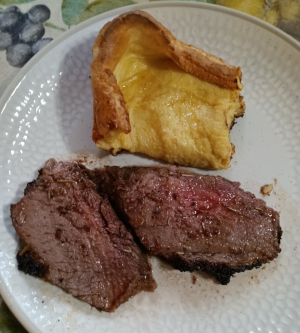
1) The above picture shows a corner piece of the Yorkshire pudding. Notice how two edges of this piece puff up way higher than the rest of the pudding. In fact, doesn’t the entire corner piece look like a meadow full of golden wheat ripe for harvesting all set against two majestic mountains?

2) This is no accident. People have want to know what different places of the world looked like. Before the age of cameras, the only real way to depict landscapes and mountains was to paint them. But painting was slow and laborious. Making pigments for the paint colors cost lots of money. Finding the proper clays and pigment bases proved daunting as well.

3) By the time the client who’d commissioned a field of grain swishing in the wind before the Alps, he could already traveled to the Alps. Alps painting languished. Travel to Switzerland fell to zero.

4) Then in 1777, Chef Hans Gasthaus made Yorkshire Pudding for some British nobility. Hans noticed his pudding looked exactly like the wheat field and Alps outside the kitchen window. Hans journeyed from Alpine town to Alpine town skillfully making Yorkshire pudding that looked exactly like the local fields and mountain. He ‘dlet these creation dry out and send them to British tour guides.

5) Penurious British lords took to displaying their pudding art in their manors. After all, pudding art cost much less than a painting. Other chef painters turned out great pudding sceneries. It was the golden age of Yorkshire Pudding landscapes.

6) Alas, the French Revolution and the Napoleonic wars soon broke out. These bloody wars ruined everything. Flour, milk, and eggs which had powered the Yorkshire Pudding Landscape Revolution (YPLR) got diverted to feed the rampaging armies on the continent.

14) Yorkshire Pudding Art died forever. Our world became forever grayer. Hardly any (YPLR) examples remain. But if you can find an antique Yorkshire pudding, keep it. They’re worth millions.


Paul De Lancey, The Comic Chef, Ph.D.

My cookbook, Following Good Food Around the World, with its 180 wonderful recipes, my newest novel, Do Lutheran Hunks Eat Mushrooms, a hilarious apocalyptic thriller, and all my other books, are available on amazon.com.

Categories: cuisine, history, international | Tags: , , , , , , , , , , , , , , , , , , , , , , , , , , , | Leave a comment

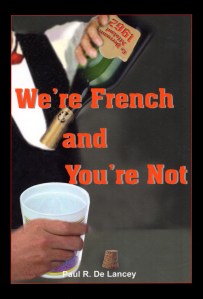
We’re French and You’re Not – Chapter One – Chardonnay Man – Part 3

1:55 p.m.: Mon Dieu! We arrive at our balloon minutes before the start of the race. Jean and I tumble into the basket. Pow! The starting gun fires. Jean starts the flame, so that our balloon will rise. But we are not going anywhere! We have neglected to untie our balloon.

Neither Jean nor I are sober enough to get out of the basket and untie the rope. What are we to do? Jean solves things by sticking his newspaper into the flame. He then sets fire to the rope with the burning newspaper. This maneuver works marvelously well and we soon soar into the heavens. We hear angry voices yelling down below. It seems that the fire from the rope is spreading to a nearby café. We shrug our shoulders, set the balloon on automatic pilot, and open our first bottle of champagne. We look forward to a fine race.

12 November, 10 a.m.: I wake up first and peer cautiously over the basket. It appears that we are over the town of Avignon. Well, I think I recognize the famous Pont d’Avignon. I awaken Jean and tell him our location. Jean marvels that we cleared the southern French Alps without incident. Our balloon’s automatic pilot and automatic navigational devices are working splendidly. We wonder for a moment how our competitors manage without them. We are now eating a simple breakfast of fresh croissants, a small omelette, and Perrier.

Noon: It is lunchtime, so we prepare lunch. We have Gruyère cheese, apples and onion soup. We drink a couple bottles of Chateauneuf du Pape, 1922. We look over the edge of the basket and would you believe it, we are over the town of Chateauneuf du Pape. We celebrate this coincidence by throwing eggs at people in the marketplace. These good-natured jests are the things that make races fun for all.

3 p.m.: We amuse ourselves by shooting at birds that land on our balloon. In a way, it is unfortunate that we are drinking so much or our aim would be better.

7 p.m.: We celebrate reaching Valence with a splendid dinner. We start with crab legs and cheese fondue, then trout à la Jean, beef bourguignon, and eclairs for dessert. We complement this satisfying meal with four bottles of Dom Perignon, 1953. Oh yes, for an after-dinner activity we examine the countryside. Jean notices that we have progressed another 100 kilometers. Splendid!

10:30 p.m.: Jean and I spend the night drinking wine and identifying constellations. I win this game by identifying Orion twenty times to Jean’s eighteen. Poor Jean, the clouds block Orion during two of his turns.

13 November, 9 a.m.: Apparently we are scudding over the city of Lyon. We don’t care much for Lyon. Suddenly, Jean spies a McDonald’s below us. What an affront to French cuisine! We bombard the place with our empty bottles and other trash. Below us, we hear the whine of converging police sirens. We also see the manager shooting his rifle at us. Ha! Ha! It appears that the police are lovers of good cuisine, as they are taking away the stupid manager of the stupid McDonald’s. We thumb our noses at your les hamburgers and your les fries!

Noon: Strong southwesterly winds blow us to the town of Besançon. We celebrate by using Doubs cheese in our magnificent omelettes. We have Kronenbourg with our lunch. This is the only time that we shall drink beer during the race. One needs to clear the palate at times.

4 p.m.: We have been heading northwest for a while. In doing so, we pass over the glorious Champagne region. We honor the land below by drinking champagne for the entire afternoon. I suggest that it would be a fine idea to gaze upon the glorious vineyards. Tears come to our eyes.


Paul De Lancey, The Comic Chef, Ph.D.

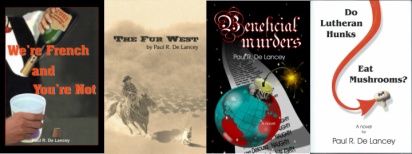
We’re French and You’re Not, my cookbook, Following Good Food Around the World, with its 180 wonderful recipes, my newest novel, Do Lutheran Hunks Eat Mushrooms, a hilarious apocalyptic thriller, and all my other books, are available on amazon.com.
Categories: Uncategorized, We're French and You're Not | Tags: , , , , , , , , , , , , , , , , , , , , , , , , , , , , , , , , , | Leave a comment

Hibiscus Tea (Jus de Bissap)

Malian Appetizer

HIBISCUS TEA
(Jus de Bissap)

INGREDIENTShibiscustea

1 cup dried hibiscus flowers
6 cups water
1 cup sugar
1 teaspoon vanilla extract
1 tablespoon fresh mint leaves

SPECIAL UTENSIL

colander

Makes 4½ cups. Takes 30 minutes

PREPARATION

Add water to lst large pot. Bring water to boil using high heat. Add hibiscus flowers Reduce heat to medium-high. Boil for 20 minutes or until water becomes aromatic and turns dark red. Strain red liquid through colander into 2nd large pot. Add sugar to red liquid. Stir with whisk or fork until sugar dissolves. Add vanilla extract. Stir with whisk or fork. Pour into tea cups. Garnish with mint leaves just before serving. Put tea in refrigerator, if you wish to serve it cold.

TIDBITS

1) Being buried by an avalanche is not fun, whether it happens in Switzerland or in the Saharan country of Mali.

2) Burial by avalanche is really, really dangerous. How dangerous? Really, really, really dangerous.

3) The downside of being buried in avalanche is death. See? Dangerous.

4) Legend has St. Bernard dogs seeeking–spelled with two “e”s outside of Switzerland–out avalanche victims and giving them brandy from a keg. What really happens is that rescue camels patrol the Saharan Dessert looking for victims of sand-dune avalanches. It can get cold under a mound of sand. The Sun’s heat can’t penetrate it. Neither can oxygen.

5) This why Malian rescues camels are proficient in CPR. After restoring the human’s breathing and heart beat, the camels serve the unlucky one a nice, hot cup of hibiscus tea. This wonderful restorative never fails, even with snow victims. The ever efficient Swiss have already tested this.

6) Indeed rescue camels are scheduled to start patrolling the Swiss Alps in late December. This will make cross-country skiing much safer. The Swiss Tourist Board expects a 37% increase in tourism.

– Paul De Lancey, The Comic Chef

My cookbook, Following Good Food Around the World, with its 180 wonderful recipes, my newest novel, Do Lutheran Hunks Eat Mushrooms, a hilarious apocalyptic thriller, and all my other books, are available on amazon.com.
 

Categories: cuisine, international | Tags: , , , , , , , , , , , , , , , , , , , , , , , , | 2 Comments

Create a free website or blog at WordPress.com.