Posts Tagged With: prehistoric

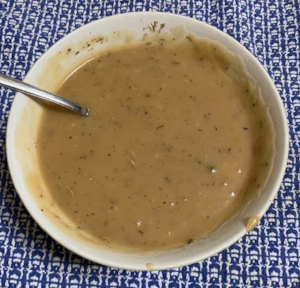
Gravy

American Appetizer

GRAVY

­
INGREDIENTS
­
1 bouillon cube (the same type as the stock)
2⅓ cups chicken, beef, or turkey stock
¼ cup butter
¼ cup flour
½ teaspoon onion powder
¼ teaspoon pepper
½ teaspoon rosemary
½ teaspoon sage
¼ teaspoon thyme
­
Serves 6.  Takes 15 minutes.
­
PREPARATION
­
Smash bouillon cube into bits. Add bouillon bits and broth to microwavable bowl. Microwave for 2 minutes or until bouillon bits dissolve. Mix with spoon until well blended. Add butter to pan. Melt butter using medium heat. Stir frequently and gently. Add flour. Stir constantly with whisk or fork for 2 minutes or until mixture turns golden brown.
­
Slowly add stock/bouillon liquid to pan. Stir as you do so. Reduce heat to low-medium. Simmer for 4 minutes or until mixture bubbles and thickens to the consistency of gravy. Stir frequently, Add remaining ingredients. Stir with spatula until well blended.
­
TIDBITS
­
1) Is there nothing that gravy doesn’t make better? Here’s a partial list of dishes and foods made tastier with gravy. Biscuits, biscuits and sausage, butter, chicken fried steak, fried chicken, hamburger patties, herbed pork roast, mashed potatoes, meatloaf, mushrooms, polenta, pork chops, rice, roast beef, roasted turkey, Salisbury steak, sausage, stuffed bell peppers, stuffing, vegetables
­
2) Are there any foods made worse by gravy? Pumpkin pie and orange juice come to mind.
­
3) Fun historical fact. The first humans to come to North America came from Asia via the famous land bridge. Only the bridge wasn’t made with land. Wandering tribes came to the Bering Strait, which of course, filled with water. Well, poo. But these first North American were terrific problem solvers and gravy lovers. They carried millions of tons on the backs of pack animals wherever they went. Why so much? They loved gravy as who does not? (See tidbit 1.)
­
4) Anyway, the problem solvers dumped half of their gravy into the Bering Strait. This water proved cold enough to freeze a gravy bridge connecting Siberia with Alaska. The land rush of North America was on! Note: you can no longer find this famous bridge. Cycles of prehistoric warming thawed the gravy bridge. Oh well.
­

– Paul De Lancey, The Comic Chef, Ph.D.

My cookbook, Following Good Food Around the World, with its 180 wonderful recipes, my newest novel, Do Lutheran Hunks Eat Mushrooms, a hilarious apocalyptic thriller, and all my other books, are available on amazon.com.

Categories: Uncategorized | Tags: , , , , , , , , , , , , , | Leave a comment

Dinner Rolls

American Appetizer

­

DINNER ROLLS

­
INGREDIENTS
­
2¼ teaspoons dry active yeast
⅓ cup lukewarm water
¼ teaspoon sugar (7 teaspoons more later)
2½ tablespoons melted butter (2 tablespoons more later)
½ cup milk, lukewarm
½ teaspoon salt
7 teaspoons sugar
2¼ cups flour (2 more tablespoons later)
1½ tablespoons flour
no-stick spray
2 tablespoons melted butter
­
SPECIAL UTENSILS
­
electric beater
8″ round casserole dish
bench scraper/chopper or long non-serrated knife
­
Makes 15 rolls. Takes 2 hours 35 minutes.
­
PREPARATION
­
Add yeast and lukewarm water to small mixing bowl. Mix with fork until well blended. Sprinkle ¼ teaspoon sugar on top. Let sit for 10 minutes or until bubbles. Add 2½ tablespoons melted butter, milk, salt, and 7 teaspoons sugar to large mixing bowl. Mix with spatula until salt and sugar dissolve. Let cool to room temperature.
­­
Add yeast mixture to large mixing bowl. Mix with fork until well blended. Gradually add 2¼ cups flour while mixing with electric beater set on medium. Mix until a slightly sticky dough ball forms. Dust flat surface with 1½ tablespoons flour. Remove dough ball to flat surface. Knead for 5 minutes until dough is smooth and elastic. Spray large mixing bowl with no-stick spray. Add dough ball to large mixing bowl. Rotate dough until covered with spray. Cover bowl with towel. Let sit for 30 minutes or until doubled in size.
­
Push down on dough. Roll dough into a log 15″ long and 1″ wide. Use bench scraper to cut log into 15 pieces. Shape 15 pieces into smooth balls. Spray casserole dish with no-stick spray. Preheat oven to 375 degrees. Add smooth dough balls to casserole dish. Cover with towel and let sit for 1 hour or until fluffy. Bake at 375 degrees for 15 minutes or until tops of rolls turn golden brown. Brush tops of rolls with 2 tablespoons melted butter.
­
TIDBITS
­
1) Doing dishes makes the kitchen clean, which makes you happy.
­
2) But, pondering the infinite brings enlightenment.
­
3) What will you chose?
­
4) May I suggest alternating 5-minute bursts of each activity?
­
5) While achieving enlightenment, I had the following stream of consciousness.
­
6) Can you have a stream of consciousness while asleep or even unconscious?
­
7) Unconscious is a hard word to spell.
­
8) You can see that I spelled it right.
­
9) You’ll have to take my word for it that I spelled it right on the very first try. Go me.
­
10) Somehow this segues into how we developed before birth.
­
11) Prehistoric peoples believed we started out as very tiny version of the baby that would eventually pop out of mama.
­
12) How do we know this? Go to the Courgette Library in Bordeaux, France. Find the research department and ask to see the ground breaking Greatest Texts of Prehistory by Farine du Ble.
­
13) Nowadays, culinary biologists say that we began as a single, undifferentiated cell.
­
14) This cell doubled into two slightly unlike* cells.
­
15) * = I used my thesaurus to come up with a different word for different.
­
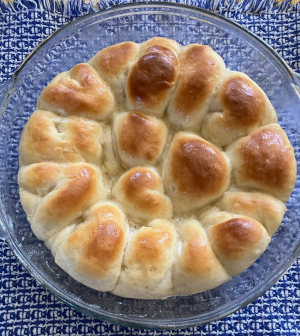
16) This doubling process kept going until we had nearly 15 slightly dissimilar cells like in the above photo.
­
17) Eventually this doubling process stops. We don’t increase twofold the day before birth.
­
18) But what if this repetitive course continues after birth?
­
19) Eventually, we’d get as big as Uranus.
­
20) We’d also possess a staggering number of specialized cells.
­
21) We’d most likely quite sport an impressive number of super-hero skills.
­
22) Which we’d need if we were truly as enormous as Uranus.
­

– Paul De Lancey, The Comic Chef, Ph.D.

My cookbook, Following Good Food Around the World, with its 180 wonderful recipes, my newest novel, Do Lutheran Hunks Eat Mushrooms, a hilarious apocalyptic thriller, and all my other books, are available on amazon.com.

Categories: Chatting With Chefs, cuisine, observations | Tags: , , , , , , , , , , , , | 2 Comments

Pepper Soup From Nigeria

Nigerian Soup

­

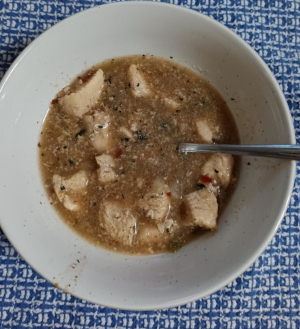
PEPPER SOUP

­
INGREDIENTS
­
2¼ pounds chicken, beef, or goat
3 whole nutmegs or calabash nutmegs, or 2 tablespoons nutmeg
1 onion
1 Scotch bonnet, habanero, 2 serrano chiles, or bird’s eye chile
2 MaggiTM** bouillon cubes, flavor should match the meat
4 cups water
2 teaspoons ginger powder
1 teaspoon red pepper flakes
1 teaspoon salt
2 tablespoons shrimp or crayfish powder (or omit)
2 tablespoons scent leaves*: Thai basil, or tarragon
­
* = Scent leaves can be hard to find.
** = Doesn’t have to be the Maggi brand, but Maggi is extremely popular in Nigeria and much of the rest of Africa.
­
SPECIAL UTENSILS
­
spice grinder
sonic obliterator
­
Serves 4. Takes 1 hour 20 minutes.
­
PREPARATION
­
Cut chicken into 1″ cubes. Grind whole nutmegs into powder. Dice onion. Seed and mince Scotch bonnet. (BE SURE to wash your hands thoroughly after touching the Scotch bonnet or its seeds. If however you touch your face after handing the Scotch bonnet or habanero, you will remember the pain it caused for a long time.)
­
Add chicken, bouillon cubes, onion, Scotch bonnet, and 4 cups water. Bring to boil using high heat. Stir enough to prevent burning. Reduce heat to low and simmer for 30 minutes. Stir occasionally.
­
Add ginger powder, nutmeg, red pepper flakes, salt, and shrimp powder. Simmer on low for 10 minutes. Stir occasionally. Add scent leaves. And simmer for another 5 minutes. Stir occasionally. Use sonic obliterator on any guests who gives your any guff over any ingredient substitutions. You don’t need that negativity in your kitchen.
­
TIDBITS
­
1) Culinary art historians will tell you, if you have the misfortune of being cornered by a feral gang of them, that the progression of European art can be summarized in the following eight stages.
­
2) First stage: Pre-prehistoric art.. How do we know it existed? We don’t. That’s why most of us cross the street to avoid a culinary art historian. (CAH.)
­
3) Second stage: .Prehistoric art, such as the wall paintings in the Lescaux Cave. Sadly, because this art comes from a prehistoric time, there are no written records of its history. Bummer. But it also gives rises to the age-old riddle, “Did prehistory inhibit written records or did the absence of written records spawn prehistory?” It is a contentious subject among the fractious CAHs.
­
4) Third stage: Roman art. Mosaics and wall paintings of geometric patterns, scenes from mythology, and pastoral landscapes. The Romans really liked the color red. Although when they really let their hair down, they would add black and yellow, hence the many mosaics at Bromidium depicting enraged wasps stinging tomatoes.
­
5) Moving onto the Fourth stage; (We really have to cover a lot of ground quickly as we only have one page.) Medieval art: Paintings depicted people of status in incredibly rigid poses. The current planking craze derives nearly all of its inspiration from Medieval nobility. Many Medieval artists made many Medieval medallions and incredibly expensive golden statues. Unfortunately, these stupendously valuable works got robbed by enterprising thieves. All gone. This explains why so few people study Medieval art. This six-sentence review is one of this period’s longest art studies
­
6) Fifth stage: Renaissance art. Really, an overall flowering of artistic ideas and techniques. The whole Renaissance era burgeoned with beauty. People love to study Renaissance art, their numbers limited only by the difficulty of spelling the word, “Renaissance.”
­
7) Sixth stage: Brown Gravy or Fifty Shades of Beige. Every freaking painting was painted in brown. It really does resemble brown gravy. Museum curators will tell you with admirably straight faces that post-Renaissance teemed with other colors. They say the painted walls, portraits, and tapestries of Hampton Court and the Louvre blazed with vibrant colors and only faded to brown over time.
­
8) Rebuttal: pish.
­
9) Brown’s supremacy derives from the massive importation of Nigerian Pepper Soup into Europe. Pepper-mad Europeans couldn’t get enough of this dish. Artists thought of Pepper Soup during every waking hour. Then dreamed of it every night.
­
10) This dish in this recipe is light brown and dark brown. So, is it any wonder that all Brown-Gravy artists worked only with brown? Where did the European artists get the funds to afford so much Pepper Soup? From the gold stolen in tidbit 5).
­
11) Seventh stage: Eventually artists went off feed and discovered other colors, such as can be found in fried eggs and split-pea soup. This naturally brought on the many-colored Impressionistic era.
­
12) Eighth stage: Modern art. It’s chock full of modern art. There, you are now an art expert.
­

– Paul De Lancey, The Comic Chef, Ph.D.

My cookbook, Following Good Food Around the World, with its 180 wonderful recipes, my newest novel, Do Lutheran Hunks Eat Mushrooms, a hilarious apocalyptic thriller, and all my other books, are available on amazon.com.
Categories: history, international | Tags: , , , , , , , , , , , , , , , | 2 Comments

Fava Bean Soup From Morocco

Moroccan Soup

FAVA BEAN SOUP
(Bessara)

INGREDIENTS

½ pound dried fava beans
3 cups water
3 tablespoons olive oil
1¼ teaspoons cumin
1 tablespoon minced garlic
1¾ teaspoons paprika
½ teaspoon salt
2 tablespoons lemon juice
¼ teaspoon cayenne
¼ teaspoon harissa* or paprika

* = Harissa maybe found in Middle Eastern supermarkets or online.

SPECIAL UTENSIL

blender

Serves 2. Takes 1 hour 50 minutes plus soaking for 10 hours or overnight.

PREPARATION

Add fava beans to large mixing bowl. Add water to cover beans with 2″ to spare. Soak for 10 hours or overnight. Drain beans. Remove their skin. Add fava beans, 3 cups water, olive oil, cumin, garlic, 1¾ teaspoons paprika, and salt to pot. Bring to boil using high heat. Stir occasionally to prevent burning. Cover pot with lid. Reduce heat to low and simmer for 1 hour or until fava beans become tender. Stir occasionally to prevent burning.

Add contents of pot to blender. Puree until smooth. Add lemon juice. Puree briefly until well blended. Garnish with cayenne and harissa. Goes well with flatbread.

TIDBITS

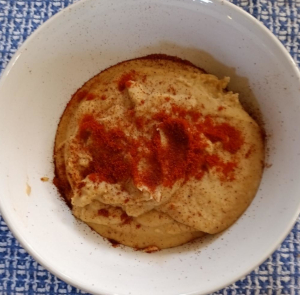
1) Doesn’t that look like an eye? The Urberqian hominids of modern-day Morocco thought so. Not only that they, along with the entire prehistoric world, believed that anything that looked like an eye but wasn’t, would steal your spirit. No one wants that. So, the Urbeqians wouldn’t eat soup. Then Abim, a really clever hominid, noted that getting cayenne in your eyes blinded you for a bit. So, sprinkling cayenne on soup would blind evil spirits dwelling in soups. Early people could now eat soup. Early people now had energy to explore the world. The Urbeqians did just that, 10 years before Lucy led her clan of Olduvai Gorge. We don’t know about the Urberqians achievement because, you know, prehistory. But this is why we garnish soups with cayenne pepper, and pepper.


Paul De Lancey, The Comic Chef, Ph.D.

My cookbook, Following Good Food Around the World, with its 180 wonderful recipes, my newest novel, Do Lutheran Hunks Eat Mushrooms, a hilarious apocalyptic thriller, and all my other books, are available on amazon.com.
Categories: Uncategorized | Tags: , , , , , , , , , , , , , , , , , , , , , , , , , | Leave a comment

Roasted Chestnuts

American Dessert

ROASTED CHESTNUTS

INGREDIENTS

1 pound chestnuts (most of the fresh ones are available in Autumn)

SPECIAL UTENSIL

baking pan

Serves 6. Takes 45 minutes.

PREPARATION

Preheat oven to 400 degrees. While oven preheats, cut an “x” that covers one entire side on each chestnut. Make the cut deep enough to cut through the shell. (This makes the chestnut easy to peel. It also keeps it from exploding. This really can happen if you omit this step.)

Place chestnuts on baking pan. Bake at 400 degrees for 25 minutes or until chestnuts become tender, the chestnut shells start to open and become easy to peel, and the edible nut that’s inside turns golden brown. Remove from heat. Cover with kitchen towel. Let cool for 5 minutes. Peel and eat immediately.

TIDBITS

1) As you can see, the left chestnut in the above photo is unpeeled. It also has an “x” cut into it by a knife. This makes it much easier to peel. The two chestnuts on the right have been peeled and are ready to eat. ☺

2) But wait! This narrative gets even more exciting. ☺☺

3) When prehistoric tribes decided to cut “x”s on chestnuts, they inadvertently developed the game Tic-Tac-Toe. The uncut chestnuts became “zero” or the letter “o.” These doughty cavemen were already two letters on the way to the present English alphabet. Go, cavemen, go! Excelsior!

4) Then one fine summer day caveman Carl La Fong invented the letter “b.” (We know about La Fong because he signed his cave paintings. They’re worth quite a bit if you can discover one.) Ancient peoples could now spell the word “box.”

5 Before you knew it, peoples everywhere had an alphabet and words for everything. Not much later, the word “box” led to actual boxes. CheeriosTM and AmazonTM became possible. And we owe it all to chestnuts and the visionary Carl La Fong. Yay.


– Paul De Lancey, The Comic Chef, Ph.D.

My cookbook, Following Good Food Around the World, with its 180 wonderful recipes, my newest novel, Do Lutheran Hunks Eat Mushrooms, a hilarious apocalyptic thriller, and all my other books, are available on amazon.com.
Categories: Uncategorized | Tags: , , , , , , , , , , , , , , , , , , , , , , , | Leave a comment

Kunde

Kenyan Entree

KUNDE

INGREDIENTS

1 cup rice
1 medium onion
2 tomatoes
½ cup unsalted peanuts or ¼ cup creamy peanut butter
2 tablespoons vegetable oil
½ teaspoon coriander
½ teaspoon turmeric
½ teaspoon salt
1½ pounds black-eyed peas, cooked and drained
½ cup water

SPECIAL UTENSIL

food processor or coffee grinder

Serves 4. Takes 25 minutes.

PREPARATION

Cook rice according to instructions on package. Mince onion. Dice tomatoes. Grind peanuts in food processor until you get a paste. Add oil and onion to pan. Sauté at medium-high heat for 5 minutes or until onion softens. Sur frequently. Add coriander and turmeric. Cook for 1 minute or until fragrant. Stir constantly.

Add tomato and salt. Reduce heat to medium and cook for 5 minutes or until liquid disappears. Stir frequently. Lightly mash black-eyed peas with a fork. Add peanut paste, black-eyed peas, and water. Bring to boil at high heat. Reduce temperature to low medium. Simmer for 5 minutes or until dish gets to the consistency of a stew. Stir enough to prevent burning. Serve over rice.

TIDBITS

1) Really ancient humans worshiped the Sun as a god. They could have adored the potato instead. But they didn’t. Not many peoples even had potatoes. So, it never occurred to these tribes to worship the mighty spud. It’s just like wanting to eat lutefisk when you’ve never heard of it. You wouldn’t want to; it’s horrible. Not enough half-centuries have gone by before I’ll eat lutefisk again.

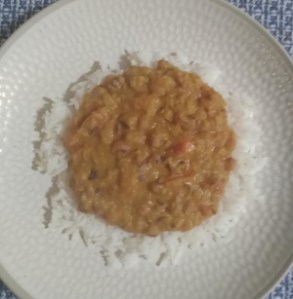
2) Anyway, the Rohohoe tribe, prehistoric Kenyans, had the Sun and they worshiped it. After much discussion, the religious leaders decided that the best way to worship Sun was to make an entree out of: rice, onion, tomatoes, peanuts, veggie oil, coriander, turmeric, salt, black-eyed peas, and water. The brownish mix of ingredients in the middle represents the Sun and the rice, its rays. There.


– Paul De Lancey, The Comic Chef, Ph.D.

My cookbook, Following Good Food Around the World, with its 180 wonderful recipes, my newest novel, Do Lutheran Hunks Eat Mushrooms, a hilarious apocalyptic thriller, and all my other books, are available on amazon.com.

Categories: cuisine, history, international | Tags: , , , , , , , , , , , , , , , , , , , | Leave a comment

Zambian Chicken Stew

Zambian Entree

CHICKEN STEW

INGREDIENTS

1 garlic clove
1 medium onion
1 large tomato
2 tablespoons vegetable oil (2 more tablespoons later)
2 tablespoons vegetable oil
4 pounds chicken pieces, bone-in, skin-on
2 cups chicken stock
½ cup spinach
⅓ cup peanuts, unsalted
½ teaspoon ginger powder
1 teaspoon seasoned salt

SPECIAL UTENSIL

Dutch oven

Serves 5. Takes 50 minutes.

PREPARATION

Dice garlic, onion, and tomato. Add garlic, onion, and 2 tablespoons oil to Dutch oven. Sauté at medium-high heat for 5 minutes or until onion and garlic soften. Stir frequently. Remove garlic and onion. Add 2 tablespoons oil. Add chicken pieces. Fry chicken pieces for 10 minutes until they turn completely gold brown on both sides. Turn enough to ensure even browning.

Add back garlic and onion Add tomato and chicken stock. Reduce heat to low and simmer for 20 minutes. Stir occasionally. While stew simmers, dice spinach and grind peanuts until they form a paste. Add ginger powder, seasoned salt, spinach, and peanut paste. Cover. Simmer for 5 minutes or until chicken pieces become tender. Stir occasionally.

TIDBITS

1) As you can see, the next recipe is Chicken Stew. That stew is from Zimbabwe. Other nations have chicken stew recipes including: America, South Africa, India, and China.

2) Some people say aliens came to prehistoric Earth and gave the recipe for Chicken Stew to cavemen on every continent. Mainstream archeologists discount that theory, noting there are no cave recipes to be found on any cave wall nor even paintings of the necessary ingredients. Culinary archeologists assert that the recipe was spread when Lucien, Lucy of Olduvai Gorge’s brother, told the recipe to all he met. Setting out to China, he found himself in Zambia and Zimbabwe. Lucien’s wife then asked for directions and so, the recipe-spreading family continued on its trek.


– Paul De Lancey, The Comic Chef, Ph.D.

My cookbook, Following Good Food Around the World, with its 180 wonderful recipes, my newest novel, Do Lutheran Hunks Eat Mushrooms, a hilarious apocalyptic thriller, and all my other books, are available on amazon.com.
Categories: Uncategorized | Tags: , , , , , , , , , , , , , , , , , , , , , , , , , | 2 Comments

Romanian Salata de Boeuf (Beef Salad)

Romanian Entree

SALATA DE BOEUF
(Beef Salad)

INGREDIENTS

1 pound thin beef sirloin
1⅓ pounds potatoes
2 carrots
2 eggs
⅓ cup green peas
1 cup diced or sliced pickles
½ cup pickled red bell peppers
1 cup mayonnaise (¼ cup more later)
2 tablespoons mustard
½ teaspoon pepper
1 teaspoon salt
¼ cup mayonnaise
1 tablespoon fresh parsley

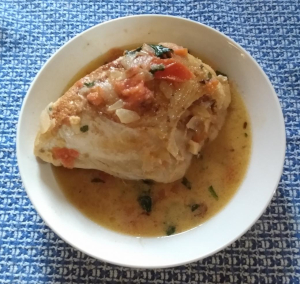
Serves 8. Takes 1 hour. No mayonnaise topping at front, so you can see inside.

PREPARATION

Add sirloin and enough water to cover. Bring to boil at high heat. Boil for 30 minutes or until sirloin is tender. Drain. Remove sirloin, let cool, and chop into ½” cubes. While beef cooks, add potatoes and enough water to large pot. Bring to boil at high heat. Boil for 25 minutes or until tender. Drain. Let potatoes cool. Peel potatoes and chop them into ½” cubes.

While sirloin and potatoes cook, add carrots and water to pot. Bring to boil using high heat. Boil for 15 minutes or until carrots becomes tender. Drain and cool. Chop carrots into ½” cubes. Add water to pot. Bring to boil using high heat. Carefully add eggs. Boil for 8 minutes for soft boiled and 12 minutes for hard boiled. Let cool. Peel and cut each egg into 6 slices.

Add sirloin, potato, carrot, peas, pickles, pickled red-bell peppers, 1 cup mayonnaise, mustard, pepper, and salt. Mix by hand until well blended. Add this mixture to a serving plate. Mold by hand into a flat, round shape like a layer of cake. Use spatula to coat cake-shape mixture with ¼ cup mayonnaise. Dice parsley. Garnish with egg slices and parsley.

TIDBITS

1) Prehistoric humans believed the Sun was a god. Egg yolks look like the Sun. Our ancestors reasoned that egg yolks themselves must possess a bit of divinity. The ancient Egyptians went further. Any animal that could birth so much godliness must itself be divine. The chicken became the preeminent Egyptian god. However, during the 18th dynasty, the priests of Amun Ra gained power and destroyed the Chicken Cult. Chickens would never again be worshipped. Their eggs, however, may be enjoyed in this dish.


– Paul De Lancey, The Comic Chef, Ph.D.

My cookbook, Following Good Food Around the World, with its 180 wonderful recipes, my newest novel, Do Lutheran Hunks Eat Mushrooms, a hilarious apocalyptic thriller, and all my other books, are available on amazon.com.
Categories: cuisine, history, international | Tags: , , , , , , , , , , , , , , , , , , , , , , , , , | Leave a comment

SPAM Fried Rice

Guamanian Entree

SPAM(TM) FRIED RICE

INGREDIENTS

1 cup rice
2 garlic cloves
1 small onion
1 12-ounce can SPAM
2 tablespoons oil
3 eggs
¼ cup soy sauce

Serves 4. Takes 35 minutes.

PREPARATION

Cook rice according to instructions on package. Mince garlic cloves and onion. Cut SPAM into ½” cubes. Add garlic cloves, onion, and oil to pan. Sauté at medium-high heat for 5 minutes or until onion softens. Stir frequently. Remove garlic and onion and set aside. Keep any oil. Add eggs to pan. Scramble eggs at medium heat for 2 minutes or until eggs are done to your liking. Remove scrambled eggs and slice any large bits into ¼” wide strips.

Add SPAM cubes to pan. Cook at high heat for 3 minutes or until SPAM starts to brown. Stir occasionally. Add garlic, onion, and eggs back to pan. Add rice and soy sauce. Cook at medium heat for 2 minutes or until all is warm and the rice is brown.

TIDBITS

1) Guamanian is the adjective for something from Guam. Ché Guevarra–If this is spelled correctly, it is purely by chance–was a revolutionary.

2) A Guavanian is someone from Guava. Well no, it isn’t. Guava is a bush. The guava bush’s fruit is a guava. No, people live in or around a guava bush. Thus, there are no Guavanians. Indeed, there is no guavanian anything. The adjective for guava is guava.

3) Indeed, this has been the case since prehistoric times. Exactly sometime ago, Cro Magnons switched from herding mastodons and sabertooth tigers to herding the rather more stationary and easygoing guava bush.

4) Che Chevarra–How the heck do you spell his name?–loved sedentary guavas. You can tell he was direct descendant of Cro Magnons. However, Ché didn’t know how to spell guavas. So, if he couldn’t spell guavas, you can’t really expect people to spell his last name correctly. It’s kinda like spelling Benadryl(TM) Cumberbund’s name correctly, who by the way also descends from Cro Magnons.

Chef Paulcookbookhunks

My cookbook, Following Good Food Around the World, with 180 wonderful recipes is available on amazon.com. My newest novel, Do Lutheran Hunks Eat Mushrooms, a hilarious apocalyptic thriller, is also available on amazon.com

Categories: cuisine, history, international | Tags: , , , , , , , , , , , , , , , , | 2 Comments

Crispy Fish Scallopini

American Entree

CRISPY FISH SCALLOPINI

INGREDIENTScrispycodscallopini

2 garlic cloves
1 pound cod fillets or other white fish
¼ cup flour (1 more tablespoon later)
¼ teaspoon pepper
1 teaspoon sage
¼ teaspoon salt
3 tablespoons chicken broth
1 tablespoons Chardonnay or white wine
3 tablespoons water
1 tablespoon lemon juice
1 teaspoon drained capers
1 tablespoon flour
2 tablespoons butter
1 tablespoon olive oil (up to 2 teaspoons more)
¾ cup grated Parmesan cheese
1 teaspoon parsley

Serves 3. Takes 50 minutes.

SPECIAL UTENSIL

cooking mallet

PREPARATION

Mince garlic cloves. Pound cod fillets to ¼” thickness with clean cooking mallet. If you don’t have such a cooking tool, try putting a few sheets of wax paper on top of the cod and whack away with a blunt instrument.

Combine ¼ cup flour, pepper, sage, and salt in mixing bowl. Dredge the cod fillets through this mixture. Cut cod fillets into 6 cutlets. Put chicken broth, Chardonnay, water, lemon juice, capers, 1 tablespoon flour, and garlic in second mixing bowl. Mix sauce thoroughly.

Melt butter in no-stick frying pan. Cook on medium high and add 1 tablespoon olive oil. Place as many flour/pepper coated fillets as possible into frying pan. Cook for up to 5 minutes on each sides or until cutlets turn golden brown and crispy. Add 1 teaspoon olive oil to the pan each time you cook another batch of fillets. Remove cod.

Pour broth/caper sauce into frying pan. Heat on medium high for 1 to 2 minutes or until sauce boils and thickens. Pour sauce over cod cutlets. Sprinkle Parmesan and parsley over the cod.
TIDBITS

1) Early humans were hunter-gatherers. They liked crispy mastodon steaks. Baby-back mastodon ribs were a particularly liked delicacy.

2) Where delicacy meant a rib or hunk of meat cut of the mastodon with flint, then thrown on to the fire. If the went out early, the meat was cooked on the outside and left rare on the inside, trapping the juices inside. Thus, the culinary technique of searing was born. Well done, mastodon chefs! Well okay, except for the omnipresent layer of ashes on the meat. Mesquite wood provided the tastiest ashes. To this day, mesquite wood is the choice for all serious barbequers. I told you the prehistoric era was a hotbed of culinary innovation. Oh, and sometime the fires were put out by sand.

3) Indeed, a revolutionary recipe by Ogg, a caveman states:

Our People Entree

MASTODON STEAKS

INGREDIENTSmastodonhunt

1 mastodon
many pieces of mesquite wood
many handfuls of sand

Serves many. Takes time.

SPECIAL UTENSIL

flint

PREPARATION

Skin mastodon with flint. Cut out chunks of meat with flint. Pile mesquite near a likely place for a likely lightning strike. Wait for lightning strike. Throw mastodon chunks on fire. Have sex with wife. If the love making is quick, the meat will be rare. If the foreplay is slow and sensitive, the meat will be well done. Put out fire with sand.

4) The eruption of Mt. Vesuvius in 79 AD wiped out the towns of Pompeii and Heraclaneum. However, a survivor, Quintus Cato, gleaned some good out of the bad days. He thought, “What if I flattened some fish with a mallet, breaded it, and gingerly dipped the fish into the edges of the lava flow just long enough for the sand to run through this timer? Why, I’d have some great crispy fish scallopini!”

5) Many fishermen met their end falling into the hot lava while making this dish. The lava method of preparing fish rapidly fell out of favor. People hated Quintus. His family was shunned.

6) Then in 112 AD, his grandson redeemed his family’s honor when he thought, “Oh feck, why not use mesquite wood or even wood from the olive tree?” And so, crispy fish scallopini became easy to make. We are forever grateful.


– Paul De Lancey, The Comic Chef

My cookbook, Following Good Food Around the World, with its 180 wonderful recipes, my newest novel, Do Lutheran Hunks Eat Mushrooms, a hilarious apocalyptic thriller, and all my other books, are available on amazon.com.
Categories: cuisine, history | Tags: , , , , , , , , , , , , , , , , , , , , , , , , , , | Leave a comment

Create a free website or blog at WordPress.com.