Posts Tagged With: Napoleon

Banane Celeste

Martinican Dessert

(From Martinique)

­

BANANE CELESTE

­
INGREDIENTS
­
1 pound cream cheese (½ pound more later)
3 tablespoons butter
6 ripe bananas
¼ cup brown sugar
½ teaspoon cinnamon (¼ teaspoon more later)
½ pound cream cheese
¼ cup heavy cream
¼ teaspoon cinnamon
­
SPECIAL UTENSIL
­
8″ *8″ baking dish
­
Serves 6. Takes 50 minutes plus at least 2 hours 30 minutes to set.
­
PREPARATION
­
Preheat oven to 350 degrees. Let cream cheese and butter soften. Peel bananas and cut them in half along their lengths.
­
Add cream cheese, brown sugar, and ½ teaspoon cinnamon to large mixing bowl. Use fork or blender on lowest setting until cream cheese/brown sugar mixture is light and fluffy.
­
Light and fluffy sounds so peaceful doesn’t it? Next time you’re at a peace conference say, “Light and fluffy” to the warring sides and see if the mood of the room doesn’t improve dramatically.
­
Meanwhile back at the stove, use medium heat to melt the butter in a pan. Add 6 banana halves to pan. Sauté bananas on medium heat for 5 minutes or until they turn light brown on both sides. Turn bananas carefully over once with spatula to ensure even browning. Repeat for second batch of 6 banana halves.
­
Evenly arrange 6 banana halves in bottom of baking dish. Spoon cream cheese/brown sugar mixture evenly over bananas. Place 6 more banana halves on top of the cream cheese. Spoon ½ pound cream cheese atop the second banana layer.
­
Smooth heavy cream over the second layer of cream cheese. Sprinkle ¼ teaspoon cinnamon over heavy cream.
­
Bake for 20 minutes at 350 degrees or until cream-cheese sauce is bubbly and golden brown. Let cool on wire rack for 30 minutes. Put in refrigerator at least 2 hours or until it sets.
­
TIDBITS
­­
1) Josephine Bonaparte, wife of the Emperor Napoleon, was born in Martinique in 1763 with the name of Marie Josèphe Rose Tascher de La Pagerie. This name was way too long so most people just called her “Ma.” Josephine possessed a lively sense of humor.
­
2) People loved her jokes. She had them in stitches. Agents from Vau de Ville frequently came to her mansion to sign her up for large engagements but she always demurred, saying she was but a simple banana plantation monopolist.
­
3) Still the island’s elite kept coming to her comedy soirées to hear her jokes. They never wanted to leave even when she got tired and wanted to retire. They’d say, “Yo, Ma, Ma, tell us another joke.”
­
4) Her funnies became known as “Ma Ma jests,” then “Mama jests,” and finally by 1779 as “Yo, Mama jokes.”
­
5) In 1779, Ma Pagerie married the owner of the Folies Bergère, Monsieur de Beauharnais, and moved to Paris.
­
6) Nothing much of note happened in the lives of the de Beauharnaises until monsieur ended their marriage by getting guillotined in 1794. Saved the unpleasantness of a bitter divorce, Ma commenced a series of mirthful affairs with the handsome leaders of the French Revolution.
­
7) In 1796 she attracted the eye of a young artillery officer named Napoleon Bonaparte. “She made me laugh,” said Napoleon before his death.
­
8) Napoleon suffered from chronic depression and often stayed in bed neglecting to fight the smallest battle until Ma bucked him up with one of the world’s first chicken-crossing the road jokes. “Pourquoi le poulet a traversé la rue? Pour obtenir à l’autre côté.”
­
9) Ma’s merriment gave Napoleon the energy to follow his dream. In 1799, he and two other hombres overthrew the constitutional government. In 1804, he reached the top of the government ladder when he made himself emperor.
­
10) Life was good for France with Napoleon conquering one country after another. People no longer had to get visas to visit the Italian Riviera. Napoleon had made it part of France. What a guy!
­
11) But things went sour in 1810. Napoleon wanted an heir for his Empire. Ma, although always able to conceive a knee-slapping joke without a moment’s notice, could not do the same with a child. So Napoleon divorced her and married Marie Louise of Austria.
­
12) Marie Louise lived in a permanent humor-free zone. She never made Napoleon laugh, not once. Napoleon grew moody, his judgment became impaired. In 1812, he invaded Russia, a disaster. By 1814, his enemies camped at the French border. They offered Napoleon a peace treaty, but without Ma’s jokes to relieve the tension caused by his tactless outbursts, negotiations went downhill.
­
13) Napoleon was forever defeated in 1815 and exiled to St. Helena. It would decades before vaudeville revived.
­

– Paul De Lancey, The Comic Chef, Ph.D.

My cookbook, Following Good Food Around the World, with its 180 wonderful recipes, my newest novel, Do Lutheran Hunks Eat Mushrooms, a hilarious apocalyptic thriller, and all my other books, are available on amazon.com.


Categories: cuisine, history, international | Tags: , , , , , , , , , , , , , , | 2 Comments

Smoked SPAM

American Entree

­

SMOKED  SPAM

­
INGREDIENTS
­
4 12-ounce cans SPAM(tm)
½ cup ham rub or pineapple-ham rub
SPECIAL UTENSILS
­
wood chips (hickory, apple, or pecan)
smoker
electric thermometer
baking pan
tin foil
­
Serves 4. Takes 3 hours.
­­
PREPARATION
­
Preheat smoker to 220 degrees. Add wood chips to smoker. Make diagonal cuts about ¼” deep on the top of the SPAM blocks. Rub ham rub all over SPAM blocks.
­
When temperature of smoker reaches 220 degrees, place SPAM blocks on  grill Put thermometer in the thickest part of a SPAM block. Smoke until SPAM’s internal temperature reaches 160 degrees. This should take about 2 hours 30 minutes, varying greatly depending on your smoker. Let sit for 5 minutes or eat right away. Goes well with macaroni and cheese.
­
TIDBITS
­
1) Amps is an anagram for SPAM.  “Amplifiers” is slang for amps. Amplifiers were first built in 1803 by the reputedly young, inventor and guitarist, Keith Richards. There were no uses for them until Mr. Richards formed the first rock n’ roll band one year later. His group, The Drifting Pebbles toured the British coasts in 1804. Wow, they were popular! 172,000-estimates vary-showed up for his second concert, held in Bristol. The front-row fans went wild. The music goers seated farther back, not so much. His third and fourth venues drew only dozens.
­
2) But Keith adapted. “Why not use my amps to project my music to everyone?” Bristol Stomp, January 30, 1804. His fans returned in droves and by horse and foot. Britain loved him. The amount of trees needed to feed his wood-feed electric power station devastated forests everywhere. Then, disaster struck in 1805. Napoleon again went on the rampage, winning land battles everywhere. Only the Royal Navy prevented his invasion of England. But the Royal Navy needed tons of oak to built its war ships. To satisfy its ravenous need, the navy requisitioned Richards’ wood. No wood, no concerts. To make things worse, the few concerts that still had wood for the amps were fertile hunting grounds for the Royal Navy’s press gangs. When word got out that going to a Drifting Pebbles concert meant be forced into the navy, Richard’s name became mud. His musical career tanked. But happily enough, he became part of The Rolling Stones in 1962. Now, everyone loves him.
­

– Paul De Lancey, The Comic Chef, Ph.D.

My cookbook, Following Good Food Around the World, with its 180 wonderful recipes, my newest novel, Do Lutheran Hunks Eat Mushrooms, a hilarious apocalyptic thriller, and all my other books, are available on amazon.com.

Categories: cuisine, history | Tags: , , , , , , , , , , , , , , | Leave a comment

Southwest Stuffed Bell Peppers

American Entree

SOUTHWEST STUFFED BELL PEPPERS

INGREDIENTS

1 green chile
5 green bell peppers
½ red onion
2 garlic cloves
1 cup pepper jack cheese
2 ounces Cotija cheese
1 pound ground turkey
1 7-ounce can diced tomatoes (1 can more later)
4 teaspoons chili powder
1 teaspoon cornstarch
1 teaspoon cumin
½ teaspoon oregano
¼ teaspoon cayenne pepper
3/4 cup water
4 tablespoons sour cream
2 stalks green onion
1 7-ounce can diced tomatoes
¾ cup water

Serves 5. Takes 55 minutes.

PREPARATION

Remove seeds from green chile. Cut bell peppers in half lengthwise. Remove stem, white innards, and seed from green bell peppers. Dice green chile, red onion, garlic cloves, and green onion. Grate or shred pepper jack cheese and Cotija cheese.

In a large frying pan or skillet, cook the turkey, green chile, red onion, and garlic over medium-high heat until meat is no longer pink. Stir occasionally.

Add 7-ounce can diced tomatoes, chili powder, corn starch, cumin, oregano, cayenne, green onion, and 3/4 cup water. Bring to boil then reduce heat. Simmer uncovered for about 15 minutes. (No, this does not mean to get angry and cook in the nude. Sauces can splatter.)

Place bell-pepper halves in a microwavable dish. (You’ll need a 3-to-4 quart dish if you want to use just one.) Add 3/4 cup water to dish. Cover and microwave on high for 7 to 8 minutes. (Microwaves vary in strength, so in general it’s best to heat for a short time, check the food and, if necessary, microwave some more.)

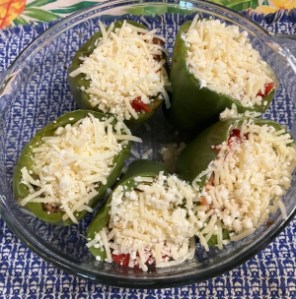
Pour any water out of the bell peppers. Fill each bell-pepper half to the top with ground-beef mixture. Put an equal amount of sour cream, 7-ounce can diced tomatoes, and cheese on the bell peppers.

Serve to adoring guests.

TIDBITS

1) Bell peppers have recessive genes that prevent them from having capsaicin, the stuff that makes other peppers hot.

2) Red bell peppers are important in Portuguese cuisine.

3) In 1801 my great-great-great-grandfather Napoleon I directed an invasion of Portugal by French and Spanish troops.

4) In 1808, Napoleon I invaded Portugal again. Say what you will about his megalomania and the countless deaths he caused, he did possess an admirable work ethic.

5) Oh, and he invaded Spain as well in 1808, unleashing more bloody, unrestrained guerrilla warfare.

6) Strange to say, most Napoleonic historians fail utterly to mention how six years of conflict in that region affected red-bell-pepper production in Portugal.

7) It seems likely, though, that red-pepper planting and harvesting fell precipitously in previously culinarily happy Portugal.

8) One’s mind recoils at the thought of wary-weary Portuguese reduced to eating beef-and-red pepper sandwiches without red peppers.

9) Bad French emperor, no éclaire.


Paul De Lancey, The Comic Chef, Ph.D.

My cookbook, Following Good Food Around the World, with its 180 wonderful recipes, my newest novel, Do Lutheran Hunks Eat Mushrooms, a hilarious apocalyptic thriller, and all my other books, are available on amazon.com.

Categories: cuisine, history, international | Tags: , , , , , , , , , , , , , , , , , , | Leave a comment

Italian Sub

American Entree

ITALIAN SUB

INGREDIENTS

1 Italian sub roll* or ⅓ baguette
2 tablespoons olive oil
1½ ounces sliced capicola
1½ ounces mortadella
1½ ounces Genoa salami
1½ ounces provolone
1 leaf iceberg lettuce, shredded (optional)
1 Roma tomato (optional)
¼ red onion (optional)

* Sub rolls can be made crunchy by putting them in a toaster oven. Use “toast” setting for 1 minute.

Serves 1. Takes 10 minutes.

PREPARATION

Cut Italian roll in half lengthwise. Drizzle both halves with olive oil. Add capicola, mortadella, and Genoa salami to bottom half of the roll. Put provolone on top of meat. Sprinkle iceberg lettuce on provolone. Cut Roma tomato lengthwise into 4 slices. Place tomato slices on lettuce. Thinly slice the red onion. Place red-onion slices on tomato slices. Put top half of sub roll on tomato slices. And Bob’s your uncle.

TIDBITS

1) In 1794, Signor Fabio Grimaldi of Florence develops the world’s first USB port. Nothing happens. The invention comes way ahead of its time. There are no computers, absolutely no place to put a USB port. There are even no memory sticks to go into the USB port.

2) And anyway Napoleon’s invasion of Italy in 1796 signals the start of nearly non-stop fighting across the European continent. Scientific investigation ends except for Signor Gabelli’s single attempt to build a under water fighting vessel made from bread. This sub research ends in frustration.

3) In 1903 Giovanni Amati makes the first edible Italian sub. It’s too big for Grimaldi’s USB port which unfortunately was tied to a kite’s tail and was blown away, lost forever.

4) But this sub was roughly the right shape. In 1955, for reasons which have been lost, Sarah Marston baked a tiny stick like sub. The dyslexic Sarah called it a USB stick.. Her husband the wine drinker munched on the stick and declared, “It needs port.” Of course, he meant port, the wine, but he had once raised again the USB-port idea. This vision was bound to grow again in the mind of science geeks everywhere. And it did. Today, every computer comes with USB ports and memory sticks. Now you know.


Paul De Lancey, The Comic Chef, Ph.D.

My cookbook, Following Good Food Around the World, with its 180 wonderful recipes, my newest novel, Do Lutheran Hunks Eat Mushrooms, a hilarious apocalyptic thriller, and all my other books, are available on amazon.com.

Categories: history, humor, international | Tags: , , , , , , , , , , , , , , , , , , , , , , , | 2 Comments

Emperor Paul I

The picture to the right shows what I would look like were I to become emperor. And why not? I’m a nice guy. Also, according to long standing family belief, I am the fifth generation, direct descendant of Emperor Napoleon I. So you can see I have a valid claim to be the ruler of France. And I’m quite up on French history as well as being aware of French politics. Also, I have spent time in France on multiple occasions, I’ve bicycled from one end of France to another, love French cuisine, am adept at cooking French dishes. At my peak, I could speak fluent French at a third-grade level. What more do you want? Anyway, the country is a total mess, I am less so. Time to make me leader of France. My slogan is, “Take naps. Do no harm.” Aux armes, citoyens.


Paul De Lancey, The Comic Chef, Ph.D., Paul I

My cookbook, Following Good Food Around the World, with its 180 wonderful recipes, my newest novel, Do Lutheran Hunks Eat Mushrooms, a hilarious apocalyptic thriller, and all my other books, are available on amazon.com.

Categories: Uncategorized | Tags: , , , , , , , , , , , , , , , , , , , , | Leave a comment

Nidi di Rondini

San Marinese

NIDI DI RONDINI

INGREDIENTS

1 12-ounce package lasagna noodles
2 tablespoons butter
2 tablespoons flour
1 cup milk
⅛ teaspoon salt
⅔ cup marinara sauce (⅓ cup more later)
1¼ cups grated mozzarella
½ pound prosciutto or deli-sliced ham
⅓ cup marinara sauce
¼ cup grated Parmesan cheese

SPECIAL UTENSILS

8″-x-8″ casserole dish
kitchen scissors or scissors
aluminum foil

Serves 5. Takes 1 hours 45 minutes.

PREPARATION

Preheat oven to 350 degrees. Cook lasagna noodles according to directions on package. (Do not let noodles stick together. You might need to cook them in batches.) Drain noodles. Spray flat surface. Place lasagna noodles flat on flat surface. (Do not let them touch each other.)

While noodles cook, add butter to pan. Melt butter using medium heat. Gradually add in flour. Stir frequently until well blended. Gradually add milk until the sauce thickens. Stir frequently. Add salt. Stir until blended. This is the bechamel sauce. Remove pan from heat.

Pour ⅔ cup marinara sauce into casserole dish. Smooth with spatula. Spread bechamel sauce evenly over all the noodles. Sprinkle mozzarella evenly over the bechamel sauce. Place proscuitto strips over the bechamel-mozzarella lasagna noodles. (If necessary, trim or fold prosciutto strips so that they are narrower than the noodles.)

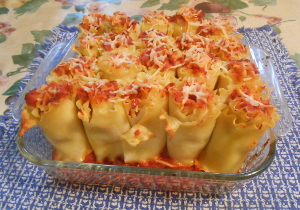
Roll up lasagna noodles so that they form a tight cylinder. Place lasagna cylinders upright and close together in casserole dish. (If necessary, place wadded-up balls of tin foil in casserole dish to keep lasagna cylinders from falling over.) Make four ½” cuts at the top of each lasagna cylinders. Pull the lasagna between the cuts down and out a bit. so that they look like rose petals.

Drizzle ⅓ cup marinara sauce over the lasagna cylinders. Sprinkle cylinders with Parmesan cheese. (Not so much that you can’t see the rose-petal design of the lasagna cylinders.) Bake for 35 minutes or until the tops of the cylinders turn crisp and golden brown.

TIDBITS

1) Nidi di rondini tastes great. Anyone making this entree will be immediately be hailed as an amazing chef and host.

2) If you are up for a Nobel Prize, you would do well to serve this dish to the judges.

3) As of press time, it is not illegal to do this.

4) So, what are you waiting for?

5) Nidi di rondini comes from the great, but tiny country of San Marino.

6) Despite being the size of a rather large postage stamp (24 square miles, 61 square kilometers), the San Marinese have preserved their independence for 1,816 years.

7) The above number is accurate as of the time of writing. Please increase the above number by one for every year after 2021.

8) Anyway, how did this tiny country maintain its independence from many other countries with much bigger armies such as: the Roman Empire, the Papal States, the French Empire under Napoleon, Italy, and Hitler’s Germany?

9) Simple. As culinary historians will tell you, soldiers with red hair make the fiercest warriors in the world. San Marino has always had fighting redheads. The chefs of this happy land commemorates their heroes with these rolled-up lasagna rolls topped with marinara sauce.

10) However, the most famous fighters in the world come from Scotland. Neighboring England failed for centuries to conquer the Scots, The English armies quailed, broke ranks and fled in terror whenever they caught sight of all that Scottish red hair.

11) The only success the English had came from their archers. But, of course, the archers were to far away to see the hair color of the Scottish pikemen.

12) One wonders why the English army never colored their hair red. Then the Scottish warriors would have fled whenever came in contact with the English.

13) What if? What if all the countries of the world made their soldiers die their hair?

14) All armies fear fighting fierce redheads. With all armies comprised of gingers, no army would dare attacking any other.

15) Peace would break out.

16) There you have it. Dye the hair of all combatants red.

17) I see a Nobel Peace Prize in my future, as long as I remember to serve nidi di rondini to the judges.

– Paul De Lancey, The Comic Chef

My cookbook, Following Good Food Around the World, with its 180 wonderful recipes, my newest novel, Do Lutheran Hunks Eat Mushrooms, a hilarious apocalyptic thriller, and all my other books, are available on amazon.com.

Categories: cuisine, history, international | Tags: , , , , , , , , , , , , , , , , , , , , , , , , , , , , , , , | 3 Comments

Pumpkin Seed Meatballs (Kanda)

Central African Entree

PUMPKIN SEED MEATBALLS
(Kanda)

INGREDIENTS

3½ cups shelled, lightly toasted pumpkins or squash seeds
6 garlic cloves
1 medium onion (1 more later)
1¼ pounds ground beef
½ cup water (if needed)
1 medium onion
4 tomatoes
1 cayenne chile pepper or chile pepper
6 tablespoons palm oil or peanut oil
½ teaspoon pepper
½ teaspoon salt
1 cup water
1 cup fresh parsley

SPECIAL UTENSILS

food processor
mandoline (optional)

Serves 6. Takes 1 hour 50 minutes.

PREPARATION

Add pumpkin seeds to food processor. Grind seeds until they become a powder. Mince garlic and 1 onion. Add pumpkin-seed powder, garlic, and onion to large mixing bowl. Blend with hands. (If needed to form a moist round meatball, gradually add up to ½ cup water, blending each time water is added.) Form mix into 1″ meatballs and chill in refrigerator for 30 minutes.

While meatballs chill, use mandoline to cut 1 onion into ¼” strips. Dice tomatoes. Seed and mince cayenne pepper. Add palm oil to large pan. Heat oil at medium-high heat or until a little bit of onion in oil starts to dance. Add onion slices, tomato, and cayenne chile pepper. Sauté at medium-high heat for 5 minutes or until onion slices soften. Stir frequently. Add pepper and salt. Stir.

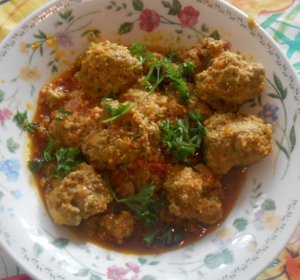
Add 1 cup water. Bring water and sauce to boil using high heat. Stir occasionally. Gently add meatballs to pan. Reduce heat to medium and simmer for 20 minutes. Stir gently and occasionally. Reduce heat to warm-low and simmer for another 30 minutes. Stir gently and occasionally. Dice parsley. Garnish meatballs with parsley. This entree goes well with rice.

TIDBITS

1) Pumpkins are round. Balloons are also round.

2) This similarity is no coincidence; Louis XVI loved pumpkin seeds.

3) What the king of France wanted, the king of France got.

4) So great merchant fleets set out from France to import pumpkins from the Spanish territory of Peru. These Peruvian pumpkins cost the royal treasury a million francs every year.

5) Disaster struck in 1777. Pirates based from British Jamaica captured the French fleet bound for Peru, along with its many chests of gold. This loss proved such a blow to French finances that its treasury wouldn’t recover until the next tidbit.

6) King Louis hired Jacques Necker to handle France’s money matter. For Monsieur Necker knew how to get the best price for everything, centuries before AmazonTM even. Many even said he’d able to count up to six billion if given enough time. And that is how many francs he borrowed.

7) The French navy could now buy enough ships to escort their pumpkin fleets to and from France. Then boom! The American Revolution started. France went to war with the British. The French fleet helped America gain its independence.

8) However, French naval expenditures trained the French treasury. Its navy wouldn’t put to sea for decades. This left King Louis’ annual pumpkin fleets unescorted, easy prey for British ships of the line.

9) What to do? Louis XVI having scooped out all the pumpkin seeds, looked down at the empty pumpkin and had an epiphany. Why not carry Peru’s pumpkins seeds back using giant, balloons made from empty pumpkins?

10) Well, of course, the Peruvian pumpkins of 1781 were not big enough to make balloons or even the baskets beneath them. So France bought up an enormous pumpkin farm in Peru dedicated to making enormous pumpkins. No franc was left unspent in pursuit of the venture.

11) By 1789, Louis XVI had no money. His finance minister asked the French nobility if it would accept new taxes. It said, “Na, na, na, poo, poo.” So Necker asked all of France for a gigantic weenie roast to discuss ways to raise revenue. Fine suggestions were made, then disaster struck. A nobleman cut in front of a long line of peasants waiting for weenies. Words were said. Knives with drawn. Before you could say François’s your uncle the French Revolution began.

12) King Louis would lose his head in the ensuing kerfuffle. Napoleon would seize power and discontinue the bigger-pumpkin experiment in Peru. So bummer.

13) However, so good came out of Louis’ misfortune. America borrowed the idea of France’s Great Weenie Roast of 1789 to celebrate every Fourth of July. And Peru’s big pumpkins are still the envy of the world.

– Paul De Lancey, The Comic Chef

My cookbook, Following Good Food Around the World, with its 180 wonderful recipes, my newest novel, Do Lutheran Hunks Eat Mushrooms, a hilarious apocalyptic thriller, and all my other books, are available on amazon.com.

Categories: cuisine, history, international | Tags: , , , , , , , , , , , , , , , , , , , , , , , , , , , , , , , | 2 Comments

Lemongrass and Five Spice Tofu

Vietnamese Appetizer

LEMONGRASS AND FIVE SPICE TOFU

INGREDIENTS

2 stalks lemongrass
3 garlic cloves
1¼ pounds firm tofu
1 cup vegetable oil (2 tablespoons more later)
2 tablespoons vegetable oil
½ teaspoon red chile flakes
1 teaspoon Chinese five spice
¼ teaspoon white pepper or pepper
½ tablespoon soy sauce

PREPARATION

Discard all but the tender, inner and lower, green part of the lemongrass stalks. Mince garlic cloves and remaining lemongrass. Slice tofu into 8 long rectangles. Pat dry with paper towel. Add 1 cup vegetable oil to pan. Heat oil at high heat until a tiny bit of tofu in the oil will start to dance. Carefully add tofu rectangles to pan. Fry tofu rectangles for 8 minutes or until golden brown and crispy on the bottom. Turn over once. Fry for 4 minutes or until golden brown and crispy on the new bottom. (Monitor the tofu carefully as the time between golden brown and crispy can be short.) Remove tofu and drain on paper towels.

Add 2 tablespoons vegetable oil to 2nd pan. Add garlic, lemongrass, and red chile flakes. Sauté at medium heat for 2 minutes or until lemongrass is tender and fragrant. Stir frequently. Add Chinese five spice, white pepper, and soy sauce. Mix until well blended. Add tofu rectangles. Sauté at low-medium heat for 2 minutes. Turn over once. Place 2 tofu rectangles on each plate. Carefully spoon sautéed lemongrass/garlic from pan over tofu rectangles.

Serves 4. Takes 45 minutes.

TIDBITS

1) It’s startling to hear this now, but for centuries, perhaps even millennia, lemons grew on grass rather than on trees. The reason for this change and other  ensuing culinary changes was war.

2) The British navy had been losing thousands and thousands of sailors to scurvy. In 1753, the British conducted controlled experiments to find a cure for this dread scourge. They strongly concluded that lemon juice would keep scurvy at bay. A scant forty-two years later, the British Admiralty began issuing daily rations of lemon juice. Scurvy disappeared! The navy could indefinitely blockade Napoleon’s ships and keep him from invading England. It was all so neat. Unfortunately, the Admiralty’s lemon mowers cut so much lemon grass that ground lemons were on the brink of extinction. Botanists stepped in and grafted lemons onto trees. This process worked well that the lemons developed seeds that would sprout into full-blown lemon bearing trees. History is such fun.

Chef Paul

My cookbook, Following Good Food Around the World, with its 180 wonderful recipes, my newest novel, Do Lutheran Hunks Eat Mushrooms, a hilarious apocalyptic thriller, and all my other books, are available on amazon.com.

Categories: cuisine, history, international | Tags: , , , , , , , , , , , , , , , , , , , , , | Leave a comment

Looking for Toilets, My Travels Through Europe: Venice

VENICE

Doge’s Palace has a public toilet.
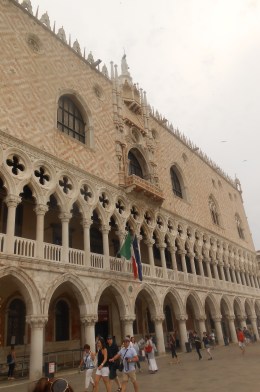
See Venice while you can for many parts of it are sinking into the sea. It’s kinda like California slipping into the ocean at the rate of a half inch a year. But there are differences as well.

California has earthquakes, fires, has water shortages, is a hot bed of information technology, has a huge agricultural sector, gives free water at restaurants (if you ask for it) and lets you use restrooms at all sorts of places such as restaurants, supermarkets, and just about any sort of business where the public comes in.

Venice has no shortage of water. It’s everywhere sometimes it floods the main square that tourists infest, which is exciting if you’re wearing designer shoes.

Venice was founded in the fifth century when Attila the Hun was rampaging through Italy, sacking cities, slaughtering the populace, destroying the Roman Empire, and otherwise being rather unpleasant. Anyway, the citizens of Aquileia, a thriving city, saw no future in being massacred and high tailed to the nearby swamp. They reckoned the Huns, a tribe that grew up in east-central Europe, wouldn’t want to slog through the swamp just to extinguish a bunch a people whom they had no real quarrel with. The Aquileians were right and before you knew it, they were sinking pillars in the marsh to provide support for the buildings they were going to put up.

These swamp people called their new city, Venice after Venn diagrams, they were astoundingly into the theory of logic, and ice, a rare commodity in a Mediterranean* seaport in the Dark Ages. Anyway, the Venetians minded their own business for centuries. In disgraceful contrast, the other nations and city states, generally went around for centuries impaling each other with lances and other weapons.

All of a sudden a Venetian woke up and decide to make galleys. These were ships powered by men using oars. Think of fishing in a tiny lake. You used a rowboat. Only the Venetians galley were huge multi-decked rowboats requiring hundreds of oarsmen. Just as you want to protect your fishing spot and perhaps wanted the lake to yourself, the Venetians wanted the Mediterranean to themselves and used their galleys to sink the other nations ships.

However, instead of catching fish, the Venetians transported spices from the Middle East to the rest of Europe. The Europe of the Middle Ages and Renaissance had really no refrigerators to speak of. Thus, their food other rotted and stank, more than lutefisk even. So, the Middle Age diners really appreciated a good spice to cover up the bad food. And so the Venetians thrived.

Until suddenly, the Ottoman Empire conquered the Near East and shut off access to the spices. Moreover, Western Europe developed large sailing vessels that could whoop the pants off the Venetian galleys in combat and could travel long distances across the open sea. Venice went into a centuries long decline. You would have thought they could have used that declining time to come up with anything, like reclining chairs and public restrooms, but no.

Venice lost its independence to Austria in 1806. However, the conquered city still had lots and lots of pasta and fish. This made going to restaurants lots of fun. About this time, Signor Scampi added chairs to his pizzeria. What a great idea. People loved being able to seat down for supper. More and more chefs provided chairs for their customers. The trend toward chairs in Venetian restaurants continues to this very day.

Venice was a republic of sorts, although if you didn’t like the current governor–doges they called them–you were denounced, tried, convicted, and imprisoned or executed in one day. Movers and shakers you bet. People were so afraid of appearing unhappy, that they sported smiles all day long. Hence, the expression, “As smiley as a Venetian.”

My family and I as we got off the water taxi that took us from the port to St. Mark’s square. We headed to our first event, a gondola ride. We took our time, enjoying the architecture. Inevitably with a family of four, some of us had to pee. Where were the public toilets? Where was Waldo? Where was Ameila Earhardt? Actually, we found Ms. Amelia, but the need for the toilets remained unabated. Indeed the pressure mounted. We did find a fancy hotel near the gondola ride. After making our donations, we went outside to find the place where we would show our vouchers. According to the maps, the gondola extravaganza was supposed to be only ten yards away.

As the crow flies. As the drunken crow flies. We crossed a bridge and went to the gondola kiosk. The sphinxes periodically manning the booth ignored us. We recrossed the bridge in search of a caring employee. Nothing. We crossed back to the booth. Nothing. We ended up going over that bridge six times before we found an employee who put a round orange sticker on our shirts. We were good to go.

We got in line. We had a good position even though the gondola guys had sold hundreds of tickets for our time slot. Actually this wasn’t true due to a cultural misunderstanding. In America, people generally stand behind the last person in line. In Venice and in the airport coming back, standing in line meant standing to the side of people in line, generally near the front. Soon a vast semi-circle sea of people stood around the gondolas pressing ever forward as if  trying to get into a Who concert.

Eventually we got on a gondola and began our bumper-to-bumper (prow-to-bow on a gondola?) tour of the back canals of Venice. Many power boats made deliveries on alcohol to the back entrances of various bars. Cool, actually.

After the ride, I had the clever idea of finding where our evening Vivaldi concert would be. Although the venue had St. Mark’s as part of its address, our consensus was to use GPS. GPS resolutely marched us to and around tiny alleys away from St. Marks. We came to an epiphany; GPS sucks in narrow alleys.

We did find a small pizzeria where authentic Chinese waitresses provided efficient and cheerful service. This restaurant might have had a restroom. We’ll never know. None of us felt brave enough to pass a shrieking toddler to look. Oh how, weak and naive we were.

But we were smart and experienced enough now to head back to St. Mark’s Square to find Saint Mark’s Cathedral. (By the way, twenty-four years earlier I had the good fortune to visit this square during the Carnival season. I saw many wonderful acts, many in Italian and some in English. I also did the Hokey Pokey with a bunch of Americans. My contribution was, “You put your left ear in. You put your left ear out…)

Anyway the biggest tourist attraction in Venice is St. Mark’s Cathedral, named after St. Mark. My family went there for a full mass on Saturday evening. Mass was in Italian, but the choir was from Britain and sang in English, which was cool. But no restroom. During mass, touring around the cathedral is forbidden. So is flash photography, at least in theory. Sitting is forbidden during the tourist hours. So, you can’t sit in a pew and look at spectacular mosaic in the ceiling. And there’s no public restroom inside.

After mass, we went outside to find our concert. My gosh, it was literally twenty yards away. There was a big sign saying, “Vivaldi Concert tonight.” Fuck you, GPS.

The concert was fantastic. We were in the second row, only fifteen feet away from the musicians. The concert hall had seats for only about forty people. The energy and the skill of the musicians, well oh my gosh they were great. And they played Vivaldi’s the Four Seasons, one of my favorites. (I had listened to Vivaldi’s Two Seasons a couple decades earlier from a slow-arriving herd of Parisian violinists. No comparison, these Venetian folks were the real McCoys.)

And the concert venue had a public toilet. Sure I had to clamber up a two-foot high step, but I had been toughened, and so it proved no obstacle at all.)

A great concert, two public toilet, and mass at one of the most famous cathedrals in the world, the day had been good.

Next day we stampeded the doge’s palace in St. Mark’s square. The doges had  lived there. It’s also where the nobility conducted the affairs of state. Venice was by the standards of its times, a rabid democracy. At first, nearly all the men could vote. Then sometime during the Middle Ages, the nobility in an admirable display of voter suppression struck all but a few thousand men from the voting rolls. The criminal justice system occurred in this building as well. With a strong Protestant work ethic, this Catholic government (the Reformation wouldn’t occur for centuries) heard, convicted, and sentenced people with assembly line efficiency.

Which they needed to do as they apparently had and still have, thank goodness, one public restroom. Would you want to spend hours uncovering quilt when you needed to pee. How did I know of this restroom? Twenty-four years earlier, I had toured the doge’s palace with a reasonably empty bladder. Only after leaving the palace did I look at my tour guide. It said, “Don’t forget to visit the public restroom at the palace. People restrooms are scarcer than hens’ teeth in St. Mark’s Square.” The tour book was right. A few hours later, I found myself wandering the Square saying, “A toilet! My American ExpressTM travellers checks for a toilet.” So this time I was able to comfortably whiz away while surrounded by centuries of history.

We then took our self-guided tour of St. Mark’s Cathedral. For love of God, Montressor, book your tickets in advance. Plate tectonics moves faster than lines at the Cathedral’s kiosks. The cathedral was as beautiful as it had been the previous day.

Our ticket to the doge palace gave our free entry to the city’s art museum. Let me tell you the energy spent railroading enemies of the state to their death did not diminish in the slightest the output of the land’s magnificent artists. Lots of busts of Napoleon, which was exciting for me as I am a direct descendant of his and it was nice to speculate how all this art and city could have been mine if only he had won the Battle of Waterloo.

Then tragedy struck. The men’s bathroom in the museum was, was . . . oh the humanity, was blocked of for cleaning. Well fuck. So we went outside to look for a public bathroom. We saw a sign for one. We did! We did!

We didn’t find it. We looked for hours. In desperation, we went into a restaurant. Number Two Son approached the proprietor*. The conversation remains burned in my brain.

“Do you have a restroom?” asked Number Two Son.

“Yes,” said the evil proprietor.

“May we use it?”

“No.”

“How about if we eat dinner here?”

“No.”

So we head back to the water-taxis with my bladder full as Boulder Dam after a rainy season. And there it was, Harry’s Bar! My gosh, the famous Harry’s Bar. Ernest Hemingway, Winston Churchill, Orson Welles, Aristotle Onassis, and other luminaries used to get drunk here and it was quite all right. And carpaccio was invented here. Contessa Amalia Nania Mocenigo was told that for her health she had to give up cooked meat. The clever bar owner sliced sirloin steak as thin as possible drizzled a sauce made of mayonnaise, dry mustard, Worcestershire sauce, lemon juice, olive oil, and a soupçon of milk. A place fit for an exclamation point!

I went in to whizz. I asked to use the restroom. They answered politely and pointed the way. I expressed my gratitude after I came out. I said how excited I was to be at Harry’s Bar. They smiled and thanked me. We went back to our ship. A palace, an art museum, culinary history, and two public restrooms. Life was good.

* = Mediterranean is hard to spell. So is proprietor.

– Paul De Lancey, The Comic Chef

My cookbook, Following Good Food Around the World, with its 180 wonderful recipes, my newest novel, Do Lutheran Hunks Eat Mushrooms, a hilarious apocalyptic thriller, and all my other books, are available on amazon.com.
Categories: history, international | Tags: , , , , , , , , , , , , , , , , , , , , , , , , , , , , , , , , , , , , , , , | 1 Comment

Bunny Chow

South African Entree

BUNNY CHOW

INGREDIENTSbunnychow

1 medium onion
3 medium potatoes
4 cardamom pods
1 cinnamon stick
½ teaspoon fennel seeds
3 tablespoons vegetable oil
2 tomatoes
2 pounds chicken breasts or lamb
3 fresh curry leaves
3 tablespoons Durban masala (See recipe)
⅓ cup chicken stock
2 1-lb whole white loaves
1 tablespoon fresh cilantro

Serves 4. Takes 1 hour.

SPECIAL UTENSIL

Dutch oven

PREPARATION

Dice onion. Peel potatoes. Cut potatoes into 1″ cubes. Add onion, potato, cardamom pods, cinnamon stick, fennel seeds, and vegetable oil to Dutch oven. Sauté at medium-high heat for 5 minutes or until onion softens. Stir constantly. Remove from heat.

Dice tomatoes. Cut chicken into 1″ cubes. Add Durban masala, Add tomato, chicken, curry leaves, and Durban masala to Dutch oven. Cook using medium heat for 5 minutes. Stir frequently. Add chicken stock. Reduce heat to low and simmer for 30 minutes or until potato is tender and chicken is no longer pink inside. Remove Dutch oven from heat. Discard cinnamon stick.

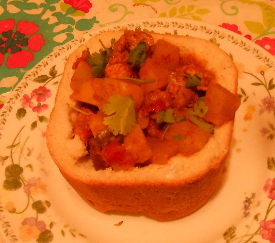
Slice bread loaf in half along its length. Use sharp knife to cut off most of the soft white bread from each half. Leave ½”-to-1″ of bread crust along the edges and bottoms. (The scooped out bread can be made into bread crumbs.) Ladle potato/tomato/chicken mixture into each hollowed-out loaf half. Garnish with coriander. Repeat for second bread loaf.

TIDBITS

1) Bunnies are naturally fierce fighters. Armies everywhere had them. Napoleon wouldn’t have dreamed of conquering Europe without his corps of bunny irregulars.

2) But you say, “Aha, Napoleon didn’t conquer Europe. See, you’re wrong. Bunnies aren’t so fierce.” Ho, ho, they are. Napoleon won victory after victory up until 1808 with his beserker bunnies.

3) Then, Napoleon invaded Spain. Spain had guerrilla fighters. More importantly, it had battle hardened bunnies. Conquistador bunnies. Bunnies that pushed Moors out of the Iberian positions during the centuries of La Reconquista. Bunnies that had accompanied Cortes to Mexico, Pizarro to Peru, and Albondigas to Greenland. Bunnies that terrified conquered peoples into quiet submission for centuries.

4) The French army never had been on the receiving end of a bunny charge. Never had seen those twitching noses and the unreasoning terror that engendered. Never had to see a sea of bunny tails popping up and down as they stamped toward them . . .

5) where they nibbled your shoes and your shoelaces and so you tripped and your comrades laughed and laughed at you and felt so ashamed that you deserted the army and ran home where you sold sprigs of cilantro which tastes like soap to some people which was okay because all life tasted like soap to you and you spent the rest of your life thinking in run-on sentences.

6) And even if you managed to man up and stand your ground after all that, the bunnies would bite your ankles repeatedly which often hurt, particularly so when their teeth actually broke your skin.

7) Suppose you were a stalwart sort, a man among and you were still fighting bunnies crazed beyond belief by sangria, you’d still have to deal with the bunnies’ powerful rear legs, legs that could kick a potato twenty feet.

8) Imagine. You’ve seen their twitching noses, their bobbing cottontails, had your shoelaces nibbled in two, had your ankles bitten, and now they’re hurting your shins and they won’t stop. And then, and then, they keep your potatoes twenty feet away where they get smooshed in the heat of battle.

9) You have no food. So, you confiscate some local food, some paella perhaps, but your body hasn’t faced Spanish food bacteria. So, now you’re a French soldier in Spain fighting for an emperor who only cares about himself and you have the mother of all stomach aches. You throw thrown your musket and flee.

10) The rest of your comrades see that you, a man among men, are fleeing. They realize the fight is lost. They flee as well. Your army is routed. Bunny-fear demoralizes the other French armies. French forces reel back to France. Allied hordes attack Paris and storm the Montmarte. France capitulates. Your flight from the Spanish battlefield brought all this about.

11) The French Emperor Napoleon gets exiled to Elba. The long-time leader gives a farewell to his Old Guard, “Adieu mes amis, nous sommes battus vaillamment et aurions gagné mais pour ce lecteur de recette et sa peur des lapins.”*

* = “Good buy my friends, we fought valiantly and would have won but for this read reader of recipes and his fear of bunnies. (Sorry, apparently Napoleon’s French is only as good as mine. Weird.)

12) So you’ve changed history. Awesome responsibility, isn’t it?

– Paul De Lancey, The Comic Chef

My cookbook, Following Good Food Around the World, with its 180 wonderful recipes, my newest novel, Do Lutheran Hunks Eat Mushrooms, a hilarious apocalyptic thriller, and all my other books, are available on amazon.com.
Categories: cuisine, history, international | Tags: , , , , , , , , , , , , , , , , , , , , , , , , , , , , , , , , , , , , | 3 Comments

Blog at WordPress.com.