Posts Tagged With: Frankish

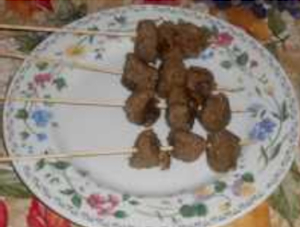
Berbe Kafta Kebabs From Morocco

Moroccan Entree

BERBERE KAFTA KEBABS

INGREDIENTS
1 medium yellow onion
1 tablespoon Berbere spices (Or see recipe for BERBERE SPICE MIX)
½ teaspoon cayenne pepper
¼ teaspoon ground cinnamon
½ tablespoon ground coriander
¼ teaspoon ground ginger
1 tablespoon parsley flakes
½ teaspoon black pepper
1 teaspoon sea salt
1½ pounds ground beef

SPECIAL UTENSILS

Electric skillet
Wooden skewers (about 8 inches long. Size matters.)
Spice grinder (if you are making your own Berbere spice mix.)

PREPARATION

Peel and dice onion. Put onion, Berbere spices, cayenne pepper, cinnamon, coriander, ginger, parsley, pepper, salt, and ground beef in mixing bowl. Indulge in gentle primal scream therapy as you mix everything together with your hands. Make meatballs about 1-inch across until mix is used up. Put meatballs in bowl and chill in refrigerator for at least one hour.

Cook meatballs on electric skillet at 350 degrees. Turn just often enough to ensure meatballs are no longer pink on the inside and starting to brown on the outside. Vigilance is a must. (Tasting isn’t a bad idea either. However, if you taste every meatball before your fiancé arrives, then maybe the relationship wasn’t meant to be.)

Let the meatballs cool down enough so they don’t burn your fingers. Gently place 2 or 3 meatballs on each skewer. (It is possible to pierce your hand or finger with the sharp edge of the skewer. These are wooden skewers, you say, how sharp can they be? Okay, I probably couldn’t terrify an intruder armed with a gun, but I could give him an owie he’d never forget.)

Tastes great on its own or serve with lemon wedges and Moroccan yogurt sauce. (See recipe for this.)

TIDBITS

1) In 711, Arab armies crossed over the Straits of Gibraltar and headed northward to the Frankish Kingdom bringing all sorts of Moroccan spices with them. It is hard to say exactly what spices, as most historians, especially military, are strangely mute on this point.

2) In 732, the Frankish leader defeated the Arabs at the battle of Tours ensuring the survival of French spices and cuisine.

3) Frankish and Arab armies marched back and forth in southern France until 915, making certain the fusion of French and Moroccan spices.

4) Culinary arts stagnated during centuries of peace between France and Morocco.

5) Fortunately, French power and imperialism came back in 1907 when Gallic armies occupied Casablanca. A new round of fighting and culinary exchange between the two great nations began.

6) Unfortunately for gourmands everywhere total peace broke out in 1956 with Moroccan independence.

7) For awhile, it seemed as if the tens of thousands of brave French and Moroccan warriors who died in the cause of culinary integration had fallen in vain.

8) But you can’t keep a good spicer down. Over the next few decades, Moroccans headed to France in search of jobs, bringing their spices with them. Now you can find good French and Moroccan restaurants all over the world. Life is good.


– Paul De Lancey, The Comic Chef, Ph.D.

My cookbook, Following Good Food Around the World, with its 180 wonderful recipes, my newest novel, Do Lutheran Hunks Eat Mushrooms, a hilarious apocalyptic thriller, and all my other books, are available on amazon.com.

Categories: cuisine, history, international | Tags: , , , , , , , , , , , , , , , , , , , , , , , , , , , | 2 Comments

Khachapuri (Georgian cheese roll)

Georgian Entree

KHACHAPURI

INGREDIENTSKhacapuri-

¾ cup milk
1 teaspoon sugar
2½ teaspoons yeast
1 tablespoon olive oil
2⅔ cups flour (4 additional tablespoon later)
¾ teaspoon salt
1 tablespoon flour (3 additional tablespoons later)
1 tablespoon butter (2 additional tablespoons later)
1 pound Muenster or mozzarella cheese
½ pound feta cheese
¼ pound ricotta cheese
2 eggs (2 additional eggs later)
2 tablespoons flour (1 additional tablespoon later)
1 tablespoon flour
2 eggs
2 tablespoons butter

SPECIAL UTENSILS

parchment paper or at least, no-stick spray
food processor
2 x 9″ pie tins
clothes dryer

Makes 2 loaves. Takes 2¾ hours.

PREPARATION

Add milk and sugar to small pot. Cook on low-medium heat until mixture is lukewarm. Stir constantly. Remove from heat and add yeast. Stir until well blended. Let cool for 10 minutes. Add olive oil, 2⅔ cups flour, and salt. Stir until mixture becomes a lumpy dough ball. Let sit for 30 minutes.

While dough ball sits, dust a flat surface with 1 tablespoon flour. Add dough ball to flat surface. Knead dough by hand until you are at peace with the world or 8 minutes. Grease large mixing bowl with 1 tablespoon butter. Add knead dough ball to greased, first mixing bowl. Turn dough ball around until it’s coated with butter. Cover bowl and let sit for 1 hour.

While dough rises, cut Muenster and feta cheeses into ½” cubes. Add grated Muenster, feta, and ricotta cheeses to food processor. Blend until only a few cubes remain. Add 2 eggs and 2 tablespoons flour. Blend until mixture is smooth. Preheat oven to 375 degrees.

After dough has risen, dust flat surface with 1 tablespoon flour. Add dough ball to flat surface. Flatten dough ball with hands. Divide dough ball in half. Flatten dough halves until they are 11″ wide and about ⅛” thick. Add parchment paper or no-stick spray to pie tins. Add flattened dough halves to pie tins. Add half of cheese/egg/flour mixture to center of each dough half. Pull edges of dough to the center until there is only a round 1″ hole in the middle. Pinch edges together.

Bake for 15 minutes at 375 degrees or until bread loaves are starting to brown. Use spoon or shot glass to press a 3″ hole in the center of the loaves. Add an egg to each 3″ hole. Bake at 375 for 15 minutes or until loaves turn golden brown and eggs are slightly set. (The eggs will continue to cook after being removed from the oven.) Remove from oven and brush each loaf with 1 tablespoon butter.

Serve hot to adoring guests. Put pairs of unappreciative guests in pairs of matched socks. Put sock-clad guests in clothes drier. When one of the matching socks disappears, as often happens, it’ll take one of the complainers with it. Repeat until your home has only happy people in it.

TIDBITS

1) This entree is from the country called Georgia. This Georgia is near Russia and Iran. There is also a state in America called Georgia. It is near Florida, Alabama, Tennessee, and South Carolina.

2) Both Georgias are named after Madamoiselle Georgia Chat. We know little about Mlle. Mousse save that she was born in Tours, France about 708. She was also extraordinarily beautiful. Okay, we know that. Oh, she was also fabulously rich. All right, we know that as well. So, you’d think she’d be a hot marriage prospect for all the local barons. Why did she never marry?

3) Mademoiselle Georgia never considered giving up her independence and she had a giant, pet rabbit Snuggles to protect her. How gigantic? Sources yield varying heights from twelve feet tall to the preposterous sixty-seven feet. Given the fact that Snuggles was also a ninja, you can see why the local nobility thought twice before courting her. On it went. Georgia performed scientific experiments. She even invented the briquette for barbecuing while Snuggles swung his one-ton hammer. at local lords and door-to-door salesmen.

4) Then in 732, Abd Al-Raman with his Berber tribesmen invaded the Frankish kingdom. The Franks assembled their forces at Tours under Charles the Pippinid. The Muslim Berbers were famed for their cavalry. The Franks had the fiercest infantry in all of Europe. Unfortunately, the Franks at the time were notorious for their allergy to horses.

5) The Muslims should have won. Europe should now be eating koushry instead of croissants. What happened? Snuggles happened. He shoved his way past the sneezing Frankish infantry and swung his mighty hammer over and over again at the massed Berber cavalry. Soon, the overmatched Berbers fled, but not before one of them shot an arrow through Snuggles’ heart.

6) Two bards saw the battle and would travel the world singing Snuggles’ praises. One settled in America, the other near Russia. Locals impressed by Snuggle’s deeds wanted to renamed their lands after him, but balked at his cutesy name. They settled on Georgia instead and there you have it.

– Paul De Lancey, The Comic Chef

My cookbook, Following Good Food Around the World, with its 180 wonderful recipes, my newest novel, Do Lutheran Hunks Eat Mushrooms, a hilarious apocalyptic thriller, and all my other books, are available on amazon.com.

Categories: cuisine, history, humor, international | Tags: , , , , , , , , , , , , , , , , , , , , , , , , , , , , , | Leave a comment

Create a free website or blog at WordPress.com.