Posts Tagged With: Chef Paul

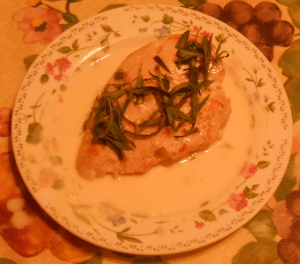
Tarragon Chicken – Poulet à Estragon

French Entree

TARRAGON CHICKEN
(Poulet à Estragon)

INGREDIENTS
3 chicken breasts
⅛ teaspoon pepper
¼ teaspoon salt
1 shallot
3 green onions
1 tablespoon butter
2 tablespoons olive oil
1 cup dry white wine
⅔ cup crème fraîche or heavy cream
1 tablespoon lemon juice
3 tablespoons fresh tarragon leaves (1 tablespoon if dried)

Serves 3. Takes 40 minutes.

PREPARATION

Rub chicken breasts with pepper and salt. Dice shallots. Thinly slice green onions. Add butter, olive oil, and shallot to pan. Sauté at medium-high heat for 3 minutes or until shallot softens. Stir frequently. Add chicken breasts and green onion. Sauté at medium-high heat for 5 minutes for each side or until chicken starts to brown. Stir occasionally. Add white wine and crème fraîche. Stir until sauce is well blended. Bring sauce to boil. Stir frequently. Reduce heat to medium. Cook for 5 minutes or until sauce has been reduced by half. Stir occasionally. Spoon lemon juice over chicken breasts. Sprinkle with tarragon.

TIDBITS

1) In 1922, the Agricultural Department, finding itself with an extra twenty-billion dollars decided to help the American farmer. Specifically, the American tarragon farmer. Why the tarragon growers? It had a really, really, really good lobby back then.

2) That amount of money bought quite a lot of tarragon seeds back then, enough to plant the entire Great Plains. Farmers gave up costly corn and wheat seeds in favor of free tarragon. USA became a global tarragon powerhouse. Tarragon farmers in other lands, however, faced bankruptcy. Foreign nations protected their farmers with prohibitively high tariffs on American tarragon. The United States retaliated with fees on European cheeses, even the non-stinky ones. European countered with tariffs on American wheat. Things got out of hand, with agricultural departments saying, “Na, nana, poo, poo” to each other and finding new ways to destroy each others commerce. Soon the global economy collapsed and we had the Great Depression of 1929-1939. Tens of millions of people were thrown out of work, including America’s tarragon farmers. This was bad; no tarragon on chicken for ten long years. But America survived. Its people are resilient.

Leave a message. I’d like to hear from you.

Chef Paul

My cookbook, Following Good Food Around the World, with its 180 wonderful recipes, my newest novel, Do Lutheran Hunks Eat Mushrooms, a hilarious apocalyptic thriller, and all my other books, are available on amazon.com.

Categories: cuisine, history, international | Tags: , , , , , , , , , , , , , , , , , , , , , , , | 2 Comments

Afghan Burgers

Afghan Entree

AFGHAN BURGERS

INGREDIENTS

3 cups crinkle-cut fries or enough to cover cookie sheet
4 eggs
1 cup fresh cilantro
3 garlic cloves
1 red onion
3 sausages, beef or chicken
3 tablespoons vegetable oil
⅓ cup water
2 Roma tomatoes
½ cup vinegar
½ teaspoon pepper
½ teaspoon salt
5 lavash or roti loaves

SPECIAL UTENSILS

11″ x 17″ cookie sheet
newspaper or paper*
tin foil*

* = This really is a street food. It is meant to be held. If you don’t have paper, and perhaps, foil on the bottom, your hands will get greasy and food will go all over everything.

Serves 5. Takes 55 minutes.

PREPARATION

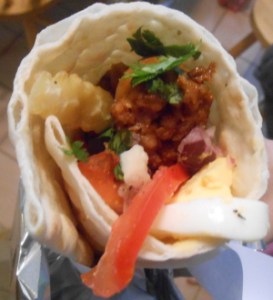
Cook French fries according to instruction on package. While fries cook, boil eggs, for 6 minutes for soft boiled to 12 minutes for hard boiled. While eggs boil, dice cilantro, garlic cloves and red onion. Slice each sausage into 8 round pieces. Add sausage pieces and vegetable oil to pan. Sauté sausage pieces at medium-high for 5 minutes or until they are brown on all sides. Turn sausages enough to prevent burning. Add water. Reduce heat to medium. Cook at medium heat for 3 minutes or until pieces are no longer pink inside.

Cut each egg into 6 slices. Cut tomatoes into ½” slices. Add vinegar, pepper, and salt to onion. Stir with fork until well blended. Cut lavash loaves into 4″-wide strips. Evenly add ingredients to the lavash strips in the following order: egg, tomato, red onion/vinegar/pepper/salt, fries, sausage, cilantro, and garlic. Roll up food-laden lavash strips. Wrap the lavash roll-ups with paper, being careful to fold paper under the bottom of the roll-ups. Then do the same with the tin foil.

TIDBITS

1) As noted above in the recipe, the Afghan burger is a street food.

2) It is less well known, however, is that it is the world’s first street food. And even less known than that is that the Afghan burger was invented in Poway, California, two million years ago*, 100,000 years before Lucy, homo habilis, the supposed first human roamed the Earth.

* = Also written as 2.0 mya. These tidbits are nothing, if not scientific.

3) Patty, homo streetfoodus and chef extra ordinaire, invented the Afghan burger, while pondering the infinite* and keeping an eye out for vicious mountain lions.

* = Homo streetfoodus’ counting system was one, two, infinite. So, her dreaming of infinity was not as grandiose as it might have seemed. But then she had a smaller brain than we do, so it all worked out.

4) Anyway, while Patty contemplated a herd of infinitely-legged gazelles, the sky began to thunder. Zap! Zap! a lightning bolt struck one of the gazelles. The force and heat of the bolt was so intense that the gazelle exploded into dozens of fully cooked sausages. It is by fortuitous events that humanity advances.

5) Pow! Zap! The storm raged. A lightning bolt hit an elm tree turning into paper. Then the storm stopped, enabling tin traders from Cornwall, homo satnavus, to arrive.

6) Then food traders from Boston*, homo marathonus, showed up at Poway; even then Poway was the place to be. They gave Patty fresh cilantro, garlic, red onions, potatoes, vegetable oil, pepper, salt, and vinegar.

* = The Boston of two million years ago was much smaller than the current city. You wouldn’t have recognized it.

7) “All we need is some eggs.” said Patty. Fortunately, and this was one of those rare days when things really came together for humanity*, a herd of chickens migrated by, leaving an infinite number of eggs.

* = Indeed, Patty won a million dollars in the lottery that very day. However, as she and the others had no notion of money, the winning ticket went uncashed.

8) And so, Patty made Afghan burgers for the happy band of traders. And the burgers said that they were good. And Patty was well pleased. But they were quite hot. Truly and forsooth, through the millennia. as people lost the enormous finger calluses they had 2.0 mya, this version of the hot, juicy Afghan burgers caused more and more pain. Eventually, the Afghan burger disappeared into the sands of time. Fortunately, an unknown chef hero resurrected the entree, this time using flatbread to soak up the hot juices. Afghan burgers are now taking the culinary world by storm.

9) Culinary paleoanthropologists, however, don’t know why this dish is called the Afghan burger when there is no patty in it but created was by Patty, and was first made in Poway, California, not Afghanistan. We may never know. Further research is indicated.

Leave a message. I’d like to hear from you.

Chef Paul

My cookbook, Following Good Food Around the World, with its 180 wonderful recipes, my newest novel, Do Lutheran Hunks Eat Mushrooms, a hilarious apocalyptic thriller, and all my other books, are available on amazon.com.

Categories: cuisine, international, recipes | Tags: , , , , , , , , , , , , , , , , , , , , , , | 4 Comments

Italian Panini

Italian Entree

ITALIAN PANINI

INGREDIENTS

1 ciabatta roll, Italian roll, or French roll
1 tablespoon olive oil
3 tablespoons mayonnaise
2 deli-thin slice Provolone cheese (2 more slices later)
¼ cup roasted red bell pepper strips
4 deli-thin slices capocollo
4 del-thin slices Genoa salami
3 deli-thin slices ham
3 deli-thin slices pepperoni
2 ounces pepperoncini peppers
⅛ teaspoon basil
2 deli-thin slices Provolone cheese

SPECIAL UTENSIL

panini press

Serves 4. Takes 20 minutes.

PREPARATION

Open ciabatta roll. Brush outside of roll with olive oil. Brush inside of roll with mayonnaise. Add 2 slices Provolone to bottom half of roll. Then add in the following order: roasted red pepper strips, capocollo, salami, ham, pepperoni, basil, pepperoncini rings, basil. 2 slices Provolone. and top half of roll. Place completed sandwich in panini press. Toast according to panini press’ instructions or until cheese melts or until bread turns golden brown.. Cut panini sandwich into four smaller ones.

TIDBITS

1) Italian panini is best made with a ciabatta roll. The cia batta roll was originally called the CIA batta roll. Because it was invented by the CIA. Specifically, by Guido Panini, the inventor of the Italian shirt press.

2) Guido was recruited by accident, in 1949, by the CIA. Nevertheless, he continually rose in position because all other employees had made enemies, while everyone loved him for his panini sandwiches. Indeed, in 1961 became director.

3) Later that year, Mr. Panini, suffering from an upset stomach, tried to overthrow Cuba’s Fidel Castro by invading the Bay of Pigs. The whole operation was a fiasco. Guido was given his pink slip, while the CIA was discredited to the extent that the CIA batta roll was quietly renamed, the ciabatta. Chastened, the Agency picks it head nowadays by proficiency in intelligence gathering.

Leave a message. I’d like to hear from you.

Chef Paul

My cookbook, Following Good Food Around the World, with its 180 wonderful recipes, my newest novel, Do Lutheran Hunks Eat Mushrooms, a hilarious apocalyptic thriller, and all my other books, are available on amazon.com.
Categories: cuisine, history, international | Tags: , , , , , , , , , , , , , , , , , , , | 2 Comments

Garlic Bread

Italian Appetizer

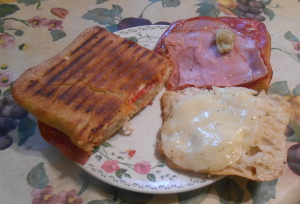
GARLIC BREAD

INGREDIENTS

1 loaf Italian bread or French Bread or French rolls
3 garlic cloves
½ cup butter, completely softened
1 teaspoon olive oil
1 tablespoon Italian seasoning

SPECIAL UTENSILS

food processor (optional)
tin foil

Serves 4. Takes 30 minutes.

PREPARATION

Preheat oven to 375 degrees. Slice bread diagonally every 1″. DO NOT slice bread all the way to the bottom; keep the loaf together. Mince garlic quite finely, use a food processor if desired. Add finely minced garlic, softened butter, olive oil, and Italian seasoning to mixing bowl. Blend thoroughly with whisk or fork. Use spatula to spread garlic butter between bread slices.

Wrap loaf in foil and bake at 375 degrees for 15 minutes or until bread is slightly browned.

TIDBITS

1) Garlic bread is an anagram for Grab Da Rice. Grab Da Rice was a slogan for the hungry French rioters of 1781. It was not a particularly good slogan as incendiary slogans go. I mean, some firebrand would whip up the Parisian sans culottes to a fever pitch and then he’d say, “Grab da rice.”

2) But not many stores in the Paris of 1781 even carried rice. So many rioters dissipated their energy tramping all over looking for riceries. They developed blisters and leg cramps and never ever again heeded the call for revolution.

3) The happy few, well as happy as you can be when you’re in full riot mode, found rice stores had trouble grabbing much rice with their hands. The rice kept slipping between their fingers as they scurried all the way home. A more informative slogan would have been, “Scoop the da rice with a large spoon and but it in a sack.” But that’s too long for exciting people to riot.

4) The French revolution only really took off when its leaders targeted bread rioters with, “Liberté, égalité, fraternité.” Proper word choice matters, even in a revolution.

Leave a message. I’d like to hear from you.

Chef Paul

My cookbook, Following Good Food Around the World, with its 180 wonderful recipes, my newest novel, Do Lutheran Hunks Eat Mushrooms, a hilarious apocalyptic thriller, and all my other books, are available on amazon.com.
Categories: cuisine, history, international | Tags: , , , , , , , , , , , , , , , | 4 Comments

Machanka

Belarusian Entree

MACHANKA

INGREDIENTS

1 pound pork shoulder or loin
1 pound Polish or pork sausages
1 medium onion
2½ tablespoons lard or butter
1¼ cups pork stock or beef stock
5 tablespoons flour
2 bay leaves
1 cup sour cream
¼ teaspoon pepper
½ teaspoon salt

Serves 4. Takes 2 hours.

PREPARATION

Cut pork into 1″ cubes. Cut Polish sausages into 1″ slices. Dice onion. Add pork cubes and lard to pan. Sauté at medium-high heat for 5 minutes or until pork cubes start to brown. Stir occasionally. Remove pork cubes and drain on paper towel. Keep lard in pan.

Add pork stock and flour to small mixing bowl. Mix with whisk until well blended. Add onion and Polish sausage to pan. Sauté for 5 minutes at medium-high heat or until onion softens. Stir frequently. Add pork stock/flour mix, pork shoulder cubes, and bay leaves. Cover and simmer at warm-low heat for 1 hour or until pork cubes are tender. Stir enough to keep sauce from burning. Add sour cream, pepper, and salt. Cover and simmer at warm-low heat for 20 minutes. Stir enough to keep sauce from burning. Remove bay leaves.

TIDBITS

1) This dish is made with pork shoulder. It is called Machanka. The speed of sound, 767 miles per hour was, at first, also called Machanka. How was this speed measured? By having someone yell “Machanka” and then measuring the speed of an air molecule issuing from the yeller’s mouth. This technique did not work well. Air molecules are transparent, making them impossible to track.

2) Thank goodness for the scientists at the Pork Shoulder Catapulting Institute (PSCI) in Minsk. The PSCI dates back to the liberation of Belarus from the Mongols in 1373 when Sergey Daškievic, realized that frozen pork shoulders catapulted at Mongol armies completely disrupted their cavalry.

3) In 1962 the United States Air Force needed to know Machanka so it could build wings strong enough to withstand that speed. Naturally, it turned to the PSCI. The Institute’s scientist yelled “Machanka” at a starving artist at the same time a pork shoulder was catapulted. After many trials, the word “Machanka” arrived at the same time as the pork shoulder. The speed of sound was then calculated as (pork shoulder distance/ air time.) Over time Machanka was shortened to Mach 1.

Leave a message. I’d like to hear from you.

Chef Paul

My cookbook, Following Good Food Around the World, with 180 wonderful recipes is available on amazon.com. My newest novel, Do Lutheran Hunks Eat Mushrooms, a hilarious apocalyptic thriller, is also available on amazon.com

Categories: cuisine, humor, international | Tags: , , , , , , , , , , , , , , , , , , , , , , | Leave a comment

Paul’s Camembert Burger – Blog 999

American Entree

PAUL’S CAMEMBERT BURGER

INGREDIENTS

1½ pounds ground beef
½ teaspoon herbes de Provence
1 tablespoon butter
1 tablespoon olive oil
3 tablespoons white wine
½ cup heavy whipping cream or crême fraiche
1 tablespoon fresh* herbs (thyme, marjoram, or sage)
4 ounces Camembert cheese, no rind
2 teaspoons Dijon mustard
4 French rolls

* = Try to use fresh ingredients for this dish. However, if that is not possible, use 1 teaspoon dried herbs instead.                A still-life painting by Vincent van Gogh.

Serves 4. Takes 30 minutes.

PREPARATION

Add ground beef and herbes de Provence to mixing bowl. Mix with hands. Shape beef into 4 oblong patties that match the shape of the French rolls. Add butter and olive oil to pan. Warm butter using medium heat until butter melts and browns. Tilt pan occasionally to ensure even melting. Add beef patties. Sauté at medium-high heat for 5 minutes per side or until meat is done to your liking. Remove beef patties to dish and cover to keep warm. Keep liquid in pan.

Toast French rolls. Add wine to pan. Bring to boil using high heat. Stir frequently. Add whipping cream and herbs. Stir. Bring to boil again using high heat. Stir frequently. Reduce heat to medium high. Add Camembert cheese and Dijon mustard. Stir constantly until cheese dissolves and blends into the rest of the sauce. Add beef patty to each French roll bottom. Pour sauce over beef patties. Place French roll tops on sauce-covered patties.

TIDBITS

1) Vincent van Gogh painted food for cookbooks. It kept him going during his lean years which were many as he sold only one non-food pictures in his lifetime. Van Gogh also had to work at carnivals as an egg catcher. He and his pals wowed crowds by tossing raw eggs for longer and longer distances without dropping them or letting them break. Van Gogh’s supple hands that helped him catch eggs also allowed him to wield his paint brush with a deft touch. Today, we honor his memory with Poway’s annual Impressionist Egg Toss Festival.

2) All his food paintings but for the incredibly valuable one here perished in s freak fire. Odd.

Leave a message. I’d like to hear from you.

Chef Paul

My cookbook, Following Good Food Around the World, with 180 wonderful recipes is available on amazon.com. My newest novel, Do Lutheran Hunks Eat Mushrooms, a hilarious apocalyptic thriller, is also available on amazon.com

Categories: cuisine | Tags: , , , , , , , , , , , , , , , , | 2 Comments

Homemade Butter

American Appetizer

HOMEMADE BUTTER

INGREDIENTS

3 cups heavy whipping cream
½ cup ice water
¼ teaspoon salt (optional, to taste)

SPECIAL UTENSILS

food processor (best), immersion blender or electric whisk
fine-mesh colander or colander with cheesecloth
butter molds (optional)

Makes 1 cup or 2 sticks butter. Takes 15 minutes.

PREPARATION

Add whipping cream to food processor. Whip cream until it cream fully separates into thickish butter and buttermilk. This can take up to 10 minutes. Place large bowl under colander. Pour contents of food processor into colander. Most of the buttermilk will go through the colander and into the bowl.

Put butter into 2nd bowl. Use your hands to press down on the butter until all of the buttermilk is out of the butter. Pour some cold water onto the butter. Knead butter. Carefully drain water from bowl. Repeat until poured-off water is clear. This process removes the last of the buttermilk from the butter. Add salt, to taste, and mix into butter with fork. Save the buttermilk for drinking or for recipes.

This butter is soft but will harden in the refrigerator. You can make sticks of butter with butter molds. Butter will store in the fridge for 2-to-6 weeks.

TIDBITS

1) There’s always the hope that prison time will rehabilitate criminals.

2) This is why most American prisons have ParcheesiTM leagues. This game teaches people to deal with the ups and downs of life and to take a longer view of things. Plus the long Parcheesi season keeps the inmates busy. More than one avid prisoner has had to be dragged from a post-season tournament game simply because his sentence was up.

3) Freshly made butter hardens in refrigerators. So do freshly made convicts. This is why the higher-security prisons never let jailbirds ever get inside a fridge or even own one. Butter also makes it much easier for people get out of handcuffs. This is why arresting officers won’t give their suspect a stick of butter. One phone call yes, but butter never.

Chef Paul

My cookbook, Following Good Food Around the World, with 180 wonderful recipes is available on amazon.com. My newest novel, Do Lutheran Hunks Eat Mushrooms, a hilarious apocalyptic thriller, is also available on amazon.com

Categories: cuisine | Tags: , , , , , , , , , , , , , , , , , | 2 Comments

Newfoundland Pork Buns

Canadian Appetizer

NEWFOUNDLAND PORK BUNS

INGREDIENTS

½ pound salt pork
¼ cup shortening or butter
3 cups flour (2 tablespoons more later)
2 tablespoons baking powder
¼ cup sugar
1 cup water

SPECIAL UTENSIL

cookie sheet

Makes 7 buns. Takes 1 hour.

PREPARATION

Dice salt pork. Add salt pork and shortening to pan. Sauté at medium-high heat for 5 minutes or until salt pork browns. Add 3 cups flour, baking powder, and sugar to large mixing bowl. Mix with whisk until well blended. Use first to make well in flour. Add salt pork and fat from pan to well in flour. Add water. Mix with fork until well blended.

Preheat oven to 375 degrees. Dust flat surface with 2 tablespoons flour. Roll out flour until it is ½” thick. Cut out 4″-wide circles or any other shape or size you desire. Arrange dough circles on cookie sheet. Allow at least 1″ between dough circles. Bake at 375 degrees for 20 minutes or until golden brown and toothpick stuck in the center of a bun comes out clean.

TIDBITS

1) Ancient Japanese samurai got into so many sword fights that they had to have swords in both hands at all times. If you were a pork-bun-holding samurai, you’d die if a ninja armed with knives, axes, swords, and death stars jumped out of the shadows to attack you. Sure, you might in the first blow, but the best you could hope is crumbs all over the murderous assailant’s face. Then you’d die.

2) Which would be a bummer. So, samurai learned to cook pork buns. They’d poke a hole in the pork bun just wide enough to fit around the warrior’s pony tail. The fierce samurai would then tie the pony into a knot. The knot kept the pork bun from falling off. This freed the samurai’s hands to hold swords. Sword wielding samurai no longer got assassinated by ninjas. The now long-living samurai of 1178 were free to pick flowers and inhale their fragrance.

3) Which didn’t happen, of course. The fierce samurai sought out danger. Since there was none at home, they traveled to Newfound in search of it. They took their pork bun recipe with them, which is why Newfoundland has the recipe. Indeed, culinary archaeologists expect to find  evidence of  samurai habitation in Newfoundland just as they did with the Vikings at L’anse aux Meadows.

– Paul De Lancey, The Comic Chef

My cookbook, Following Good Food Around the World, with its 180 wonderful recipes, my newest novel, Do Lutheran Hunks Eat Mushrooms, a hilarious apocalyptic thriller, and all my other books, are available on amazon.com.

Categories: cuisine, history, international | Tags: , , , , , , , , , , , , , , | 1 Comment

Bananas With Split Peas

Rwandan Entree

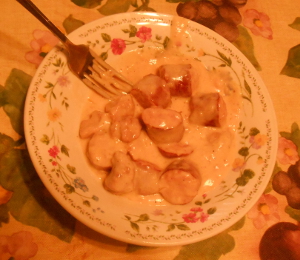
BANANAS WITH SPLIT PEAS

INGREDIENTS

1¾ cups dried split peas
4 cups water or enough to cover split peas
4 ripe bananas¼ teaspoon cayenne pepper or black pepper
½ teaspoon salt
2 tablespoons palm oil or peanut oil
1 medium onion

SPECIAL UTENSIL

mandoline

Makes 4 bowls. Takes 1 hour 30 minutes.

PREPARATION

Add split peas and water to large pot. Bring to boil using high heat. Reduce heat to low, cover, and simmer for 1 hour or until peas soften. Stir occasionally.
Peel bananas. Place entire bananas on top of mushy peas. Cover and simmer on low for 10 minutes. Stir occasionally to keep peas from burning. (Stir gently so that bananas don’t break into pieces.)

While bananas and peas simmer, use mandoline to cut onion into slices ⅛” thick. Add onion, palm oil, and onion to pan. Sauté at medium-high heat for 5 minutes or until onion softens and browns. Add cayenne pepper and salt. Ladle onion and oil over bananas. Stir gently until oil blends in with the peas.

TIDBITS

1) This recipe calls for a medium onion. Onion mediums help us, the living, communicate with those who have gone to the Great Beyond.

2) This differs from musicians communicating to the great Beyoncé. They do that by cell phone.

3) Anyway, the most commonly question asked of the dearly departed was, “Our are missing socks over there with you?” The answer was always, “Yes. you’ll soon see them again.”

4) Unfortunately, people asked that question so often that the onion mediums became unable to channel any other questions between our world and the next. So, frustrated truth seekers took to eating the mediums. The onions proved to be tasty. This is why they are in so many recipes. But do try to cook with medium onions, they’ll leave you more than enlightened than will the other sizes.

– Paul De Lancey, The Comic Chef

My cookbook, Following Good Food Around the World, with its 180 wonderful recipes, my newest novel, Do Lutheran Hunks Eat Mushrooms, a hilarious apocalyptic thriller, and all my other books, are available on amazon.com.
Categories: cuisine, international | Tags: , , , , , , , , , , , , , , , , , | Leave a comment

Picadillo

Cuban Entree

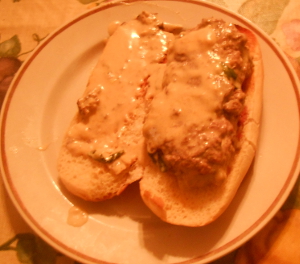
PICADILLO

INGREDIENTS

1 green bell pepper
3 garlic cloves
1 large onion
3 Roma tomatoes
2 tablespoons olive oil
¾ teaspoon cumin
1 teaspoon oregano
¼ teaspoon pepper
¼ teaspoon salt
1½ pounds ground beef
3 tablespoons dry white wine
3 tablespoons tomato paste
12 pimiento (aka pimento) stuffed olives
¼ cup raisins
2 tablespoons fresh parsley

Serves 6. Takes 45 minutes.

PREPARATION

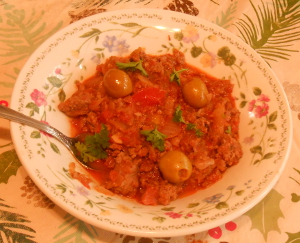
Seed and mince bell pepper. Mince garlic cloves. Dice onion and tomato. Add bell pepper, garlic, onion, olive oil, cumin, oregano, pepper, and salt to pan. Sauté at medium-high heat for 5 minutes or until onion softens. Stir frequently. Add ground beef, wine, tomatoes and tomato paste. Reduce heat to low and simmer for 10 minutes. Stir occasionally. Add olives and raisins. Simmer on low heat for 10 minutes or until raisins plump. Stir occasionally. Garnish with parsley.

TIDBITS

1) The first soup bowls didn’t have a bottom. Scalding-hot soup ladled into them went straight through to the would-be diner’s lap. This is why birth rates were so low until the Renaissance. Then in 1466 a young busboy, Leonardo Da Vinci, weary of cleaning up soup spills, invented soup bowls with bottoms. Suddenly, he had free time to invent and paint. Other busboys such as Michelangelo used this expanded off hours to paint and sculpt. The Renaissance was born.

2) Unfortunately, with creative energies diverted to the arts, bowl design stagnated. Soup-eating armies found little time for campaigning as they took forever to be served. Indeed, General Lee’s peanut-eating army consistently stole a march on their soup-slurping Northern counterparts. Then in 1863, busboy, George Meade discovered he could toss the soup bowls like a FrisbeeTM, if he made the bowls round. (Yes, it does take practice to this without spilling the soup.) President Lincoln, realized an army that could serve soup suddenly could keep up with the Rebels. He made Meade general. Three days, the round-bowl eating bluecoats defeated the gray coats at Gettysburg. The Union would be preserved, slavery would be abolished, and we are eating out of round bowls.

– Paul De Lancey, The Comic Chef

My cookbook, Following Good Food Around the World, with its 180 wonderful recipes, my newest novel, Do Lutheran Hunks Eat Mushrooms, a hilarious apocalyptic thriller, and all my other books, are available on amazon.com.
Categories: cuisine, history, international | Tags: , , , , , , , , , , , , , , , , , , , , , , , | 2 Comments

Create a free website or blog at WordPress.com.