Posts Tagged With: spaghetti

Fried Green Tomatoes

American Appetizer

FRIED GREEN TOMATOES
With Dipping Sauce

INGREDIENTS – DIPPING SAUCEFriedGreenTomatoesCornmeal-
2 stalks green onions
⅔ cup Dijon mustard
½ cup mayonnaise
⅓ cup sour cream
1 teaspoon white pepper

INGREDIENTS – TOMATOES

4 large or 2 pounds green tomatoes*
½ tablespoon salt (1 teaspoon more later)
1 cup cornmeal
1 cup flour
¾ teaspoon pepper
1 teaspoon salt
1 cup buttermilk
up to 2 cups vegetable oil

* = WARNING. This really is a lot of work if you’re using many tiny green tomatoes. If it takes more than 8 green tomatoes to make 2 pounds, consider cutting the amount of ingredients in half. Certainly, you’ll only get to eat only 1 pound of tomatoes this way, while people living in the land of big tomatoes get 2 pounds. However, you won’t be muttering to yourself and looking in the garage for an axe. Alternatively, move to the land of the big tomatoes. Oh, and leave your axe behind.

SPECIAL UTENSIL

electric skillet
3 mixing bowls

Serves 8. Takes 1 hour 20 minutes to 2 hours 30 minutes depending on the size of the tomatoes. Bigger tomatoes take less time. They really do.

PREPARATION – DIPPING SAUCE

Mince green onions. Add dipping sauce ingredients to mixing bowl. Mix with fork until well blended. Cover and chill until tomatoes are deep fried.

PREPARATION – TOMATOES

Cut tomatoes into ¼” slices. Pat tomato slices dry with paper towel. Put slices on wire racks over plates. Sprinkle slices evenly with ½ tablespoon salt. Let sit for 30 minutes to draw out water.

While tomato slices sit, add cornmeal, flour, pepper, and 1 teaspoon salt to large, second mixing bowl. Mix with whisk until well blended. Divide this cornmeal/flour mixture onto 3 plates. (This will keep the cornmeal/from clumping up from the moisture of buttermilk laden tomato slice.) Add buttermilk to third mixing bowl. Dip tomatoes slices in buttermilk. Dredge buttermilk-covered slices one at time through cornmeal/flour mixture until they are well coated.

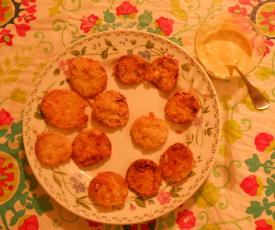
Set skillet to 375 degrees. Add enough oil to coat tomato slices to skillet. Oil will be hot enough when a tiny bit of flour added to skillet will dance in the oil. Add as many tomato slices as possible to skillet without them touching each other. Fry 3 minutes on each side or until they turn golden brown. (Cooking time tends to go down a little with each successive batch.) Additional batches might be necessary. Drain on paper towels. Serve with dipping sauce.

TIDBITS

1) Tomatoes can be cut with a regular knife. But not with any uniformity. Sure, you’ll get the occasional .25″ thick slice, but more often than not you’ll get slices with widths of .28″ or even .35″. However if your neighbors know that your make half-inch wide slices, you will be shunned.

2) In cases like these, it’s best to bolt all the doors and pull down all the shades until you have gotten rid of your deformed tomato slabs. Thieves know that houses with drawn shades and bolted doors mean that desperate knife-wielding, tomato-disposing folks are at a home and leave them at home. So when you leave the homestead, bolt your doors and draw their shades. Thieves won’t know if you’ve stepped out or are destroying culinary crimes. They won’t take the chance.

3) So don’t slice tomatoes with a knife. Then with what? A mandoline. This kitchen device makes uniform tomato slices. Now you can raise your shades and go out into your anal retentive, tomato-loving neighborhood. Be accepted, even.

4) How did the mandoline get started? Renaissance mandolin players loved sliced tomatoes. But the knives way back were even less precise than the ones we use today. Thick-tomato-slice shame ran rampant. Frustrated mandoliners took to smashing their tomatoes with their mandolins. This is how pasta sauce got invented. This is how spaghetti with marinara sauce came about. This is how Italy became the culinary capital in the world.

5) Folk music became popular in America during the 19th century. Folk guitarists took over the role of pasta-sauce makers. However, wooden acoustic guitars were amazing fragile. Just a few tomato smashings would break them. So, the pasta-sauce industry invented the sturdy electric guitar. Those things could smash tomatoes forever.

6) In 1968, a word-changing event occurred. The band Iron Butterfly released the song “In a Gadda Da Vida.” It was great. It was immensely popular. Rock bands started earning big bucks playing music of all things.

7) Rich electric guitarists gave up making pasta sauce. Italian restaurants all over the world were in danger on closing. But they didn’t, Mandy Linne, lead singer for Beefsteak had a drug-induced vision. “Why not insert a blade into a fixed surface, couple that with an adjustable upper surface, slide the tomato along the adjustable surface until it meets the blade resulting in uniform slices?” Mandy L. passed out. Her idea did not. We are living in a golden age of uniformly sliced tomatoes.

– Paul De Lancey, The Comic Chef

My cookbook, Following Good Food Around the World, with its 180 wonderful recipes, my newest novel, Do Lutheran Hunks Eat Mushrooms, a hilarious apocalyptic thriller, and all my other books, are available on amazon.com.

Categories: cuisine, history | Tags: , , , , , , , , , , , , , , , , , , , , , , | 4 Comments

Spaghetti And Meatballs

Italian Entree

SPAGHETTI AND MEATBALLS

INGREDIENTS

1 1/2 pounds of ground turkey meat
2 big garlic cloves
1 cup of sourdough bread crumbs
2 jars of spaghetti sauce
12 ounces of spaghetti

COOKING THE SPAGHETTI

Follow the instructions on your bag of spaghetti. Different sizes and types of spaghetti have different cooking instructions.

PREPARING THE MEATBALLS

This dish is relatively forgiving. If it’s too spicy, add some water or tomato sauce. If it isn’t spicy enough add some more. If it’s too “liquidy”–-“liquidy” is a legitimate cooking term–-cook the sauce a little longer. If there isn’t enough sauce add more.

Begin defrosting the turkey meat overnight. This way saves electricity and is better for the environment than defrosting by microwave. Sometimes, however, you just don’t have the time. It’s a good idea to take the meat out of the microwave and remove the defrosted outer meat. If you don’t, you will end up cooking the outer part of your block of turkey meat, making it extremely difficult to make meatballs.

Mince the garlic cloves. Take a slice of sourdough bread and make crumbs out of it. I suggest a food processor as it can make smaller crumbs than you can and it won’t get bored doing it either. Sourdough is the chosen bread in this recipe as it goes well with the garlic and spaghetti sauces.

Mix the meat, cloves, and crumbs together. Make meatballs that are at least 1 inch in diameter and less than two. Meatballs that are more than 2 inches across stand a good chance of resembling a model of the Earth–-a hard crust on the outside, gray in the middle with a reddish core.

Put the meatballs in the pan. Actually, this recipe will make two pans worth, giving a huge, delicious meal or wonderful leftovers that your kids will eat the next day before you get up.

Cook on medium heat. Gradually add spaghetti sauce until the medium balls are covered. Reduce heat to low and cover. You won’t have to turn over the meatballs more than a few times as the sauce atop will keep the moisture in.

You’re ready with your sauce at this point. However, if your noodles are not, if you can’t get your kids to log off Wizard 101 or if your sweetheart is in the middle of a Wii Fit session, it is an extremely good idea to set the heat to warm at most or even shut it off. Stir occasionally and gnash your teeth. Your anger will evaporate with the compliments your hungry brood or guests will give you for this meal.

TIDBITS

1) Pasta was eaten by the Chinese seven-thousand years ago.

2) Cortez brought tomatoes back to Spain from Mexico in 1519. So his conquest of Mexico, while bad for the Aztecs, was a positive boon for the culinary world. No tomato sauces for spaghetti noodles for 5,500 years! Ugh.

3)Pasta was not brought back from China by Marco Polo. Ancient Romans ate this food as well. Dang, yet another example of how boring history can be.

4) Pasta was considered to be peasant food by Italian nobility until around the 19th century.

5) Pasta is an anagram for “pa sat.”

– Paul De Lancey, The Comic Chef

My cookbook, Following Good Food Around the World, with its 180 wonderful recipes, my newest novel, Do Lutheran Hunks Eat Mushrooms, a hilarious apocalyptic thriller, and all my other books, are available on amazon.com.

Categories: cuisine, food, history, humor, international, recipes | Tags: , , , , , , , , , , , , , , , | Leave a comment

Hard-Boiled Eggs: Extreme Cookbook Basics

Fusion Breakfast

HARD-BOILED EGGS

Take a deep breath. Today you’ll make your first heated meal. Don’t give that excuse of going to the dentist. I’ve heard it too many times.

INGREDIENTSboilegg-

eggs
water

Find a big pot. Gently put eggs, maybe four, into the pot. Be careful not to crack the eggs or they will ooze albumen, that white stuff, during the boiling. You will not have nice round eggs.

(Instead, you will be serving something that looks like a tentacled Jabba the Hut. Your dinner guests will laugh at you, first behind your back and then to your face. You’ll take up drinking. Before you know it, you’ll find yourself look down into the foamy abyss from the cliffs of Niagra falls, reliving that horrible moment one last time.)

So be careful when you place those eggs in the pot. Alternatively, consider putting more than the desired number of eggs in the pot. Try, for example, putting six eggs instead of the required four. This way, you can break the shells of up to two eggs and still pridefully serve the four remaining to your three dining companions and you.

Warning! Don’t place the eggs on the bottom of the pot by hand if the water is boiling or has even begun to heat. You’ll scald your hands. Ouch. Use a spaghetti spoon, one that cradles the egg, to gently deposit it on the bottom.

If somehow boiling water splatters onto your hands, immediately put your hands under the kitchen faucet and pour cold water on them. You have only a few seconds to do this to avoid searing pain.

And oh, I’m glad I didn’t forget this. Fill the pot with water until it covers the eggs and not to the top. Air bubbles form as the water boils, pushing the water upward. The water can then boil over onto the stove, making a big mess. It can also splatter onto your hands.

Anyway, turn the heat to high. For some minutes, nothing will happen. Nothing. Experienced chefs have a sixth sense of how long the water will take to boil and will retire to the library to knock off a few pages more of Moby Dick.

Once the water truly starts to boil–and you mastered spotting this in the previous chapter–-set the timer to how long you want to cook the egg. I prefer twelve minutes.

Green yolks come from the reaction of iron in the egg yolk and sulfur in the egg and occurs if the eggs are heated too long. Don’t let it happen.

Remove the eggs from the pot when the timer goes off. Use a spoon with holes in it or carefully pour the hot water out of the pot (Here’s a helpful tip! Pour the boiling water onto those dirty dishes in your sink. The boiling water works wonders in loosening the encrusted food from your dishes.)

Put the hot eggs into another pot or large bowl full of cold water. The cold water stops the cooking of the eggs. When the eggs stop cooking, you stop green yolk in its tracks.

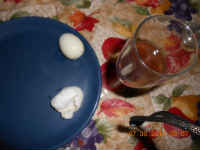
Don’t peel off the shell until it is fairly cool. (Your fingers will thank and your neighbors won’t have to hear you cussing.) Examine the egg. Find the rounder, less pointy end of the egg. The empty pocket of well, nothingness, existing at this end makes cracking open the egg easier. Tap the rounder part of the egg to a hard surface–-don’t use your skull, a counter top will do. Carefully peel off the large eggshell bits and there you have it, a NICE HARD-BOILED EGG. Woo hoo.

TIDBITS

1) A raw egg will wobble when spun. A hard-boiled one spins smoothly.

2) Poke a small hole in the bottom of the egg before cooking to make sure your hard-boiled egg will have a round bottom. Be careful, a large hole or crack lets much of the egg seep out and be boiled outside the shell.

3) Eggs age more in one day outside the refrigerator than inside. Use this to your advantage when considering the likability of your guests.

– Paul De Lancey, The Comic Chef

My cookbook, Following Good Food Around the World, with its 180 wonderful recipes, my newest novel, Do Lutheran Hunks Eat Mushrooms, a hilarious apocalyptic thriller, and all my other books, are available on amazon.com.

Categories: cuisine, food, humor, recipes | Tags: , , , , , , , | Leave a comment

Blog at WordPress.com.