Posts Tagged With: extinction

Why Neanderthals Went Extinct

If only they could have hit the curveball.

The following is an extract from the best-seller, We’re French and You’re Not, so it must be true.
­
“Robert, I wonder why Cro-Magnon survived and Neanderthal died out.”

­
“Let me tell you ma chérie. My five-hundredth great grandfather was there.”
­
“Your five-hundredth great grandfather?”
­
“Yes, his name was Henri Ogg. Henri was upset that the Neanderthals didn’t properly spice their mastodon steaks. So, he started boycotting Neanderthal restaurants. Other Cro-Magnons followed suit. The Neanderthals retaliated by banning us from their hot springs. Fights started here and there. Soon, a stone-axe race began.
­
“A war of annihilation nearly broke out. Instead, Monsieur Ogg tactfully suggested a baseball game to determine the extermination.“
­
“Baseball was much different then, with bats fashioned from enormous twigs and five balls needed to get a walk. Both sides played this game of extinction in typical, jovial dawn-of-mankind fashion. Hunter-gatherers supplied food to the enormous crowd.
­

“It was an exciting game. Many fans forgot to breathe and died. It all came down to the bottom of the ninth, two outs, bases loaded with the score: Cro-Magnons: All fingers of five men and three fingers of another, to Neanderthals: All fingers of five men and two of another.

“The Neanderthals had their best batter at the plate, Craggy. He sneered at our pitcher, Henri Ogg. Ogg hurled a blood ball, it was legal then. Craggy sneered and stepped away. Strike one!

“Henri hurled an anthrax ball. Craggy yawned. Strike two!
­

“The crowd tensed. The Neanderthals smiled. Surely, Craggy would win the game now.

“Henri hurled a plain fastball. Craggy shattered the air with his mighty swing.

“Oh, somewhere the sun was shining and the people laughing, but there was no joy for the first cavemen; mighty Neanderthal was wiped out.”

“How do we know the Cro-Magnons were truly ahead?” says Harriet. “After all, cavemen were often missing fingers.”

“Hush.”
­

– Paul De Lancey, The Comic Chef, Ph.D.

My cookbook, Following Good Food Around the World, with its 180 wonderful recipes, my newest novel, Do Lutheran Hunks Eat Mushrooms, a hilarious apocalyptic thriller, and all my other books, are available on amazon.com.


Categories: Uncategorized | Tags: , , , , , , , , , , , , , , | Leave a comment

Green Goddess Dressing

American Appetizer

­

GREEN GODDESS DRESSING

­
INGREDIENTS
­
4 anchovies*
2 tablespoons lemon juice
¾ cup mayonnaise
½ cup sour cream
2 tablespoons diced fresh chives
½ tablespoon fresh dill
2 garlic cloves
⅔ cup fresh parsley
¼ teaspoon pepper
¼ teaspoon salt
1 tablespoon fresh tarragon
­
* = 2 teaspoons anchovy paste or ½ the anchovy bits in a 2-ounce can.
­
SPECIAL UTENSIL
­
food processor or blender
­
PREPARATION
­
Add all ingredients to food processor. Blend until smooth. Use now. Transfer unused portion to Mason jar. Store in refrigerator. Keeps for 1 week.
­
TIDBITS
­
1) Nearly all dinosaurs died out 66 million years ago (66 mya) when a bloody minded comet slammed into the Earth. The Dinosaur Greeting Card company died out as well. Both are mourned. Only a small percentage of dinosaurs survived this mass extinction. Those that did evolved into birds. But they never lost their dinosaurial–if that is indeed a word–traits. So a condor is a bird. An eagle is a bird. The pigeon that craps on your car is a dinosaur.
­
2) The two-ounce hummingbird is a dinosaur. As of press time, the largest dinosaur, amphicoelias fragillimus weighed 100 to 150 tons. That’s quite a weight variance. Perhaps Amphi Fragilli alternated between dieting and binge eating.
­
3) Anyway, gigantic mobile plants such as: estranikon (tarragon), anitho (dill) and maintanos (parsley) walked the land after the comet crash. Alas, for this vibrant, burgeoning genus, kinita votana, dinosaur birds and mammals stalked the active plants as an abundant source of vitamin-rich food.
 Noting that their mobility garnered the attention of their predators, mobile plants evolved into stationary and much smaller plants, like the ones we grow or buy at the store. This dish, Green Goddess Dressing honors the survival of these herbs.

­

– Paul De Lancey, The Comic Chef, Ph.D.

My cookbook, Following Good Food Around the World, with its 180 wonderful recipes, my newest novel, Do Lutheran Hunks Eat Mushrooms, a hilarious apocalyptic thriller, and all my other books, are available on amazon.com.

Categories: cuisine, history, international | Tags: , , , , , , , , , , , , , , | Leave a comment

Nepali Chicken Thukpa

Nepali Soup

­

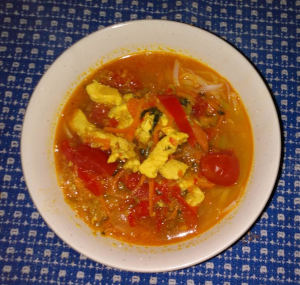
CHICKEN THUKPA

­
INGREDIENTS
­
½ pound rice noodles
2 garlic cloves
¼ cup fresh cilantro
2 green chiles
2 green onions
1 small yellow or white onion
1 bell pepper
2 carrots
⅔ pound boneless, skinless chicken parts
2 tablespoons olive oil
⅛ teaspoon asafoetida* or ½ teaspoon dried chives
1 teaspoon minced ginger
¼ teaspoon pepper
¼ teaspoon salt
¼ teaspoon timur powder* or Szechuan pepper* or red pepper flakes
½ cup chopped tomatoes
½ teaspoon turmeric
5 cups chicken broth
1 tablespoon lemon juice
­
* = These can be found online. Use sonic obliterator on those who complained if you substituted.
­
SPECIAL UTENSIL
­
sonic obliterator
­
Serves 4. Takes 1 hour.
­
PREPARATION
­
Cook noodles according to instructions on package. Be sure to stir occasionally so noodles don’t stick together. Drain. Rinse with cold water. Mince garlic. Seed green chiles. Dice cilantro, green chiles, green onions, and yellow onion. Julienne bell pepper and carrots. Cut chicken into strips 1½” long and ¼” wide.
­
Add olive oil, garlic, and yellow onion to pot. Sauté at medium-high heat for 4 minutes or until yellow onion softens. Stir frequently. Add chicken strips. Sauté at medium heat for 3 minutes or until chicken is cooked. Stir frequently. Add asafoetida, bell pepper, carrot, cilantro, minced ginger, green chile, green onion, pepper, salt, timur powder, tomatoes, and turmeric. Stir until well blended. Add chicken broth. Bring to boil using high heat. Stir enough to prevent burning. Reduce to low heat and simmer for 10 minutes. Stir occasionally. Add lemon juice and stir. Divide noodles into bowls. Ladle chicken soup over noodles.
­
TIDBITS
­
1) There are reasons why the Nepalis love Chicken Thukpa so much. It’s soup. Who doesn’t love soup?  It has chiles in it. Who loves chiles? People in hot climates, such as Mexico and Kenya.
­
2) But just because you love to put spicy chiles in your food doesn’t necessarily mean you can abide your land’s hot, sweltering weather. You leave your homeland in search of cooler climes and you take along with you the seeds of your beloved in chiles.
­
3) In fact, culinary historians and anthropologists say the first such migration occurred when Lucy of Olduvai Gorge, a hominid, butterfly* collector, persuaded her tribe to search out cool, pleasant pastures where chicken herds teemed. * = Butterfly fossils are hard to find.
­
4) And so Lucy’s tribe trekked north. They got lost many times as their GPS didn’t work and the men refused to ask for directions.
­
5) They continued their march to the European-North American land bridge, evolving along the way and relaxing with a good game of bridge during rest stops.
­
6) A long time later, give or take a year, the Evolving Hominids–Isn’t that a great name for a rock ‘n’ roll band?–found Mexico where they naturally united with the Polloan Pueblo. The combined chile-seed-carrying Oldupo People crossed over the North American-Asian land bridge and eventually found themselves in what is now modern-day Nepal.
­
7) The Oldupo loved the cool breezes coming down from Nepal’s Himalayan mountains and decided to settle down and finish their evolving there. So, we’ve explained the Nepali’s love of chile, but what about chicken? Chicken Thukpa has chicken it. What about that?
­
8) The meteor of 66 million years ago that wiped out nearly all dinosaurs, did not result in the extinction of the gigantic Pullumosaur. This dinosaur chicken stretched to 90 feet in length and stood 80 feet high. It’s very size intimidated the heck out of the predators, who noted the Cretaceous maxim, “There’s nothing more dangerous than colossal giant chicken.”
­
9) The pullumosaurs managed to dodge the extinction of its fellow dinosaurs with the simple expedient of burying their head in the sand until the meteor event ran its course.
­
10) More than a bit skittish, the dinosaur chickens departed for a new home free of meteors. By a strange coincidence, the pullumosaurs–after many exciting adventures–found themselves in modern-day Nepal.
­
11) Unfortunately, Nepal simply didn’t have enough food to support countless herds of gigantic chickens. Over time, evolutionary pressures shrank the pullumosaur in size to our current chicken.
­
12) When the Oldupo of tidbit 7) arrived in Nepal, they naturally wondered if chickens would be tasty. Would they go with chiles? They wondered and wondered until Juana Lucy first ate one. “They taste just like chicken,” she shouted. “I bet they’ll make a great soup mixed with chiles.” Ever since, the Nepali descendants of the Oldupo have loved Chicken Thuka Soup. And so do I.
­

– Paul De Lancey, The Comic Chef, Ph.D.

My cookbook, Following Good Food Around the World, with its 180 wonderful recipes, my newest novel, Do Lutheran Hunks Eat Mushrooms, a hilarious apocalyptic thriller, and all my other books, are available on amazon.com.

Categories: cuisine, history | Tags: , , , , , , , , , , , , , , | Leave a comment

Pudim de Coco (Coconut Pudding)

East Timorese

PUDIM DE COCO
(Coconut Pudding)

INGREDIENTS
1¾ cups sugar
5 eggs
2 cups coconut milk
2½ tablespoons cornstarch
3 tablespoons coconut flakes (optional)

SPECIAL UTENSILS

6-to-8 cups baking dish or casserole dish
9″ x 13″ casserole dish* (Must be longer and wider than baking dish)
sonic obliterator

Serves 6. Takes 1 hours 20 minutes plus 6 hours in refrigerator.

PREPARATION

Preheat oven to 350 degrees. Add sugar to pan. Melt sugar using low-medium heat until it begin to melt. Stir enough to keep sugar from burning and clumping. Reduce heat to low and continue warming sugar until it melts completely and turns a caramel brown. Stir constantly. Remove immediately from heat. (Don’t let it solidify.) Pour this caramelized sugar right away into baking dish. Smooth it with spatula.

Add eggs to mixing bowl. Blend eggs thoroughly with whisk. Add coconut milk and cornstarch. Mix with whisk until this custard becomes smooth. Ladle mixture over caramelized sugar. Put baking dish into casserole dish. Add hot water until it is 1″ high in the casserole dish. Bake for 35 minutes or until a toothpick inserted into the middle of pudding comes out clean.

Loosen pudding by sliding spatula around the edges and, as far as possible, the bottom. Put plate on top of casserole dish. Carefully turn casserole dish and plate upside down. Tap casserole dish with knife. Say a brief prayer. Lift casserole dish. Pudding should come out cleanly onto plate. Spoon liquid caramel on plate onto the caramel already on top of pudding.

Let sit in refrigerator for 6 hours or overnight. If desired, garnish with coconut flakes. Serve to adoring guests. Use sonic obliterator on any guest who gives you guff in any way. You cannot afford to let any threat or insult to your authority as chef go unchallenged.

TIDBITS

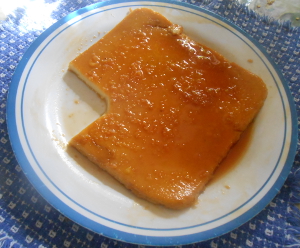
1) Many of you would look at the picture for this recipe and declare, “Why someone has hungry. That person was too tempted by the dessert to wait for the chef to take a photo for the cookbook.” And you would be right.

2) Many others. gazing at the photo would say, “Why it looks like a tiny square was taken from a larger square. If only high school geometry had been as tasty.” And you too would be right.

3) But these reasons are not the reason this picture touches your soul so deeply, why it speaks so strongly to your innermost self, why you feel the spirits of generations after generations of primitive ancestors dating back to Olduvai George whispering in your inner ear.

4) Go back into the distant mists of time when Lucy of Olduvai Gorge, your great, great, great, great, . . ., really, really great grandmother saw dust sweeping down, down the gorge to her.

5) Then Lucy heard thundering getting ever closer.

6) She, of course, saw the dust before she heard the accompanying thunder. For light travels at 3 * 10^8 meters per second and sound at 3 * 10^3 meters per second.

7) It is doubtful that Lucy fully grasped the concept of relative velocities. Culinary scientists even discount the notion that Lucy even knew about scientific notion. It is certain, though, that either she never developed the Theory of Relativity or if she had, that she never published it.

8) Oh my gosh, while I speculated about Lucy’s scientific achievements, the dust-shrouded herd got really close. Run, Lucy, run!

9) But the soul of a lion beat in Lucy’s heart. She picked up a stone and hurled it at middle of the dusty cloud. (This is, by the way, the real genesis of the sport of baseball. Now you know.)

10) A creature in the herd shrieked in pain. The thundering stopped. The dust settled. Thousands upon thousands of panting coconut puddings became gradually clearer. “What are they?” wondered Lucy. She gazed at the dead coconut pudding. “Is it edible? I hope so. I’m ever so hungry. And all I ever get to eat are thistlewort berries. I shall eat this meat.”

12) She tore a remarkably square section out of the dead, square coco pudding and ate. She looked at what remained. The photo for this recipe bears an uncanny resemblance to what Lucy saw those millions of years ago.

13) “It tastes great,” shouted Lucy. Her tribe raced toward her. “Eat these squares, eat them. They’re ever so yummy.” And they did. They felt full for the first time ever. Even though they couldn’t articulate the concept, they just knew they had ingested sufficient caloric intake to leave the gorge, leave Africa, and spread humanity all over the Earth. It was the dawning of the Age of Humanity.

14) Unfortunately, the first humans fed themselves almost completely on herds of coco puddings, so much so that coco puddings became extinct. But the hankering for coco pudding never went away. It just went dormant for eons until the Age of Discovery started in the fourteenth century. Fueled by the need for a vegetarian version of coco pudding, European monarchs starting with Henry the Navigator dispatched fleet after fleet in search of sugar, coconut milk, and coconut flakes. They’d eventually find these ingredients. Humanity would once again live in a culinary golden age.

15) Oh, and in doing, we’d chart the entire world. And we owe it all to brave Little Lucy.

– Paul De Lancey, The Comic Chef

My cookbook, Following Good Food Around the World, with its 180 wonderful recipes, my newest novel, Do Lutheran Hunks Eat Mushrooms, a hilarious apocalyptic thriller, and all my other books, are available on amazon.com.
Categories: cuisine, history, international | Tags: , , , , , , , , , , , , , , , , , , , , , , , | Leave a comment

Beef Rendang

Indonesian Entree

BEEF RENDANG

INGREDIENTS

4 red chiles
1 inch galangal or ginger root
5 garlic cloves
¾ teaspoon peppercorns
6 shallots
1 inch turmeric root
1 stalk lemongrass
2 pounds beef tenderloin or top round
2 tablespoons oil
1 inch cinnamon stick
½ tablespoon salt
3 kaffir lime leaves or ½ teaspoon lime zest
1 salam leaf or bay leaf
3 13-ounce cans coconut milk

SPECIAL UTENSIL

spice grinder

Serves 4. Takes 2 hours 45 minutes.

PREPARATION

Seed red chiles. Add red chile, galangal, garlic cloves, peppercorns, shallots, and turmeric to spice grinder. Grind until these spices become paste. Remove and discard upper ⅔rd of lemongrass stalk. Remove and discard the three outer layers. Dice remaining lemongrass. Cut beef into 1″ cubes.

Add spice paste and oil to work or large pan. Sauté at medium-high heat for 2 minutes or until paste becomes fragrant. Stir constantly. Add all remaining ingredients to wok. Bring to boil using high heat. Stir frequently. Reduce heat to medium and cook for 1 hour. Stir enough to prevent burning. Reduce heat to low and simmer for 45 minutes or until the milky part of the liquid is gone, leaving a little bit of coconut oil. (Most of the liquid should be evaporated.) Stir enough to prevent burning. Simmer on low for another 15 minutes or until beef and sauce turn brown. Remove cinnamon stick, bay leaf, and kaffir lime leaves. Goes well with rice.

TIDBITS

1) The dish into the above picture is served on, well, a dish. The dish is round.

2) Why is it not square?

3 )Because you cannot roll something is square

4) Why does it matter if you can roll a dish? After all, if you rolled the above dish before you ate, you lost the food.

5) Clearly, the round shape was designed for something else in mind.

6) What was that?

7) One theory, advanced by culinary, archeologists, is that primitive caveman invented the stone FrisbeeTM.

8) They didn’t call it the Frisbee, of course. It’s named after the Frisbee Pie Company which sold its wares in round pie dishes.

9) Culinary historians believe most prehistoric companies were called Ogg, Inc. because nearly all cavemen were named Ogg. Cavewomen were called Ogg.

10) Therefore, these ancient humans probably named their invention the OggTM.

11) Isn’t surprising early humankind possessed the knowledge to incorporate and trademark things?

12) Alas though, the Ogg proved a dismal failure. If you didn’t catch it, it hit you in the head and that was that.

13) Indeed, culinary historians believe widespread Ogg playing extinguished the Neanderthals.

14) After a much briefer fling with the sport, the Cro Magnons abandoned Ogg tossing.

15) Tossing the Ogg around was supposed to be a fun leisure time activity. But making the circular Ogg took up all their free time. So, what was the point of making Oggs?

16) None, the Cro Magnons concluded. So, they went on to make spears, axes, animal skins, and the like. Humanity went on not quite a talc age, which is a bit below a golden age.

17) Throwing round things became a popular sport in Ancient Greek Olympics. Physically fit from throwing the much lighter and metallic Ogg–by then called the discus–Greeks explored the entire known world.

18) The Romans, inheritors of Greek civilization, conquered the entire Mediterranean and much of northwestern Europe. The Roman built roads to facilitate rapid deployment of legions from crisis point to another. And we all know, the Roman legionnaire loved to throw the discus.

19) The Roman army passed on discuss throwing to the natives wherever they went. The natives became buff as well. So, the Roman conquest proved to be quite the good thing for the locals once everybody got past the initial wholesale slaughter-and-enslavement phase. And ever since then we have lived in a round-thingy-throwing golden age.

20) But it’s sobering to think how the Cro Magnons, the last remaining branch of humankind, came to throwing themselves into extinction.

– Paul De Lancey, The Comic Chef

My cookbook, Following Good Food Around the World, with its 180 wonderful recipes, my newest novel, Do Lutheran Hunks Eat Mushrooms, a hilarious apocalyptic thriller, and all my other books, are available on amazon.com.
Categories: cuisine, history, international | Tags: , , , , , , , , , , , , , , , , , , , , , , , , , , , , , , , | Leave a comment

Create a free website or blog at WordPress.com.