Posts Tagged With: bakeries

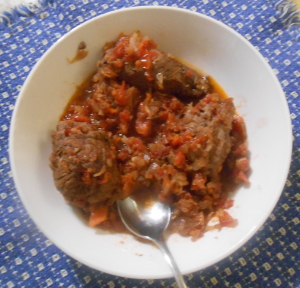
Bragioli (Maltese Stuffed Beef Rolls)

Maltese Entree

BRAGIOLI
(Stuffed Beef Rolls*)

INGREDIENTS – BEEF ROLL
2 pounds topside, bottom, or round steak
6 slices bacon
2 garlic cloves (3 more cloves later)
⅔ cup fresh parsley
2 hard boiled eggs
¼ cup bread crumbs
½ teaspoon pepper
¾ teaspoon salt
2 tablespoons olive oil (2 tablespoons more later)

INGREDIENTS – SAUCE

1 carrot
3 garlic cloves
3 medium onions
3 medium tomatoes
2 tablespoons olive oil
2 bay leaves
⅔ cup red wine

Serves.4. Takes 2 hours 40 minutes.

SPECIAL UTENSILS

kitchen mallet
kitchen twine or toothpicks
sonic obliterator (Why is this not in your kitchen?)

* = The best, or at least most common, translation is really “Beef Olives.” Apparently, many people think rolls look like olives. This interpretation has over 500 years of history behind it Indeed, the word olive was sometimes used a verb, as in to olive, roll up, some ingredient. Now you know.

PREPARATION – BEEF ROLL

Cut steak into 12 slices. Pound beef slices with mallet to make them thinner and flatter. Dice bacon. Dice 2 garlic cloves and parsley. Cut each egg into 6 slices. Add bacon, 2 diced garlic cloves, bread crumbs, parsley, pepper, and salt to mixing bowl. Mix with hands until this stuffing is thoroughly blended.

Top a beef slice with 2 tablespoons stuffing. Place 1 egg slice on bacon/bread crumb mixture. Roll up beef slices lengthwise over stuffing. Secure rolled-up steak, bragioli with kitchen twine or toothpicks. Repeat for each bragioli Add 2 tablespoons olive and bragiolis to large pot. Sauté at medium-high heat until bragiolis turn slightly brown. Turn bragiolis enough to ensure even browning. Remove bragiolis from pot.

PREPARATION – SAUCE

Dice carrot, 3 garlic cloves, onions, and tomatoes. Add 2 tablespoons olive oil, 3 diced garlic cloves, and onion to same pot. Sauté at medium-high heat for 5 minutes or until onion softens. Stir frequently. Add carrot, tomato, bay leaves, and red wine. Simmer at low heat for 10 minutes. Stir enough to prevent burning. Add bagiolis back to pot.

Bring to boil using high heat. Stir enough to prevent burning. (Gently, don’t break open the bagiolis.) Simmer at low-medium heat for 45 minutes or until sauce thickens. Remove bay leaves. Serve to adoring quests. Zap unappreciative ones with your sonic obliterator. You don’t need negativity in your kitchen.

TIDBITS

1) This recipe uses eggs. Each egg is to be cut into six slices. This is easy to do if the egg is three inches long. Why, each slice would be one-half-inch thick. That’s easy to measure, but three-inch long eggs are hard to find, especially ones that come from hens.

2) Okay, what about an egg that is 1-8/9 inches long. Divide that by six and you get slices that should 17/54 inches wide. How the heck, do we measure that on a standard ruler? I’ll bet no ruler has ever been made that divides inches into 54 equal parts.

3) So what do we do? I’m glad you asked. 17/9 inches equals 4.8 centimeters. Divide that by six and you get 0.8. It’s a snap to measure that on a metric ruler. But how did we get the metric system?

4) From the French Revolution. French chefs everywhere ran into considerable delays when the aristocrats suddenly wanted their meal portions to include exactly one sixth of an egg. We don’t have rulers that measure in fifty-fourths now. It’s certain that pre-revolutionary chefs didn’t either. So cutting eggs became much problematic.

5) Problems in dividing eggs meant long delays in making the aristocrats’ favorite dishes. This enraged the impatient French nobility. Gourmet chefs all over Paris found themselves chucked into prisons especially the Bastille.

9) The French elite still clamored for their exquisite meals But there were no more gourmet chefs. But where would the aristocracy find new chefs? From the bakeries. This action, however, meant a shortage of bakers to mean bread.

10) So Paris suffered a bread shortage. Incensed Parisian mothers stormed the bakeries for anything they could find. A hungry mob gathered. It stormed the Bastille to release the imprisoned chefs. The French Revolution had begun. Desiring stability, the Revolutionary government of France converted to the metric system. France is now a stable country.

12) America is not metric. We are sitting on a powder keg.


Paul De Lancey, The Comic Chef, Ph.D.

My cookbook, Following Good Food Around the World, with its 180 wonderful recipes, my newest novel, Do Lutheran Hunks Eat Mushrooms, a hilarious apocalyptic thriller, and all my other books, are available on amazon.com.

Categories: cuisine, history, international | Tags: , , , , , , , , , , , , , , , , , , , , , , , , , | Leave a comment

Greenlandic Cake

Greenlandic Appetizer

GREENLANDIC CAKE

INGREDIENTS – CAKE

7 tablespoons butter
1 cup lukewarm milk
2¼ teaspoons (1 packet) yeast
⅔ cup raisins
½ teaspoon salt
½ cup sugar
4 cups flour
no-stick spray
2 tablespoons cold coffee
1½ tablespoons sugar, pearl or confectioner’s

SPECIAL UTENSILS

bread maker (optional)
bread pan

Serves 8. Takes 2 hours.

PREPARATION – CAKE

Add butter to pan. Melt butter using medium heat. Add milk. Stir gently until well blended. Add in yeast, stirring gently as you do so. Mix gently until yeast dissolves. Add raisins, salt, and sugar. Mix until well blended. Add flour. Knead with bread maker or by hand for 10 minutes or until you get a smooth dough.

Place dough on flat surface, cover with towel, and let stand for 45 minutes. Preheat oven to 390 degrees 15 minutes before dough has finished standing. Spray bread ban with no-stick spray. Add dough to bread pan. Spread coffee on top with brush. Sprinkle with sugar. Bake at 390 degrees for 35 minutes or until a toothpick inserted into the middle of the cake comes out clean.

TIDBITS

1) The fierce Vikings of old loved cakes, particularly this cake. They got a might testy, particularly when they didn’t get their favorite dessert. Indeed, the Vikings were apt to loot whole cities when in such a mood. What towns did the berserk Norsemen target? Why, the ones with lots and lots of flour and milk, of course, there being no wheat fields or cowherds in icy, cold Greenland.

2) Why didn’t the Vikings simply move to mainland Europe where there were wheat and cows in abundance? Why not set up cake bakeries there? Because all the great Viking cake makers would only live in Greenland. Something about being able to always step out into cold Arctic air after a long day working beside hot ovens. So you can see, if air-conditioned kitchen had been available in the ninth century, there were have been no Fury of the Norsemen. Something to chew on.

– Paul De Lancey, The Comic Chef

My cookbook, Following Good Food Around the World, with its 180 wonderful recipes, my newest novel, Do Lutheran Hunks Eat Mushrooms, a hilarious apocalyptic thriller, and all my other books, are available on amazon.com.

Categories: cuisine, history, international | Tags: , , , , , , , , , , , , , , , , , , , | Leave a comment

Cinnamon Rolls (Kanelbullar)

Swedish Dessert

CINNAMON ROLLS
(Kanelbullar)

INGREDIENTS – DOUGH

⅔ cup butter (⅓ cup more later)
1½ cups milk
1 egg (1 egg more later)
2 teaspoons cardamom
¾ teaspoon salt
½ cup sugar (⅓ cup more later)
2½ teaspoons yeast
5 cups bread flour or flour (2 tablespoons more later)

INGREDIENTS – FILLING

2½ tablespoons cinnamon
⅓ cup sugar
¼ cup brown sugar
⅓ cup butter, softened

INGREDIENT – ASSEMBLY

2 tablespoons flour
1 egg
1½ tablespoons water
3 tablespoons pearl sugar*, sparkling sugar, or sugar

* = Pearl sugar is remarkably hard to find in supermarkets. Try Whole FoodsTM, the food department of IKEATM, or the cake decoration sections of JoannTM, Michael’sTM. and other hobby stores. Alternatively, smash sugar cubes with a kitchen mallet.

SPECIAL UTENSILS

bread maker
parchment paper
2 cookie sheets

Makes 16 rolls. Takes 2 hours 45 minutes.

PREPARATION – DOUGH

Add ⅓ cup butter and milk to pan. Cook using low-medium heat until butter melts. Stir often. Add butter/milk and 1 egg to small mixing bowl. Mix with whisk until well blended. Add cardamom, salt, ½ cup sugar, yeast, and 5 cups flour to large mixing bowl. Mix with whisk until well blended. Add butter/milk from small mixing bowl to large mixing bowl. Whisk until well blended.

Add flour/butter/milk/sugar/yeast mix to bread maker. Run bread maker using dough setting for 10 minutes. Add dough to large mixing bowl. Cover and let rise for 1 hour or until doubled in size.

PREPARATION – FILLING

While dough doubles in size, add cinnamon, ⅓ cup sugar, brown sugar, and ⅓ cup softened butter to small mixing bowl. Mix with whisk until well blended.

PREPARATION – ASSEMBLY

Dust flat surface with 2 tablespoons flour. Add dough to center of dusted flat surface. Roll out dough until is a 12″ x 16″ rectangle. Spread filling evenly over rolled-out dough. Tightly roll dough along 16″ side until you get a 12″ long log. Cut log into 16 round discs or rolls. Cover with kitchen towel for 45 minutes or until doubled in size.

While dough rises, add 1 egg and water to cup. Mix with whisk or fork until well blended.

Preheat oven to 425 degrees. Line cookie sheets with parchment paper. Place rolls on parchment paper. Brush rolls with egg/water. Sprinkle pearl sugar on rolls. Bake at 425 degrees for 7 minutes or until golden brown.

TIDBITS

1) October 4 is Cinnamon Bun Day in Sweden. Sweden is a wonderful country.

2) So is Britain. Even during hard times when its RAF was on the ropes fighting the Luftwaffe, which could turn the sky black with its fighter planes.

3) British pilots were superb. But no matter how many dogfights the British aces won, they still lost planes. No one could get around the fact that the RAF was running out of metal to build new Spitfires and Hurricanes.

4) Britain needed a miracle. It occurred when Chef Ollie Erickson of London’s Royal Swedish Bakery mentioned the dual nature of cinnamon rolls to Prime Minister Winston Churchill. “They’re tasty as Heaven when fresh, but absolutely impenetrable when dry.”

5) The boffins at Churchill’s Toy Shop learned how to make Spitfire-shaped cinnamon molds. One only needed to pour cinnamon-roll batter into these molds, remove the molds, and let the shaped dough dry. These cinnamon-roll Spitfire proved to be impervious to the Luftwaffe’s machine-gun and cannon fire. Not only that, bakeries turned out cinnamon-roll fighters by the baker’s dozens. The RAF rapidly established supremacy in the skies and soon won the Battle of Britain.

6) Britain also mass produced thousands of cinnamon-roll tanks. America with its preference of bacon and eggs over cinnamon rolls, had many more steel-rolling mills than bakeries. So, it mass produced tanks and planes the old-school way, with steel. Germany simply could not compete against both dough and steel. Germany lost. The world was once again made safe for breakfast.

Chef Paul

My cookbook, Following Good Food Around the World, with its 180 wonderful recipes, my newest novel, Do Lutheran Hunks Eat Mushrooms, a hilarious apocalyptic thriller, and all my other books, are available on amazon.com.

Categories: cuisine, history, international | Tags: , , , , , , , , , , , , , , , , , , , , , , , | Leave a comment

Blog at WordPress.com.