history

Banana Split

American Dessert

­

BANANA SPLIT

­
INGREDIENTS­
2½ tablespoons hot fudge sauce or chocolate syrup
1 banana
1 scoop chocolate ice cream*
1 scoop strawberry ice cream*
1 scoop vanilla ice cream*
½ tablespoon roasted chopped peanuts
¼ cup whipped cream**
3 maraschino cherries with stems
¼ teaspoon sprinkles (optional)
* = Should be fairly firm.
** = Oh heck, spray or spoon as much whipped cream as you want.
­
SPECIAL UTENSIL
­
banana split boat or small oval dish
­
Serves 1 or 2. Takes 5 minutes.
­
PREPARATION
­
Microwave hot fudge sauce for 20 seconds or put hot fudge sauce in small pot. Heat on low until sauce becomes warm and fluid. Peel banana and split in half along its length.
­
Place banana halves cut sides face up in banana split boat. Put ice cream scoops between banana halves. Drizzle hot fudge sauce over ice cream. Sprinkle chopped peanuts over fudge sauce. Spoon whipped cream over peanuts. Sprinkle sprinkles over whipped cream. Top everything with maraschino cherries.
­
Note: Work quickly if the temperature in your kitchen is 90 degrees or more.
­
TIDBITS
­
1) In 1904, David Evans Strickler, of Tassel Pharmacy created first banana split for the nearby sweet-toothed college students of Latrobe, Pennsylvania. The tasty dessert spread like wildfire across the world. Alas, swirling controversy enveloped the tasty dish with multiple towns claiming to have created the first banana split. In 2004 the National Association of Ice Cream Retailers (NAICR) declared Latrobe to be the birthplace of the banana split. Nine years later the Pennsylvania Museum and Historical Commission placed a plaque at the former site of Tassel Pharmacy. Someone later,  perhaps at midnight, erected a gigantic banana split statue nearby. Show up there to see the activities of Latrobe’s annual Great American Banana Split Celebration. Be sure to go there and see how exciting and tasty history really can be. Latrobe welcomes you with open arms and split bananas.
­

– Paul De Lancey, The Comic Chef, Ph.D.

My cookbook, Following Good Food Around the World, with its 180 wonderful recipes, my newest novel, Do Lutheran Hunks Eat Mushrooms, a hilarious apocalyptic thriller, and all my other books, are available on amazon.com.
Categories: cuisine, history | Tags: , , , , , , , , , , , , , , | Leave a comment

Malva Pudding

South African Dessert

­

MALVA PUDDING

(Malvapoeding)

­

INGREDIENTS – CAKE
­
2 tablespoons butter, melted
⅔ cup white sugar
3½ tablespoons apricot jam
2 eggs
1 teaspoon baking powder
¾ cup whole milk
¼ teaspoon salt
1¼ cups flour
no-stick spray
­
INGREDIENTS – SAUCE
­
1 cup evaporated milk or heavy whipping cream
½ cup brown sugar
5 tablespoons butter
1 teaspoon vanilla extract
­
SPECIAL UTENSILS
­
electric beater
8″ * 8″ baking or casserole dish
­
Serves 8. Takes 1 hour.
­
PREPARATION – CAKE
­
Preheat oven to 350 degrees. Add 2 tablespoons melted butter and sugar to large mixing bowl. Mix with electric beater set on medium until butter and sugar become creamy. Add apricot jam, baking powder, eggs, milk, and salt. Mix with beater set on medium until mixture becomes fluffy. Gradually add flour, mixing all the while until well blended. Spray baking dish with no-stick spray. Pour batter into baking dish. Bake for 35 minutes at 350 degrees or until toothpick inserted into middle comes out clean. Poke holes in cake with fork.
­
PREPARATION – SAUCE
­
About 10 minutes before cake is done, add all sauce ingredients to large pan. Cook at medium heat for 5 minutes or until sugar and butter melt, the mixture becomes smooth, and bubbles start to form. Remove from heat and cover. Ladle warm sauce evenly over cake. Let cake sit for 20 minutes to give the cake time to absorb the sauce. Cut cake into 12 pieces. Goes well with vanilla ice cream.
­
TIDBITS
­
1) Malva puddings are square. Keyboard keys are square. Keyboard keys were inspired by malva puddings. Because everyone loves malva puddings.
­
2) Most malva pudding is to be found in South Africa. But there can’t be many South Africa keyboard users and professional typists in comparison to the rest of the world.
­
3) That’s true now, but in the first year in the existence of the square keys, 98% of the square-key enthusiasts were South African.
­
4) Indeed, these squarekeyers so loved their malva pudding that they made their keys from fresh malva. As one could imagine, typing with fresh malva was quite squishy. Globs of malva pudding got into everything, particularly the keyboard. Typing became impossible.
­
5) Everyone knows the surrender ceremony ending the war with Japan was signed on the Battleship Missouri. This document was supposed to have been composed on a square-key typewriter. But the fresh malva keys gummed up the typewriter. No more malva typewriters, no Japanese surrender. No surrender would have meant more atomic bombs, perhaps a bloody invasion of Japan.
­
6) Which was bad.
­
7) Fortunately, Corporal Lucy Dubai, reserve typist second class, had her personal round-key with her. Her roundkeyer was made of metal with glass caps.
­
8) Sure, these keys didn’t give off the same pleasing scent of the square malva keys, but they worked. General MacArthur had Corporal type up the surrender document. The relevant dignitaries signed the surrender terms that very day.
­
9) Grateful soldiers and marines, scheduled for the invasion of Japan. Lucy Dubai became a wildly popular pinup girl in barracks all over the Pacific Ocean. Her roundkeyer replaced the malvakeyer as the number-one typewriter pinup. Round keys would dominate the world for decades.
­
10) Culinary anthropologists general credit Lucy* of Olduvai Gorge with inventing the first roundkeyer. So, you’d think that round keys would dominate the world to the very moment that you’re reading this tidbit.
­
11) However, much of humanity left Africa after Lucy’s invention. Those who went to Europe would favor square keys. This bias can be found in their DNA. However, the tribes who stayed in Africa and those who trekked to Asia preferred round keys. Waves of squarekeyers and roundkeyers would eventually wash up on the shores of North America causing tension and conflict in the United States that haunts us to this very day.
­
12) Then how did squares conquer the modern keyboard world? It has something to do with a bar bet at the Blue Armadillo in 1993. There, now you know.
­
13) * = Corporal Lucy Dubai could trace direct descent from Lucy of Olduvai Gorge.
­

– Paul De Lancey, The Comic Chef, Ph.D.

My cookbook, Following Good Food Around the World, with its 180 wonderful recipes, my newest novel, Do Lutheran Hunks Eat Mushrooms, a hilarious apocalyptic thriller, and all my other books, are available on amazon.com.

Categories: cuisine, history, international | Tags: , , , , , , , , , , , , , | Leave a comment

Strawberry Balsamic Chicken

American Entree

­

STRAWBERRY BALSAMIC CHICKEN

­
INGREDIENTS­
­
⅔ pound (about 2 cups) strawberries
4 chicken breasts
½ teaspoon pepper
½ teaspoon salt
½ cup balsamic vinegar (½ cup more later)
½ cup balsamic vinegar
1 tablespoon brown sugar
1 tablespoon Dijon mustard
½ tablespoon minced garlic
1 teaspoon cornstarch
1 tablespoon fresh basil
­
SPECIAL UTENSIL
­
8″ * 12″ casserole dish.
­
Serves 4.  Takes 1 hour 45 minutes.
­
PREPARATION
­
Preheat oven to 375 degrees. Remove stems from strawberries. Cut each strawberry into 4 pieces. Rub pepper and salt over chicken breasts. Add chicken breasts and ½ cup balsamic vinegar to mixing bowl. Turn chicken breasts until they are completely coated. Let marinate in refrigerator for 1 hour. Add chicken to casserole dish. Bake at 375 degrees for 30 minutes or until chicken is no longer pink inside.
­
Add strawberry bits. Simmer at low heat for 4 minutes or until strawberry bits start to lose their shape. Add a chicken breast to each plate. Ladle strawberry glaze over chicken breasts. Goes well with rice or spinach.
Add strawberry bits. Simmer at low heat for 4 minutes or until strawberry bits start to lose their shape. Add a chicken breast to each plate. Dice basil. Ladle strawberry glaze over chicken breasts. Garnish with basil. Goes well with rice or spinach.
­
TIDBITS
­
1) At the first Iowa Caucus, the Iowa Strawberry Growers Association (ISGA) made a mad attempt to showcase their strawberries to the nation. In return the “strawberry candidates” wore strawberries on their lapels. Political analysts counted strawberries distributed to determine the ISGA’s strength. This was the first strawberry poll. Strawberry poll got shortened to straw poll to save newspaper ink. Now you know.
­

– Paul De Lancey, The Comic Chef, Ph.D.

My cookbook, Following Good Food Around the World, with its 180 wonderful recipes, my newest novel, Do Lutheran Hunks Eat Mushrooms, a hilarious apocalyptic thriller, and all my other books, are available on amazon.com.

Categories: cuisine, history, recipes | Tags: , , , , , , , , , , , , , , | Leave a comment

Digaag Qumbe (Coconut Yogurt Chicken)

Somali Entree

­

DIGAAG QUMBE

­(Coconut Yogurt Chicken)

­
INGREDIENTS­
­
½ cup rice
2 garlic cloves
1 red onion
1 carrot
1 small potato
1 pound boneless chicken thighs
1 jalapeno
1 red bell pepper
2 tomatoes
¼ cup olive oil
2½ teaspoons ginger
1 teaspoon salt
2 tablespoons Xawaash spice (See above recipe or buy online or at Middle Eastern stores.)
½ cup coconut yogurt or plain yogurt
1 tablespoon ghee or butter
2½ teaspoons tomato paste
¾ cup coconut milk
¼ cup fresh cilantro
6 bananas
­
Serves 6. Takes 1 hour 25 minutes.
­
SPECIAL UTENSILS
­
food processor
mandoline
­
PREPARATION
­
Cook rice according to instructions on package. Mince garlic and red onion. Use mandoline to cut carrot into circles ¼” thick. Cut potato into ½” cubes. Cut chicken into 1″ cubes. Add jalapeno, bell pepper, and tomatoes to processor. Puree until smooth. Add olive oil, garlic, and red onion to large pot. Sauté for 5 minutes at medium-high heat or until onion softens. Stir frequently.
­
Add ginger, salt, Xawaash spice mix, and mixture from blender. Bring to boil using high heat. Stir frequently. Reduce heat to low-medium. Simmer for 5 minutes. Stir occasionally. Add coconut yogurt, ghee, and tomato paste. Simmer for 3 minutes. Add coconut milk, chicken, carrot, and potato. Simmer for 35 minutes or until chicken, carrot and potato are tender and sauce thickens. Stir occasionally. While chicken, carrot, and potato simmer, dice cilantro. Add rice to plates. Top with coconut yogurt/veggies/chicken. Garnish with cilantro. Serve alongside a peeled banana.
­
TIDBITS
­
1) According to Google Translate(tm). digaag, part of this entree’s name, translates into English as “digaag.”
­
2) Digaag translates into French as “digaag.*”
­
3) Digaag translates into Spanish as “digaag.”
­­
4) Tiny Luxembourg has its own language. It’s Luxembourgish. Digaag translates into Luxembourgish as “digaag.”
­
5) Digaag even translates into Swahil as “digaag.”
­
6) What can we conclude from this?
­
7) That “digaag” is an important word to humanity.
­
8) How important?
­
9) So important that when humanity fractured into different group when they marched out from their common birthplace, Africa, they all hung onto a few common concepts. These common concepts remind us that we share common ground with our brothers and sisters all over the Earth.
­
10) When an American man says, “digaag” to a French woman living in Paris, she will understand him just as clearly would any listener in Colorado, Columbia, or Germany.
­
11) When we understand our foreign neighbors, we realize just how much we resemble them.
­
12) When we know just how much other nations’ peoples resemble ours, our fears of them evaporate.
­
13) When our fears evaporate, world peace breaks out.
­
14) And that’s a good thing.
­­
15) So if you hear people speaking in a foreign tongue, go up to them and say, “Digaag.” They will appreciate your effort to communicate to them. They will even smile. You’ll smile back. And just like that, you’ll have new friends.
­
16) And that’s a good thing, because one of your old friends still owes you money.
­
17) Great news! Other words are the same* in other languages. They are: banana, coffee, computer, dollar, euro, film, gram, huh, internet, kilometer, mama, no, okay, papa, stool, sauna, sushi, and taxi.
­
18) The possibilities for talking to people of other languages are endless. You could say, “banana, coffee, sauna, sush” or alternatively, “Internet, film, papa, taxi” and you’d be understood!
­
19) You’d be taking one small step for new friends, one giant step for world peace. Yay!
­

– Paul De Lancey, The Comic Chef, Ph.D.

My cookbook, Following Good Food Around the World, with its 180 wonderful recipes, my newest novel, Do Lutheran Hunks Eat Mushrooms, a hilarious apocalyptic thriller, and all my other books, are available on amazon.com.

Categories: history, international, recipes | Tags: , , , , , , , , , , , , , , | Leave a comment

Shrimp Pineapple Curry

Sri Lankan Entree

­

SHRIMP PINEAPPLE CURRY

­
INGREDIENTS – CURRY PASTE­
­
2 green chiles
½ teaspoon black mustard or brown mustard seeds
1 medium onion
2 tablespoons sesame, coconut, or vegetable oil
1½ tablespoons fresh curry, kaffir lime, or basil leaves
3 garlic cloves
1½ tablespoons fresh* pandanus** or cilantro
­
INGREDIENTS – SHRIMP PINEAPPLE
­
1 cup coconut milk
¾ teaspoon fish sauce or soy sauce
1½ tablespoons sugar
1½ cup chopped or crushed pineapple
1 pound shrimp
­
* = 1 tablespoon fresh herbs = 1 teaspoon dried herbs
** = Pandanus and some of the other ingredients can be hard to find. This is why I list substitutes.
­
SPECIAL UTENSILS
­
spice grinder
blender or food processor
­
Serves 4. Takes 45 minutes.
­
PREPARATION – CURRY PASTE
­
Seed chiles. Grind mustard seeds in spice grinder. Mince onion. Add oil and onion to pan. Sauté at medium-high heat for 5 minutes or until onion softens. Stir frequently. Add ground mustard seeds, sautéed onion, and the remaining curry paste ingredients to blender. Blend until you get a curry paste.
­
PREPARATION – SHRIMP PINEAPPLE
­
Add curry paste, coconut milk, fish sauce, and sugar to large pan. Bring to boil using high heat. Stir frequently. Reduce heat to medium and simmer for 5 minutes. Stir occasionally. Add pineapple and shrimp. Simmer at medium heat for 4 minutes or until shrimp turns pink. Stir occasionally. Goes well with rice.
­
TIDBITS
­­
1) Nearly everyone who isn’t a little child finds shrimp to be ever so tasty.
­
2) Tots, however, greatly prefer ice cream.  This is why thousands upon thousands of ice cream trucks roams patrol the streets of our towns of cities.
­
3) But what about the adults? Why can’t we can’t have shrimp trucks driving around, playing the notes to “Blow the Man Down” or ever better, “Shrimp Boats are  Sailing” Instead of various dairy desserts, these plucky vendors could sell: shrimp cocktails, shrimp scampi, or Shrimp Pineapple Curry?
­
4) How did Shrimp Pineapple Curry come about?  Remarkably, while billions of words have been written, over hundreds of years, over what people like to eat and how to make their dishes, nearly nothing has been written about what shrimp like to dine on.
­
5) Oh sure, we know they will devour all manner of algae organisms. And itty, bitty bits of deal corral, roots, and other rotting ocean-floor delicacies. But such fare doesn’t sound very appetizing, does it?  No, and the shrimp don’t think so either.
­
6) So, it was quite a momentous event for the shrimp nation when the Portuguese navigator Bartolomeo Diaz sailed into the Indian Ocean in 1488.
­
7) Bartolomeo had a shrimp, Vasco, for a pet when he was little. Everyday, little Barty watched his plucky shrimp perform high-impact acrobatics. “Wait and see,” said Barty to his pet, “I’m going to achieve great things on the open sea. Just like you.”
­
8) But he had to endure endless name calling, such as “Batty Barty,” before he grew up enough to command a crown-sponsored naval expedition. Batty had wanted  trade coconuts to the shrimps of the Indian Ocean in exchange for algae, but a crabby King John II insisted on bringing back valuable spices.
­
9) In disgust, Barty threw his cargo of coconuts overboard. The shrimp loved coconuts, once they decomposed. The cleverest shrimps discovered a way to grow ocean-floor coconuts.  A few years later an Arab trading vessel carrying pineapples and curry leaves sank. Brainy shrimps found a way to harvest these ingredients beneath the waves.
­
10) Naturally, the shrimps who had been hating their bland diet since tidbit 5) created Pineapple Curry. Brilliant, industrious shrimps created colossal aquatic coconut, curry, and pineapple farms.
­
11) Indian Ocean shrimps led a blissful culinary existence until submariners during World War II noticed thousands of square miles aquatic acreage. “I’ll bet Coconut Curry would make a great dish would make a scrumptious entree if one only added shrimp to it,” said Chef Bertie of HMS Entre.
­
16) And he did. Now the world eats tons of shrimp every day and their vast aquatic farms lie untended and forgotten. And if you try to tell someone at cocktail party about this, they’ll make a squeaky sound and scurry to the other side of the room.
­

– Paul De Lancey, The Comic Chef, Ph.D.

My cookbook, Following Good Food Around the World, with its 180 wonderful recipes, my newest novel, Do Lutheran Hunks Eat Mushrooms, a hilarious apocalyptic thriller, and all my other books, are available on amazon.com.

Categories: cuisine, history, international | Tags: , , , , , , , , , , , , , , | Leave a comment

Pepper Soup From Nigeria

Nigerian Soup

­

PEPPER SOUP

­
INGREDIENTS
­
2¼ pounds chicken, beef, or goat
3 whole nutmegs or calabash nutmegs, or 2 tablespoons nutmeg
1 onion
1 Scotch bonnet, habanero, 2 serrano chiles, or bird’s eye chile
2 MaggiTM** bouillon cubes, flavor should match the meat
4 cups water
2 teaspoons ginger powder
1 teaspoon red pepper flakes
1 teaspoon salt
2 tablespoons shrimp or crayfish powder (or omit)
2 tablespoons scent leaves*: Thai basil, or tarragon
­
* = Scent leaves can be hard to find.
** = Doesn’t have to be the Maggi brand, but Maggi is extremely popular in Nigeria and much of the rest of Africa.
­
SPECIAL UTENSILS
­
spice grinder
sonic obliterator
­
Serves 4. Takes 1 hour 20 minutes.
­
PREPARATION
­
Cut chicken into 1″ cubes. Grind whole nutmegs into powder. Dice onion. Seed and mince Scotch bonnet. (BE SURE to wash your hands thoroughly after touching the Scotch bonnet or its seeds. If however you touch your face after handing the Scotch bonnet or habanero, you will remember the pain it caused for a long time.)
­
Add chicken, bouillon cubes, onion, Scotch bonnet, and 4 cups water. Bring to boil using high heat. Stir enough to prevent burning. Reduce heat to low and simmer for 30 minutes. Stir occasionally.
­
Add ginger powder, nutmeg, red pepper flakes, salt, and shrimp powder. Simmer on low for 10 minutes. Stir occasionally. Add scent leaves. And simmer for another 5 minutes. Stir occasionally. Use sonic obliterator on any guests who gives your any guff over any ingredient substitutions. You don’t need that negativity in your kitchen.
­
TIDBITS
­
1) Culinary art historians will tell you, if you have the misfortune of being cornered by a feral gang of them, that the progression of European art can be summarized in the following eight stages.
­
2) First stage: Pre-prehistoric art.. How do we know it existed? We don’t. That’s why most of us cross the street to avoid a culinary art historian. (CAH.)
­
3) Second stage: .Prehistoric art, such as the wall paintings in the Lescaux Cave. Sadly, because this art comes from a prehistoric time, there are no written records of its history. Bummer. But it also gives rises to the age-old riddle, “Did prehistory inhibit written records or did the absence of written records spawn prehistory?” It is a contentious subject among the fractious CAHs.
­
4) Third stage: Roman art. Mosaics and wall paintings of geometric patterns, scenes from mythology, and pastoral landscapes. The Romans really liked the color red. Although when they really let their hair down, they would add black and yellow, hence the many mosaics at Bromidium depicting enraged wasps stinging tomatoes.
­
5) Moving onto the Fourth stage; (We really have to cover a lot of ground quickly as we only have one page.) Medieval art: Paintings depicted people of status in incredibly rigid poses. The current planking craze derives nearly all of its inspiration from Medieval nobility. Many Medieval artists made many Medieval medallions and incredibly expensive golden statues. Unfortunately, these stupendously valuable works got robbed by enterprising thieves. All gone. This explains why so few people study Medieval art. This six-sentence review is one of this period’s longest art studies
­
6) Fifth stage: Renaissance art. Really, an overall flowering of artistic ideas and techniques. The whole Renaissance era burgeoned with beauty. People love to study Renaissance art, their numbers limited only by the difficulty of spelling the word, “Renaissance.”
­
7) Sixth stage: Brown Gravy or Fifty Shades of Beige. Every freaking painting was painted in brown. It really does resemble brown gravy. Museum curators will tell you with admirably straight faces that post-Renaissance teemed with other colors. They say the painted walls, portraits, and tapestries of Hampton Court and the Louvre blazed with vibrant colors and only faded to brown over time.
­
8) Rebuttal: pish.
­
9) Brown’s supremacy derives from the massive importation of Nigerian Pepper Soup into Europe. Pepper-mad Europeans couldn’t get enough of this dish. Artists thought of Pepper Soup during every waking hour. Then dreamed of it every night.
­
10) This dish in this recipe is light brown and dark brown. So, is it any wonder that all Brown-Gravy artists worked only with brown? Where did the European artists get the funds to afford so much Pepper Soup? From the gold stolen in tidbit 5).
­
11) Seventh stage: Eventually artists went off feed and discovered other colors, such as can be found in fried eggs and split-pea soup. This naturally brought on the many-colored Impressionistic era.
­
12) Eighth stage: Modern art. It’s chock full of modern art. There, you are now an art expert.
­

– Paul De Lancey, The Comic Chef, Ph.D.

My cookbook, Following Good Food Around the World, with its 180 wonderful recipes, my newest novel, Do Lutheran Hunks Eat Mushrooms, a hilarious apocalyptic thriller, and all my other books, are available on amazon.com.

Categories: history, international | Tags: , , , , , , , , , , , , , , , | 2 Comments

Suya From Nigeria

Nigerian Entree

­

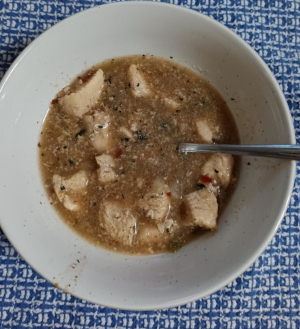
SUYA

­
INGREDIENTS
1¼ pounds steak or chicken breasts
3 garlic cloves
1 inch ginger root
3 tablespoons roasted peanuts
8 Uda pods*
1 bouillon cube (It should be the same flavor as the meat used. MaggiTM is, by far, the most popular brand in Africa.)
1 tablespoon cayenne
2 teaspoons paprika
no-stick spray
1½ tablespoons peanut oil or vegetable oil
1 onion
1 tomato
­
* = These pods impart a distinctive, authentic taste. They are also known as Selim peppers and Senegal peppers. They are also hard to find, especially offline. Substitute with Szechuan peppercorns. If neither are available, add ¼ teaspoon pepper. If guests notice you didn’t use Uda pods, zap them with your sonic obliterator. You don’t need that kind of negativity.
­
SPECIAL UTENSILS
­
food processor or spice grinder
kitchen mallet, mortar and pestle, or even squeaky clean long-nose pliers!
4 metallic skewers (If you use wooden ones, soak them in water 30 minutes before grilling.)
indoor grill
­
Makes 4 skewers. Takes 2 hours 45 minutes.
­
PREPARATION
­
Cut steak into 1″ cubes. Mince garlic cloves and ginger root. Grind roasted peanuts into paste with food processor. Smash open Uda pods and remove seeds. Add Uda pods to bowl and crush with kitchen mallet. Crumble bouillon cube. Add garlic, ginger, peanut paste, Uda, bouillon bits, cayenne, and paprika to mixing bowl. Mix with whisk or fork. Add steak cubes to bowl. Mix with hands until cubes are well coated. Cover and marinate in refrigerator for 2 hours. (Soak skewers for 30 minutes if using wooden ones.) While beef marinates, cut onion and tomato into thin slices.
­
Thread coated steak cubes to skewers. Brush cubes with peanut oil. Spray grill with no-stick spray. Add skewers to griddle. Cook at medium heat or 300 degrees for 5 minutes or beef cubes are done and golden brown. Garnish with onion and tomato slices.
­
TIDBITS
­
1) In 356 BC*, or BCE**, Alexander the Little was born.
­
2) He was called The Little as he was little at birth.
­
3) I too was little at birth, as were billions of people.
­
4) * = It’s really quite extraordinary to think how people nearly 2,400 years ago knew that Christ would be born 356 years later.
­
5) ** = Or even 356 years before the Common Era. How could they possibly know that era would occur? Or even if they did, how could they ever have guessed it would have been called the Common Era? What if instead, they could have foreseen that the first pita bread would have been baked at Year One? In that case, 356 BCE would be 356 BBFPB (Before Baking First Pita Bread.)
­
6) Anyway, Alexander the Little ascended to the Macedonian crown in 336 BBFPB.
­
7) His enemies still called him the Little. After Alexander executed these people, these taunts stopped. Alex let everyone know, that they were to refer to him as Alexander the Man.
­
8) Alexander, a 20-year-old King, naturally wanted to conquer someone. But which countries?  Was the time right for conquest?
­
9) Of course, the thing that all men of Ancient Greece did when wanting to know the future was to consult the Oracle of Delphi.
­
10) But that oracle was booked. Apparently, there was a convention of stock brokers in nearby Athens and they all wanted to predict stock prices.
­
11) So, The Man headed to the oracle at Suya, in what is now Nigeria.
­
12) Little Alex–Oops, he doesn’t want to be called that anymore–made his way across the great Sahara Dessert.
­
13) Alexander had a “Serving 56″ ticket and the seers of the oracle were only on 23. So, he looked out the waiting room’s door. He saw to his astonishment Suyan soldiers march by, carrying 16′ spears. The spears held impaled bits of steak and chicken breasts for sustenance on long marches.
­
14) 16-foot spears could easily overmatch the daggers and hurling tomatoes favored by the Macedonians and all other Mediterranean empires.
­
15) Anyway, the Suyan Oracle told him to conquer the Persian Empire.
­
16) Alexander did so with his entree-laden spears. His called this entree “Suya” in honor of the oracle that foresaw his rise to greatness.
­
17) And oh, this conquest also earned him the right to call himself Alexander the Great.
­

– Paul De Lancey, The Comic Chef, Ph.D.

My cookbook, Following Good Food Around the World, with its 180 wonderful recipes, my newest novel, Do Lutheran Hunks Eat Mushrooms, a hilarious apocalyptic thriller, and all my other books, are available on amazon.com.
Categories: cuisine, history, international | Tags: , , , , , , , , , , , , , , , , , , | Leave a comment

Jackfruit Curry (Polos Curry)

Sri Lankan Entree

­

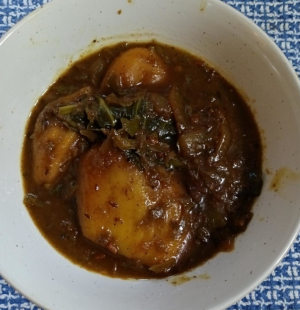
JACKFRUIT CURRY

(Polos Curry)

­

INGREDIENTS
­
1 pound canned jackfruit*, drained
3 green chiles
3 garlic cloves
1 onion
2 tablespoons coconut oil or vegetable oil
½ teaspoon cumin seeds
½ teaspoon fennel seeds
½ teaspoon fenugreek seeds
½ teaspoon mustard seeds
1 tablespoon chili powder
½ tablespoon diced ginger
½ teaspoon pepper
1½ tablespoons roast curry powder* or curry powder
½ teaspoon turmeric
2″ cinnamon stick
3 collard green leaves or 2 pandan* leaves
6 curry leaves
1⅓ cups coconut milk
1 tablespoon tamarind juice or goraka*
­
* = Can be found in Asian supermarkets or online.
­
Serves 2. Takes 1 hour 30 minutes.
­
PREPARATION
­
Cut jackfruit into strips 2″ long. Seed green chiles. Mince garlic and green chiles. Dice onion. Add coconut oil. Heat coconut oil using medium heat until a cumin seed starts to dance in the oil. Add cumin seeds, fennel seeds, fenugreek seeds, and mustard seeds. Sauté for 30 seconds or until seeds start to pop. Stir constantly.
­
Add garlic, green chile, onion, chili powder, ginger, pepper, roast curry powder, turmeric, cinnamon stick, collard leaves, and curry leaves. Sauté for at medium heat for 4 minutes or until onion softens. Stir frequently.
­
Add coconut milk, tamarind juice, and jackfruit pieces. Bring to boil using high heat. Stir frequently. Cover. Reduce heat to low and simmer for 1 hour or until jackfruit pieces turn brown and soften. Stir enough to prevent burning. Remove cinnamon stick. Goes well with rice.
­
TIDBITS
­
1) This entree, Jackfruit Curry, is a curry that uses jackfruit.
­
2) We are indeed starting this tidbit series on solid ground.
­
3) It is less well known that this dish also goes by the name of Polos Curry.
­
4) Culinary historians tell us that this curry was named after Marco Polo. Hence, Polo’s Curry.
­
5) How do we not know this? Unfortunately for foodies everywhere, Polo’s travelog, The Travels of Marco Polo, blew his recipe book out of the water.
­
6) I mean, Venetians, Pisans, Genoese, other Italians, and Europeans, from well, all over Europe kept saying, “Ooh, ooh, I want to know about far-off Asia.” So, Polo’s travel tale sold thousands and thousands of copies.
­
7) So, the European book readers generally blew their literature budget on The Travels of Marco Polo.
­
7b) Just now, I made a small typo and added an “i” before the “o” in “polo” to get “polio.” That kinda changed the meaning of the previous tidbit a bit. Fortunately, I edited out the offending letter, so you would never know my mistake.
­
8) Anyway, Polo’s great culinary masterpiece Ottimi Pasti del Gran Khan, or Great Meals of the Great Khan, gathered dust in the most hidden parts of just a few European bookstores.
­
9) Marco dictated Ottimi Pasti del Gran Khan to Fabio Manzo who languished in the same Genoese jail.
­
10) How did Manzo’s effort get relegated to the dustbin of history, while everyone knows of Marco Polo and only a dedicated group of introverts talk freely–that is if they could talk freely to people–of the not great, but still pretty good, Signore Manzo.
­
11) Sure, Marco Polo dictated his travels to his other cell mate, Rustichello da Pisa. Okay, da Pisa rates a mention. But Fabio Manzo never rates a mention.
­
12) Why is this so?
­
13) Literary agents.
­
14) Signores Polo and da Pisa hired literary agents. Polo has been famous for nearly a millennium. Da Pisa merits a footnote every now and then. However, penny-pinching, Manzo hired no one. He is literature’s most forgotten man.*
­
15) * = See Time Magazine’s(tm) issue, The 100 Most Forgotten Names in Literature.
­
16) However, while Manzo and Great Meals of the Great Khan remain largely forgotten, this cookbook can always be found on the shelves of all great chefs. Something to think about.
­

– Paul De Lancey, The Comic Chef, Ph.D.

­My cookbook, Following Good Food Around the World, with its 180 wonderful recipes, my newest novel, Do Lutheran Hunks Eat Mushrooms, a hilarious apocalyptic thriller, and all my other books, are available on amazon.com.
 

Categories: cuisine, history, international | Tags: , , , , , , , , , , , | Leave a comment

Pearl Sugar

Belgian Dessert*

­

PEARL SUGAR

­
INGREDIENTS
­
3 cups sugar
3½ tablespoons water
­
Takes 40 minutes. Make 3½ cups.
­
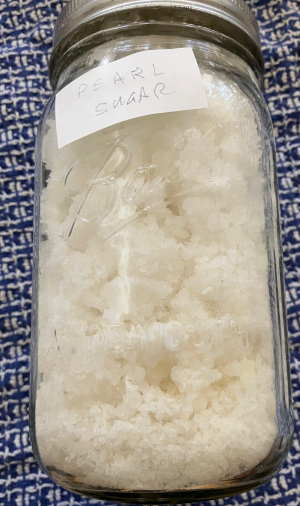
* = Belgian pearl sugar is larger than the Swedish variety and resembles pearly white pebbles. It’s sugar, if you can find it, has large granules made from sugarbeets. The Belgian variety is best for Liege, or Belgian, waffles. Swedish pearl sugar, pärlsocker, has smaller sugar granules. Use Swedish pearl sugar to top pastries, cakes, and breads.
­
PREPARATION
­
Add both ingredients to 2 large pans. Mix with wooden spoon or spatula. Use low heat. Stir constantly until clumps start to form. (If too much loose sugar remains, add 1 more teaspoon sugar and stir again.) Try for larger clumps if you want Belgian pearl sugar and smaller clumps if you’re going for Swedish pearl sugar.
­
When happy with clump sizes, dry them out over low heat for 20 minutes. Stir occasionally. Remove from heat and let cool until clumps harden.
­
TIDBITS
1) Swedish pearl sugar granules are small. Belgian pearl sugar granules are big. But are they the world’s biggest?  No. Sugarologists say Tahitian granules are 23-to-25 percent than those from Belgium.
­
2) Culinary historians says the largest pearl sugar granule came from Greenland during the Viking Age. Please Bengt Erickson’s The Sugar Cane Fields of Greenland’s East Settlement, (Sockerrörsfälten i Grnlands Östra Bosättning.)
­
3) Erickson raised cane from 1012 to 1025. His success encouraged hundreds of other Swedish Vikings to voyage over and do the same. Unfortunately, so many came to harvest sugar that they completely chopped down all the trees in Greenland’s vast forest just to build their log cabins.
­
4) What, you you’ve never heard of the Great Greenlandic Forest? You say that aren’t any trees there? Sure, now.
­

– Paul De Lancey, The Comic Chef, Ph.D.

My cookbook, Following Good Food Around the World, with its 180 wonderful recipes, my newest novel, Do Lutheran Hunks Eat Mushrooms, a hilarious apocalyptic thriller, and all my other books, are available on amazon.com.
Categories: cuisine, history, international | Tags: , , , , , , , , , , , , , , | 1 Comment

Loco Moco

Hawaiian Entree

­

LOCO MOCO

­
INGREDIENTS – RICE & PATTY­
­
1⅔ cups rice
1 small onion (½ small onion more later)
1 pound ground beef (80%-to-85%)
¾ teaspoon garlic salt
¼ teaspoon pepper
¼ teaspoon salt
½ tablespoon Worcestershire sauce (1 teaspoon more later)
­
INGREDIENTS – GRAVY
­
1½ tablespoons butter (softened)
½ small onion
1¾ cups beef broth
1½ tablespoons cornstarch
1 teaspoon ketchup
4 teaspoons soy sauce
1 teaspoon Worcestershire sauce
­
INGREDIENTS – FINAL
­
4 eggs
1 green onion
­
Serves 4. Takes 40 minutes.
­
PREPARATION – RICE & PATTY
­
Cook rice according to instructions on package. Mince 1 small onion. Add all patty ingredients to mixing bowl. Mix with hands until well blended. Form into 4 patties, each 3″ wide. Smooth the edges. Add patties to large pan. Fry at medium heat for 5 minutes. Flip patties and fry for 5 minutes more. (More or less time) Remove patties. Keep drippings in pan.
­
PREPARATION – GRAVY
­
Mince ½ small onion. While patties cook, add all gravy ingredients to small mixing bowl. Mix with whisk or fork until well blended. Add gravy to pan. Sauté for 4 minutes or until onion softens and gravy thickens. Stir occasionally.
­
PREPARATION – FINAL
­
While patties and gravy cooks, add eggs to 2nd frying pan. Fry eggs to your liking. Put 1 cup steamed rice on plate. Smooth the edges into a circle about 3″ across, Top rice with patty. Ladle ¼th of the gravy onto patty. Place fried egg on gravy. Repeat three times. Dice green onion. Garnish eggs with green onion.
­
TIDBITS
­
1) About 50 years ago, Om Corporation(tm), Om Co., dominated all other Hawaiian food distributers.
­
2) Stop and ponder how cool is it to live in a universe where there is a word that has the sequence “aiia,” in it.
­
3) We are truly fortunate that over billions–or maybe just ten millions of years, I really don’t for sure how may years as I wasn’t there–that Earth’s plates shifted in such a way that Hawaii formed. With-out Hawaii, there be no word Hawaii, and thus no word with out aiia in it. We certainly have no Hawaiian pizzas. Nor ever Hawaiian luaus. That would have been a great loss indeed.
­
4) But how would we have known what we would be missing from the loss of Hawaiian luaus? Maybe things would have gotten something better in return.
­
5) Like Greek luaus for example. Especially likely, if Greece could grow pineapples.
­
6) Anyway, Om Co., or Omco as people who hate spaces used to call it, developed the very first Hawaiian pizza boomerang pizza.
“I want a Hawaiian pizza.”
“But I want a functioning boomerang.”
­
7) “Wait, both your desires will be fulfilled with Omco’s new and exciting Hawaiian boomerang pizza. Take a bite. Mmm, wasn’t delicious. Now, fling the boomerang. It’ll come back. But in the meantime, you can continue your statewide volleyball tournament. You don’t want to miss that. After you’ve spiked the volleyball down the other team’s throats, wait a second and your boomerang pizza will come back to your hand. Take another tasty bite and fling the boomerang pizza away again. Pizza and high-stakes volleyball at the same time. Way cool. Way cool.”
­
8) In fact the boomerang pizza was so cool, that Hawaiians took to calling, Om. Co, “Cool Omco.” Dyslexics, over time, changed this name to “Cool Moco.” The next generations of dyslexic Hawaains altered this to “Loco Moco.”
­
9) The name stuck. And a bit later Om Corporation held a recipe contest to honor its golden anniversary.
­
10) Carl La Fong won first prize with this entree. He called it “Loco Moco “in honor of Om Co.’s stellar culinary reputation. There you go, innovative chefs and companies and plucky dyslexics* making life a little better.
­
11) * = I am slightly dyslexic. Maybe this explains things.
­

– Paul De Lancey, The Comic Chef, Ph.D.

My cookbook, Following Good Food Around the World, with its 180 wonderful recipes, my newest novel, Do Lutheran Hunks Eat Mushrooms, a hilarious apocalyptic thriller, and all my other books, are available on amazon.com.
Categories: cuisine, history | Tags: , , , , , , , , , , , , , , | Leave a comment

Create a free website or blog at WordPress.com.