Posts Tagged With: spice grinder

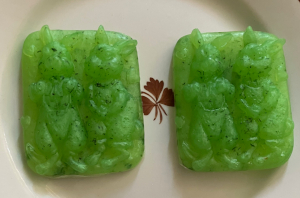
Basil Glycerin Soap

BASIL GLYCERIN SOAP

­
INGREDIENTS
­
6 tablespoons fresh basil
1 teaspoon pale green mica powder
2 tablespoons isopropyl alcohol
2 pounds glycerin soap base
1 teaspoon basil essential oil
isopropyl alcohol
­
SPECIAL UTENSILS
­
soap mold
spray bottle
soap slicer (optional)
­
Makes 10½ bars, 1″ wide. Takes 3 hours.
­
PREPARATION
­
Add basil to spice grinder. Grind until the basil bits are small as possible.. Add pale green mica and 2 tablespoons isopropyl alcohol to small mixing bowl. Mix with fork until well blended.
­
Cut glycerin base into 1″ cubes. Add glycerin base to large glass measuring cups. Melt base in 30 second intervals. Stir after every time. Add green mica powder/isopropyl mix and basil essential oil. Stir with knife until well blended. Let sit for 15 minutes. (This inhibits basil bits from settling to the bottom of the soap mold.) Add basil bits. Mix with knife until well blended.
­
Spray silicon mold with isopropyl alcohol. Pour melted soap into soap mold. If desired, lightly spray bubbles with isopropyl alcohol to make them disappear. Let soap sit for 3 hours. Use soap slicer to cut soap into slices 1″ wide.
­
TIDBITS
­
1) Perhaps the most famous Basil of all time is Basil Rathbone, who is most remembered for his portrayal of Sherlock Holmes.
­
2) The next most renowned Basil is Basil II emperor of the Byzantine Empire, 976 – 1025. He proved to be more aggressive than the above actor as evinced by his nickname, “Bulgar Slayer.” Bulgars, or Bulgarians, come from Bulgaria. However, bulgur wheat is a nutrient dense cracked grain that improves blood sugar control, heart health, and digestion.
­
3) Basilicas were first designed by the famous architect Basil Ica in Greece in 452 AD.
­

– Paul De Lancey, The Comic Chef, Ph.D.

My cookbook, Following Good Food Around the World, with its 180 wonderful recipes, my newest novel, Do Lutheran Hunks Eat Mushrooms, a hilarious apocalyptic thriller, and all my other books, are available on amazon.com.

Categories: soap | Tags: , , , , , , , , , , , , , , | Leave a comment

Turkish Stuffed Bell Pepper Recipe

Turkish Entree

TURKISH STUFFED BELL PEPPERS

INGREDIENTSTurkSBP-

1 cup brown rice
2 cups water (1/2 cup more later)

1 1/2 tomatoes
8 red or green bell peppers
2 tablespoons pine nuts (see note below for substitutions)
2 medium onions
1/2 cup water
1/2 teaspoon allspice
1 teaspoon cinnamon
1 teaspoon dill
2 teaspoons mint
2 teaspoons parsley
1/4 teaspoon black pepper
1/4 teaspoon sea salt
2 tablespoons lemon juice
3 tablespoons olive oil

Many people are more allergic to pine nuts than other types. Substitutes for pine nuts are: walnuts, almonds, pistachios, cashews, and peanuts.

SPECIAL UTENSIL

spice grinder
casserole dish

PREPARATION

Preheat oven to 375 degrees. Cook rice according to instructions shown on bag. Mince tomatoes. Cut off tops from bell peppers. Keep tops for later. Remove seeds. Grind nuts. Mince onions.

Put olive oil and onion in frying pan. Sauté for about 5 minutes or until onions soften. Stir frequently.

Add 1/2 cup water, tomatoes, pine nuts, onion, allspice, cinnamon, dill, mint, parsley, black pepper, salt, lemon juice, and cooked rice. Cook on low heat for about 10 minutes, stirring occasionally.

Put bell pepper bottoms, open-end up, in casserole dish. Fill bell peppers with rice/tomato/spice mix. Put bell-pepper caps on top of bell-pepper bottoms. Add 1″ water to casserole dish. Put casserole dish in oven. Bake at 375 degrees for 40 minutes or until bell peppers are soft.

Discard bell-pepper tops before serving this entree to adoring family or guests.

TIDBITS

1) I looked up “fun facts about Turkey” and found the country is a member of the Council of Europe (1949), NATO (1952), OECD (1961), OSCE (1973) and the G20 industrial nations (1999).

2) I guess some people have different ideas about fun.

3) The Turks introduced coffee to Europe during some three-hundred years of invasion. Bad for the Europeans of that time, but really good for us now when we need to wake up.

4) The mighty croissant was invented in Vienna in 1683. Viennese bakers preparing breads and pastries in the wee hours in the morning heard the Turks tunneling under the city. The bakers sounded the alarm. The alerted Viennese defenders defeated the tunnelers and the city was saved. The bakers celebrated the event with pastries shaped like the crescent on the Turkish flags, hence the name croissant.

5) Isn’t tidbit 4) much more fun than tidbit 1)?

6) The Turks haven’t invaded anyone for about three centuries bringing that mode of culinary enlightenment to an end.

7) We now discover Turkish culinary recipes at bookstores and from the internet.

8) There is no more need for war.

– Paul De Lancey, The Comic Chef

My cookbook, Following Good Food Around the World, with its 180 wonderful recipes, my newest novel, Do Lutheran Hunks Eat Mushrooms, a hilarious apocalyptic thriller, and all my other books, are available on amazon.com.

Categories: cuisine, food, humor, international, recipes | Tags: , , , , , , , , , , , , , , , , , , , , , , , , , , , , , , , , , , , | Leave a comment

St. Martin Hamburger Recipe

St. Martin Entree

ST. MARTIN HAMBURGER

INGREDIENTSStMarHB-

1 medium yellow onion
1/2 teaspoon bird pepper (St. Martin spice)
1 teaspoon nigelle (St. Martin spice)
1 1/2 pounds ground beef
6 hamburger buns

SPECIAL APPLIANCES

spice grinder
time machine

PREPARATION

Mince yellow onion. Use spice grinder to grind bird pepper. Use hands to combine onion, bird pepper, nigelle, and ground beef in large mixing bowl. Make 6 patties.

Your hands will be messy. Use time machine to go back to a moment when your hands were clean. Be sure to come back to the present moment. Those patties need to be fried and you don’t want to cause a time paradox, do you?

Cook patties in frying pan until meat browns. Flip patties over at least once to keep moisture from exiting the top. Toast hamburger buns. Put patties in buns. Enjoy.

TIDBITS

1) St. Martin is the French side of an island in the Caribbeain. St. Maarten is the Dutch side. Both countries valued the island for its vast salt deposits.

2) Packing meat and fish in salt was one of the few ways to preserve meat and fish way back when. Nations in those days often waged war over lands rich in salt.

3) Indeed, global wars raged constantly in the seventeenth, eighteenth, and nineteenth centuries. The number of such bloody conflicts plummeted in the twentieth century and in our very own, the twenty-first.

4) Why? The development of the refrigerator made it unnecessary for chefs worldwide to use salt to preserve their perishable beef and fish.

5) Well preserved food results in happy contented chefs. Happy chefs cook for happy eaters. Happy eaters comprise happy nations. Happy nations are agreeable nations. Agreeable nations don’t fight each other. No wars, no nuclear Armageddon.

6) So think about that when considering to send back that overcooked steak to the chef.

– Paul De Lancey, The Comic Chef

My cookbook, Following Good Food Around the World, with its 180 wonderful recipes, my newest novel, Do Lutheran Hunks Eat Mushrooms, a hilarious apocalyptic thriller, and all my other books, are available on amazon.com.


Categories: cuisine, history, international | Tags: , , , , , , , , , , , , , , , , , , , , , | Leave a comment

Blog at WordPress.com.