Posts Tagged With: Parisian

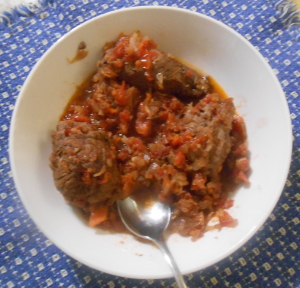
Bragioli (Maltese Stuffed Beef Rolls)

Maltese Entree

BRAGIOLI
(Stuffed Beef Rolls*)

INGREDIENTS – BEEF ROLL
2 pounds topside, bottom, or round steak
6 slices bacon
2 garlic cloves (3 more cloves later)
⅔ cup fresh parsley
2 hard boiled eggs
¼ cup bread crumbs
½ teaspoon pepper
¾ teaspoon salt
2 tablespoons olive oil (2 tablespoons more later)

INGREDIENTS – SAUCE

1 carrot
3 garlic cloves
3 medium onions
3 medium tomatoes
2 tablespoons olive oil
2 bay leaves
⅔ cup red wine

Serves.4. Takes 2 hours 40 minutes.

SPECIAL UTENSILS

kitchen mallet
kitchen twine or toothpicks
sonic obliterator (Why is this not in your kitchen?)

* = The best, or at least most common, translation is really “Beef Olives.” Apparently, many people think rolls look like olives. This interpretation has over 500 years of history behind it Indeed, the word olive was sometimes used a verb, as in to olive, roll up, some ingredient. Now you know.

PREPARATION – BEEF ROLL

Cut steak into 12 slices. Pound beef slices with mallet to make them thinner and flatter. Dice bacon. Dice 2 garlic cloves and parsley. Cut each egg into 6 slices. Add bacon, 2 diced garlic cloves, bread crumbs, parsley, pepper, and salt to mixing bowl. Mix with hands until this stuffing is thoroughly blended.

Top a beef slice with 2 tablespoons stuffing. Place 1 egg slice on bacon/bread crumb mixture. Roll up beef slices lengthwise over stuffing. Secure rolled-up steak, bragioli with kitchen twine or toothpicks. Repeat for each bragioli Add 2 tablespoons olive and bragiolis to large pot. Sauté at medium-high heat until bragiolis turn slightly brown. Turn bragiolis enough to ensure even browning. Remove bragiolis from pot.

PREPARATION – SAUCE

Dice carrot, 3 garlic cloves, onions, and tomatoes. Add 2 tablespoons olive oil, 3 diced garlic cloves, and onion to same pot. Sauté at medium-high heat for 5 minutes or until onion softens. Stir frequently. Add carrot, tomato, bay leaves, and red wine. Simmer at low heat for 10 minutes. Stir enough to prevent burning. Add bagiolis back to pot.

Bring to boil using high heat. Stir enough to prevent burning. (Gently, don’t break open the bagiolis.) Simmer at low-medium heat for 45 minutes or until sauce thickens. Remove bay leaves. Serve to adoring quests. Zap unappreciative ones with your sonic obliterator. You don’t need negativity in your kitchen.

TIDBITS

1) This recipe uses eggs. Each egg is to be cut into six slices. This is easy to do if the egg is three inches long. Why, each slice would be one-half-inch thick. That’s easy to measure, but three-inch long eggs are hard to find, especially ones that come from hens.

2) Okay, what about an egg that is 1-8/9 inches long. Divide that by six and you get slices that should 17/54 inches wide. How the heck, do we measure that on a standard ruler? I’ll bet no ruler has ever been made that divides inches into 54 equal parts.

3) So what do we do? I’m glad you asked. 17/9 inches equals 4.8 centimeters. Divide that by six and you get 0.8. It’s a snap to measure that on a metric ruler. But how did we get the metric system?

4) From the French Revolution. French chefs everywhere ran into considerable delays when the aristocrats suddenly wanted their meal portions to include exactly one sixth of an egg. We don’t have rulers that measure in fifty-fourths now. It’s certain that pre-revolutionary chefs didn’t either. So cutting eggs became much problematic.

5) Problems in dividing eggs meant long delays in making the aristocrats’ favorite dishes. This enraged the impatient French nobility. Gourmet chefs all over Paris found themselves chucked into prisons especially the Bastille.

9) The French elite still clamored for their exquisite meals But there were no more gourmet chefs. But where would the aristocracy find new chefs? From the bakeries. This action, however, meant a shortage of bakers to mean bread.

10) So Paris suffered a bread shortage. Incensed Parisian mothers stormed the bakeries for anything they could find. A hungry mob gathered. It stormed the Bastille to release the imprisoned chefs. The French Revolution had begun. Desiring stability, the Revolutionary government of France converted to the metric system. France is now a stable country.

12) America is not metric. We are sitting on a powder keg.


Paul De Lancey, The Comic Chef, Ph.D.

My cookbook, Following Good Food Around the World, with its 180 wonderful recipes, my newest novel, Do Lutheran Hunks Eat Mushrooms, a hilarious apocalyptic thriller, and all my other books, are available on amazon.com.

Categories: cuisine, history, international | Tags: , , , , , , , , , , , , , , , , , , , , , , , , , | Leave a comment

Cheese Souffle

French Dessert

CHEESE SOUFFLE

INGREDIENTS

1 tablespoon butter (3 tablespoons more later)
1 tablespoon grated Parmesan cheese (¾ cup more later)
3 tablespoons butter
¼ cup flour
1¼ cups milk
1 cup grated gruyère cheese
¾ cup grated Parmesan cheese
4 egg yolks
¼ teaspoon paprika
¼ teaspoon pepper
¼ teaspoon salt
6 egg whites
¼ teaspoon cream of tartar

SPECIAL UTENSILS

4 ramekins or 1 souffle dish
electric beater with whisk attachments, if available
baking sheet
flying monkeys, just in case

Serves 4. Takes 1 hour 15 minutes.

PREPARATION

Preheat oven to 375 degrees. Butter each ramekin with an equal part of 1 tablespoon butter. Coat each ramekin with an equal part of 1 tablespoon Parmesan cheese. (This is a good time to separate egg yolks and whites if you haven’t already done so.)

Add 3 tablespoons butter to pan. Melt butter using medium heat. Add flour. Stir flour constantly until you get a flour paste. Gradually add milk, stirring constantly with whisk until mixture is smooth. Bring to boil using medium heat. Stir constantly. Reduce heat to low and simmer for 3 minutes or until you get a thick white sauce. Remove from heat.

Add gruyère and Parmesan to pan. Stir until well blended. Add eggs yolks, paprika, pepper, and salt. Stir gently until well blended. Transfer flour/egg/cheese mixture to 1st large mixing bowl and let cool.

Add egg whites and cream or tartar to 2nd large mixing bowl. Beat egg whites with electric beater set on low. Beat until egg whites become foamy and form peaks. Gently fold in ¼ of the egg whites into the flour/egg/mixture. Then gently fold in the remaining egg whites until well blended. Pour this blended souffle equally into the ramekins. Gently smooth souffles with spoon. Place ramekins on baking sheet and bake at 375 degrees for 30 minutes or until souffles puff up and turn golden brown.

Do not open the oven the door while baking the souffles. NO, NOT EVEN ONCE! OPENING THE OVEN DOOR WILL MAKE THE SOUFFLES COLLAPSE. YOU WILL FALL SOBBING TO THE FLOOR. NOT ONLY THAT, YOU WILL RELEASE VICIOUS FLYING MONKEYS ALL OVER THE WORLD.

Serve immediately to adoring guests. If they’re unappreciative or late to table, by all means, release the flying monkeys. Those critters need exercise.

TIDBITS

1) With the proper type of internal combustion engine, cars can run on cheese souffle.

2) This actually happened from 1937 to 1940.

3) For on July 14th, Bastille Day, 1937 a very inebriated Chef Auguste Oeuf accidentally staggered to his Renault, unscrewed its gas cap, staggered back to his restaurant, grabbed a tray of cheese souffles, staggered back to his car, and one by one threw the souffles into his gas tank.

4) What are the odds are doing all those things while drunk? And in that order?

5) Small.

6) Less than half.

7) Any way, Chef Oeuf needed to go to the market and buy some chickens for his plat du jour. He turned the ignition. The engine roared into action. He used the newly untamed fury of his Renault to make to the market in record time.

8) He would make trip after trip for ingredients. His customers loved the unparalleled freshness of his cuisine. Ouef’s restaurant, Le Chaton D’or became the most popular restaurant of all Paris. Other chefs of the city noticed this. They too would get rip-roaring drunk and whip up a batch of cheese souffles for their cars. The culinary reputation of Parisian food reigned supreme.

9) The secret of drunken chefs feeding souffles to their cars soon spread to every corner of France.

10) There was though a distressing period, though. when some chefs didn’t get sufficiently soused. Miles per souffle (MPS) suffered. And in consequence, so did the vital culinary/automotive industry.

11) As a result, an anagramist in French government required all cheese-souffle chefs to enter the Fuels Of Cheese (FOC) association.

12) Mais zut alors, in 1940, the Germans conquered France. The long horrors of the occupation permanently sobered up all the country’s chefs. The dried-up cooks retained no memory of how to make souffle fuel. This is why our cars now run of gas.

– Paul De Lancey, The Comic Chef

My cookbook, Following Good Food Around the World, with its 180 wonderful recipes, my newest novel, Do Lutheran Hunks Eat Mushrooms, a hilarious apocalyptic thriller, and all my other books, are available on amazon.com.

Categories: cuisine, history, international | Tags: , , , , , , , , , , , , , , , , , , , , , , , | 2 Comments

Create a free website or blog at WordPress.com.