Posts Tagged With: Louvre

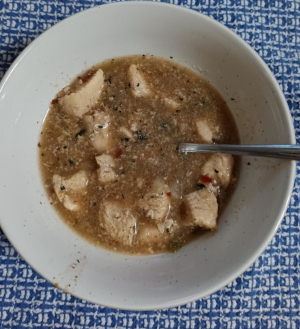
Pepper Soup From Nigeria

Nigerian Soup

­

PEPPER SOUP

­
INGREDIENTS
­
2¼ pounds chicken, beef, or goat
3 whole nutmegs or calabash nutmegs, or 2 tablespoons nutmeg
1 onion
1 Scotch bonnet, habanero, 2 serrano chiles, or bird’s eye chile
2 MaggiTM** bouillon cubes, flavor should match the meat
4 cups water
2 teaspoons ginger powder
1 teaspoon red pepper flakes
1 teaspoon salt
2 tablespoons shrimp or crayfish powder (or omit)
2 tablespoons scent leaves*: Thai basil, or tarragon
­
* = Scent leaves can be hard to find.
** = Doesn’t have to be the Maggi brand, but Maggi is extremely popular in Nigeria and much of the rest of Africa.
­
SPECIAL UTENSILS
­
spice grinder
sonic obliterator
­
Serves 4. Takes 1 hour 20 minutes.
­
PREPARATION
­
Cut chicken into 1″ cubes. Grind whole nutmegs into powder. Dice onion. Seed and mince Scotch bonnet. (BE SURE to wash your hands thoroughly after touching the Scotch bonnet or its seeds. If however you touch your face after handing the Scotch bonnet or habanero, you will remember the pain it caused for a long time.)
­
Add chicken, bouillon cubes, onion, Scotch bonnet, and 4 cups water. Bring to boil using high heat. Stir enough to prevent burning. Reduce heat to low and simmer for 30 minutes. Stir occasionally.
­
Add ginger powder, nutmeg, red pepper flakes, salt, and shrimp powder. Simmer on low for 10 minutes. Stir occasionally. Add scent leaves. And simmer for another 5 minutes. Stir occasionally. Use sonic obliterator on any guests who gives your any guff over any ingredient substitutions. You don’t need that negativity in your kitchen.
­
TIDBITS
­
1) Culinary art historians will tell you, if you have the misfortune of being cornered by a feral gang of them, that the progression of European art can be summarized in the following eight stages.
­
2) First stage: Pre-prehistoric art.. How do we know it existed? We don’t. That’s why most of us cross the street to avoid a culinary art historian. (CAH.)
­
3) Second stage: .Prehistoric art, such as the wall paintings in the Lescaux Cave. Sadly, because this art comes from a prehistoric time, there are no written records of its history. Bummer. But it also gives rises to the age-old riddle, “Did prehistory inhibit written records or did the absence of written records spawn prehistory?” It is a contentious subject among the fractious CAHs.
­
4) Third stage: Roman art. Mosaics and wall paintings of geometric patterns, scenes from mythology, and pastoral landscapes. The Romans really liked the color red. Although when they really let their hair down, they would add black and yellow, hence the many mosaics at Bromidium depicting enraged wasps stinging tomatoes.
­
5) Moving onto the Fourth stage; (We really have to cover a lot of ground quickly as we only have one page.) Medieval art: Paintings depicted people of status in incredibly rigid poses. The current planking craze derives nearly all of its inspiration from Medieval nobility. Many Medieval artists made many Medieval medallions and incredibly expensive golden statues. Unfortunately, these stupendously valuable works got robbed by enterprising thieves. All gone. This explains why so few people study Medieval art. This six-sentence review is one of this period’s longest art studies
­
6) Fifth stage: Renaissance art. Really, an overall flowering of artistic ideas and techniques. The whole Renaissance era burgeoned with beauty. People love to study Renaissance art, their numbers limited only by the difficulty of spelling the word, “Renaissance.”
­
7) Sixth stage: Brown Gravy or Fifty Shades of Beige. Every freaking painting was painted in brown. It really does resemble brown gravy. Museum curators will tell you with admirably straight faces that post-Renaissance teemed with other colors. They say the painted walls, portraits, and tapestries of Hampton Court and the Louvre blazed with vibrant colors and only faded to brown over time.
­
8) Rebuttal: pish.
­
9) Brown’s supremacy derives from the massive importation of Nigerian Pepper Soup into Europe. Pepper-mad Europeans couldn’t get enough of this dish. Artists thought of Pepper Soup during every waking hour. Then dreamed of it every night.
­
10) This dish in this recipe is light brown and dark brown. So, is it any wonder that all Brown-Gravy artists worked only with brown? Where did the European artists get the funds to afford so much Pepper Soup? From the gold stolen in tidbit 5).
­
11) Seventh stage: Eventually artists went off feed and discovered other colors, such as can be found in fried eggs and split-pea soup. This naturally brought on the many-colored Impressionistic era.
­
12) Eighth stage: Modern art. It’s chock full of modern art. There, you are now an art expert.
­

– Paul De Lancey, The Comic Chef, Ph.D.

My cookbook, Following Good Food Around the World, with its 180 wonderful recipes, my newest novel, Do Lutheran Hunks Eat Mushrooms, a hilarious apocalyptic thriller, and all my other books, are available on amazon.com.
Categories: history, international | Tags: , , , , , , , , , , , , , , , | 2 Comments

Oeufs en Meurette

French Entree

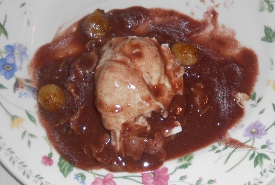
OEUFS EN MEURETTE

INGREDIENTSOeufsEnMeurette-

3 ounces thick, really fatty bacon*
12 pearl onions
1 small onion
½ celery stalk
2 shallots
1 garlic clove
5 cups water
¼ teaspoon pepper
12 ounces red Burgundy wine
1 cup beef stock
1 bay leaf**
5 springs parsley**
2 sprigs thyme**
2 tablespoons butter (2 additional tablespoons later)
3 tablespoons flour
4 eggs
4 slices white bread (¼” thick)
2 tablespoons butter

Makes 4 servings. Takes 1 hour 15 minutes.

* = How do you look for fatty bacon? It’s easy! Simply go to your supermarket and pick the package of bacon that has been tossed to the side, the one where the little flaps have been torn open. That’s the bacon for you. Or . . . buy any package of bacon and cut off all the fatty sections. Save the lean bits for future breakfasts. Your kids, family, and friends will love you for it.

** = This ingredients comprise bouquet garni or bouquet garnish. Now impress your friends with your culinary knowledge. Walk with pride.

PREPARATION

Cut bacon crosswise into ¼” wide strips. Cut off tops and bottoms of pearl onions. (Do not remove skins.) Dice onion. Thinly slice celery and shallots. Crush garlic. Add water to pot. Bring water to boil using high heat. Add pearl onions to pot. Boil for 1 minute. Remove pearl onions and set aside. Save oniony water to poach eggs.

While water comes to boil, add fatty bacon strips to pan. Fry using medium heat for 3 minutes or until bacon starts to brown. Stir frequently. Remove bacon strips and place them on a plate covered by paper towels. Keep bacon grease in pan. Remove skins from pearl onions. Place pearl onions in pan. Sauté on medium-high heat for 4 minutes or until they soften and turn golden brown. Stir frequently. Remove pearl onions and set aside. Keep bacon grease in pan.

Add diced onion, sliced shallot, and pepper to pan. Sauté for 5 minutes at medium-high heat or until onion and shallot soften. Stir frequently. Reduce heat to medium. Add garlic. Sauté for for 1 minute or until you can smell the garlic. Add wine, beef stock, celery, bay leaf, parsley, and thyme. Reduce heat to low and simmer for 30 minutes or until sauce is reduced by half.

While sauce reduces, add 2 tablespoons butter and flour to bowl. Smash together with fork. This is called beurre manié. (Don’t confuse beurre manié with beurre manic. You don’t want to know what manic butter is. Even I don’t want to know.) Add this to pan. Mix with whisk. Simmer on low-medium heat for 3 minutes or until sauce thickens. Stir occasionally. Add beurre manié to pan. Simmer for 3-to-5 minutes or until sauce thickens. Stir occasionally. Strain sauce through colander into bowl.

While sauce still reduces, bring oniony water in pot to boil using high heat. (You did save the oniony water, didn’t you?) Crack eggs into a large ladle. Gently place eggs in water one at a time. Poach the eggs for 3-or-5 minutes, depending on your preference for soft or hard eggs. Remove pot from burner. Add fatty-bacon strips.

Now make the croûtes, a fancy French work for bread crusts. Use a round cookie cutter, about the size of a poached egg, cut the 4 bread slices into 4 circles. Add 2 tablespoons butter to pan. Melt using medium heat. Add bread circles to pan. Sauté bread for 1-to-2 minutes on each side or until browned Add a croûte to each plate. Use slotted spoon to remove poached egg from pot. Place egg on top of croûte. Ladle ¼ of the sauce onto the egg. Garnish with ¼ of the pearl onions. Repeat for each croûte.

TIDBITS

1) A small kitchen is a kitchenette. A small pipe is a pipette. So, a small mural should be a muralette. But it isn’t. It’s a meurette. We can all blame the French impressionist Paul Gauguin for this.

2) Monsieur Paul was a painting maniac. He literally painted every moment he was awake. When he was full of vim and vigor and ate this recipe, then called oeufs en vin, he painted outside with his friend Vincent van Gogh. Paul and Vincent would talk about brush versus finger painting, the local babes, and fantasy baseball leagues. Yes, they were visionaries in matters outside of the arts as well.

3) However, on days when Paul had been consuming vat after vat of wine, it was hard for him to get out of bed, pick up his easel and paints downstairs, and head to the fields. Indeed, he even found it difficult to head down to the breakfast table. On these occasions, the owner of La Meur would bring a plate on runny, fried eggs to Paul’s bed. But even with a throbbing wine induced migraine, Paul had to paint. He’d just prop himself up on one elbow, dip his hand into the runny yolks, and fingerpaint on a mural on the wall. He did a great job! Wealthy art lovers came from all over France to admire his little murals.

4) Since Paul had no money to pay for his room and board, he sold the rights to his little murals to La Meur’s owner. This and the fact that Paul drank wine heavily and painted with runny eggs, made the renaming of oeufs en in to oeufs en meurette inevitable. And if you wish, you can go to the Gauguin room at the Louvre in Paris and see Monsieur Paul Gauguin’s walls covered with one finger-painted egg mural after another. Be sure to spend some looking at his most famous one, Le Chaton d’Or.

– Paul De Lancey, The Comic Chef

My cookbook, Following Good Food Around the World, with its 180 wonderful recipes, my newest novel, Do Lutheran Hunks Eat Mushrooms, a hilarious apocalyptic thriller, and all my other books, are available on amazon.com.

Categories: cuisine, history, humor, international | Tags: , , , , , , , , , , , , , , , , , , , | Leave a comment

Costa Rican Pork Casado

Costa Rican Entree

PORK CASADO

INGREDIENTSCasado-

8 tablespoons orange juice
4 tablespoons orange zest
2 teaspoons garlic salt
1 teaspoon chili powder
1 teaspoon cumin

¼ head cabbage
1 small carrot
1 small tomato
¼ teaspoon pepper
¼ teaspoon salt

1 cup basmati or white rice
1 onion (1 additional onion later)
2 red bell peppers
2 tablespoons vegetable oil (5 additional tablespoons later)

2 plantains
5 tablespoons vegetable oil

1 onion
4 pork loins

1 15-ounce can black beans

PREPARATION MARINADE

Coat pork loins throughly in orange juice, orange zest, garlic salt, chili powder, and cumin.. Let marinate for 30 minutes. Keep marinade.

PREPARATION – SALAD

Shred cabbage. Dice carrot and tomato. Add cabbage, carrot, tomato, pepper, and salt to mixing bowl. Mix with fork.

PREPARATION – RICE

Add rice to pot. Cook rice according to instructions on package. While rice cooks, mince 1 onion and red bell peppers. Sauté at medium-high heat for 5 minutes or until onion softens. Keep rice and onion/bell pepper mix warm.

PREPARATION – PLANTAINS

Peel plantains. Slice plantains in half lengthwise. Add 5 tablespoons vegetable oil and plantain to pan. Sauté on medium heat for 5 minutes or until plantains become tender and turn golden brown. Drain and keep warm.

PREPARATION – PORK

Cut onion into four slices. Grill onion and pork loins on barbecue grill at high or 450 degrees. Grill onions for 10 minutes or until they start to char. Turn them over once. Grill pork for 20 minutes or until it is cooked through (white inside) or starts to brown. Turn over every 5 minutes. Brush with marinade each time.

PREPARATION – FINAL

Put beans in pot. Cook on medium heat for 5 minutes or until sauce begins to bubble. Add pork to plate with grilled onion slice on top. Add rice to side and top with onion/red pepper mix. Add 2 plantains to the side. (Lots of sides, aren’t there?) Add cabbage to a remaining spot on plate and top with carrot and tomato.

(snarky comment. ☜ Weeks later: I was interrupted by a melee in the house, plate tectonics, or something, so I typed “snarky comment” as a place filler. Clearly, I had hoped to come back in a jiffy with a brilliant thought intact. However, my brilliance was as fleeting as the perfect ripeness of an avocado. So let this be a cautionary tale to everyone; write down your thoughts if you suspect a bout of plate tectonics coming on.)

Enjoy!

TIDBITS

1) This recipe is made with orange zest. As far as I know there are no movies titles with the word zest in them.

3) But there is a classic movie called “Lust for Life” starring Kirk Douglas and Anthony Quinn. It’s about the life of Vincent Van Gogh.

4) Van Gogh was an artist. So am I. I had a vase displayed in the Gemente Museum in the The Hague, Netherlands.

5) I am much more into cooking now. The upcoming movie about my life is likely to be called, “Lust for Zest.”

6) Any dish I create gets eaten.

7) You are not allowed to eat paintings in art museums, particularly so at the Louvre in Paris.

8) Not even if you bring the correct spices and wine. However, you can eat popcorn at the movies. As of press time, however, few movie theaters serve gourmet dinners and fine wine. It’s a hard world out there.

– Paul De Lancey, The Comic Chef

My cookbook, Following Good Food Around the World, with its 180 wonderful recipes, my newest novel, Do Lutheran Hunks Eat Mushrooms, a hilarious apocalyptic thriller, and all my other books, are available on amazon.com.
Categories: cuisine, food, humor, international, recipes | Tags: , , , , , , , , , , , , , , , , , , , , , , , , , , | 1 Comment

Blog at WordPress.com.