Posts Tagged With: battle of Tours

Berbe Kafta Kebabs From Morocco

Moroccan Entree

BERBERE KAFTA KEBABS

INGREDIENTS
1 medium yellow onion
1 tablespoon Berbere spices (Or see recipe for BERBERE SPICE MIX)
½ teaspoon cayenne pepper
¼ teaspoon ground cinnamon
½ tablespoon ground coriander
¼ teaspoon ground ginger
1 tablespoon parsley flakes
½ teaspoon black pepper
1 teaspoon sea salt
1½ pounds ground beef

SPECIAL UTENSILS

Electric skillet
Wooden skewers (about 8 inches long. Size matters.)
Spice grinder (if you are making your own Berbere spice mix.)

PREPARATION

Peel and dice onion. Put onion, Berbere spices, cayenne pepper, cinnamon, coriander, ginger, parsley, pepper, salt, and ground beef in mixing bowl. Indulge in gentle primal scream therapy as you mix everything together with your hands. Make meatballs about 1-inch across until mix is used up. Put meatballs in bowl and chill in refrigerator for at least one hour.

Cook meatballs on electric skillet at 350 degrees. Turn just often enough to ensure meatballs are no longer pink on the inside and starting to brown on the outside. Vigilance is a must. (Tasting isn’t a bad idea either. However, if you taste every meatball before your fiancé arrives, then maybe the relationship wasn’t meant to be.)

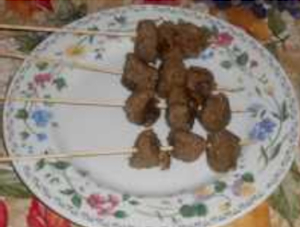
Let the meatballs cool down enough so they don’t burn your fingers. Gently place 2 or 3 meatballs on each skewer. (It is possible to pierce your hand or finger with the sharp edge of the skewer. These are wooden skewers, you say, how sharp can they be? Okay, I probably couldn’t terrify an intruder armed with a gun, but I could give him an owie he’d never forget.)

Tastes great on its own or serve with lemon wedges and Moroccan yogurt sauce. (See recipe for this.)

TIDBITS

1) In 711, Arab armies crossed over the Straits of Gibraltar and headed northward to the Frankish Kingdom bringing all sorts of Moroccan spices with them. It is hard to say exactly what spices, as most historians, especially military, are strangely mute on this point.

2) In 732, the Frankish leader defeated the Arabs at the battle of Tours ensuring the survival of French spices and cuisine.

3) Frankish and Arab armies marched back and forth in southern France until 915, making certain the fusion of French and Moroccan spices.

4) Culinary arts stagnated during centuries of peace between France and Morocco.

5) Fortunately, French power and imperialism came back in 1907 when Gallic armies occupied Casablanca. A new round of fighting and culinary exchange between the two great nations began.

6) Unfortunately for gourmands everywhere total peace broke out in 1956 with Moroccan independence.

7) For awhile, it seemed as if the tens of thousands of brave French and Moroccan warriors who died in the cause of culinary integration had fallen in vain.

8) But you can’t keep a good spicer down. Over the next few decades, Moroccans headed to France in search of jobs, bringing their spices with them. Now you can find good French and Moroccan restaurants all over the world. Life is good.


– Paul De Lancey, The Comic Chef, Ph.D.

My cookbook, Following Good Food Around the World, with its 180 wonderful recipes, my newest novel, Do Lutheran Hunks Eat Mushrooms, a hilarious apocalyptic thriller, and all my other books, are available on amazon.com.

Categories: cuisine, history, international | Tags: , , , , , , , , , , , , , , , , , , , , , , , , , , , | 2 Comments

Shrimp Briouates

Moroccan Entree

SHRIMP BRIOUATES

INGREDIENTS

1 garlic clove
2 green onions
1 small yellow onion
2 tablespoons olive oil (maybe ½ cup more later)
¼ teaspoon chives
½ teaspoon coriander
¼ teaspoon cumin
¼ teaspoon paprika
1 teaspoon parsley
¼ teaspoon white pepper or black pepper
1 pound shrimp, peeled and deveined
8 ounces filo (phyllo)* sheets
¼ cup melted butter
1 egg yolk**
3 tablespoons olive oil.

* = It’s more authentic to buy ouarka or warqa sheets. They, however, can be very, very difficult to find no matter what the spelling might be.
** = It’s a frustrating experience buying a single egg yolk at the store. For that matter, purchasing a single egg is often difficult as well.

Makes 30. Takes 1 hour 45 minutes.

PREPARATION

Mince garlic, green onions and yellow onion. Add garlic, green onion, yellow onion, and 2 tablespoons olive oil to pan. Sauté at medium-high heat for 5 minutes or until onion softens. Stir frequently. Add chives, coriander, cumin, paprika, parsley, and pepper. Add shrimp. Lower heat to medium and sauté for 3 minutes or until shrimp turns pink or orange. Stir frequently. Remove from heat. Mince shrimp.

Add filo sheet to flat surface. (Keep other sheets covered until needed. They dry out fast.) Brush filo sheet with butter. Cut filo sheet into strips 4″ wide. Add ½ tablespoon shrimp ½” from the end of the strip. Take one corner of the strip and fold it over diagonally to make a side of a triangle. Take bottom corner of triangle and fold it up to make another triangle. Continue to fold dough until you come to the end. You now have a briouate. Dab loose end of briouate with butter and fold into pocket formed by the open edg.

Add olive oil (½” deep) to pan. Heat oil using medium-high heat. Add as many briouates as possible without them touching. Deep fry on medium-high heat for 2 minutes or until golden brown. (Frying times go down with successive batches.)Turn briouates enough to prevent burning. Removebriouates and drain on paper towels. Repeat for successive batches. Goes well with harissa.

TIDBITS

1) Frankia, modern-day France, was named after I. A. Frank.

2) Frank operated a chain of sausage stands/inns for hungry, weary pilgrims.

3) The pilgrims loved Frank’s sausage in a bun.

4) So much so that they started calling his delicacies, Franks.

5) The entire land went so hot-dog made that the entire region started calling itself Frankia.

6) See the seminal work on Medieval treatise by Monk Jean de Tours, Mon Dieu, Mon Pays, et Mon Frank.

7) Reading this literary masterpiece is harder than just seeing it. You really do need to be fluent in Medieval French.

8) Anyway in 732*, an invading Arab army under Emir Abdul Rahman threatened Frank’s culinary empire and Frankia itself.

9) *That’s 732 AD. AD stands for Anno Domini, Latin for the year of Our Lord. This system of dating is falling out of favor with many historians who prefer the less assertive, CE, or Common Era. I like to refer to this date as 1246 APB, or After Paul’s Birth. In a strange coincidence, my name is Paul.

10) So why did the Arabs invade Frankia? To convert Frankian Christians to Islam.

11) Culinary historians assert, however, that the reason was that Frank’s Franks were made out of pigs. The Arabs believed no one should eat pigs. So by conquering Frankia, they’d rid the land of forbidden pig-filled Franks.

12) To be replaced by Shrimp Briouates The invaders believed this blessed dish to be the best entree in the entire world.

13) I, personally, do not wish to take sides in the Great Hot Dog/Shrimp Briouate Controversy that has racked humanity for centuries. I can see, however, how they came to believe so strongly in the tastiness of the Shrimp Brioautes.

14) But the adherents of Frank’s Franks prevailed in the Battle of Tours. European pilgrims came to visit Tours to give thanks for hot dog’s victory. Larger and larger groups of pilgrims came, necessitating the forming of tour companies. So many tours came to Tours, that people took to changing the town’s name from Tours to Tours.

15) As a side note, briouate is one of the few dishes that’s spelled with all the vowels: a,e,i,o, and u.
You can even use the sometime vowel, y, if you want to spell briouatey, as in “That pastry is so flaky, it’s positively briouatey.”


– Paul De Lancey, The Comic Chef, Ph.D.

My cookbook, Following Good Food Around the World, with its 180 wonderful recipes, my newest novel, Do Lutheran Hunks Eat Mushrooms, a hilarious apocalyptic thriller, and all my other books, are available on amazon.com.

Categories: cuisine, history, international | Tags: , , , , , , , , , , , , , , , , , , , , , , , , | Leave a comment

Create a free website or blog at WordPress.com.