American Entree
PAN FRIED CHICKEN BREAST
INGREDIENTS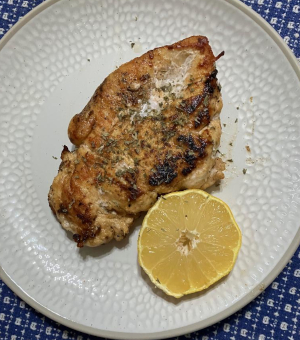
4 chicken breasts, boneless & skinless, 5-to-6 ounces each
½ teaspoon pepper
¾ teaspoon salt
½ cup flour
1 teaspoon garlic powder
¾ teaspoon onion powder
1¼ teaspoon paprika
1 teaspoon parsley (1 teaspoon more later)
3 tablespoons vegetable oil (ip to 3 tablespoons more, if necessary)
up to 3 tablespoons more, if necessary
1 lemon
1 teaspoon parsley
SPECIAL UTENSILS
plastic wrap
kitchen mallet
Serves 4. Takes 45 minutes.
PREPARATION
Remove chicken breasts from refrigerator and pat dry with paper towels. Cover with plastic wrap. Pound chicken breasts lightly with kitchen mallet until they are ½” thick or thinner. Rub chicken with pepper and salt.
Add flour, garlic powder, onion powder, paprika, and parsley to small mixing bowl. Mix with fork until well blended. Dredge chicken breast through mixture in bowl. Shake off any excess. (Excess flour falls off in the oil, adding a burnt taste and look..) Repeat for remaining breasts.
Add 3 tablespoons vegetable oil to large pan. Heat oil using medium-high heat until a little bit of flour in the oil starts to dance. Add 2 chicken breasts to pan. Cover and fry chicken breasts for 2½ minutes or until bottom of chicken breasts turn golden brown. DO NOT move them. (Only lift a corner of a chicken breast to see if the bottom is golden brown. Use spatula to flip chicken breasts. Cover and fry for another 2 minutes or when new bottom turns golden brown as well. Remove breasts to plate and cover to keep warm. Add up to 2 more tablespoons oil, if necessary. Repeat for 2nd batch of chicken breasts. (The 2nd batch might take less time to cook.)
Slice lemon into 4 pieces. Serve each chicken breasts with a lemon slice Garnish each chicken breast with ¼ teaspoon parsley..
TIDBITS
1) The title of this dish pretty much tells us that chicken breasts are fried in a pan.
2) Or can we be so sure of this?
3) Sure, the picture to the right is indeed a pan.
4) But maybe, just maybe, pan here means something else.
5) “Pan” is a term used by drama and movie critics to denote harsh criticism of the artistic endeavor.
6) Indeed, Cal Porter’s*, Broadway play, Fried Chicken Breast closed after only one performance.
7) The very next day, the headline on Variety(tm) read, “All Critics Pan Fried Chicken Breast.”
8) Noted acid-penned critic, Farine du Ble called the play, “Fried Chicken Beast” and advised Cal Porter to stick to one-word haikus.
9) To this day, actors morn the quick closing of a play by eating Pan Fried Chicken Breasts. And this is how this entree got this name.
10) But wait, there’s another subtle explanation.
11) In ancient Greek mythology, Pan was the god of the wild, shepherds, rustic music, and great chefs. He had the hindquarters, legs, and horns of a goat. Yep, he was the original Goat Man.
12) Goat Man loved chicken as what Greek god didn’t?
13) Pan originally ate fire-burned chicken. This recipe involved herding chickens into a brush fire. This frustrated the hooves off Pan. When the blaze finally died, chances were all the chickens had to turned to ash. He’d throw himself down and beat the ground with his fists. This is the origin of the line, “Ashes, ashes, we all fall down.”
14) Plus Goat Man had to wait for lightning to strike the fields near his chicken. And you can’t really count on a lightning strike when you’re hungry.
15) Then happy mythological day, the god Prometheus** gave fire to us mortals. Zeus’s monopoly on fire went up in smoke. Petulant Zeus tied Prometheus to a rock and had an eagle peck away every day at the fire-donor’s liver.
16) Sure, that was bad for Prometheus, but fire was a positive boon to Greek cuisine***. We could now fry things. Pan started Hellenic cuisine off right with his Fried Chicken breast. Grateful Greek chicken diners called it Pan Fried Chicken Breast. So maybe this dish got its name this way.
17) * Cal Porter was Cole Porter’s distant cousin. ** Prometheus twin brother was Antimetheus. *** Fire was also a boon for Greeks wishing to stay warm on cold, like during wintry nights.
– Paul De Lancey, The Comic Chef, Ph.D.
My cookbook, Following Good Food Around the World, with its 180 wonderful recipes, my newest novel, Do Lutheran Hunks Eat Mushrooms, a hilarious apocalyptic thriller, and all my other books, are available on amazon.com.


 Paul De Lancey's Blog