Uncategorized

As Requested by Millions, Okay Fewer Than That. My Bio.

About the Author

Paul De Lancey’s novels, We’re French and You’re Not and The Fur West, have won acclaim from award-winning novelists. He is also the author of hilarious articles and somewhat drier ones in Economics.

The humorist is a direct descendant of the great French Emperor Napoleon. Actually, that explains a lot of things. Mr. De Lancey makes his home, with his wonderful family, in Poway, California. He divides his time between being awake and asleep.

Paul, known to his friends as Paul, hopes to become a literary giant without having to die for the title.

– Paul De Lancey, The Comic Chef

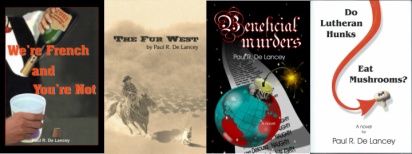
My cookbook, Following Good Food Around the World, with its 180 wonderful recipes, my newest novel, Do Lutheran Hunks Eat Mushrooms, a hilarious apocalyptic thriller, and all my other books, are available on amazon.com.

Categories: Uncategorized | Tags: , , , , , , | Leave a comment

Lutefisk Recipe From Forthcoming Cookbook “Eat Me”

Swedish Atrocity

LUTEFISK

INGREDIENTS

dried codlutefis-
lye
water
other stuff

PREPARATION

No! No, a thousand times, no. I will not give you a recipe for lutefisk. You got my cookbook. I have a warm and fuzzy feeling for you. So, look at the ingredients. Lye is a poison.

Furthermore, lutefisk assaults the senses as no other widespread dish. It looks like glue or broiled phlegm; there is no debate on this. It smells like, like, a rat died under the furnace supplying central heating. It has the texture of boogers. It tastes like fermented cod-liver oil. Fortunately, lutefisk cannot speak.

When I was little, my mother made me eat lutefisk to show what she had to go through when she was small. My grandmother fed lutefisk to my mother to show what she had to go through when she was little girl. My grandmother’s parents left Sweden in the 1880s to get away from lutefisk.

Vikings raided Europe with unparalleled ferocity stoked by lutefisk meal after lutefisk meal in the homeland. Many thousands of them never came back.

There are more disgusting dishes than lutefisk, but they are little known and regional. Let’s pray they stay that way.

– Paul De Lancey, The Comic Chef

My cookbook, Following Good Food Around the World, with its 180 wonderful recipes, my newest novel, Do Lutheran Hunks Eat Mushrooms, a hilarious apocalyptic thriller, and all my other books, are available on amazon.com.
Categories: cuisine, food, humor, international, Uncategorized | Tags: , , , , , , , , , , | Leave a comment

How To Commit A Tasty Murder

If you’re thinking of committing murder, why not use Twizzlers? They’re yummy and fatal if used correctly as shown below.

1) Buy  several bags. Don’t worry about this, there is no waiting period for buying Twizzlers as can happen for guns.

2) Interweave the short, weak Twizzler pieces into a massive, sturdy candy rope. E Pluribus Unum. “Out of many, one.” This used to be the motto of our great country. By constructing a Twizzler rope you are paying hommage to our nation’s founding fathers.

3) Choke your victim with the Twizzler rope. Did your murder make society better off? Did your victim annoy the heck out of everyone he met? If so, give yourself a pat on the back.

4)  Eat the Twizzler rope. This act neatly disposes of the murder weapon and honestly, can you really stop yourself from eating all that yummy candy?

5) Call the police and say you found the victim dead and you just don’t know what happened. They might not believe you but without a murder weapon what can they do?

I hope you’ll find this little household tip useful.

– Paul De Lancey, The Comic Chef

My cookbook, Following Good Food Around the World, with its 180 wonderful recipes, my newest novel, Do Lutheran Hunks Eat Mushrooms, a hilarious apocalyptic thriller, and all my other books, are available on amazon.com.

Categories: Uncategorized | Tags: , , , , , , | Leave a comment

GEORGE RANDALL, BADGER FAN – PART 2

GEORGE RANDALL, BADGER FAN – PART 2

George returned to a state gripped in the clutches of Badgermania. Madison and other cities were renaming streets after players of the University of Wisconsin’s football team. George’s town of Stoughton honored him as well, by renaming no less than twenty-three streets after George. Yes sir, George was a hero to all.

People all over Wisconsin yearned to see their Badgers stomp their menacing rivals from UCLA. Wisconsin had gone thirty-one years since their last Rose Bowl appearance. Millions of Wisconsinites had grown up without even knowing the location or meaning of the Rose Bowl. As for a Rose Bowl victory, well, there may have been one in the time of legends before writing had been invented. Certainly, no one other than George had ever thought it had been possible. Now, it was possible.

Millions of folks from Wisconsin made every effort to see their beloved Badgers play the Bruins in the Rose Bowl. Entire towns, such as Baraboo, Barneveld, Belleville and Blue Mounds, and many towns that didn’t start with “B” made travel arrangements for everyone in their town to see the game. Millions of folks bought tickets to see the game. Millions of people spent several hundred dollars on air fare and hotels. Millions of people dipped into their retirement funds and their college funds for their children to see the Badgers in Pasadena on New Year’s day.

The airlines honored their commitments to the hardy Badger fans. The hotels honored their commitments to these loyal supporters. Unfortunately, the Rose Bowl seats only a 100,000. So, alas, nearly three million Badger fans could not get in.

What had happened? Apparently, many fly-by-night travel agents promised Badger fans tickets they did not have. Eager to accept the fans’ money, the travel agents did not care that they crushed the dreams of many honest souls.

Our hero’s heart burst with sympathy toward his brethren. He had his tickets for the game within minutes of the Badgers’ clinching a trip to the Rose Bowl. He knew what it meant to be a Badger fan, scorned by the world. Early in the morning of January 1, 1994, he walked to the wailing crowd of Badger fans by the Rose Bowl. With heavy heart, he saw shattered hopes everywhere. Marriages everywhere were being tested to their limits as spouses blamed each other for the mess. As he walked along, a little girl tore away from her mother’s arms and ran crying toward George.

George shook in anguished surprise. This girl was the same age that he was when he first announced his dream of seeing the Badgers win in the Rose Bowl. He remembered his humiliation, his lack of human friends. Tear welled in his eyes when the memory of that awful Fourth of July parade flooded back to him.

“What is your name, little girl?” he asked. “Suzy,” she replied. “My name is Suzy Dock. What is your name?” she inquired. But George could not reply. He fell to the ground, tore open his shirt, and pummeled his naked chest with his fists until he covered himself with bruises. “As God is my witness,” he shouted to the heavens, “this little girl shall not endure the torments that I went through to see the Badgers have a chance at winning the Rose Bowl.” Sobbing uncontrollably, he thrust his packet of tickets toward little Suzy. “Take them and be happy. Go!” he shouted.

Little Suzy ran to her mother just as fast as her little legs could carry her. She showed the tickets to her mother, explained how she obtained them, and pointed out the wretched George. The mother gathered little Suzy to her bosom and rushed to thank George.

“God bless you, sir!” she gushed. “You sir, are my knight in shining armor. You have restored my faith in humanity. You are a true Badger.”

George stopped his crying, looked up at her, and drank in her gratitude.”Thank you,” he choked, “That is the nicest thing anyone has ever said to me.” Suddenly, he grabbed his chest and sank to the ground.

“You’re having a heart attack!” the mother…

Categories: Uncategorized | Tags: , , , , , , , , , | Leave a comment

GEORGE RANDALL, BADGER FAN – PART 1 Our

GEORGE RANDALL, BADGER FAN – PART 1

Our hero was born in the small town of Lodi, Wisconsin, in the year 1937. Red-haired George grew up in a house overlooking the small stream that ran through town. Whenever grownups asked him “What do you want to do when you grow up?”, George would always reply “I want to be there when the Badgers win the Rose Bowl!” They all laughed at him. So he shied away from humanity. His one true friend was Suzy the Duck. George sought out his fowl friend whenever his burden of woe proved too much to bear.

He would tell her, “I know that I will see the Badgers win the Rose Bowl. I will be there when it happens.” “Quack,” Suzy always cheerfully replied. She would then bob her head under the water, flap her little wings, and playfully splash George.

George learned to keep his vision of the red-clad Badgers to himself. The strain of doing this was great. He grew moody and his grades suffered. Finally, he lost control and erupted at the worst possible moment.

July 4, 1953 would prove to be a day that the good citizens of Lodi, Wisconsin would never forget. Senator Joe McCarthy of Wisconsin had been invited to be Marshall of Honor for the town’s Fourth of July parade.

All the good townsfolk participated in the festivities in one way or another. The Clark boys rode in a canoe in the back of a pick-up truck to symbolize the expedition of Lewis and Clark. All admired Sally Magnusson as she walked along sewing an American flag, in a perfect imitation of Betsy Ross. The little Thorvald triplets performed a darling re-enactment of the Battle of Gettysburg. Miss White’s second-grade debating club entranced all with their re-enactment of the famed Lincoln-Douglas debates.

Then George Randall strode onto the parade route. The crowd gasped. George was dressed all in red. Senator McCarthy stared open-jawed; George must be trying to humiliate him! It became worse. George pointed at the Senator, while jumping up and down and yelling “Go Big Red! Go Big Red!”

“George is mocking me! Me, a great man!” McCarthy fumed. Quickly plotting revenge, he rose to point an accusing finger at George. “Communist!” he thundered. The good townsfolk, including his parents, peeled away in horror from the offending George, shunning him for the disgrace that he had brought to their parade. His mind in a swirl, George fled Lodi that very night.

It transpired that this very incident changed the fate of this great country. McCarthy later confessed in his memoirs Crisis at Lodi that George’s brazen of defiance fatally shook his confidence necessary to carry on in his red-bashing campaign. George had saved American democracy. However, he was unaware of this and would wander the Midwest for some years in sullen despondency.

George eventually settled in the town of Stoughton, Wisconsin and married the lovely Anna Knudson. Together, they operated a small but cheerful Norwegian deli. In November 1962 they had a son, whom they named Vanderkelen after the brilliant Wisconsin quarterback who had just led the Badgers to their first Rose Bowl appearance in decades.

How could they manage to get to Pasadena? Anna and he had gotten deep into debt setting up their deli. “How about selling the store?” he wondered. He broached the idea to his wife. Initially, she resisted, but his infectious enthusiasm overcame her misgivings. So they hurriedly sold the store. They were ready to fulfill George’s lifelong dream.

Disaster struck! Their precious Vanderkelen came down with measles three days before the Game. The cost of fighting the dread sickness, and its complications, used up every dollar gained from the sale of their unused Rose Bowl tickets. George and Anna were at the hospital on New Year’s day when their son’s fever broke. They were so happy they did not mind missing the game, or even the Badgers’ narrow defeat. Their faces did, however, betray small smiles when they read of the heroic exploits of the Badgers’ Vanderkelen….

Categories: Uncategorized | Tags: , , , , , , , , , , , , , | Leave a comment

The Elephants’ Graveyard – Part 2

“Yep, but that won’t do me no good. That ‘phant will just hunt me down and crush every car I drive.”

“Surely, you are blowing a little tiff by that elephant all out of proportion.”

“No, I’m not. An elephant never forgets.”

The cabby remained inconsolable, and so, I waited quietly for AAA to bring the new cab. I then spied the smashed meter, and so, waited contentedly for the new car.

We got into the new car when it arrived, and sped eastward. A few blocks later, we turned into Beauvoir, the last home of Jefferson Davis, only President of the confederacy.

“Is this the Elephants’ Graveyard?”

“No, it isn’t. Well, okay, there’s one elephant buried here.”

We got out of the car and headed toward the guide stationed at the gate.

“I hear you have an actual elephant buried on the grounds.”

“Yes, it’s true,” responded the guide. “His name was Hector, and he’s buried right beside Jefferson Davis under the shade of the oak tree where he used to read.”

“What’s this, an elephant that could read, hard to believe?”

“I’m sorry,” mumbled the blushing guide. “I meant to say where President Davis used to read. But look here, notice how Hector’s grave comes between Jefferson’s grave and that of his wife, Varina.”

“Varina often complained, ‘Jefferson, I do declare you love that beast more than you love me, your own wife.’ Jefferson would respond with the factoid that Varina meant ‘over-the-hill elephant’ in Swahili. Varina then invariably threw a hissy fit which, if she was five foot ten inches tall, instead of her occasional four foot nine, ended with her decking the great man with a solid, right hook. When he regained consciousness, Jefferson would ride Hector over to the home of his great friend Edward Hurlyburly to eat peanuts and drink delicious grape-citrus coolers.”

I listened entranced for hours to many great tales of Mr. Davis and his elephant. “You know, you all won’t find these stories in the history books,” said the guide as I took my leave.

The cabby and I fought our way back through the thick forest and shrubbery of Beauvoir to the cab. I took the lead and held any branches that got in our way.

I suddenly remembered the meter that was no doubt astronomically high.

Thwack! “Ow!”

I turned around and noticed the cabby lying on his back spitting hazelblatt leaves.

“Hey, I know many parts are edible, but let’s get moving. I want to see that Elephants’ Graveyard.”

“Grumble, grumble, Yankee, grumble, ‘phant, grumble.”

Soon, we sped eastward. We turned left at Peters Street and headed toward Keebler Air Force Base. The sight of guards leveling their rifles at us prompted the cabby to stop. The guard knocked at the cabby’s window just as he pushed the button to roll it down.

“Ow, why’d you do that?” complained the cabby as he rubbed his head.

“I’m sorry sir. This is a restricted area. You’re not allowed inside.”

“I don’t want in. I just wanted to show this Yankee those elephant statues.”

The guard then waved to the sergeant on duty who put down his sausage, onion, and hot pepper sandwich to come over. The two airmen talked briefly before the sergeant came over to the car. The sarge, a man of few words, leaned inside the car and talked across the cabby.

“Well sir, those two statues are memorials to Castor and Pollux, two brave elephants, who gave their lives for their country. Back in January 1942, a German U-boat landed a platoon of marines to blow up this base. Security was disorganized back then and the Germans managed to get within just a few yards of the fuel dump when all of a sudden, Castor and Pollux, two wandering elephants charged. They routed the Germans but not before taking hits from a marine, who just happened to be carrying an elephant gun. They saved hundreds of airmen.”

“Gosh, what heroes,” I said.

I revived the wilted cabby and we soon continued eastward on Beach Boulevard. There, just beyond Mameuse Street, on the North side of the street was it, the Elephant’s Graveyard. I would soon understand one of history’s greatest mysteries.

“Son, you’d best stop right there,” said the guard at the entrance. “See, that herd inside. Well, that’s a herd of elephants holding a funeral. It’s not smart to disturb elephants when they’re grief stricken and edgy. You might start a stampede and you just might get stomped and killed. We’ve lost far more than a tolerable amount of tourists that way.”

We argued with the guard but eventually I turned away disappointed. The cabby seemed contented, but then the meter read $350

Categories: Uncategorized | Tags: , , , | Leave a comment

The Elephants’ Graveyard – Part 1

“The Elephants’ Graveyard is right there in Biloxi.”

The cabby’s assertion startled me.

“Biloxi, Mississippi? Are you sure about that? It seems hard to believe.”

“It’s true all right. You have my word as a cabby.”

“Come now, I don’t see any elephants here.”

“We’re not in Biloxi, friend. We haven’t left the Airport. We gotta go east to Biloxi to see any elephants. The FAA don’t let no elephants into Gulfport. Dangerous to landing planes, you know.”

The meter ran as he talked and I was anxious to make my meeting, but I couldn’t resist saying,

“But the government is shut down again. Who will keep the elephants out of Gulfport now?”

“Damn!” The cabby slammed on the brakes to stop the cab, which wasn’t hard to do as we weren’t moving. He jumped out of the car. “Ow!” Chastened and little more cautious he opened the door and then got out. He retrieved a massive weapon out of the trunk and made his way back to the cab.

“Here, take this,” he growled as he hurled the gun at me. Minutes later when the ringing in my ears subsided I replied,

“How is it that I never read about it, anywhere?”

“Oh, I don’t know. I guess the local reporters just got used to ’em, and just never wrote ’em up.”

“But surely, the migration of elephants to Mississippi would have made front-page news?”

“You’re wrong, friend. The elephants came here in 1862, right in the middle of the war. Folks round were just too preoccupied with the fighting to notice them right off. But soon enough, General Lee enrolled them into his army. The ‘phants, as some call them, were in Pickett’s charge at Gettysburg. We would have won the battle, but them Yankees let loose thousands of mice. Those mice scared the ‘phants, who turned around and stampeded the Rebel men. That’s how we lost the war.”

“Fascinating, but why did they choose here of all places?”

“For the peanuts.”

“But they don’t grow peanuts in Mississippi, they grow peanuts in Georgia as you well know.”

“Well, those ‘phants didn’t know nothing about that, did they? You’re not as smart as you looked, Mister. I’m fixing to take you there, right now.”

“But, I simply must be at a meeting in Long Beach, to the West!”

He ignored my feeble protests, gunned the engine, and soon we hurtled eastward at speeds up to 20 miles per hour. Soon the fair gulf regaled us with its shimmering beauty.

“Thalassa! Thalassa!”, I shouted to the cabby, “That’s Greek for the ‘The Sea.’ The Sea.”

“Yea, whatever. Look, there’s Peanuts Pavilion. Right next to that is the Planter’s dock and peanut refinery.”

“Ooh, that looks quite interesting. May we stop and investigate?”

“No.” He stomped on the gas pedal as way of protest and soon we were pushing the edge of the envelope at 25. “We’re looking for ‘phants. You gotta problem with that?”

“No,” I meekly replied. Since I was at the cabby’s mercy, I resolved to endure the best I could and would resolutely scan the horizon for the noble beasts whenever I wasn’t following the soaring meter.

Soon we crossed the border into Biloxi and immediately the clouds parted to reveal glorious, golden shafts of sunlight. I could almost swear I could hear angels singing melodious hymns of joy. The cabby belched.

Soon, the traffic in our lane slowed and eventually stopped at Eisenhower Drive, while in the lane to the bookstore, traffic ground to a halt. All the while, the meter merrily climbed. We noticed state troopers inspecting the cars, talking to all, waving some on, and pulling over others. Soon, one made his way to the cabby’s Honda Accord.

“Transporting any illegal elephants with you?”

“No,” the cabby explained at length as he handed over his license.

The trooper examined the license and then carefully pointed his flashlight inside the cab. Eventually, he seemed satisfied by our serene demeanor and waved us on. Whoosh, aided by a tail wind, we again darted eastward, leaving even the most vigorous pedestrians far behind. I turned to watch the Miss-Elephant-Rider-of-the-Mississippi-Gulf-Coast contest taking place on the beach; so did the cabby.

Crash! After shaking off the shattered glass, I looked up to behold a most angry pachyderm. Instinctively, I knew the elephant’s name to be Felix.

“What ho, Felix! How’s it hanging?” I bantered cheerfully to the gray skinned beast breathing in my face. Evidently, this was not proper elephantine etiquette as Felix trumpeted loudly as he crushed the front of the cab with one mighty stamp.

“Damn,” gushed the rattled cabby and then moments later, “I’m ruined.”

“My goodness, it’s not as bad as all that,” I opined. “Aren’t you covered by AAA insurance? I have it and it explicitly states that they will replace any one car crushed by a rampaging elephant.”

“Yep, but that won’t do me no good. That ‘phant will just hunt me down and crush every car I drive.”

“Surely, you are blowing a little tiff by that elephant all out of proportion.”

“No, I’m not. An elephant never forgets.”

The cabby remained inconsolable, and so, I waited quietly for AAA to bring the new cab. I then spied the smashed meter, and so, waited contentedly for the new car.

Categories: Uncategorized | Tags: , , , | Leave a comment

Soft-Shelled Nuts – Originally published in San Diego Writers’ Monthly, 1995

I. Rumbles from the Deep

My life changed forever when Bert Bivalve, my pet mollusk, announced his attention to form a political party. Bert had trouble communicating as he had no lips with which to form the “m” sound, so necessary in English speech.

He also had a patchy vocabulary due to a lack of a brain. Did you know there is no mollusk equivalent to the word “danger.” What’s the point for a mollusk cannot outrun any predator? However, there are 273 phrases to express the anguish of being eaten by a humongous furry creature with sharp claws. Eventually Bert and I worked out a sign language and so, interspecies dialogue began.

Bert, a cultured soul, had wearied of his benign neglect by humanity. He contacted mollusks all over the world to express his discontent–this explains my huge long distance bills. Thousands echoed Bert’s frustration and disillusionment. With Bert’s encouragement these sea creatures rushed to form debating societies. At first, however, they called these societies “Bicycling Clubs,” so as not to arouse humanity’s suspicions.

At first, these gatherings were chaotic and violent with the ugliest of insults exchanged freely. The phrase, “So’s your mother,” by itself, generated dozens of drunken brawl with gastropods careening into cephalopods. Eventually, cooler shells prevailed and organizing began.

One momentous day, Chuck Chiton, suggested that they would never get any respect from the politicians inside Washington unless they themselves entered politics. “After all,” he said, “Puerto Rico never got any respect until it became the 51st state.” As you no doubt know, Puerto Rico is not a state. Some think it is this inattention to detail to research that held mollusks back through the centuries.

The mollusks overcame their lack of political knowledge with shrewd business sense. As we all know mollusks are superb lichen harvesters. By skillful manipulation of the lichen markets, the mollusks quietly amassed a huge fortune over the centuries which they quietly deposited in off-shore banks.

These wealthy critters, conservative by nature, initially considered throwing in their lot with the Republican party. Only inopportune anti-mollusk rhetoric by some of the GOP candidates stopped this alliance.

What to do? They couldn’t back the democrats with its welfare society. Why the idea the very idea of a young mollusk just sitting there and doing nothing was disgusting.

Eventually, Sarah Scaphopod raised her hand, figuratively, of course, to suggest they form their own political party. All the mollusks agreed that she had a wonderful idea and brought out the fermented lichen to celebrate.

I laughed, along with the rest of humanity, when the mollusks held their first press conference in Bodega Bay, California. For one thing, how were they going to get enough signatures to be on the ballot in all fifty states.

Well, they had the last laugh. Hell hath no fury like a mollusk mocked. They set the world on its ear with their alliance with Carl Hickham, the billionaire seafood king from Texas. Mollusks control the supply of lichen, the bottom of the food chain in the oceans, and they let Mr. Hickham know it. The crafty critters presented the Texan with an ultimatum, either provide us with machines that help us to write or we’ll let your fish starve. Carl Hickham caved into their demands the next day.

II. One Giant Step for Mollusk

Mollusks from all over the world swarmed the United States. The beaches of Southern California became saturated with walls of mollusks reaching up to ten feet high. Beach merchants complained to the police that these invaders were devastating business. The men in blue sympathized, but pointed out the mollusks had a constitutional right to freedom of assembly.

The mollusks used Hickham’s machine to great effect. Within two weeks they gathered 423 million signatures; which is nine times the total human population of California. In the face of impending molluskan–if that is a word–domination the peoples of California buried their differences with an enormous clam bake that ran the length of the state.

Mollusks reacted to this barbarism by overwhelming and suffocating a dozen surfers off the shore of La Jolla. Some commentators remarked that interspecies warfare signaled the end of the world, while most thought it just an aggressive campaign tactic in the vein of the Willie Horton ads of 1988.

It was pretty much the same in all the coastal states. The mollusks consistently refused to blend into American society. They never bothered to learn English or any other language, save Romanche, an obscure language spoken by a few thousand Swiss.

The Democrats and Republicans united in the face of impending political disaster. Would it be enough? The coastal states were goners, but could they hold onto Middle America? Would the People’s Party prevail?

III. Remember Maine!

The leaders of the People’s Party assembled in Lincoln, Nebraska. Peacemakers solved lingering differences by feeding the chairmen of the old parties to mollusks stationed at Fort Sumter. Voter registration drives began in earnest as everyone did his bit. Negative ads ruled the day. You couldn’t watch tv for more than five minutes without seeing an ad ripping into the mollusks. Do you remember the ad that said “If the mollusks gain power, your daughter will be forced to marry one.” I do.

The mollusks did their best, but so did the humans. The boatmen of Mississippi refused to transport the mollusks. So did the railmen of Texas. The pilots of New Orleans were not tested as mollusks are afraid of flying.

Our defiant stand forced the mollusks to trek overland from California. Have you ever seen mollusks move? Take it from me, it’s not very fast. Weeks later, the mollusks began to die of exhaustion and dehydration. Most died in the middle of Phoenix where they began to decompose. Millions of birds now live in Phoenix, but no people do.

The heartland of American had been saved. But what about Maine and the other coastal states?

IV. The Readers of Nebraska

Remarkably it was the readers of America that rescued our great land. Fortunately, Nebraska, home of sixty percent of all book sales in U.S., remained mollusk free. These readers reminded the politicos that voters must be eighteen and American citizens. Amazingly, no one else had thought of that. Ha, we had the shelled bastards by the balls, or what passed for balls on a mollusk.

Election officials fanned out into all fifty states checking voter registrations. It was always the same; the mollusks were all underage. We struck them off every voting list. The stricken mollusks protested as vehemently as they could, but their protests fell on deaf ears.
We had won, or had we?

V. The California Mollusk Rush

We totally forgot about the stubbornness of your typical Joe Mollusk. They say an elephant never forgets, well an elephant has nothing on a mollusk. I can say with certainty that a mollusk knows as much today as it did a year ago.

Those mollusks–oh dang it, what’s a good synonym for mollusk; how about “invertebrate animals,” well that’s passable–still harbored an abiding hatred for our mistreatment of them. Since, they could not take America by the ballot box, they would take it by force.

Well, we weren’t afraid of those mollusks. Our army would soon make them cry uncle. In fact, our army was singularly unprepared to fight. Three years ago, the Pentagon asked Congress for thirty-two billion dollars for a weapon system to combat crustaceans and mollusks. At the time it seemed like just another example of the Pentagon wasting tax dollars. So, the proposal was defeated. Who knew?

Congress voted again; this time the vote was in favor of making the weapons. But it was too late; the weapons would take two years to develop. In that time, the coastal states would be permanently lost. The mollusks, stinking ‘lusks, were already starting to push the locals around. It was especially bad in California where they restricted surfing to one hour a week, hogged all the good times at all the best seaside restaurants, and darn near monopolized the inland tennis courts.

VI. Wally and the Beaver

Not all Americans gave up so easily. Wally Quoin, a true mountain man from the Sierra Nevada came to our rescue. He suggested that we set all our beavers on those damn ‘lusks. He said beavers love to eat ‘lusks. He also said beavers and ‘lusks have been feuding for centuries, its origin lost in the mist of time.

The President went on tv to tell us of our new allies. As he spoke, rangers in the National Park Service enlisted our friends, the beavers.
Well, you know what happened next. Millions of beavers swarmed the beaches. Their sharp claws broke open the mollusks’ shells to make countless tasty meals.

VII. E Pluribus Unum

We thanked the beavers for saving America. All they asked in return was that we stop logging near their homes. We stopped doing it, for the beaver is our friend forever. Look at the front of your five-dollar bill; you will see a portrait of a beaver.

– Paul De Lancey, The Comic Chef

My cookbook, Following Good Food Around the World, with its 180 wonderful recipes, my newest novel, Do Lutheran Hunks Eat Mushrooms, a hilarious apocalyptic thriller, and all my other books, are available on amazon.com.
Categories: Uncategorized | Tags: , , , , , , , , , , , , , , , , , , | Leave a comment

The Wonder Dog – Part Two

Captain Pizarro surveyed the yellow-orange expanse and announced that we were going to eat those hot dogs or die. Pale-faced Lieutenant Kelso staggered to his feet to voice his support before pitching forward into a huge bowl of papaya-bisque soup. Corporal Conigliaro timidly suggested that eating rotting hot dogs might kill us, or worse, give us diarrhea. Sergeant Gagliano put both of his powerful hands on Conigliaro and volunteered the Corporal for the honor of tasting the hot dogs.

Conigliaro said that although he was aware of the immense honor, he was reasonably sure that army regs stated that a certified medical doctor had to test all suspect foods. He was only an unregistered quack and so, respectfully declined.

It appeared that some stupid health regulation written by some desk-bound, pencil pusher in the Pentagon was going to deny us this wondrous, alternate source of food. However, our Sarge immediately volunteered Private Romero, a veterinarian, to taste the frankfurters.

Bilko accepted the assignment but said that he was such a good vet that he could determine the quality of the franks just by looking at them. He headed straight to the Hut of Hell, stopping only at the infirmary to put on a gas mask. Moments later he returned, ashen and trembling, stating that they were safe to eat. Though I did hear him mumble as he headed back to his tent hot dogs should not display internal movement. The other airmen just heard our cook announce hot dogs for tomorrow’s lunch.

Around eleven o’clock cookie started boiling the franks. Fortunately, a strong wind from the south blew the fumes away from the camp toward the town of Lake Harbor. About that time in an unrelated incident, Bert Taylor, a tea tester from that town, suddenly pulled his own head off and died.

We all lined up at the mess tent to eat our hot dogs in shifts of one hundred which was also the number of gas masks on hand. Well, the first shift manfully ate their hot dogs and immediately fell to the floor suffering from violent convulsions. Then Private Owchinko’s stomach burst open flinging his guts all over the mess hall. Soon, everyone’s guts erupted just like cooking popcorn. Owchinko turned his hideously contorted face toward me and said, “Dang, at least it wasn’t papaya.” He then died with a look of complete serenity on his face; well, at least as serene as one could get with an exploded stomach.

We carried the men outside and buried them properly. We put on all their tombstones, “He wouldn’t eat papaya.” Since bullets were scarce at our base, we gave our departed comrades ten hot-dog salutes. Most of these franks exploded in air giving off the same noise as rifle shots. However, some didn’t explode until they hit the ground. One hot dog, in particular, landed on a latrine and exploded, scattering its contents for hundreds of yards. Private Franco noted that the smells of the latrine improved the smell of the hot dog. However, Captain Pizarro displayed true genius when he stated these franks could be terrible weapons of war.

We drifted along in papaya hell until we received orders to fly over to Europe. The Germans had just broken through our lines in a massive offensive now known as the Battle of the Bulge. Disaster loomed and every airman was needed. We armed our bombers with our hot dogs, which now had been rotting for an additional four months in the hot, humid Hut of Hell.

Our 800th Bomber Group arrived just as the Germans seemed poised to overrun the heroic defenders of Bastogne. None of our infantry or armored divisions could get to them in time. None of the other bomber groups could get off the ground due to bad weather. However, we could and we did.

We bombed the hell out of those Nazis. A Tiger tank can take a direct hit from a Sherman tank just twenty yards away and drive away only mildly annoyed, but just one hit from our franks just ripped those tanks to bits. Down they fell, ton after ton of freedom franks. The foul, poisonous vapors from the exploding dogs suffocated the supporting German infantry. Our hot dogs created a huge hole in the German lines into which poured General Patton’s troops. Patton, that glory hog, claimed full credit for the American victory at Bastogne.

However, we knew better and so did many others. In fact, Winston Churchill, Prime Minister of Great Britain praised us saying, “This was their finest meat product.”

Categories: Uncategorized | Tags: , , | Leave a comment

The Wonder Dog – Part 1 – Originally Published in Community of Voices, 1999

We won the war. We brought the Nazis to their knees, not some namby-pamby foot soldier who probably counted dodging Spam thrown in the mess halls as combat experience. Yes sir, it was me and the airmen of Okeechobee. Young man, I’m gonna tell you our story.
Okeechobee, Florida then was only known for its millions of bugs; huge bugs the size of baseballs. But it was there, in 1944, that the Army set up the 800th Bomber Group, captained by Henry Pizarro.

Well, we were out in the middle of nowhere in a state often forgotten by the rest of the Union. Supplies never did get to us in a regular manner. Sometimes we’d go weeks without any supplies. Sometimes, we got a lot of stuff we didn’t really need. One week they sent us one million scarves, and 22,187 bird feeders stamped “U.S. Army bird feeder, Red-Headed Woodpecker Only.” Antonio Cedeno, Army Head Scratcher First Class, scratched his head and said, “That’s army for you.” Oh, we also received eight hundred tons of papayas. It seemed that although our nation’s scientists were still failing with the general concept of refrigeration, they had miraculously found a way to refrigerate papayas several months ago.

Well, around August, we had run out of all food but papayas for two months, and no one wanted to eat bugs. Hell, the bugs had been biting us so much that some of us figured we’d be cannibals if we’d eat them. So, we approached Lieutenant Kelso, who was in charge of food supplies. Kelso said that he was mighty sick of papaya soup and papaya burgers. He said he’d raise heaven and earth to find some new food.

The next day we heard a terrible ruckus all around us. Every flea-bitten mutt in the flea-bitten state of Florida was barking, yelping, yipping, and scratching his balls. Sergeant Niekro went out to investigate. Apparently, Kelso planned to use these dogs to sniff up some food for us.

Well, I decided to follow the dogs. They headed away from the mess hall as even dogs get tired of papaya biscuits. Those mutts made a bee line toward the swamp where bugs felt particularly secure and ornery. Way in the distance I could make out that huge ominous, gray, metallic building so forbidding that even the chaplain called it “the Hut of Hell.” The Hut of Hell housed our chemical supplies, used oil drums, and various pleasant poisons.

Those dogs just ran to the Hut and barked something fierce. Kelso, opened the door and immediately the dogs keeled over in agony. Kelso doubled over and proceeded to vomit big yellow chunks of papaya loaf. Sure, it was up to me, Robert Carbo, the man with the big sniffer. I dodged a stream of papaya spew from Kelso and went inside.

As God is my witness, I have never seen so many hot dogs in my life. These hot dogs were arranged in huge columns. Each column was twelve feet long by ten feet wide and stretched at least fifty feet up to the ceiling. There were thousands of these majestic columns.

Well, perhaps not majestic, more like tons of decaying, larva infested, grayish-green beef shapes. How long had they been sitting in that metal building in Florida’s fine, humid, 120-degree weather? However, stench worse than Private Aparicio’s pits after a twenty-mile hike, prompted to me continue this thought outside. I wrenched my boots free from some hot-dog ooze and bolted outside.

I carried Kelso all the way back to the infirmary. Unfortunately, our doctor was away in Miami picking up popsicle sticks off the sidewalks as we had run through our last shipments of tongue depressors. Corporal Johnny Conigliaro, a quack in civilian life, prescribed a dose of deadly nightshade, a rather poisonous, purplish flower. Kelso nearly died from this treatment but did not complain, saying, “It’s worth risking death to eat something that’s not yellowish orange.”

A week later Captain Pizarro, arose from his desk and put on his papaya-woven flak jacket and walked to the mess tent. The cook had outdone himself with a gourmet feast. We started off with a snappy papaya fondue and a Waldorf salad where the apples, celery, walnuts, and mayonnaise were substituted with papaya, papaya, papaya, and papaya sauce. For the main course he regaled us with a choice of: barbecued papaya sandwiches on papaya bread with a papaya sauce or chicken cordon bleu, where instead of chicken, ham, gruyere cheese, breading, and butter, he substituted papaya, papaya, curdled papaya juice, papaya crumbs, and melted papaya. For dessert we could choose either the papaya balls or the papaya flavored ice cream made with creamed papaya instead of cream. We washed down this feast with good ol’ papaya juice.

Categories: Uncategorized | Tags: , , , | Leave a comment

Create a free website or blog at WordPress.com.