Excerpt from Heartly God?
Chapter Three
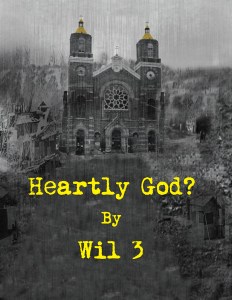
The protestors’ movement, if it can be deservingly titled as such, was aimed at the removal of Father O’Toole from St. Mary’s Parish and the whole Catholic Church. It started with a few unhappy parishioners who didn’t take kindly to Father O’Toole’s most recent and more progressive sermons. A few unhappy parishioners led to a few unhappy families, who then enlisted the help of other, very concerned, non-parishioners who were equally offended by what Father O’Toole had to say. Although they never actually heard it first-hand, but through their friends, which apparently was good enough to cause them to be offended.
At first, the movement was easily ignored by the remaining St. Mary’s faithful and by Father O’Toole. But when it became apparent that it had grown and was not going away, Father O’Toole decided it was time to engage the protestors in dialogue. That was a mistake. The dialogue was short-lived and within a matter of minutes, Father O’Toole’s Irish got the better of him and he had to be physically restrained and separated from the group. The “swear jar” Father O’Toole kept in the office behind the altar was contributed to heavily that day by him.
It used to be easy for Father O’Toole to bridge gaps between those who were with him and those who were against him. He made a short career of that in the Army prior to the priesthood. It seemed to him that he was losing that ability due to his old age in the same way that he was losing his hair and his hearing. Sadly, Father O’Toole’s lack of statesmanship only fueled the fire of the protestors’ movement. The following week, after word got out via social media, the movement doubled in size. The week after that, the local media was at the 9:00 AM. Mass to cover the protestors. A thirty-second clip of the protestors aired on local news the following Monday.
“We are protesting Father O’Toole’s ludicrous message! The Bible says that a man should not lay down with another man. That is a sin. It’s an abomination against nature! Women who have abortions are killing babies! They don’t need forgiveness; they need to be locked up!!”
Once the media coverage of the protestors’ movement aired, the Bishop and other higher-ups in the Church became heavily involved in the situation. The Bishop didn’t necessarily agree with Father O’Toole’s new message or ministry. In fact, he never really saw eye-to-eye with Father O’Toole on much of anything. But more importantly, he did not like to see one of his churches under siege. It was bad for business. Attendance at Mass was down because many of the remaining parishioners felt uneasy trying to navigate amongst the protestors as they tried to get into the church. Accordingly, the weekly collection started to come up short … very short at times.
The stress on the income stream necessitated constant communication, which Father O’Toole equated to constant aggravation, between him and the Bishop. If he wasn’t talking to the Bishop, he was talking to one of the Bishop’s underbosses. If it wasn’t an underboss, it was someone from the Diocese public relations department. If it wasn’t public relations, it was a Diocese lawyer. All the stress and constant watchdogging of Father O’Toole made him physically tired and mentally weak. Making the situation worse was Father O’Toole’s acknowledgment that he simply did not have the time to devote to the parishioners who still needed him, or to those unfortunate sick and dying people that he would minister to in three of the local hospitals.
Father O’Toole was no longer a young man. Far from it. He should have retired years ago, by his age. But he grew up in the Strip District, went to St. Mary’s grade school and he welcomed the opportunity to become the pastor at St. Mary’s when the opportunity presented itself. Truth be told, St. Mary’s was on the verge of collapse before Father O’Toole’s arrival. The Diocese plan was to let Father O’Toole run the parish for one or maybe two years, then close it down and sell it to a developer for a big profit. It was expected that Father O’Toole would retire after that. It was a clever and convenient strategy by the Diocese and their legal think tank. Fortunately, or unfortunately, Father O’Toole actually grew the parish in the short time that he had been pastor. Prior to the protestors’ movement, St. Mary’s Parish had become bigger and stronger than ever. Father O’Toole initially felt a youthful resurgence as the parish grew around him, but in the wake of this protest movement, Father O’Toole was not sure how much longer he could last. He was clearly nearing his breaking point.
The easiest way to resolve the problem would have been to reassign Father O’Toole to another parish. However, the higher-ups in the Diocese thought that move would signal the Church’s acquiescence to the will of the protestors. Besides, reassignment did not guarantee that the same thing would not happen at a different location. The last thing the Diocese wanted was to engage in war on two fronts. The Diocesan leaders asked Father O’Toole to retire, but that conversation was even shorter than Father O’Toole’s attempt at dialogue with the protestors. With all the brain power and money of the Diocese, nobody had any clear solution for resolving the situation. And they also knew that they were dealing equally with a very hard-headed old Irishman who never backed down from a fight before. Thus, they were all stuck and decided nothing could be done other than to ride it out. The situation evolved into a chicken fight between three entities to see just who had the most stamina.
One thing was for sure—the thick concrete walls and enormous oak doors of St. Mary’s that once created a spiritual and a physical safe-haven for the parishioners could no longer keep the din and ruckus of the protestors outside. In calmer days, the only sound that might have been heard from the outside during a Mass was the occasional siren on a police car or ambulance. Now, even the sirens couldn’t be heard over the protestors’ fanatical rants and chanting.
Bio

Wil 3 is a father, an educator and a retired college assistant basketball coach who graduated from Washington and Jefferson college with a double major in Political Science and Secondary Education. He has worked as a teacher and curriculum developer in several school districts and post-secondary institutions. An advocate to end homelessness, Wil currently sits as a Board Member at “Hearts of the Homeless,” a 501(c)3 non-profit and regularly volunteers at Light of Life Mission in the North Side of Pittsburgh, PA. Prior to releasing Heartly God?, Wil authored several one-act plays that have been performed by various theater groups in Western Pennsylvania. Heartly God? is his first full-length novel. When not writing, Wil can be found trout fishing or on a stand-up paddle board with his son Rider and occasionally practicing law, if time permits.
**********************
Paul De Lancey
www.pauldelancey.com





 Paul De Lancey's Blog